

Most teams treat AI keyword research like a faster spreadsheet. That's where things drift. You get piles of terms, weak intent calls, and content that looks busy but doesn't move pipeline.
What matters is a working process: choose topics that match buyer questions, fit your site's authority, and turn into pages you can ship. We've seen teams lose months chasing volume that never converts.
Start here: - low-volume terms with buyer intent, especially comparison and workflow queries - clusters that belong on one page instead of six near-duplicates - Search Console terms stuck in positions 8 to 20, where quick wins live
What AI Keyword Research Actually Means Today
AI keyword research isn't about asking a model for 500 keywords and calling it strategy. It's the use of AI to expand topics, classify intent, cluster related queries, surface content gaps, and help decide what to create next.
The distinction that trips people up is simple. There are two different jobs here:
- using AI to do keyword research
- doing keyword research for AI-driven search experiences like AI Overviews, ChatGPT, and Perplexity
Those overlap, but they aren't the same thing.
Traditional research was built around isolated phrases and monthly search volume. Modern research has to go wider. We look at prompts, sub-questions, entities, modifiers, and topic clusters. We care about whether a topic deserves one page, five pages, or no page at all.
The unit of success has changed too. Rankings still matter. But on their own, they don't tell the whole story. Now we're also weighing click potential, citation potential, prompt coverage, and conversion value. A keyword that drives 50 visits and 5 demos is usually worth more than one that drives 1,000 visits and nothing else.
AI is best used as an analyst and organizer, not as a replacement for real search data.
That's the practical question running through this whole article: how do you use ai keyword research to grow traffic and pipeline without adding more manual SEO workload?
Why the Old Spreadsheet Workflow Stops Organic Growth
Most growing teams hit the same wall. They export thousands of keywords, sort by volume, argue about intent, build disconnected briefs, and end up with a content calendar held together by guesswork.
It feels busy. It doesn't feel reliable.
Volume-first research underperforms because search volume is a weak proxy for business value. Low-volume commercial terms often convert better than broad informational keywords. We see this constantly with SaaS, ecommerce, and service businesses. The spreadsheet says one thing. Revenue says another.
Manual workflows also break because they treat each keyword like a separate task. That's the wrong operating model. Search demand is structured in systems. Your workflow should be too.
A few things make the old approach worse:
- long, conversational queries often don't appear cleanly in standard exports
- AI-engine prompts rarely map neatly to old keyword buckets
- SERP changes distort value, especially when AI Overviews reduce clicks but still shape visibility
- teams spend more time moving rows around than making decisions
By the second afternoon, the research file gets heavy and the thinking gets shallow.
The business impact is real. Publishing slows down. Prioritization gets weaker. Content gaps stay hidden. And when leadership asks what SEO is doing for acquisition, the answer is usually vague because the workflow never connected keywords to outcomes in the first place.
Why AI Keyword Research Is the Strategic Starting Point for Scalable Growth
If you treat keyword research as an SEO chore, you get SEO chores. If you treat it as market intelligence, you get better decisions across the whole content system.
Better topic selection improves everything downstream. Briefs get tighter. article structures get clearer. Internal links make more sense. Publishing cadence becomes easier to sustain. Refresh decisions stop feeling random.
Scalable organic growth comes from compounding topic authority, not chasing one-off keywords. That's the shift.
Different businesses feel this in different ways:
- SaaS teams need use case, comparison, integration, and problem-solving terms tied to pipeline
- Ecommerce brands need category, feature, comparison, and post-purchase queries that support revenue
- Service providers need local, commercial investigation, and pain-point terms that turn into inquiries
- Agencies need repeatable systems they can run across multiple clients without reinventing research every month
A smart operator doesn't ask, "What keywords should we write?" They ask, "What intent system should we own?"
That question changes everything. It moves you from hunting keywords to building a content engine around customer intent. Once that happens, SEO stops being a pile of articles and starts becoming a durable acquisition channel.
The Inputs That Matter More Than Search Volume Alone
Search volume still matters. We use it. But volume alone is not enough to make a good decision anymore.
A modern workflow should evaluate several inputs together:
- search intent
- commercial value
- ranking difficulty
- SERP features and AI Overview presence
- prompt and question patterns
- entity coverage
- your site's existing authority
- refresh potential from current rankings
The best opportunities are often long-tail, specific, and unimpressive on paper. They look too small in a spreadsheet. Then they quietly become some of the highest-converting pages on the site because they match real buyer intent.
A meaningful share of daily searches are new. That matters. If your research relies only on historical keyword databases, you're operating with a lag built into the system.
Some of the most useful demand signals come from places teams ignore:
- customer support logs
- sales calls and objections
- product documentation
- Reddit-style communities
- Google Search Console
- AI-generated question expansion that you then validate with real data
One non-obvious pattern: process-oriented queries, methodology queries, and highly specific how-to searches often have stronger citation potential in AI search than broad best-of terms. They're easier to retrieve, easier to summarize, and easier to trust.
Score keywords by business impact, not just traffic potential. Otherwise you'll keep shipping content that looks promising and performs politely.
A Practical AI Keyword Research Workflow for Modern Content Teams
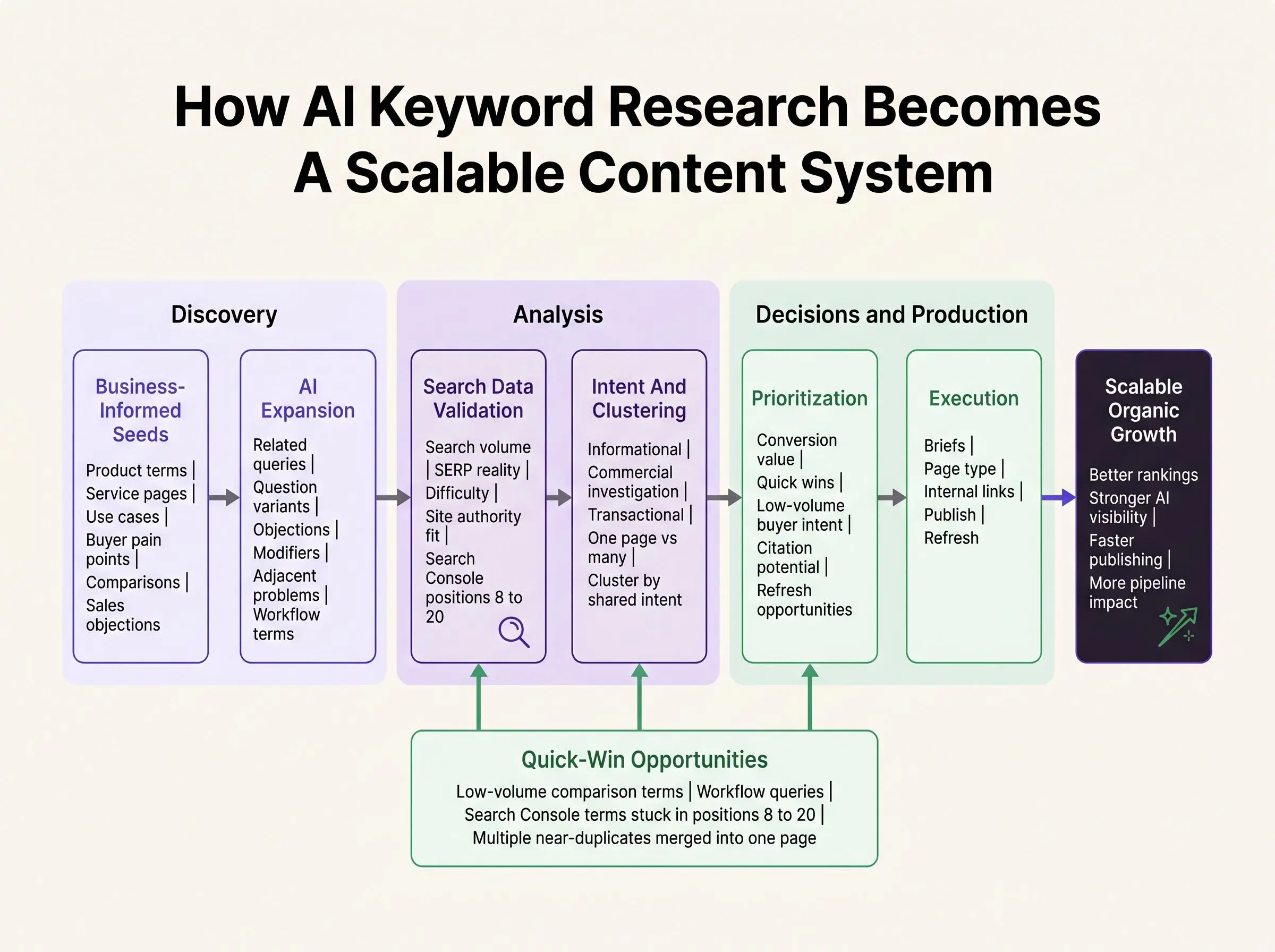
This doesn't need to be messy. The best workflow is usually the one your team can repeat every month without friction.
Here's the sequence we recommend.
1. Start with business-informed seeds
Pull seed topics from products, services, use cases, customer pain points, competitor comparisons, and sales objections. Don't start with generic head terms alone. They flatten context too early.
2. Use AI for automated topic research
Use AI to expand the semantic neighborhood around each seed. Generate related queries, objections, question variants, industry modifiers, comparisons, adjacent problems, and use cases. This is where automated topic research earns its keep.
3. Validate with search data
Bring those ideas into tools with live keyword and SERP data. Filter by relevance, search volume, difficulty, and your current authority. AI can suggest. It can't validate demand on its own.
4. Classify intent with AI
Sort terms into informational, navigational, commercial investigation, and transactional intent. Then map each to the likely page type:
- guides
- comparison pages
- category pages
- templates
- landing pages
5. Use keyword clustering with AI
Group keywords by shared intent, topic overlap, and likely page destination. Separate terms that look similar but deserve different pages because the format or intent changes.
6. Prioritize clusters
Score them by opportunity, conversion relevance, competition, freshness needs, and how much they strengthen topical authority.
7. Turn it into execution
Build briefs. Assign page types. Set internal links. Publish. Schedule refreshes.
This is where most teams lose momentum. Research gets finished, then handoffs kill speed. That's one reason platforms like Intelliminds matter. When research, writing, publishing, and refreshing live in one operating system, the process stops resetting itself every step of the way.
How to Find Low Competition Keywords With AI Without Chasing Junk Terms
Low competition doesn't mean low difficulty in a vacuum. It means a realistic opportunity for your current authority.
Newer sites usually need easier terms first. Established sites can push into harder territory. That part is obvious. The less obvious part is that "easy" often hides inside specificity, not inside keyword scores.
AI helps you find low competition keywords with AI when you use it for expansion and interpretation, not blind generation. Useful patterns include:
- problem plus audience
- tool plus workflow
- feature plus outcome
- comparison plus constraint
- location or vertical modifiers
- year, version, integration, and pricing qualifiers
AI can also help by:
- generating long-tail variants from seed topics
- expanding into use case and industry-specific modifiers
- identifying overlooked question patterns
- spotting underserved subtopics in competitor coverage
- turning support and sales language into search-led content ideas
But there's a trap here. Language models are very good at producing plausible junk. If you rely on them alone, you'll get ideas that sound right and have no real demand.
So the process should stay hybrid:
- Use AI for expansion and pattern recognition
- Use keyword tools and Search Console for validation
- Sanity-check every term against intent and page value
One of the fastest wins is often page-two and lower-performing existing rankings. Especially when there's no dedicated page for the query yet. You're not starting from zero. You're finishing a job the site already started.
Don't chase single low-volume terms in isolation. Look for clusters of related low-volume terms that can accumulate into one strong page.
How Keyword Clustering With AI Turns Research Into a Content System

Keyword clustering with ai is the process of grouping related queries into page-level opportunities based on shared intent and topic similarity.
That matters more now because search engines and AI systems evaluate context, entity relationships, and topical coverage. Exact-match thinking is too narrow.
Here's the practical difference:
- a flat keyword list creates duplicate pages, thin briefs, and internal competition
- a true cluster creates stronger pillar pages, cleaner support content, and better internal linking
Good clustering follows a few rules:
- one dominant intent per page
- different intents get different page formats
- parent topics stay separate from supporting subtopics
- supporting questions get mapped into headings, FAQs, tables, and definitions
A simple cluster structure usually includes:
- pillar topic
- subtopic clusters
- comparison content
- bottom-of-funnel pages
- refresh opportunities
For a SaaS company, this is straightforward. Don't create ten disconnected CRM automation articles. Build one central cluster around CRM automation, then support it with pages for setup, pricing, integrations, comparisons, use cases, and troubleshooting.
That's not just better SEO. It's better operations.
Clusters reduce wasted production because they force you to decide what each page is actually for.
They also improve AI citation potential. Retrieval-friendly passages, concise answers, structured lists, and clear explanations are easier for AI systems to use.
How Automated Topic Research Uncovers Opportunities Humans Miss
Automated topic research is the use of AI plus search data to continuously surface new angles, adjacent problems, and content gaps without restarting the process from scratch every cycle.
That changes the cadence of SEO work. Instead of periodic research projects, you get an always-on discovery system.
This is where automation becomes genuinely useful for lean teams. It can uncover:
- emerging long-tail queries
- new question variants
- competitor content gaps
- seasonal shifts
- product update opportunities
- refresh candidates for aging content
The value isn't just speed. It's continuity. Teams with limited bandwidth can't afford to rebuild the same topic map every month. They need a system that keeps feeding the queue.
This connects directly to content planning with ai. When research outputs move straight into topic queues, briefs, publishing schedules, and refresh calendars, you remove a lot of the dead space between insight and execution.
With Intelliminds, that handoff doesn't have to live in another spreadsheet. Discovery can move directly into creation and publishing workflows. That's less glamorous than a flashy dashboard, but it's usually where the gains come from.
Skeptical teams usually change their mind when they see one thing: less guesswork, faster cycles, and more confidence that each asset supports a larger growth thesis.
How to Choose SEO Topic Discovery Software That Fits Your Team
Choose tools based on workflow fit, not feature lists. A long feature list won't save a broken process.
Most teams need a combination of categories:
- LLMs for ideation, expansion, summarization, and initial clustering
- traditional SEO tools for volume, difficulty, and SERP analysis
- question and prompt mining tools for conversational demand
- Search Console for real-site query discovery
- integrated platforms for turning research into briefs, drafts, publishing, and refreshes
Each category has limits.
LLMs are fast but can hallucinate demand. SEO databases are stronger on metrics but often lag emerging conversational queries. Prompt tools help with AI search visibility but don't replace full planning.
A practical evaluation framework for seo topic discovery software looks like this:
- does it connect topic discovery to business goals
- does it support intent analysis and clustering
- does it help prioritize by realistic opportunity
- does it reduce manual handoffs between research and production
- does it support refreshes, not just net-new ideas
- does it fit your team's maturity and operating style
If your team wants research, writing, publishing, and refreshing in one place, an integrated platform like Intelliminds can remove a lot of operational drag. Not because "all in one" sounds nice, but because handoffs are where good research goes to die.
How to Turn Research Into Content Planning With AI
Research does not create growth on its own. Publishing systems do.
Content planning with ai should map every cluster to a few clear decisions:
- funnel stage
- page type
- publishing priority
- internal linking role
- refresh schedule
- conversion goal
A simple planning model works well for most teams:
- quick wins from existing authority and page-two rankings
- authority builders from high-value clusters
- bottom-of-funnel assets tied to product or service evaluation
- refreshes for aging articles with ranking potential
AI can accelerate this by generating briefs, identifying required subtopics, summarizing SERP patterns, and drafting initial outlines. That's useful. But don't outsource judgment. AI-generated briefs still need editorial review, brand nuance, and customer context.
One practical fix we recommend: set quarterly content themes. Don't improvise article by article. Themes create momentum, cleaner internal linking, and better allocation across funnel stages.
When planning is connected to writing and publishing, the system keeps moving. When it's not, the backlog gets bigger and confidence gets smaller.
How AI Keyword Research Supports SEO and AI Search at the Same Time
Modern visibility is now dual-channel. You need to rank in traditional search and earn inclusion in AI-generated answers.
That changes what good research looks like.
You need broader coverage of prompt-like queries, better entity and definition coverage, more direct answers near headings, and stronger use of comparisons, lists, tables, and FAQs. Those choices help both ranking and retrieval.
Some queries are more likely to earn citations:
- specific and process-driven searches
- data-supported or methodology-based questions
- highly factual or current topics with clear structure
Broad, generic terms may still drive traffic, but they're often harder to win citations for. They're also more likely to be diluted by SERP features.
So ai keyword research now has to consider three things at once:
- ranking potential
- answerability
- citation likelihood
Don't throw away classic SEO metrics. Add newer ones where relevant, like prompt coverage, answer inclusion, and citation share. The teams that win here aren't abandoning SEO fundamentals. They're widening the definition of visibility.
The Most Common Mistakes Teams Make With AI Keyword Research
The mistakes are usually operational, not technical. Teams don't fail because the tools are weak. They fail because the workflow stays fragmented.
Common ones show up fast:
- treating AI as a source of truth instead of a reasoning layer on top of real data
- publishing separate pages for every keyword variation instead of clustering by intent
- prioritizing volume without checking conversion relevance or SERP reality
- ignoring Search Console, which often reveals the easiest wins
- chasing generic head terms before building authority in narrower clusters
- creating briefs that match keywords but miss buyer questions
- stopping at ideation and never connecting research to publishing or refreshes
- assuming AI-generated structure automatically matches search intent
- neglecting refreshes even though existing pages often return faster than new ones
- measuring success only by rankings and traffic instead of pipeline impact and citation visibility
A lot of wasted SEO work comes from one bad assumption: if the keyword looks right, the page will work. It won't. Intent still decides whether the asset earns attention or gets ignored.
What Success Looks Like and How to Measure It
Good ai keyword research should improve efficiency and business outcomes at the same time. If it only creates more content, you haven't fixed the system. You've just sped up production.
We recommend measuring across four layers:
- research efficiency: time saved in discovery, classification, and clustering
- search performance: rankings, impressions, clicks, and cluster coverage
- AI search visibility: prompt coverage, answer inclusion, and citations where measurable
- business outcomes: assisted conversions, demo requests, sales conversations, and revenue influence
Look at performance at the cluster level, not just article by article. One piece might underperform on its own and still strengthen the cluster that drives the actual commercial result.
A practical review cadence works like this:
- monthly for new opportunities and refresh candidates
- quarterly for cluster expansion and re-prioritization
Compare your pre-AI and post-AI workflows honestly. Are you moving faster? Is output quality better? Is the content hit rate improving? Are more topics tied to acquisition, not just traffic?
The goal isn't more content. It's a smarter system that compounds over time.
Conclusion
The real shift is from manual keyword collection to AI-supported topic systems built around intent, clustering, prioritization, and continuous execution.
Scalable organic growth doesn't come from doing more keyword research. It comes from connecting research to writing, publishing, and refreshes so the whole engine keeps moving.
If you want a practical next step, keep it simple. Audit one core topic. Cluster it by intent. Validate the opportunity with real data. Then build the next quarter of content from that system instead of from another spreadsheet.
That's usually when SEO starts feeling less like manual labor and more like leverage.