

Finding the best AI SEO software gets messy fast because most tools look smart in a demo and then dump more work on your team. If you run a growing brand, you don't need another dashboard. You need output.
What matters is simple: can the tool help you find topics, ship pages, refresh old content, and keep the whole thing moving every week (without babysitting it)? That is where weak options fall apart.
We cut this list down to the ones worth a real look.
1. Intelliminds

Pros
- End-to-end content workflow automation
- Boosts publishing consistency fast
- Reduces tool sprawl for teams
- Built for ongoing content output
- Low-friction trial for testing
Cons
- Less suited to deep backlink research
- May need pairing for technical SEO
- Best when content velocity is bottleneck
If your SEO problem is simple to describe but hard to run, this is where Intelliminds fits. You know you should be publishing consistently, refreshing older pages, and covering more topics tied to your products or services. The issue is that your team doesn't have time to coordinate all the moving parts every week.
We built Intelliminds for growing brands that need an AI software for SEO content workflow, not another isolated writing or optimization tool. That matters more than most buyers realize. A lot of platforms help at one stage. Fewer help you keep the whole machine running.
Here’s where it tends to fit best:
- lean marketing teams with no appetite for more tool sprawl
- ecommerce, SaaS, service businesses, startups, and agencies trying to scale output without hiring a bigger content operation
- teams moving from occasional posts to a repeatable publishing rhythm
The real difference is that Intelliminds is workflow-driven. It automates topic discovery around your site, audience, products, services, and existing content. Then it supports article writing, planning, scheduling, publishing, and refreshing. In practice, that changes how work gets done by the second or third week. You stop asking, "What should we publish next?" and start managing throughput.
SEO content usually breaks in the handoff, not the draft.
Compared with optimization-first tools, we’re less about scoring a page after it exists and more about keeping content production in motion from research through publishing. Compared with research-heavy suites, we’re more directly aligned to teams that need ongoing output, not just better analysis.
There are limits, and they’re worth saying plainly. If your content operation is already mature and your main need is deep backlink analysis or technical SEO research, you’ll likely pair Intelliminds with a broader suite. But if your bottleneck is content velocity and publishing consistency, this is the cleaner answer.
The self-serve onboarding, weekly publishing workflows, and free trial with 3 free articles also lower the risk of testing. That’s not a small detail. The best seo automation tools should prove value quickly, not require a quarter of setup before your team can tell if the workflow holds.
2. Semrush
Pros
- Broad all-in-one SEO coverage
- Keyword research tied to execution
- AI content tools in-platform
- Useful for brands and agencies
- Reduces disconnected tool sprawl
Cons
- Can be more platform than needed
- Adoption depends on team ownership
- Some teams may underuse features
Semrush makes sense when you want broad coverage across SEO, content, and workflow in one platform. For teams comparing the best ai seo software from a portfolio view, it stays on the shortlist because it can serve multiple functions at once.
That breadth is useful, but it cuts both ways. We’ve seen growing teams buy all-in-one suites and end up using 20 percent of what they paid for. So the right question isn’t whether Semrush does a lot. It does. The question is whether your team will actually use that range every week.
Semrush is a practical choice for brands and agencies that want:
- keyword research tied closely to execution
- AI content support in the same environment
- fewer disconnected systems for marketing and SEO work
It compares differently depending on what you need. Against specialized content tools, it offers more breadth. Against research-first platforms, it feels more integrated for teams that want content workflows alongside strategy work. Against other general platforms, the decision often comes down to adoption and internal process, not headline features.
This is where experienced operators get a little skeptical. A broad suite can look efficient in a demo and still create drag in real life if nobody owns the workflow. If your team needs a central SEO operating system, Semrush is a serious option. If you mostly need article production and publishing consistency, it may be more platform than process.
3. Surfer SEO

Pros
- Strong on-page optimization guidance
- Helpful content scoring for drafts
- Good for refreshing older articles
- Improves workflow for regular publishers
Cons
- Less useful for topic discovery
- Scores can be over-trusted
- Not built for full automation
Surfer SEO is usually the right call when drafts already exist and your problem is performance. Some brands don’t need more ideas. They need their pages to stop underperforming after publication.
That’s Surfer’s lane. It’s built around AI-assisted content optimization, scoring, and improving on-page competitiveness. If your team publishes regularly and wants a tighter optimization workflow, it can be a strong layer to add.
A few situations where it tends to make sense:
- you have a library of articles worth updating
- your writers produce decent drafts, but rankings stall
- your team wants more structured guidance during refresh cycles
Compared with Intelliminds, Surfer is more optimization-centric and less focused on full publishing automation. Compared with planning-oriented tools, it’s better when the writing exists and you want to refine it rather than shape the initial strategy.
There’s an important tradeoff here. Content scores can be useful, but teams often over-trust them. We’ve seen brands spend too much time polishing pages that were aimed at the wrong topic from the start. Optimization helps. It doesn’t rescue weak topic selection or inconsistent publishing cadence.
If you already have content to improve, Surfer is relevant. If you’re still struggling to produce that content in the first place, start elsewhere.
4. Clearscope
Pros
- Strong editorial quality support
- Improves topical coverage depth
- Helpful optimization for skilled writers
- Fits structured review workflows
Cons
- Less end-to-end automation
- May add manual workflow steps
- Weaker fit for lean teams
Clearscope fits editorial teams that care about content quality as much as rankings. That sounds obvious, but the distinction matters. Some tools push teams toward production speed. Clearscope tends to support stronger writing discipline and better topical coverage.
This usually appeals to brands with capable writers and editors already in place. They don’t want pure automation running the show. They want optimization support that helps them produce clearer, deeper pages without flattening their editorial standards.
Where it earns its place
- content optimization workflows that support quality control
- stronger attention to topical coverage
- a better fit for teams with real editorial review, not just fast publishing
Relative to Surfer, Clearscope feels less scoring-led and more editorially oriented. Relative to Intelliminds, it’s less end-to-end because it doesn’t center the full planning-through-publishing workflow. Relative to broad platforms, it’s more specialized around content quality.
That specialization is both the advantage and the constraint. If you’ve got editors who will actually use it, it can sharpen output. If you need automation to compensate for a thin team, it may leave too much manual work in place.
A tool can improve writing quality and still fail the business if it slows the system down too much. That’s the tension to weigh here.
5. Frase

Pros
- Speeds up content brief creation
- Improves search intent alignment
- Reduces pre-writing planning time
- Creates more consistent writer briefs
Cons
- Limited beyond the planning stage
- Less broad than all-in-one suites
- Not built for publishing automation
Frase is a planning tool first. If your team loses too much time at the brief stage, or keeps writing content that misses search intent, Frase becomes a more interesting option than the flashier all-in-one platforms.
Its value is straightforward: help teams generate briefs faster, tighten intent research, and reduce the drag that happens before writing starts. For many growing brands, that early-stage delay is the hidden bottleneck. Not publishing is often a planning problem wearing a writing costume.
What makes Frase useful is not that it replaces strategy. It shortens the path to a usable structure.
You’d usually look at Frase if:
- briefs are inconsistent across writers
- topic planning takes too long
- intent alignment feels shaky before drafts are produced
Compared with Surfer or Clearscope, Frase leans earlier in the workflow. Compared with Semrush or SE Ranking, it’s less broad. Compared with Intelliminds, it’s less oriented to publishing automation and ongoing output.
That last point matters. Frase can help you start faster, but it doesn’t necessarily solve what happens after the brief is done. If your bottleneck is planning, that’s fine. If your real issue is sustaining weekly production, you may still need another layer in the stack.
6. Ahrefs
Pros
- Deep keyword opportunity research
- Strong competitor intelligence data
- Useful backlink analysis for prioritization
- Helps avoid wasted content efforts
Cons
- Limited publishing automation built in
- Less useful for content production
- Often works best with other tools
Ahrefs belongs in this list for a different reason than most of the other tools. It’s not primarily about AI writing or workflow automation. It’s about research depth. And for some teams, that matters more than generating content faster.
If your growth challenge is figuring out where the opportunity actually is, Ahrefs stays relevant. Strong keyword research, competitor analysis, and backlink research can prevent a lot of wasted publishing. That’s not exciting work, but it saves months.
Here’s where it earns its keep:
- identifying realistic keyword opportunities
- understanding who already owns the search landscape
- using backlink and competitor signals to guide content priorities
Compared with optimization tools, Ahrefs is stronger when the main need is opportunity analysis. Compared with Intelliminds, it’s far less workflow-automation focused. Compared with Frase, it’s less about briefing and more about research depth.
This is often a complementary platform, not the central content engine. That’s the honest framing. If you want turnkey publishing automation, Ahrefs won’t be enough on its own. But if your team is making content decisions without solid research, speed won’t fix the problem. You’ll just publish the wrong things faster.
7. SE Ranking

Pros
- Broad SEO coverage in one tool
- Balanced fit for growing teams
- Simpler than multi-tool stacks
- Includes newer AI capabilities
Cons
- Less specialized than category leaders
- Not built for content throughput
- May lack deep workflow focus
SE Ranking sits in the middle in a useful way. It’s one of the top ai seo tools for businesses that want broad SEO coverage without immediately jumping into a highly specialized stack.
That middle-ground position is more valuable than it sounds. Many growing teams don’t need the deepest tool in every category. They need decent coverage across core SEO work, plus newer AI capabilities, in a system they can actually adopt.
A practical way to think about SE Ranking:
- broader than content-only tools
- simpler to evaluate than stitching together multiple point solutions
- better suited to teams that want balanced coverage across SEO tasks
It competes most directly with general platform options like Semrush. Against specialized tools such as Surfer, Clearscope, or Frase, it offers more breadth but less focus on any one content stage. Against Intelliminds, it’s less explicitly centered on content automation and publishing cadence.
That last distinction is usually the deciding one. If you need a generalist platform, SE Ranking makes sense. If you need a true content engine, define that early so you don’t buy breadth when you actually need throughput.
8. MarketMuse
Pros
- Strong topical authority planning
- Supports deeper editorial coverage
- Useful for long-term content strategy
- Optimization tied to topic depth
Cons
- Less suited for fast publishing
- Not built for hands-off automation
- May require a structured team
MarketMuse is for teams playing a longer content game. If your goal is topical authority, structured planning, and deeper editorial coverage across multiple themes, it becomes more compelling than tools built mainly for speed.
Some brands need more than article-by-article optimization. They need a stronger content intelligence layer that helps them decide how a whole topic set should grow over time. MarketMuse is more aligned to that kind of program.
Where it stands out
- content planning across larger editorial themes
- optimization support tied to topic depth
- a stronger orientation toward authority building, not just single-page wins
Compared with Frase, it’s less about quick briefs and more about planning depth. Compared with Surfer, it’s less optimization-first. Compared with Intelliminds, it’s less automation-led and less focused on execution cadence.
This makes it a fit for teams with patience and structure. If your organization is investing in a sustained content strategy, that can be a good thing. If you need pages going live every week with minimal coordination, strategy depth alone won’t carry the workload.
There’s a simple way to say it. Some tools help you publish. Some help you build a content program. MarketMuse is closer to the second category.
9. Search Atlas

Pros
- Strong technical SEO automation
- Supports content and technical workflows
- Useful for reducing execution drag
- Good fit for technical bottlenecks
Cons
- Less ideal for editorial quality
- May be too specialized for some
- Not focused on publishing cadence
Search Atlas is more interesting when your decision includes technical SEO automation, not just content support. That gives it a different shape from most platforms in this roundup.
For teams looking at the best seo automation tools, Search Atlas stands out because it pushes further into hands-on automation workflows across content and technical optimization. The OTTO SEO angle is especially relevant if your bottleneck isn’t only editorial output.
This tends to fit brands that need both sides of the house moving:
- content workflows that still need automation support
- technical SEO work piling up in the background
- a platform that goes beyond recommendations into more active execution
Compared with content-first tools like Surfer, Clearscope, and Frase, it’s more technical and automation-heavy. Compared with broad general platforms, it can feel more specialized around automation in certain use cases. Compared with Intelliminds, it’s a different answer to a different bottleneck. If your issue is publishing cadence, we’d still choose the content engine. If your issue is technical execution drag, Search Atlas becomes more relevant.
Not every growing brand needs technical automation right away. But when technical debt starts slowing revenue pages, it stops being optional.
How to Choose an AI SEO Platform
The fastest way to make a bad decision is to start with the demo instead of the bottleneck. If you want to choose an AI SEO platform well, get specific about where the workflow is actually breaking.
Usually, it’s one of these:
- no real content pipeline exists
- briefing and planning eat too much time
- on-page performance is weak after publishing
- keyword and competitor insight is too shallow
- technical SEO tasks keep stacking up
Once that’s clear, match the platform type to the problem. End-to-end content automation platforms solve a different issue than research-first tools or content optimization software. That sounds basic, but plenty of teams still compare them as if they’re interchangeable. They’re not.
A few decision filters matter more than feature count:
- how much manual work the platform actually removes
- whether it supports one stage or the full chain from research to refresh
- how quickly a lean team can adopt it
- whether it fits your business model, not just SEO theory
- whether you need one platform or a focused stack
Ask blunt questions before signing. Are you trying to scale output, improve quality, or increase strategic visibility? Do you need ai software for seo content or a broader operating system? Will the actual team use it weekly, not just admire it in a demo? Are you buying for today’s problem or the next stage of growth?
Those answers usually narrow the field fast.
What to Compare Across SEO AI Platforms
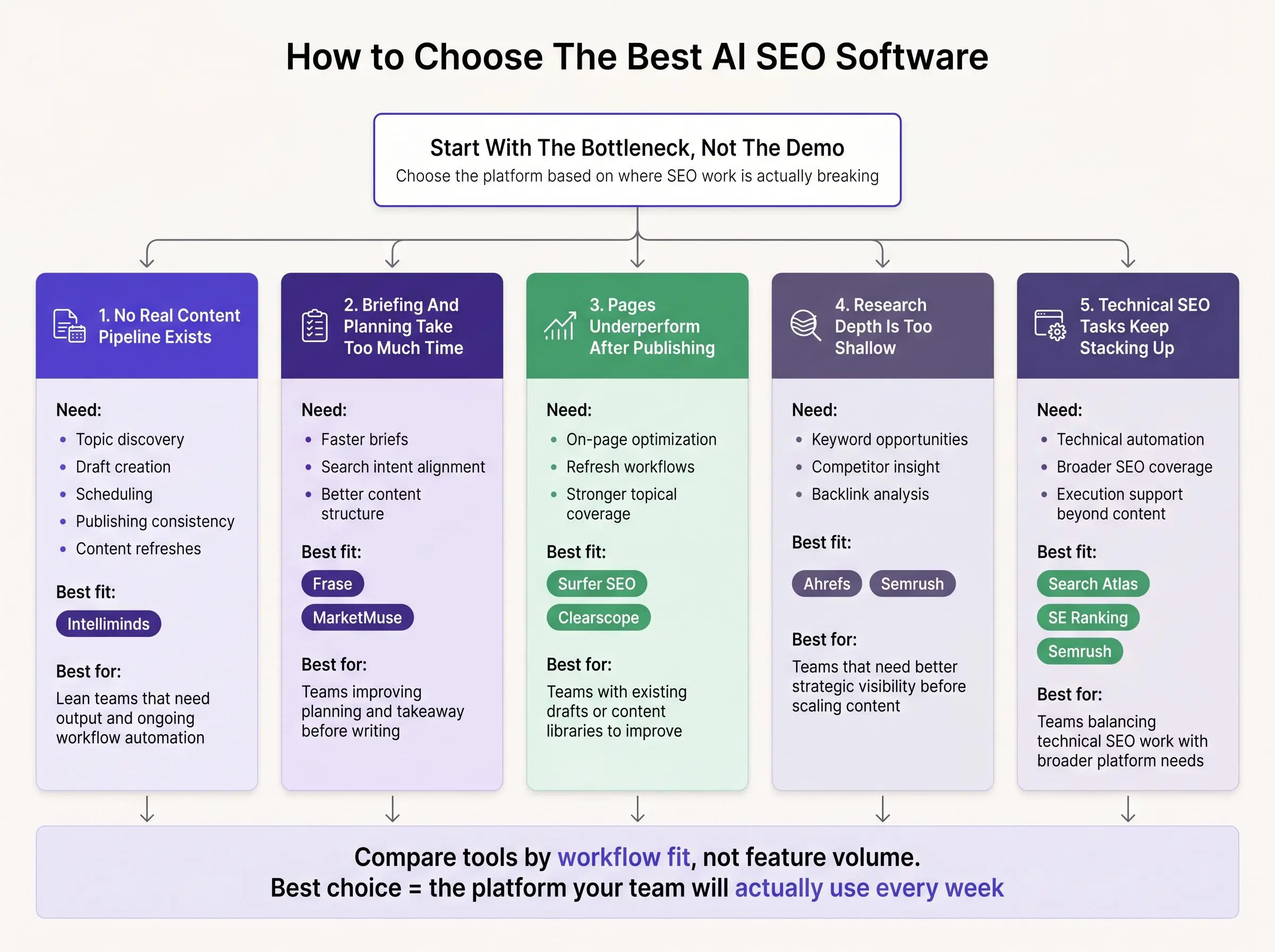
When you compare SEO AI platforms, don’t stop at features. Compare workflow depth, strategy depth, automation depth, and team fit. That’s what tells you whether a tool will hold up in real use.
Start with the content workflow itself. Can it handle topic discovery, briefs, draft generation, optimization, scheduling, publishing, and refreshing old content? Many tools cover one or two of those steps. Very few cover the whole chain.
Then look at strategy depth:
- keyword discovery
- competitor analysis
- backlink intelligence
- topic planning
- support for topical authority
After that, assess automation honestly. Some platforms only recommend actions. Others guide the workflow. A smaller group supports ongoing execution or technical automation. That difference affects workload more than most buyers expect.
Team fit is the part people rush through and regret later. A solo marketer, a dedicated content team, an SEO-led organization, and an agency managing multiple clients won’t use the same platform the same way.
Breadth looks efficient until nobody owns it.
The tradeoffs are usually clear once you look properly. Breadth versus specialization. Speed versus editorial control. Research power versus ease of publishing. Content scale versus technical depth. There isn’t one best ai seo software for every company. There is a best-fit system for the workflow you need to run next quarter.
Common Mistakes When Choosing the Best AI SEO Software
Most mistakes happen before implementation. Teams buy a tool to solve SEO growth, but they haven’t defined the actual operating problem.
The common misses are predictable:
- choosing based on feature volume instead of workflow fit
- buying separate tools for every stage before proving the process
- assuming AI writing alone will solve growth
- overvaluing optimization scores while underinvesting in topic selection and publishing cadence
- choosing an all-in-one suite when only one stage is broken
- ignoring the difference between planning tools, optimization tools, and SEO automation tools
The biggest mistake is failing to define success metrics before testing. If you don’t know what success looks like, every platform looks promising for two weeks.
Track something concrete:
- faster production
- better rankings
- more pages published
- higher refresh velocity
- more qualified organic traffic
Experienced teams keep this simple. Run one real workflow. Measure the output. See what manual work actually disappears. If a tool creates a nicer dashboard but the same workload, that’s not progress.
Conclusion
Choosing the best ai seo software comes down to fit, not hype. The right platform is the one that removes the bottleneck holding back growth right now.
Choose Intelliminds if your biggest need is turning SEO content into a repeatable engine with less manual work. Choose Semrush or SE Ranking if you want broader all-in-one coverage. Choose Surfer SEO or Clearscope if optimization quality is the main priority. Choose Frase or MarketMuse if planning and topical structure need the most work. Choose Ahrefs if research depth drives your strategy. Choose Search Atlas if automation and technical SEO are central to the decision.
Then keep the next step practical. Shortlist two or three options based on your current constraint, test them against one real workflow, and choose the platform your team can actually sustain over the next 6 to 12 months.
That’s usually the right answer. Not the tool with the loudest pitch. The one your team will still be using on a Tuesday afternoon three months from now.