

Most teams treat publishing like the finish line. With content lifecycle management, you catch the slow leaks before they turn into content debt: stale pages, split authority, and articles that still pull traffic but stop helping the business.
What matters is knowing what to refresh, merge, leave alone, and when to act. If you're scaling SEO for SaaS, ecommerce, services, startups, or clients, don't confuse more output with more growth.
Watch for these pressure points:
- Pages that still rank but carry old pricing, screenshots, or product claims
- Multiple posts chasing the same query and weakening one another
- No clear review owner, so good content fades before you notice
What Content Lifecycle Management Actually Means in SEO
Content lifecycle management is the operating system behind durable SEO growth. It covers the full path of a page from idea to creation, review, publishing, distribution, monitoring, refresh, repurposing, and eventually retirement.
That’s broader than basic content management. Content management handles storage, editing, and publishing. Lifecycle management adds the hard part: deciding what deserves to exist, what needs attention next, and what should stop taking up space.
In SEO, content rarely moves in a straight line. A strong page might get published once, then cycle through updates, internal link changes, SERP-driven rewrites, and new conversions paths over the next 12 months. Search intent shifts. Product positioning changes. Competitors improve their pages. Even a page that ranked well last quarter can start slipping quietly.
If your team keeps producing new content while older assets decay, you’re not running an SEO engine. You’re funding content debt.
A useful lifecycle model separates stages clearly enough that ownership is obvious. Otherwise, the same thing happens every time:
- strategy owns ideation
- content owns drafting
- someone publishes
- then nobody owns what happens after launch
That gap is where a lot of organic growth gets lost.
Why Most SEO Content Loses Momentum After Publishing
Most teams follow the same pattern. They do keyword research, build the brief, write the article, push it live, and then move straight to the next deadline. The page gets treated like a finished deliverable instead of a living acquisition asset.
That model feels productive. It isn’t.
What usually happens next is less visible but more expensive:
- rankings drift with no clear owner assigned to fix them
- pricing, screenshots, examples, or claims go stale
- multiple teams create overlapping pages around the same topic
- older content stops matching the current business
- brand voice and compliance standards split across old and new pages
In many B2B organizations, 60 to 70 percent of content goes unused after publication. That number should bother you. It means the problem often isn’t content volume. It’s content waste.
We see growing brands misread stalled organic growth all the time. They assume they need to publish more. Often they need to manage what they already have. A decaying library creates drag everywhere: weaker rankings, confused users, scattered authority, and a team that feels overworked for no clear reason.
More output does not create more control.
The Eight Stages of a Healthy SEO Content Lifecycle
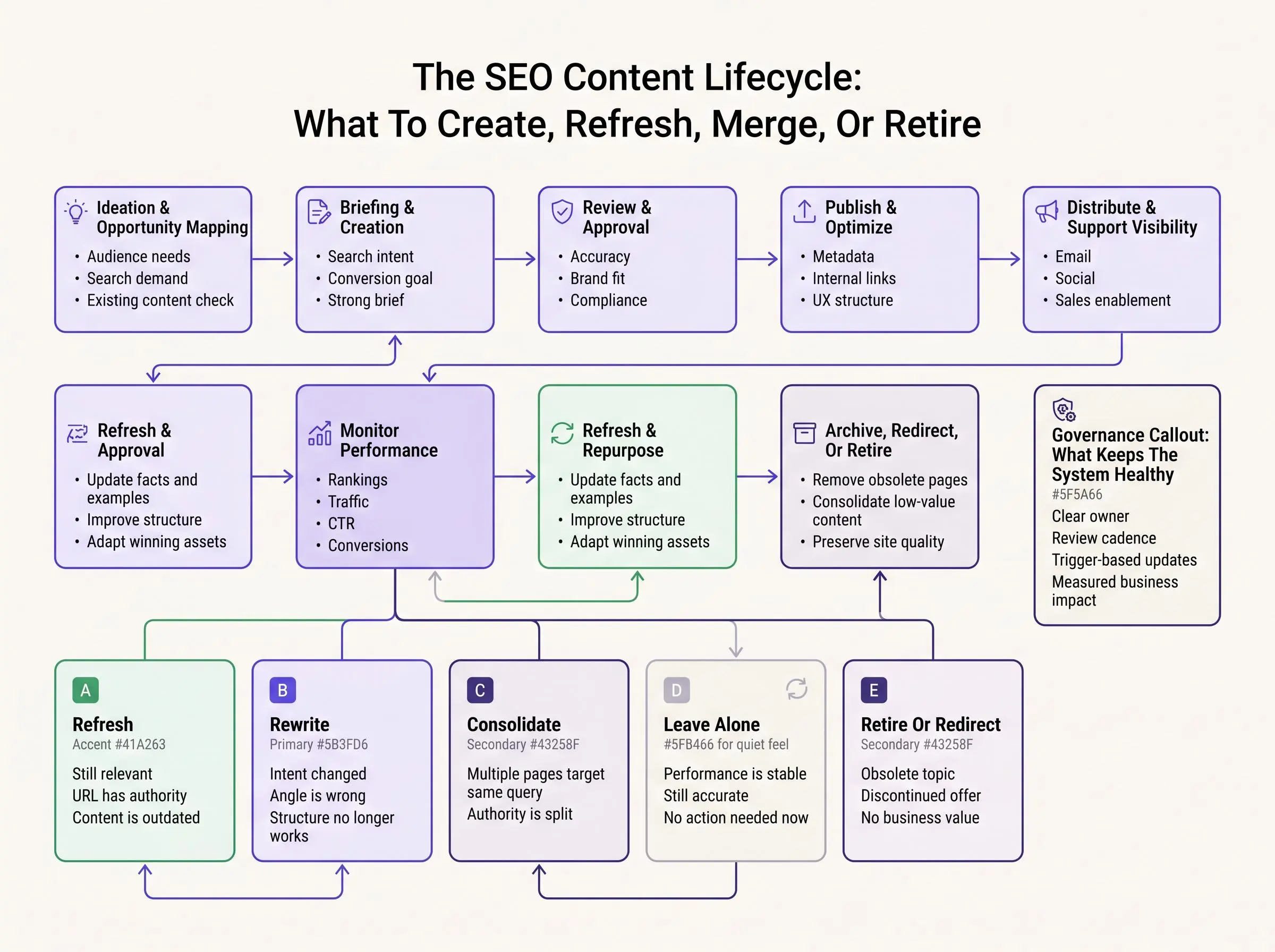
A healthy lifecycle needs distinct stages. Not because frameworks are fashionable, but because vague systems create vague ownership.
1. Ideation and opportunity mapping
Start with audience needs, business goals, search demand, and competitor gaps. Then check your existing library before approving anything new.
Sometimes the right move is a new page. Sometimes it’s a refresh, a merge, or a redirect. Teams skip this check because it feels slower. It usually saves months.
2. Briefing and creation
A page starts going wrong before the first draft. If the brief misses search intent, audience pain points, format, or conversion goal, the content will be wrong in a very polished way.
Good briefs reduce rework. Great briefs reduce future decay.
3. Review and approval
This stage covers quality, factual accuracy, brand fit, and compliance. In regulated or high-stakes categories, this isn’t optional. Legal risk and trust risk don’t sit outside SEO. They shape how well the page can perform.
4. Publishing and on-page optimization
Publishing is a transition point, not the finish line. Strong metadata, internal links, structured formatting, and clean UX all matter here.
A page can be well written and still underperform because nobody set it up to be found or used.
5. Distribution and visibility support
SEO content performs better when it gets used. Email, social, internal linking, sales enablement, and customer-facing teams all help strong pages earn attention and authority.
A good page left alone often stays smaller than it should.
6. Performance monitoring
Track rankings, traffic, CTR, conversions, and keyword coverage. Also watch operational friction. If approvals take too long or refreshes never happen, the problem isn’t just content performance. It’s system performance.
7. Refreshing and repurposing
This is where compounding happens. Update outdated material, improve structure, add missing sections, align to current intent, and adapt proven assets into other formats when it makes sense.
The best page on the site is often an old one that got maintained properly.
8. Archiving, redirecting, or retiring
Not every page should live forever. Obsolete, duplicative, or low-purpose content should be consolidated, redirected, or removed. Retirement is not failure. It’s maintenance.
Strong libraries are edited collections, not storage units.
How Often Should You Update SEO Content?
There’s no single answer to how often update SEO content. Anyone giving you one universal number is simplifying the problem too much.
First, separate review frequency from update frequency:
- Review frequency is how often you check a page for decay, risk, or opportunity
- Update frequency is how often that page needs meaningful revisions
Those are not the same. A page may need quarterly review and only one major update a year.
Your content update frequency should be driven by change velocity and business impact:
- SERPs shift quickly for the topic
- the page supports revenue, pipeline, or core category terms
- pricing, features, offers, or positioning changed
- the page includes stats, screenshots, comparisons, or time-sensitive claims
- seasonality affects relevance
A practical way to think about it:
- Pricing pages, comparison pages, seasonal pages, and product-led SaaS content usually need the shortest review cycles
- Evergreen educational content can go longer, but it still needs scheduled checks
- High-conversion pages deserve closer monitoring than low-impact informational pages
Trigger-based refreshing is usually smarter than arbitrary calendars. Review when rankings slip, CTR drops, conversions fall despite stable traffic, rich results disappear, or the page stops reflecting current market reality.
The best content update frequency is not based on editorial superstition. It’s based on how much the page matters and how fast the truth around it changes.
When to Refresh Blog Posts, Rewrite, Consolidate, or Retire
Not every weak page needs the same fix. This is where teams waste a lot of effort. They rewrite pages that only needed updating, or keep refreshing pages that should have been merged months ago.
Use the treatment that matches the problem.
Refresh the page when
- the topic is still relevant
- the URL already has authority or backlinks
- the structure is mostly sound
- examples, screenshots, data, links, or recommendations are outdated
- search intent is still similar, but competitors have become more useful
This is often the fastest win. Especially when the page already has some traction.
Rewrite when
The page no longer matches the SERP, the angle is wrong for the audience’s stage, or the content is thin and anchored in an outdated narrative. Sometimes the original structure is fighting you the whole way. Start over, keep the URL when appropriate, and rebuild around current intent.
Consolidate when
You have multiple posts chasing overlapping terms and splitting authority. Several short pieces can often become one stronger page. This shows up a lot on teams that have been publishing for years without a lifecycle plan.
Retire or redirect when
A topic is obsolete, an offer has been discontinued, or the page no longer supports business goals. Keeping weak pages live “just in case” creates confusion for users and search engines.
Deciding when to refresh blog posts is not just an editorial call. It’s a strategic choice about preserving authority, improving UX, and protecting organic acquisition.
How to Update Content for Rankings Without Starting Over
Before editing anything, diagnose the page. What query cluster was it meant to win? What is it ranking for now? Has intent shifted? Are traffic, CTR, and conversions moving together, or are they telling different stories?
That last one matters more than people think. Stable traffic with falling conversions often means relevance has changed even if rankings haven’t fully collapsed yet.
Then review the live SERP. Look at what top pages are doing now:
- are they more comprehensive?
- more current?
- more product-led?
- more comparative?
- answering questions your page ignores?
Once you know what changed, update the parts that usually move both rankings and usefulness:
- outdated facts, screenshots, workflows, and examples
- headline and subhead structure
- internal links and calls to action
- metadata and snippet appeal
- missing sections tied to current user questions
Updating content for rankings should improve the page for real people. Sprinkling in fresh keywords on stale copy is mostly theater.
Preserve what already works:
- keep the existing URL when it still makes sense
- protect strong sections already ranking
- retain backlink equity
- don’t break a conversion path that’s already proven
Only change dates when the update is substantial. Cosmetic edits made to look fresh don’t fool users for long, and they don’t create meaningful gains.
Refreshed content can produce serious traffic growth when the original asset already has a foundation. We’ve seen the pattern enough times that it’s hard to ignore: improving a proven page is often more efficient than replacing it.
Build an SEO Maintenance Schedule Your Team Can Actually Keep
A good SEO maintenance schedule is where strategy turns into something real. Without it, lifecycle management stays stuck in planning docs and quarterly discussions.
Start with a content inventory. Keep it practical:
- URL
- primary topic or keyword cluster
- content type
- owner
- business value
- current performance
- lifecycle status
Use simple statuses that make action obvious:
- Planned
- In production
- Live
- Monitor
- Refresh needed
- Consolidate
- Retire
Then prioritize review order. Revenue-linked pages, lead drivers, and core category terms come first. Pages with visible decay signals come next. Low-value or obsolete content can be grouped for archival review instead of stealing weekly attention.
A workable schedule mixes recurring reviews with event-based triggers. Product launch next month? Review related pages. New pricing? Audit comparison and bottom-funnel content. Rankings slip after a competitor overhaul? Don’t wait for the quarterly check-in.
Different teams need different levels of structure:
- lean in-house teams need a system that doesn’t rely on memory
- agencies need visibility across multiple client libraries
- startups need lightweight governance, not bureaucracy
This is where automation becomes operationally useful. It should surface what needs attention next instead of forcing someone to hunt through spreadsheets on a Tuesday afternoon.
What to Measure Across the Lifecycle
If you only measure outputs, you miss the system problems. If you only measure workflow, you miss the business result. You need both.
Track content outcomes such as:
- rankings for core terms and related clusters
- organic traffic and trend direction
- CTR from search
- conversions, demos, purchases, or leads influenced by the page
- engagement signals that show whether intent is still being satisfied
Then track process efficiency:
- time from idea to publish
- time from issue detection to refresh
- approval delays
- refresh backlog size
- percentage of pages with clear ownership
You also need hygiene indicators. These are boring until they start costing you money:
- broken links
- outdated claims
- conflicting versions of similar content
- orphaned pages
- duplicate or cannibalizing topics
And don’t ignore reuse. Measure which assets were refreshed, expanded, or repurposed, and which ones kept delivering after the update.
The point of measurement is not reporting for reporting’s sake. It’s knowing what to create next, what to fix now, and what to stop maintaining.
What This Looks Like for SaaS, Ecommerce, and Service Brands
The framework stays the same. The cadence doesn’t.
For SaaS, product-led blog posts, comparisons, integration pages, feature education, and use case content need frequent review. Screenshots age fast. Workflows change. Positioning evolves. Older pages often become technically accurate but commercially off.
For ecommerce, category pages, buying guides, seasonal collections, and promotional content need closer attention because inventory, pricing, merchandising, and demand can shift quickly. A page can keep ranking while becoming less useful by the week.
For service brands, service pages, location pages, case studies, and industry guides need updates as offers, proof points, expertise, and local market conditions change. Trust signals often matter as much as keyword targeting. Sometimes more.
Agencies get a different kind of leverage from lifecycle management. They can scale results by improving and reusing proven assets instead of rebuilding from zero for every client and every quarter.
Different businesses need different review rhythms. Every one of them benefits from treating content like an asset that should be monitored, improved, and retired with intention.
Where Automation Removes the Busywork

The lifecycle is easy to understand in theory and hard to sustain manually at scale. That’s the real problem.
Automation helps most in the places that drain team time without adding much strategic value:
- topic research and opportunity discovery
- content briefs and first-draft development
- publishing workflows
- performance monitoring and decay detection
- refresh recommendations tied to rankings, traffic, or business changes
In a mature SEO program, automation should reduce repetitive work, not replace judgment. It should free your team to spend more time on positioning, customer insight, prioritization, and final quality. The human work becomes more valuable when the manual drag is removed.
A platform like Intelliminds can bring topic research, article writing, publishing, and content refreshing into one repeatable system, which matters when you’re trying to grow traffic without adding manual workload.
Some things still need people:
- brand point of view
- final approval
- customer understanding
- business prioritization
Smart automation doesn’t make content less thoughtful. It makes content lifecycle management more consistent.
Common Mistakes That Quietly Break Content Lifecycle Management
The failures are usually ordinary. That’s why they stick around.
Here are the mistakes that cause the most long-term damage:
- treating publish as the endpoint instead of the midpoint
- creating net-new content before checking whether an existing page should be refreshed or merged
- using one content update frequency for every asset, regardless of volatility or value
- making surface edits that change the date but not the usefulness
- keeping obsolete pages live without redirects, consolidation, or archival logic
- leaving ownership vague so no one monitors key pages
- running disconnected tools and workflows that create version confusion and slow publishing
- measuring success only by traffic instead of acquisition impact
- ignoring retirement stages until the content library becomes bloated and contradictory
A lot of teams don’t have a content problem. They have a decision problem.
Conclusion
Content lifecycle management turns SEO from a draining output machine into a system that compounds value. Each asset gets planned, published, monitored, refreshed, repurposed, or retired with intent.
If you want smarter SEO growth, stop asking only what to publish next. Ask what in your existing library should be improved, consolidated, expanded, or removed.
Start with a simple audit. Give every key page a lifecycle status. Build a review process your team can actually keep. That’s how you update content for rankings with more confidence and a lot less chaos.