
Most AI visibility tools look impressive until you need to turn a mention into a publishable fix. Growing brands often buy dashboards that count appearances, then get stuck asking, “Now what?”
The worthwhile options show the prompts, citations, competitors, and next moves. They fit how your team actually handles content, reporting, product pages, and search.
We cut the noise. These are the AI visibility tools worth your attention.
Show 5 more productsShow fewer products
1. AthenaHQ
- Tracks 11 major answer engines
- Actionable content and optimization guidance
- Strong governance for larger teams
- Supports multi-region, multilingual reporting
- Useful executive dashboards and exports
- Advanced features need higher tiers
- Starter plan add-ons raise cost
- Overkill for small experimental teams
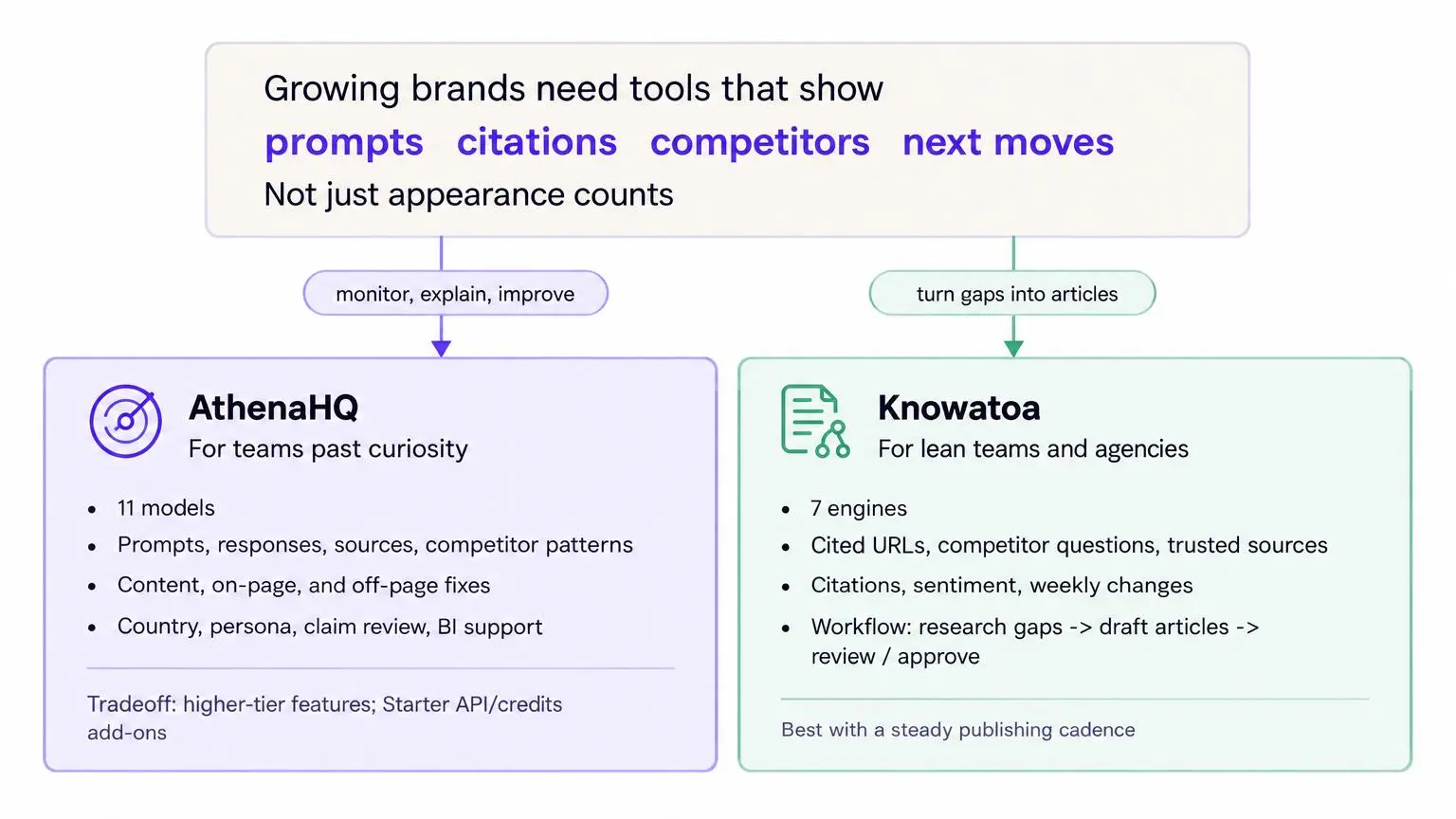
AthenaHQ is for teams that are past curiosity. If you already know AI search matters and now need a system to monitor it, explain it internally, and improve it, this is one of the more serious ai visibility tools in the list.
It tracks visibility across 11 models, including AI Overviews, AI Mode, ChatGPT, Perplexity, Gemini, Claude, Copilot, Grok, DeepSeek, Meta AI, and Mistral. That breadth matters if your brand sells across regions or buyer types, because the answer engine your audience uses isn't always the one your team assumes.
AthenaHQ goes further than mention tracking. It analyzes prompts and responses, shows sources and competitor patterns, and pushes teams toward action with content recommendations, on page and off page tasks, and a content optimization agent. The practical difference is simple: some tools tell you that you lost visibility; Athena tries to tell you what to fix.
A few details stand out for larger teams:
- country level support
- CSV exports
- persona targeting
- knowledge base and claim review
- discrepancy detection
- executive dashboard support for BI tools
- multi region and multi language support
That governance layer is where Athena separates itself from lighter tools. If legal, PR, SEO, and content all need to agree on what the brand should say in AI answers, the extra controls stop this from turning into a messy side project by the second month.
Good enterprise software doesn't just surface problems. It gives a team a way to own them.
The tradeoff is obvious. Some of the stronger features sit in higher tiers, and API access plus extra credits are add-ons on Starter. We wouldn't put this in front of a tiny team still deciding whether AI visibility deserves a line item. But if you're ready to operationalize, AthenaHQ feels built for that job.
2. Knowatoa

- Turns gaps into draft-ready content
- Shows citations and trusted sources
- Weekly recommendations keep teams moving
- Tracks visibility across seven engines
- Approval workflow reduces manual handoffs
- Best with steady publishing cadence
- Less enterprise governance depth
- Weekly cadence may feel limiting
Knowatoa takes a more useful path than most small-team tools. It doesn't stop at showing where you're weak. It turns those gaps into a publishing workflow.
That's why it lands well with lean marketing teams and agencies. A lot of tools collect AI search data and then leave you staring at another dashboard on Friday afternoon. Knowatoa is more direct.
It tracks visibility across seven engines, including ChatGPT, AI Overviews, and AI Mode. It shows which URLs AI already cites for your brand, where competitors dominate specific questions, which sources AI trusts, and when answers start drifting into the wrong message. It also tracks citations, sentiment, and visibility changes over time on a weekly rhythm.
The workflow piece is the real differentiator:
How the workflow runs
- Research gaps
One agent researches content gaps.
- Draft articles
Another drafts articles from those gaps.
- Review and approve
Your team reviews, approves, or auto approves.
That setup makes sense for brands with a steady publishing cadence. Weekly recommendations on what changed and what to publish next are a better fit for actual content operations than broad analytics that nobody uses after onboarding.
Compared with other tools here, Knowatoa is lighter than AthenaHQ and much more execution-oriented than Peec AI or Rankscale. It also has a stronger drafting angle than Scrunch, which is thinking more about site readiness and agent behavior.
The limitation is that it works best when your team can respond consistently. If you publish once every quarter, the workflow advantage fades fast. But if your organic engine depends on turning insight into articles, refreshes, and approvals without extra manual drag, Knowatoa is close to the mark.
3. Peec AI

- Tracks sentiment, position, and mentions
- Strong prompt and source intelligence
- Prioritizes prompts by business value
- Clean reporting for teams or clients
- Flexible MCP and API integrations
- Limited direct content production
- Needs existing content or PR motion
- Lighter governance than enterprise tools
Peec AI is less about raw mention counts and more about how AI systems frame your brand. That distinction matters. A mention isn't always a win.
It tracks visibility, position, and sentiment in AI search, then ties those readings back to prompts, sources, and competing brands. For teams trying to understand not just "are we present?" but "what story are these models telling about us?", Peec is one of the clearer tools in the category.
A strong part of the product is prioritization. It uses AI-suggested prompts and search volumes to help teams focus on questions that are actually worth chasing. That's more useful than a giant prompt list with no business context.
Peec also gives you source intelligence. If citations keep coming from review sites, LinkedIn, forums, or editorial coverage, you can see that pattern and respond in the right channel. That's a practical edge, especially for brands where PR, partnerships, and community visibility influence search outcomes as much as blog content does.
Where it fits
- teams that already have a content or PR motion
- agencies that need clean reporting
- operators who want source and sentiment detail without a heavy governance layer
It also supports MCP and API connections, with integrations that can plug into stacks using Claude, Cursor, n8n, and similar tools. That makes it more flexible than audit-style products that trap the data inside their own interface.
The catch is that Peec doesn't appear to lean as hard into direct content production. So if you're looking for tools for ai mode seo that also help you draft and publish, Knowatoa may feel more complete. If you already have execution handled and need better reporting, source analysis, and prompt intelligence, Peec is easier to justify.
4. Rankscale
- Very broad engine coverage
- Strong ecommerce visibility tracking
- Deep citation and source analysis
- Useful prompt research and audits
- Good fit for multi-market teams
- Can overwhelm smaller teams
- GA4 and GSC integrations beta
- Best value needs active ownership
Rankscale is built for teams that want a lot of coverage and can actually use it. That usually means bigger brands, publishers, ecommerce teams, and agencies with multiple clients or markets.
It monitors visibility across 17 or more AI engines, including AI Overviews, AI Mode, ChatGPT, Perplexity, Gemini, Claude, Copilot, DeepSeek, Grok, and Mistral. Few tools in this roundup go that broad.
The platform gives you a centralized view of visibility score, rankings, sentiment, competitors, citations, and source domains. Then it keeps going with query fanouts, page audits, and prompt research. This is closer to a full GEO analytics stack than a simple checker.
For ecommerce brands, the shopping layer is the interesting part. Rankscale tracks shopping and ads visibility, merchant reach, and buybox coverage over time across ChatGPT, Google AI Mode, and Copilot. That's not a side detail. If AI answers start intercepting commercial discovery, product visibility becomes a revenue issue, not just a brand issue.
Why bigger teams will care
- broader engine coverage than most tools here
- stronger fit for publisher and commerce environments
- more ways to connect AI visibility with technical, content, and commercial actions
Its GA4 and Search Console connections are in beta, which is promising but still worth treating carefully. We usually prefer mature integrations over flashy beta checkboxes, especially when reporting goes to leadership.
Rankscale can be more than a small team needs. And honestly, extra dashboards don't help if nobody owns the response. But for operators who need wide monitoring and want one of the stronger sets of google ai mode seo tools plus commerce visibility, Rankscale has real depth.
5. Scrunch

- Improves site readiness for AI
- Agent Pages support cleaner citations
- Product-level shopping visibility insights
- More actionable than simple graders
- Lighter prompt tracking depth
- Limited content drafting support
- Best fit for technical teams
Scrunch starts from a different belief: AI visibility isn't only about rankings or mentions. It's also about whether AI systems can easily consume, navigate, and cite your site.
That sounds technical, but it has practical consequences. If your pages are hard for agents to interpret, you're asking for weak visibility no matter how good your reporting looks.
Scrunch focuses on Agent Pages, agent traffic analysis, site optimization, monitoring, citations, shopping visibility at the product level, and AI search trends. It's designed around the shift from human-first browsing to AI-mediated discovery, which is a fancy way of saying the visit may never happen unless the model trusts and understands the page first.
One reason we like this angle is that it forces a harder conversation inside the team. Many brands want AI mentions without doing the site work. That usually doesn't hold.
If the machine can't parse the page cleanly, it won't quote you cleanly either.
Scrunch compares well against dashboard-first tools because it gives you another optimization surface. It's more site-structure and agent-experience focused than Peec AI or Semrush AI Visibility Toolkit, and more action-oriented than lightweight graders.
The tradeoff is that it doesn't appear to show the same prompt-tracking depth you get from Rankscale or Semrush. And if your main need is content planning and article production, Knowatoa is the more obvious choice. Still, for ecommerce and enterprise teams thinking about discoverability at the page and product level, Scrunch is one of the smarter bets in this list.
6. AI Search Grader
- Free, no-account brand check
- Fast cross-platform baseline report
- Clear five-dimension visibility scoring
- Useful for leadership buy-in
- One-time snapshot only
- Limited model coverage
- Minimal optimization guidance
AI Search Grader is the easiest place to start. No account. No setup project. No procurement loop that somehow lasts six weeks.
It gives you a one-time brand check across ChatGPT, Perplexity, and Gemini, then scores visibility across five dimensions:
- sentiment
- presence quality
- brand recognition
- share of voice
- market position
This is not a long-term operating system. That's fine. It doesn't need to be.
The value is speed. If your leadership team keeps asking about AI search and nobody has hard evidence yet, a fast baseline is useful. You can get a written brand perception report and use that to decide whether you need a deeper platform.
Compared with the rest of this roundup, AI Search Grader is much lighter than AthenaHQ, Rankscale, or Semrush's toolkit. It also has narrower model coverage than the broader suites. But for zero-friction diagnosis, it does the job.
A quiet benefit here is organizational clarity. Sometimes the first problem isn't tool selection. It's getting the team to agree that the problem is real. A simple benchmark often settles that faster than a giant vendor demo.
7. Semrush AI Visibility Toolkit
- Fits existing Semrush workflows
- Daily tracking across key LLMs
- Strong prompt and competitor research
- Country-level mention visibility
- Connects AI and SEO reporting
- Best for Semrush users already
- Prompt tracking split across tools
- Less differentiated on site readiness
If your workflow already lives in Semrush, this is probably the cleanest extension into AI search. That's the main reason to care about it.
The toolkit adds an AI Visibility Score, mentions, cited pages, citations, audience trends, visibility trends, distribution by LLM, mentions by country, competitor research, topic and prompt gaps, plus prompt tracking through Position Tracking. It also tracks daily visibility in ChatGPT Search, Google AI Mode, and Gemini.
That makes it one of the more practical ai mode seo tools for teams that don't want a separate environment for classic SEO and AI visibility. There is real value in keeping your search data, prompt research, and competitive analysis close together. Fewer tabs. Less friction. Better odds someone actually uses it.
Where it wins
It fits best when your team already knows the Semrush way of working. You get country-level mention visibility, can see which LLMs refer to your brand most often, and can compare AI performance with traditional search performance over time.
That's useful because AI visibility shouldn't sit in a silo. The same content system usually feeds both. We see too many teams treat AI answers like a separate channel when it's often the same authority, pages, and brand signals showing up in a new interface.
The main limitation is product sprawl. Some prompt tracking lives inside Position Tracking rather than one unified view, and it's less differentiated on site readiness than Scrunch or content workflow than Knowatoa. But as google ai mode seo tools go, it's a sensible choice for teams already committed to Semrush.
8. XFunnel

- Deep buyer question research
- Persona-level insights for B2B
- Broad data beyond LLMs
- Frequent prompt refreshes and alerts
- Hands-on onboarding supports execution
- More complex than lightweight tools
- Less drafting support than rivals
- Best for consultative buying teams
XFunnel is for teams that want research depth and a more hands-on path to action. It feels closer to strategy execution than software-only monitoring.
It focuses on question research, impact scoring, topic classification, visibility measurement across AI answers, and detailed monitoring of answers, citations, and sentiment. It also slices data by persona, segment, and other filters, which matters for B2B brands with different buyers asking very different things.
The data layer is unusually broad. XFunnel combines clickstream trends, Google follow-up and autocomplete data, ChatGPT and Perplexity answers, plus UGC sources like Reddit, G2, and Capterra. Then it dedupes, detects language, and scores sentiment. That gives teams a clearer view of how buyer questions form before they ever become a branded search.
A few practical signals make it feel operational:
- Slack and email alerts
- prompt refreshes multiple times a week or on demand
- action-first positioning
- white glove onboarding tailored to a niche
Early users who acted on recommendations reportedly saw up to 50% more assisted conversions in six weeks. We'd still treat any vendor outcome claim with the usual caution, but it does point to the tool's core idea: don't just measure the conversation, move it.
XFunnel is more consultative than AI Search Grader or Semrush's toolkit, and less drafting-centric than Knowatoa. If your team wants high-impact prompt strategy, audience question intelligence, and support turning findings into action, it's a strong candidate.
| AthenaHQ | Knowatoa | Peec AI | Rankscale | Scrunch | AI Search Grader | Semrush AI Visibility Toolkit | XFunnel | |
|---|---|---|---|---|---|---|---|---|
| Continuous monitoring | ✓ | ✓ | ✓ | ✓ | ✓ | × | ✓ | ✓ |
| Prompt/question tracking | ✓ | ✓ | ✓ | ✓ | ✓ | × | ✓ | ✓ |
| Citation/source analysis | ✓ | ✓ | ✓ | ✓ | ✓ | × | ✓ | ✓ |
| Actionable recommendations | ✓ | ✓ | ✓ | ✓ | ✓ | × | ✓ | ✓ |
| Sentiment analysis | ✓ | ✓ | ✓ | ✓ | ✓ | ✓ | ✓ | ✓ |
| Competitor analysis | ✓ | ✓ | ✓ | ✓ | ✓ | ✓ | ✓ | ✓ |
How to Choose the Right AI Visibility Tool for Your Stage
The buying decision is easier when you frame it around maturity instead of hype. Most teams don't need the biggest platform. They need the one they'll actually use next week.
Here's the practical mapping:
- Need a baseline first: AI Search Grader
- Need ongoing monitoring across answer engines: Peec AI or Rankscale
- Need visibility tied to content operations: Knowatoa
- Need site optimization for AI agents: Scrunch
- Need enterprise governance and reporting depth: AthenaHQ
- Need search and AI visibility in one stack: Semrush AI Visibility Toolkit
- Need research plus strategic action: XFunnel
A few filters matter more than vendor noise:
- Which engines matter to your audience?
- Do you need daily, weekly, or one-time prompt tracking?
- Can you see citations and sources, not just mentions?
- Will the platform tell you what to publish or fix next?
- Who needs the reporting: operators, executives, or clients?
- Do you specifically need AI Mode tracking?
If you're a lean team, workflow beats feature count. If you're an enterprise team, governance and multi-market support start to matter fast.
What to Look for in AI Mode SEO Tools and Google AI Mode SEO Tools
Not all tools for ai mode seo measure the same thing. Some are basically brand mention trackers. Others are closer to operating systems.
The market usually breaks into six buckets:
- brand presence and sentiment measurement
- prompt and competitor gap discovery
- citation and source analysis
- site optimization for AI consumption
- content recommendations or drafting
- executive reporting and integrations
The metrics worth paying attention to are pretty consistent:
- mentions
- citation frequency
- source quality
- answer position or rank
- share of voice
- sentiment
- topic and prompt gap coverage
For ai search seo tools, actionability is the real test. Can your team see what changed? Can you spot where competitors are winning? Can you connect that insight to content, technical fixes, PR, or product page updates?
A simple tradeoff framework helps:
- broad engine coverage versus workflow simplicity
- site optimization versus content planning
- free benchmark versus continuous monitoring
- self-serve dashboards versus white-glove support
We've learned this the hard way: more data is not better if the next move is unclear.
Common Mistakes Growing Brands Make When Buying AI Visibility Tools
Most buying mistakes aren't technical. They're operational.
Teams often buy the biggest platform before deciding who owns the workflow. Then the tool becomes shelfware with expensive screenshots. Others treat AI visibility like traditional rank tracking with a new label, which misses prompts, citations, and answer framing.
The more common mistakes look like this:
- choosing a tool that tracks mentions but not sources or prompts
- ignoring whether the team can act through content, PR, product page updates, or technical fixes
- obsessing over engine count while overlooking recommendation quality
- treating AI visibility as a gimmick instead of part of a repeatable content system
- mismatching the tool to the operating model
That last one causes a lot of wasted money.
Lean content teams need execution help. Agencies need reporting and segmentation. Ecommerce teams may need shopping visibility. Enterprise teams often need governance, approval paths, and support across regions.
The best ai visibility tools are the ones your team can use consistently enough to shape what gets published, refreshed, and corrected over time.
Conclusion
The real decision isn't which platform has the longest feature list. It's which one helps your team understand where your brand shows up, why competitors win, and what to do next.
If you need a fast baseline, start with AI Search Grader. If you want visibility insights tied directly to drafting and publishing, Knowatoa is the clearest fit. AthenaHQ and Rankscale make more sense when you need deeper optimization and broader reporting. Scrunch is the call when AI agent site readiness matters most. Semrush AI Visibility Toolkit fits teams already working inside Semrush. XFunnel and Peec AI both make sense when question intelligence, reporting, and actionability are central.
Start with an audit. Identify the prompts, sources, and answer engines that actually influence your pipeline. Then pick the platform that fits how your team creates, publishes, and improves content in the real world.
That's the part that compounds.
Article Record
ReferencesPrimary sources used for this article
- AI Visibility Toolkit: Boost Brand Visibility in AI Search
- AI Visibility Toolkit Pricing | Semrush
- AEO Tools to Track & Improve Your AI Visibility
- Getting Started with the AI Visibility Toolkit
- AI Search Monitoring Tool: Track ChatGPT, Perplexity & Google AIO
- AI Search Analytics: Track Mentions & Citations
- OtterlyAI Pricing - Transparent & Simple
- AI search analytics for marketing teams
- Pricing for Brands
- AI Visibility Tracker for ChatGPT & AI Overviews | Rankscale
- Plans that scale with yourambition
- Scrunch | The AI Customer Experience Platform | AI search visibility & optimization
- Scrunch | FAQs - What products does Scrunch offer for AI search optimization?
- Scrunch | Pricing
- Profound | The AI Platform to Power Your Marketing
- The Complete AEO Platform | Profound
- Welcome to Peec AI - Peec.ai Docs
- Plans & Pricing
- AI Search Monitoring Tool Features | OtterlyAI Platform