
Finding a Surfer SEO alternative gets messy when every tool promises “better content” but leaves your team doing the same manual work. Growing brands and agencies don’t need another scorecard. They need fewer handoffs, faster publishing, and content that doesn’t go stale by month 3.
The strong options handle more than keyword suggestions. They support real workflow: research, drafting, approvals, publishing, and updates.
We cut this list to four options worth your attention.
Show 1 more productsShow fewer products
1. Intelliminds SEO Automation Software

- Automates research through publishing
- Human approval keeps brand control
- Reduces handoffs across content workflow
- Refreshes content after publication
- Scales output without extra headcount
- Not a deep technical SEO suite
- Broader than simple editor needs
- Less focused on scoring alone
If you're searching for a surfer seo alternative because you're tired of optimizing drafts and then doing everything else by hand, this is the one to look at first. We built Intelliminds for teams that don't need another scorecard. They need the work to move.
The real difference is scope. Intelliminds is built to automate the content side of SEO end to end, not stop at recommendations inside an editor.
A lot of teams hit the same wall around month three or four. Research lives in one place. briefs in another. Drafts get done, but publishing waits. Then nobody circles back to refresh older posts unless traffic drops hard enough to force the issue. That's not an optimization problem. It's an operating problem.
Here's where Intelliminds changes the shape of the work:
- automated keyword research
- topic research
- AI writing
- on page SEO support
- automatic publishing to your CMS
- content refreshing over time
- human approval before anything goes live
That last part matters more than people admit. Most teams want speed, but they don't want a machine posting unchecked content at 3 p.m. on a Tuesday. We keep a human in the loop because control matters when your brand is on the page.
For content marketers, the gain isn't just faster drafting. It's fewer handoffs. Your team isn't bouncing between research tools, writing tools, publishing tools, and a spreadsheet nobody enjoys updating. When output grows, consistency usually breaks first. Intelliminds is built to keep the process stable while volume increases.
Where it fits best
A few use cases show the fit pretty clearly:
- a brand publishing several articles each month and already falling behind on updates
- a lean SaaS or ecommerce team that wants AI help but still needs human review before publish
- an agency that wants a repeatable production workflow instead of living inside an editor all day
This is less of a content optimization tool alternative in the narrow sense, and more of a content operating system. If your goal is traffic growth and customer acquisition, that matters. Better drafts help. Better systems compound.
The tradeoff is straightforward. Intelliminds is content focused SEO automation, not a deep technical SEO suite built around crawling, audits, and issue management. If your main need is technical SEO control, you're solving a different problem. But if you're trying to build a surfer replacement for scaling content without adding headcount, this is the strongest fit in the list.
Publishing is not the finish line. It's the start of maintenance.
2. Scalenut

- Optimization and AI writing together
- Speeds up brief-to-draft creation
- Keeps writers hands-on
- Fits familiar team workflows
- Limited post-publication workflow depth
- Not full end-to-end automation
- Less focused on distribution
Scalenut makes sense for teams that still want a familiar content workflow but need more writing help built in. It sits in the middle ground: not just optimization, not fully operational automation either.
That's a useful lane.
Some teams aren't ready to change how work moves across approvals, publishing, and maintenance. They just want the brief-to-draft path to stop dragging. Scalenut fits that kind of team better than a platform built around full workflow automation.
Its core appeal is simple:
- SEO content optimization and AI writing live in the same workflow
- marketers can move from guidance into first draft creation faster
- the team can stay hands on inside the writing process
Compared with a classic Surfer style setup, Scalenut gives you more help getting words on the page. Compared with broader systems, it stays closer to the writer's desk. For some teams, that's exactly right. Especially if writers still own the article from draft through final polish.
The practical fit
This is a solid surfer alternative for content teams that publish blogs regularly and want less friction during creation. It also works as an ai seo writer alternative when the pain is speed, not infrastructure.
You can think of it this way:
- If your bottleneck is slow first drafts, Scalenut deserves a look.
- If your team likes the current approval and publishing setup, it won't force a bigger change.
- If you mainly want optimization plus generation, it's more aligned than a pure scoring layer.
The limitation is where many teams misread the category. Faster creation doesn't automatically fix content operations. If the real drag starts after the article is written, Scalenut may improve the front half of the process while leaving the back half mostly intact. That's not a flaw. It's just the boundary of the tool.
We'd look at Scalenut for an internal content team that wants drafting and optimization in one place, but doesn't need a full shift in workflow yet. It is closer to a Surfer replacement than the broader automation-first options here. That's either a strength or a ceiling depending on what's broken in your process.

3. Rankability

- Strong multi-stakeholder collaboration
- Clear briefs and optimization workflows
- Tracks AI search visibility
- Good for existing content updates
- Less CMS automation depth
- Limited publishing and refresh breadth
- Not ideal for pure scale
Rankability is the most agency-shaped option in this group. You can feel it in the workflow orientation. It's built less like a solo writing tool and more like something meant to be touched by several people before the work is done.
That matters if you're managing client programs, multiple reviewers, or a team where strategy and execution are split.
The useful parts of its setup include:
- content briefs
- writing support
- optimization workflows
- AI search visibility tracking
- AI search readiness auditing
- optimization of existing content
- creation of new content
An agency usually doesn't just need articles written. It needs a process that survives handoffs between strategist, writer, editor, account lead, and client. Rankability fits that environment better than tools that assume one person owns the page from start to finish.
Why agencies look at it
A few strengths stand out in real use:
- writers and client facing teams can work from the same process
- it's easier to show what changed and what needs attention next
- structured workflows reduce the usual "who has this now?" confusion
That last point sounds minor until you're juggling eight clients and thirty active pieces of content. Then it becomes the whole game.
Compared with Scalenut, Rankability leans more clearly into collaboration and process discipline. Compared with Intelliminds, it's less centered on end to end CMS automation and refresh cycles. Compared with Distribb, it cares less about distribution breadth and more about operational visibility across stakeholders.
This makes it a strong surfer alternative for agencies, but not only agencies. In house teams with multiple reviewers can also benefit, especially if they want content work tied more closely to AI search performance and existing page improvement, not just new article output.
The caution here is simple. If your main pain point is raw production volume, look carefully at how much automation you actually need. Structured collaboration is valuable, but it doesn't replace production lift. And if content refreshing and automatic publishing are high on your list, you should weigh those needs directly instead of assuming any workflow tool will cover them.
Teams rarely break because they lack ideas. They break because nobody can see the next step.
4. Distribb

- Ties SEO to publishing workflow
- Strong buyer-intent keyword focus
- Built-in scheduling and auto-publishing
- Supports clusters and internal linking
- Tracks AI search visibility
- Broader than simple editor needs
- May feel heavy for smaller teams
- Less ideal for optimization-only buyers
Distribb points at a different problem. It is for teams that no longer want content optimization isolated from publishing, scheduling, and visibility work. That's a meaningful shift if your drafts are fine but your go-to-market motion around content is messy.
Some marketers still buy as if the article is the product. It isn't. The live page, the internal linking, the schedule, and the distribution path all affect whether that content does anything.
Distribb pushes further into that full path with capabilities such as:
- buyer intent keyword research
- in depth article writing
- brand voice and E-E-A-T structure support
- topic clusters and internal linking
- auto publishing across multiple CMS and site platforms
- content calendar with auto scheduling
- backlink and outreach related functionality
- AI search visibility tracking
That's broader than a conventional optimizer, and broader than a team may actually need. Still, for the right buyer, the appeal is obvious.
Where it differs from the others
Distribb is more outward facing than Rankability's agency workflow angle. It reaches further into publishing and distribution than Scalenut. It also sits closer to search visibility plus content deployment than a pure editor replacement.
That makes it a sensible surfer seo alternative for teams focused on publishing velocity and buyer intent traffic. If you care about getting content live fast, keeping it connected, and tying it to a broader visibility motion, this category starts to make more sense than editor-first tools.
The catch is that some teams don't need this breadth. If you want a simpler, narrower editor experience, a platform built around scheduling, outreach, and wider deployment can feel like more machine than you need. Buyers should be honest about that.
Distribb is useful when the problem isn't "how do we optimize this paragraph?" but "why does every article take too many steps to become traffic?" That's a better question anyway.
| Intelliminds SEO Automation Software | Scalenut | Rankability | Distribb | |
|---|---|---|---|---|
| End-to-end content automation | ✓ | × | × | ✓ |
| Automatic CMS publishing | ✓ | × | × | ✓ |
| Keeps existing workflow largely intact | × | ✓ | × | × |
| Agency-focused collaboration | × | × | ✓ | × |
| AI search visibility tracking | × | ✓ | ✓ | ✓ |
How to Choose the Right Surfer SEO Alternative
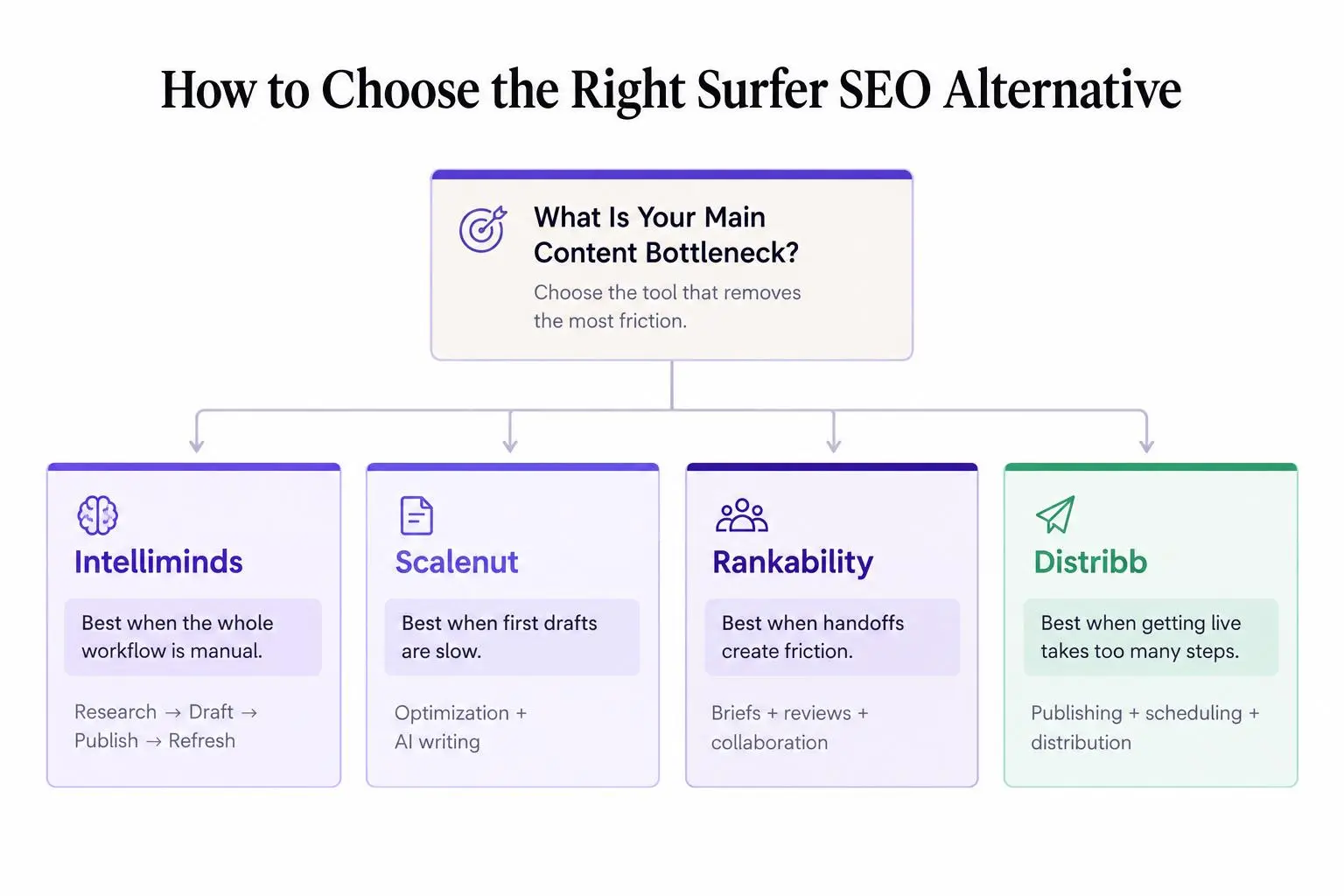
The best surfer alternative for content teams is not always the one that looks most like Surfer. That's the trap. Buyers often search for a substitute and end up buying the same workflow pain in a different interface.
Start with the bottleneck, not the feature list.
Here are the questions worth asking before you commit:
- Do you need an optimization layer or an end to end content system?
- Is your bottleneck research, writing, approvals, publishing, or refreshes?
- Do you publish occasionally or run a continuous content engine?
- Do multiple stakeholders need access, review, and visibility?
- Do you need AI search visibility or only on page content help?
Those answers usually point you into one of four purchase paths.
The four paths
- Choose an editor-adjacent platform if your writers already own publishing and you mostly need better guidance.
- Choose an ai seo writer alternative if first draft speed is the biggest issue.
- Choose a publishing-first system if work keeps stalling between finished draft and live page.
- Choose a workflow-driven platform if coordination is the real problem.
A few buying questions cut through the noise fast:
- Can this tool remove manual steps, or does it just move them around?
- Can it help keep content fresh after publication?
- Does it fit your review process, or force a new one?
- Will it help you scale useful content, not just produce more drafts?
For a quick decision matrix:
- Best for full content automation: Intelliminds SEO Automation Software
- Best for optimization plus AI drafting: Scalenut
- Best for agencies and structured collaboration: Rankability
- Best for publishing and distribution breadth: Distribb
If you're still unsure, look at where your team loses momentum by the second afternoon after a draft is "done." That's usually where the tool choice becomes obvious.
What Matters More Than Content Scores
Content scores can help. They're just not the thing that determines whether content becomes a dependable growth channel.
Teams outgrow score-first tools for boring reasons, and boring reasons usually matter most:
- research still happens elsewhere
- publishing still takes manual effort
- updates slip because nobody owns them
- performance becomes inconsistent when the process is fragmented
A score can improve a page. It can't run a system.
When you're evaluating a content optimization tool alternative, the capabilities that matter most usually look like this:
- topic discovery and keyword prioritization
- draft creation support
- on page optimization guidance
- CMS publishing flow
- refresh and maintenance workflows
- human oversight and approval
- visibility into how content ties back to traffic and customer acquisition
Tactical fit vs strategic fit
This distinction clears up a lot of confusion.
Tactical fit means the tool helps improve a draft. Strategic fit means the tool helps your team run content as a repeatable growth process.
Those are not the same purchase.
We see teams make the same mistakes over and over:
- choosing the closest Surfer clone without checking workflow gaps
- overvaluing content scores and undervaluing refresh workflows
- buying for isolated features instead of team constraints
- assuming AI writing alone fixes content operations
Most teams are not failing because they can't write. They're slowed down by fragmented execution and stale content. Once you see that clearly, the tool decision gets less emotional and more useful.
Better content systems beat better content intentions.
Which Option Fits Your Team Best
At this point, the choice should feel narrower. Each option in this list solves a different kind of friction. Match the tool to the bottleneck and the decision gets easier.
If you need fewer manual steps across the whole lifecycle
Choose Intelliminds SEO Automation Software.
This fits lean in house teams, growing brands, startups, and agencies that want a surfer replacement for scaling content without adding more people. If you need research, writing, publishing, refreshing, and human review in one motion, start there.
If you want drafting and optimization together
Choose Scalenut.
This is the cleaner fit for teams that still like a traditional content workflow but want faster creation inside it. You're not replacing the whole machine. You're making the writing phase move better.
If you need structured collaboration
Choose Rankability.
Agencies and multi-stakeholder teams usually care about visibility, briefs, and handoffs as much as the content itself. Rankability fits when process discipline matters almost as much as output.
If you want publishing and distribution tied closely to SEO
Choose Distribb.
This fits brands that care about buyer intent traffic, publishing velocity, and getting content beyond the draft stage with fewer disconnected tools.
Migration mindset matters too. Sometimes you should replace a standalone optimizer. Sometimes you should add a tool without changing the whole workflow. And sometimes scaling pressure is your signal that you don't need a better editor. You need a bigger operating system.
That last move is usually uncomfortable right before it becomes obvious.
Conclusion
The best surfer seo alternative isn't the one that copies Surfer most closely. It's the one that removes the most friction from the way your team actually works.
The four lanes are pretty clear:
- Intelliminds SEO Automation Software for teams that want end to end content automation with human oversight
- Scalenut for teams that want optimization plus AI assisted writing
- Rankability for agencies and collaborative optimization workflows
- Distribb for teams that want publishing, buyer intent SEO, and distribution in one system
Here's the practical next step. Map where your content process slows down today. Is it research? Drafting? approvals? publishing? refreshes? Then match that bottleneck to the tool category above.
Don't buy based on who scores content best. Buy based on who helps your team build a repeatable path to organic traffic and customer acquisition. That's the shift that actually changes outcomes.
Article Record
ReferencesPrimary sources used for this article
- 9 Best Surfer SEO Alternatives: Features, Pricing & Use Cases
- Scalenut vs Surfer SEO: Which Tool is better?
- Pricing
- 8 Top Surfer SEO Alternatives For SEO & Content Teams
- 10 Surfer SEO Alternatives for Content Optimization
- NeuronWriter Review: Read This Before You ... | SEOengine.ai
- Surfer SEO Review: a Powerful Content Optimization Tool - Alex Birkett