Choosing an AI search optimization platform gets messy fast. Most tools can show a visibility score. That does not mean they can tell you what to fix next—or help your team ship it without adding another weekly ritual.
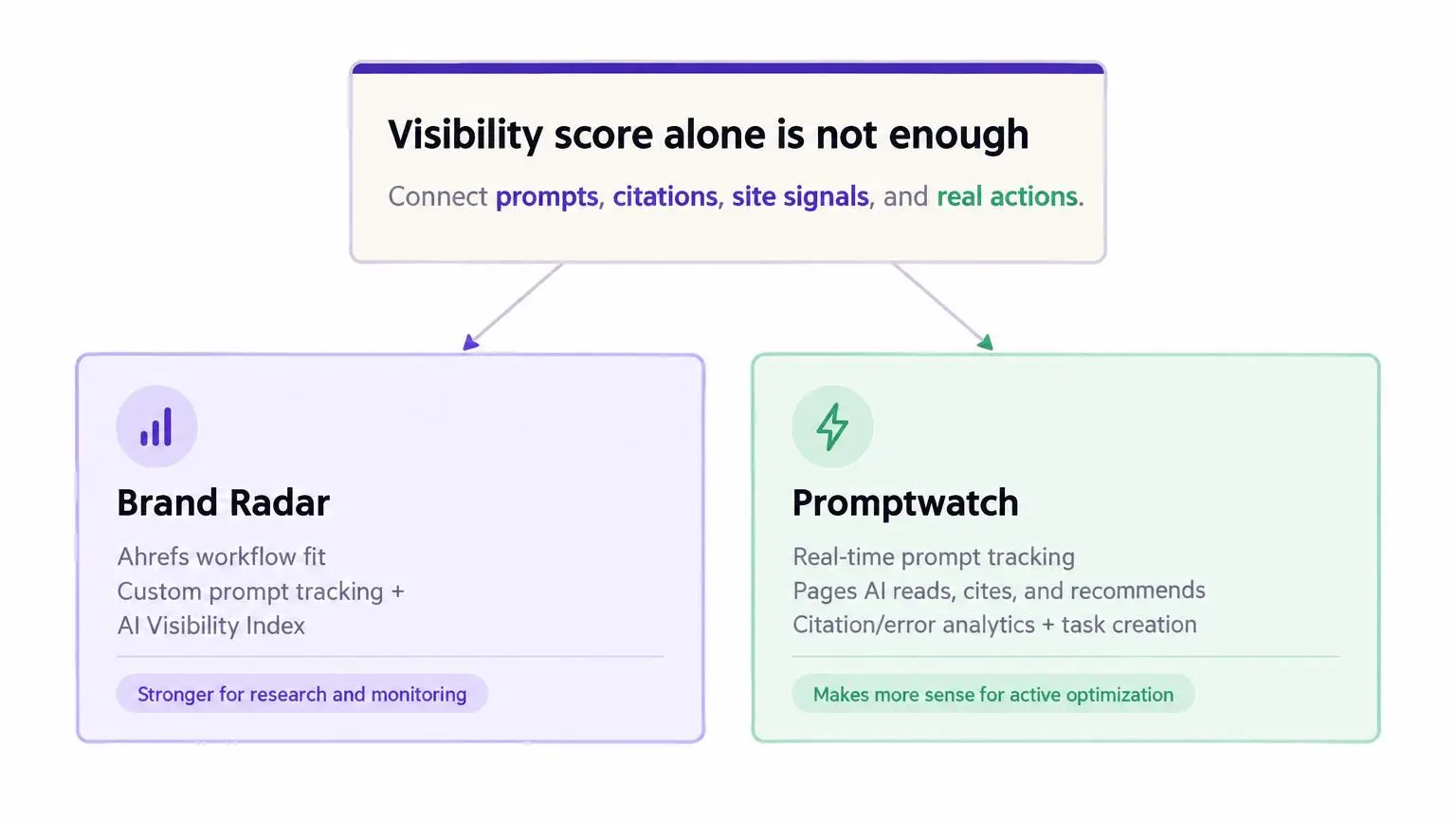
The good options connect prompts, citations, site signals, and real actions. For growing brands, ecommerce teams, SaaS companies, and agencies, that gap matters. A dashboard is not a plan.
We cut the noise and kept the platforms worth your attention.
Show 4 more productsShow fewer products
1. Brand Radar
- Fits naturally into Ahrefs workflows
- Tracks exact buyer prompt visibility
- Strong citation and competitor insights
- Uncovers related fanout content gaps
- Shows AI traffic and bot visits
- Lighter on built-in execution
- Best if you already use Ahrefs
- Visibility Index improves with presence
Brand Radar is a sensible pick if your team already lives in Ahrefs and wants AI search data without adding another entirely separate workflow. That matters more than people admit. Tool switching sounds minor until it quietly kills adoption by week two.
Ahrefs positions Brand Radar around two tracks:
- custom prompt tracking for the exact questions buyers ask
- an AI Visibility Index that lets you explore any brand's visibility across a very large prompt dataset with no setup
That split is useful because prompt tracking and broad visibility research are not the same job. One tells you how you show up for specific commercial questions. The other helps you sanity check whether your brand is appearing at all.
A few pieces stand out:
- prompt tracking is available from Ahrefs paid plans upward
- prompt ideas can be generated from competitor comparisons, pricing data, and other signals Ahrefs collects
- fanout query discovery helps surface the related questions AI systems generate behind the scenes
- visibility reporting includes mentions, competitor comparisons, citations, sentiment, and buyer journey stage
- AI analytics extend into traffic and bot visits, so you can see which pages AI systems already touch
That last part is easy to overlook. If a page is already attracting AI traffic or crawler attention, it may be faster to improve that page than create something net new. Good operators look for leverage first.
Where Brand Radar lands in practice is pretty clear. It's stronger as a research and monitoring layer than an execution layer. Compared with workflow-heavy options like AthenaHQ or Orchly, it leans more toward analysis than action. Compared with narrower AI monitoring tools, it feels more at home inside a broader SEO stack.
Use it when your team already trusts Ahrefs and wants an ai search optimization platform that fits familiar habits. If you need built-in task routing, approvals, or a tighter loop from insight to implementation, you'll probably want something more operational.
Good visibility data helps. It doesn't ship the fix.
2. Promptwatch

- Real-time prompt and citation tracking
- Shows which pages AI cites
- Fact-checks brand and pricing claims
- Turns findings into assignable tasks
- Flexible API, MCP, and agents
- Less suited to passive reporting
- Not a full traditional SEO suite
- Lighter on site architecture depth
Promptwatch is for teams that are tired of dashboards that stop at "interesting." It leans into real-time visibility, but it doesn't stop there. It tries to turn that visibility into work that actually gets done.
The platform focuses on:
- real-time prompt tracking, visibility score, and share of voice across major AI platforms
- page-level tracking for which pages AI reads, cites, and recommends
- citation analytics, error tracking, and optimization suggestions for indexing and visibility
- off-site mention tracking
- task creation for teams and AI agents
- agent, MCP, and API access for deeper operational workflows
The page-level angle is one of the more useful distinctions here. A lot of tools can tell you whether your brand shows up. Fewer can tell you which specific page is doing the work, or failing to. That's a much better starting point for content teams.
Promptwatch also puts weight on fact-checking what AI says about your brand, products, and pricing. That's not a side issue. In AI search, being mentioned inaccurately can be worse than being absent, especially if pricing or positioning gets distorted.
This platform makes more sense for active optimization than passive reporting. If your team is comfortable working from prompts, tasks, and integrations, it has a clear place. If you're looking for a classic SEO suite with this as one small tab, this isn't really that product.
Compared with Scrunch, it's less about site architecture and agent consumption. Compared with Brand Radar, it's more action oriented. That's the real distinction. Promptwatch is not just asking, "Are we visible?" It's asking, "What do we fix next, and who owns it?"
3. Scrunch

- Strong AI site readiness focus
- Optimizes pages for AI agents
- Useful agent traffic analytics
- Great for complex enterprise sites
- Supports product-level shopping visibility
- Heavier than lightweight trackers
- Less prompt ideation depth
- May be overkill for small teams
Scrunch takes a different view of the category. It is less obsessed with brand mentions alone and more focused on whether your site is actually usable for AI agents. For larger sites, that can be the smarter question.
Its product set includes:
The parts that matter most
- Agent Pages to deliver an optimized experience to AI agents
- Agent Traffic to analyze AI website traffic
- Site Optimization to improve how AI consumes your content
- Monitoring & Citations for visibility in AI answers
- Insights for growth recommendations
- Shopping for product-level AI search performance
- AI Search Trends for broader behavior patterns
Scrunch describes itself around making sites AI-ready so brands show up in answers, get cited, and grow revenue. That framing is more infrastructure focused than what you'll get from prompt-first platforms.
If you run a complex ecommerce catalog, a large documentation site, or a multi-layered enterprise property, this starts to make sense fast. AI visibility is often downstream of whether the system can parse your site cleanly. Plenty of marketers would rather discuss prompts than fix structure. The bots do not care.
Scrunch also explicitly serves enterprise and agency use cases. That's a clue about the depth and likely complexity. Smaller teams that just want lightweight prompt tracking may find it heavier than necessary.
Compared with Brand Radar or Promptwatch, it pushes further into AI experience on-site. Compared with Peec AI or Semrush's AI Visibility Toolkit, it is less centered on prompt ideation and reporting. It's a stronger fit when the site itself is the bottleneck.
If AI agents can't read the site properly, another reporting layer won't save you.
4. AthenaHQ
- Tracks 11+ LLMs and AI Mode
- End-to-end GEO workflow management
- Actionable content and citation recommendations
- Free tier eases initial evaluation
- Supports on-page and off-page actions
- Credit-based pricing complicates forecasting
- Overkill for passive reporting teams
- Needs clear ownership and process
AthenaHQ is closer to a full ai mode seo system than a simple monitoring tool. It covers visibility, recommendations, workflow, and action in one workspace, and it does that across a wide model set.
The platform says it tracks visibility across 11 or more LLMs, including AI Mode in paid coverage. That breadth matters if you're working across SEO, PR, content, and brand and don't want to optimize for one engine while missing the others.
Key areas include:
- end-to-end GEO workflow management
- prompt and response analysis
- sources and competitor insights
- automated content optimization recommendations
- citation source analysis and link building support
- content recommendations and an Athena AI agent
- on-page and off-page actions
- self-learning content improvement
- country-level support plus unlimited topics, prompts, and competitors on paid tiers
This is not a casual tool. It looks built for teams actively forming an AI search playbook, not just checking monthly visibility snapshots. That has upside, but it also means the buying decision should include operational maturity. More system usually means more setup, more process, and more need for ownership.
One practical plus is the free entry tier. Athena includes prompt analysis and competitor insights there, which is useful if you're validating the category before committing budget. On the other hand, credit-based usage and add-ons matter, so cost forecasting deserves a hard look before rollout.
Compared with Semrush's AI Visibility Toolkit, AthenaHQ is more workflow driven. Compared with lighter monitoring-first tools, it expects a team that's ready to act, not just observe.
5. Orchly

- Connects insights directly to execution
- Unifies Google, AI, Reddit visibility
- Prioritized tasks reduce manual triage
- Agent-drafted updates keep approvals
- Strong fit for lean teams
- Overkill for simple benchmarking
- Less technical than site-first tools
- Best for active optimization teams
Orchly is built for marketers who don't want another split between insight and execution. It tracks visibility across Google, AI answers, and Reddit, then tries to push the work into ranked tasks and draft changes your team can approve.
That handoff is the point.
The platform connects with Search Console, GA4, a CMS, and AI engine tracking. From there, it can surface gaps, prioritize them by value, and route them into agents for article writing, refreshing, translation, link enrichment, site health, and activation.
A few details make the product easier to place:
- it combines Google organic, AI search, and Reddit visibility in one workspace
- it suggests actions like page refreshes, schema updates, metadata fixes, and off-site citation work
- agents draft changes, but the team stays in control of approvals
That last part matters more than the marketing copy around "autonomous" anything. In real teams, automation without governance becomes cleanup work. Approval flow is not boring admin. It's how you avoid publishing something careless on a high intent page.
Orchly fits lean teams especially well because it reduces manual coordination. Instead of discovering issues in one tool, planning in another, and drafting fixes in a third, the workflow stays tighter. Compared with Brand Radar and Semrush's toolkit, it's far more execution oriented. Compared with Scrunch, it leans more into content operations than AI agent experience on the site itself.
If all you need is benchmarking, it may be more system than you use. But if the real problem is that your team knows what to do and still can't ship consistently, Orchly is aimed right at that bottleneck.
6. Peec AI

- Clear focus on visibility metrics
- Strong prompt and source analysis
- Useful competitor model comparisons
- Streamlined reporting and integrations
- Good fit for agencies and teams
- Limited technical site optimization
- Less automated execution depth
- May need separate production workflows
Peec AI feels more focused than many products in this category. That's not a small thing. A lot of teams don't need a giant ai mode seo platform. They need a clear view of prompts, sources, sentiment, and where to push next.
The platform is built around three core metrics:
- visibility
- position
- sentiment
From there, it expands into prompt discovery, competitor comparison across selected AI models, and source analysis so you can see which citations shape performance. It also surfaces recurring source patterns like review sites, LinkedIn, Reddit, and editorial domains, then turns those into strategy recommendations.
There is a practical sharpness to that setup. It helps teams answer questions like:
Where Peec AI earns its keep
- Which prompts actually matter?
- Which sources keep appearing in answers?
- Are we being framed well or badly?
- Which competitor is winning the citation layer?
Peec AI also supports reporting plus integrations with Google Workspace, Slack, Zapier, MCP, and API workflows. That makes it more flexible than a static reporting dashboard without pushing fully into a workflow engine.
Compared with broader suites, it is more streamlined. Compared with Scrunch, it's lighter on technical site optimization. Compared with Orchly, it's lighter on automated execution. That's fine if your team already has production systems and mainly needs sharper signal.
This is a good fit for agencies and in-house marketers who want a platform for ai mode rankings without drowning in extra surface area. Sometimes the best tool is the one your team will still be using after the first burst of curiosity wears off.
7. AI Visibility Toolkit
- Fits existing Semrush workflows well
- Strong prompt and competitor research
- Tracks AI Mode daily
- Useful AI bot site audits
- Presentation-ready stakeholder reporting
- Limited built-in execution tools
- Better for research than action
- Most valuable for Semrush users
Semrush's AI Visibility Toolkit makes the most sense for teams that already operate inside Semrush and want AI search reporting to sit next to the rest of their SEO planning. It is less about execution and more about structured research, monitoring, and reporting.
The toolkit includes:
- Visibility Overview with an AI Visibility Score
- competitor research for gaps and missing citations
- prompt research with topic-level volume, difficulty, and user intent
- brand performance reporting for share of voice, sentiment, and narrative analysis
- daily prompt tracking for Google AI Mode and ChatGPT
- regional visibility analysis
- AI Search Site Audit for technical blockers affecting AI bots
- presentation-ready reporting
That mix will feel familiar to SEO teams. In a good way. If your team already thinks in terms of topics, intent, competitive gaps, and reporting cadences, this ai search optimization software fits cleanly into that motion.
It is also explicitly positioned for marketers, agencies, SMBs, and mid-market teams adapting to AI-driven search. So while it has useful depth, it isn't only for enterprise specialists.
The limitation is also obvious. This is more audit and reporting driven than action driven. If you want a platform that turns findings into briefs, approvals, or implementation work, you'll still need another layer. Compared with Promptwatch or Orchly, it stays closer to research.
| Brand Radar | Promptwatch | Scrunch | AthenaHQ | Orchly | Peec AI | AI Visibility Toolkit | |
|---|---|---|---|---|---|---|---|
| Research/reporting-first positioning | ✓ | × | × | × | × | ✓ | ✓ |
| Built-in workflow/action layer | × | ✓ | × | ✓ | ✓ | × | × |
| Site AI-readiness as a core focus | × | × | ✓ | × | × | × | × |
| Citation/source analysis | ✓ | ✓ | ✓ | ✓ | ✓ | ✓ | ✓ |
| Prompt-centric research as a core capability | ✓ | ✓ | × | ✓ | ✓ | ✓ | ✓ |
How to Choose the Right AI Search Optimization Platform
Most teams don't have a tooling problem first. They have a bottleneck problem. If you solve the wrong one, the platform will look disappointing even when the product is fine.
Start by sorting your need into one of four buckets:
Research first
You need prompt discovery, competitor gaps, share of voice, and topic insight.Monitoring first
You need citations, mentions, sentiment, and narrative accuracy.Optimization first
You need better technical accessibility and stronger AI agent consumption of the site.Workflow first
You need findings to become tasks, content updates, approvals, and shipped changes.
Then pressure test the shortlist against a few practical questions:
- Does it track the models that matter to your pipeline, including AI Mode if that's a priority?
- Can it discover prompts, or only track prompts you've already thought of?
- Is citation analysis shallow or genuinely useful?
- Does it show page-level AI engagement, or only brand-level visibility?
- Can it support content, on-page, or off-page action?
- Will your stakeholders actually understand the reporting?
- Are approval controls clear enough for your team?
If you already know what to fix, buy execution depth. If you don't know where you're visible or invisible, buy better research and monitoring first. And if AI bots struggle to interpret your site, site readiness matters more than another dashboard.
What Matters Most in an AI Mode SEO Platform
A traditional SEO tool mostly answers, "Where do we rank?" An ai mode seo platform has to answer something harder: "How are we being interpreted, sourced, and described?"
That's a different standard.
Judge these tools on:
- prompt-level visibility, not just ranking-style summaries
- source quality, not raw mention counts
- narrative accuracy around your brand, pricing, and positioning
- model-by-model breakdowns, because engines do not behave the same way
- AI crawler and agent accessibility
- whether the product helps turn findings into actual work
There are tradeoffs. More model coverage usually means more complexity. More automation only helps if approval flow stays clean. More reporting is useless if nobody can prioritize from it on Monday morning.
The strongest ai mode seo system doesn't just tell you where you stand. It helps you decide what changes next. That's the line buyers should care about.
When You Need an AI Mode Content Platform Instead of Basic Monitoring

Some teams are past the "show me the dashboard" stage. They know the prompts. They know the gaps. They are still not shipping enough. That's when basic monitoring stops being enough.
You're probably there if:
- refreshes happen late and rankings drift before anyone reacts
- technical fixes sit in a backlog
- AI search, Google, and off-site mention data live in different tools
- reporting looks polished but customer acquisition impact stays fuzzy
The workflow shift is simple on paper and hard in practice:
- research reveals real demand
- visibility data shows where you're missing
- recommendations become tasks
- publishing and refresh cycles keep momentum from slipping
This is where we think a lot of teams make the same mistake. They buy visibility software when they actually need an ai mode content platform or a broader execution system. Insight without output becomes another weekly meeting.
At Intelliminds, that's exactly how we think about the problem. Sustainable growth usually comes from a tighter operating system: automated keyword research, article production, CMS publishing, and content refreshing, with a human still in the loop. The AI part removes drag. It shouldn't remove judgment.
Early-stage teams can start with research and monitoring. Growing teams often need a blended system with approvals and execution support. Larger organizations may split visibility, technical readiness, and governance across separate layers.
Conclusion
The best ai search optimization platform depends less on hype and more on where your team gets stuck right now.
Brand Radar and AI Visibility Toolkit fit research-oriented SEO workflows. Promptwatch and Peec AI fit marketers who want prompt, citation, and narrative visibility with clearer action paths. Scrunch fits teams treating AI agents and site experience as a serious operational layer. AthenaHQ and Orchly fit teams that want a more complete ai mode seo system with deeper workflow support.
Here's the practical next step:
- list the prompts and models that matter to your pipeline
- decide whether your real gap is visibility, execution, or AI site readiness
- shortlist two or three tools based on that gap
- compare how each one supports the full path from insight to action
That's the part that decides whether the software helps or just looks busy.
Article Record
ReferencesPrimary sources used for this article
- Ahrefs Brand Radar: Study your brand's AI visibility
- Plans & Pricing | Action on AI Search
- OtterlyAI's knowledge habitat 🦦
- AI Search Monitoring Tool: Track ChatGPT, Perplexity & Google AIO
- AI search analytics for marketing teams
- Pricing for Brands
- Make OpenAIOpenAI AI searchyour next revenue channel
- Turn AI search into growth
- SE Visible: AI Visibility Platform by SE Ranking
- SE Visible FAQ - Knowledge Base - SE Ranking
- AI Visibility Toolkit: Boost Brand Visibility in AI Search
- AI Visibility Toolkit Pricing | Semrush
- The AI Platform to Power Your Marketing | Profound
- The Complete AEO Platform | Profound
- Pricing | Profound
- Scrunch home
- What is Orchly? The AI search visibility platform
- Orchly AI Pricing: Plans for AI Search Visibility
- What is Dageno? (/)
- Dageno Pricing | Plans and Features