
Most teams treat seo traffic forecasting like a search volume sheet. Then the plan misses because big terms never turn into clicks or rankings.
What matters is a forecast you can defend: rank ranges, CTR, timing, and whether the topic can drive signups or sales. That gives you a content plan you can actually trust.
Start here:
- Model pages, not single keywords.
- Forecast ranges, not one neat number.
- Split new content from refreshes.
What SEO Traffic Forecasting Actually Tells You
SEO traffic forecasting is the process of estimating future organic performance before you publish. It pulls together keyword demand, likely rankings, click behavior, your site’s current strength, and, if you have it, conversion or revenue data. Done well, it helps you decide where content effort is likely to pay off and where it probably won’t.
A lot of teams confuse estimates with forecasts. They’re not the same.
- Traffic estimates give you a static snapshot of opportunity right now.
- Forecasts model what could happen over time under specific assumptions.
That difference matters more than most teams admit. A keyword with 4,000 monthly searches is not a forecast. It’s a data point. The forecast starts when you ask questions like:
- Can our site realistically rank for this in 6 months?
- Would a single page capture traffic from a broader cluster?
- How many clicks might positions 3 to 5 actually generate on this SERP?
- Would that traffic likely produce leads, signups, or sales?
A strong forecast helps brands and agencies answer practical planning questions, not just SEO questions. Which topics should move to the top of the calendar. How much traffic a new article or cluster might generate. Whether the upside justifies the writing, review, and publishing time.
Good forecasting doesn’t predict the future. It filters bad bets before they become expensive.
The mindset shift is simple. Stop treating content like a list of tasks. Start treating it like a portfolio of bets with different upside, speed, and confidence.
Why Most Content Plans Miss Their Traffic Goals
Most content plans fail before the first draft is written. The usual pattern is familiar: export a keyword list, sort by volume, fill a calendar, hope publishing creates momentum. It feels organized. It’s often fantasy.
Search volume on its own is one of the easiest ways to fool yourself.
It doesn’t tell you how many clicks organic results will actually get. It ignores whether a SERP is crowded by ads, snippets, AI summaries, video blocks, local packs, or shopping features. It says nothing about whether your page can rank for a wider set of related queries, which is where a lot of page-level traffic really comes from.
Then there’s the competitive check that teams skip because it’s slower and less comfortable. You have to look at the pages already winning.
- How strong is your domain relative to the current top results?
- Are you up against major publishers, marketplaces, or niche specialists?
- Do those ranking pages have link profiles you’re unlikely to match quickly?
- Is the first page full of a different content format than the one you planned?
Keyword tools help model demand. They do not measure your future traffic with precision. Volume numbers are often rounded. Trend shifts lag. Seasonality gets flattened into averages. By the second afternoon of planning, those soft edges can turn into very hard promises.
And there’s pressure. Leadership wants ROI before content ships. Clients want numbers they can repeat internally. You need an answer, but not a made-up one.
Forecasting helps because it forces every topic through a more honest opportunity model.
The Two Forecasting Approaches That Matter Most
There are two main ways to handle content growth projections, and the right one depends on the decision in front of you.
Keyword-based forecasting
This is usually the better fit when you’re planning net-new content.
Use it when:
- your site has limited traffic history
- you’re launching new articles or clusters
- you’re entering new categories, services, or products
- past traffic can’t guide an emerging keyword set
It’s useful because it starts with opportunity at the query and topic level. The catch is that it depends heavily on ranking and CTR assumptions, which is exactly where weak models go off the rails.
Historical or statistical forecasting
This works better when a site already has a stable organic baseline and enough history to model trends. As a rule, 24 months of monthly data gives you something worth trusting.
It’s better for:
- seasonality
- year-over-year comparisons
- expected baseline growth
- understanding how fast your site usually matures content
But historical models get weaker when you try to use them for brand-new topic areas. Past performance can’t tell you much about traffic from a category you’ve never seriously covered.
The mature answer is usually a blend. Use keyword-based forecasting to model upside for new pages. Use historical data to reality-check ramp speed and growth pace. Strong teams don’t pick one method forever. They pick the method that matches the decision.
The Inputs Behind a Useful Forecast
A forecast is only as credible as its inputs. If the assumptions are loose, the output will look precise and still be wrong.
At minimum, you need:
- monthly search volume for the main query and close variants
- a current or assumed ranking position
- a realistic CTR curve by position
- a view of how competitive your site is relative to current winners
- timeline assumptions for indexing, movement, and maturity
- conversion metrics if you want business impact, not just visit projections
Search demand should never be treated as one flat monthly number. Check the 12-month trend. Some topics spike around launches, budgets, hiring seasons, or holidays. Averages hide this.
Ranking assumptions need even more discipline. For a new page, don’t pretend it starts on page one. Most don’t. Use conservative starting points and group keywords by ranking potential, not just topic similarity.
CTR is where many models become quietly dishonest. Position one does not get all the clicks. In some SERPs, it doesn’t even get most of the valuable ones. Layout matters. Intent matters. Modules steal attention.
Competition inputs deserve manual review. Keyword difficulty scores are directional. They are not verdicts. Open the SERP and look at what’s there. Marketplaces, giant publishers, mixed intent, product pages when you planned a blog post. That tells you more than a single number.
If you have conversion rate, lead-to-customer rate, average order value, or contract value, bring them in. Traffic without business context is still only half a forecast.
How to Forecast Traffic From SEO Content at the Article Level
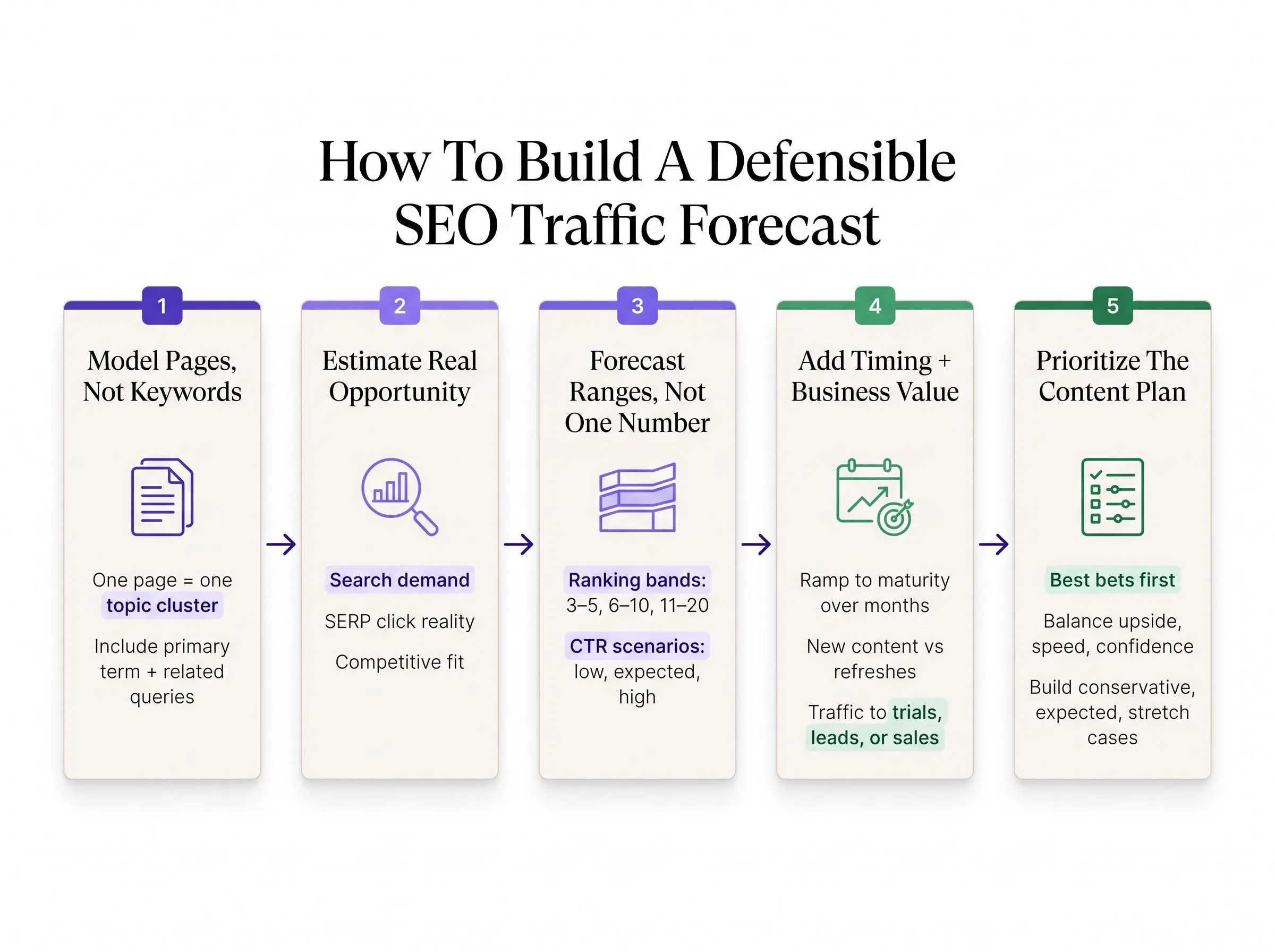
This is where forecasting gets practical. You don’t need a giant model to predict organic traffic from articles. You need a believable one.
Here’s the process we use.
Choose the topic and keyword cluster.
Start with one primary keyword and the related queries a single page could reasonably rank for. Forecast the page, not just the headline keyword.Estimate realistic demand.
Pull search volume for the main term and supporting variants. Then adjust for seasonality or trend direction if the topic is climbing, flat, or fading.Set a ranking band.
Use ranges like positions 3 to 5 or 6 to 10. Exact rank predictions look confident and usually aren’t.Apply a CTR model.
Convert ranking ranges into expected clicks. Build low, expected, and high cases. SERP uncertainty is real, so model it.Add a ramp timeline.
Month 1 and 2 might only show indexing and early impressions. Competitive terms climb slower. Newer sites usually need a longer runway.Translate traffic into business impact.
Estimate leads, demos, trials, purchases, or assisted conversions depending on the business model.
A simple example is enough. Say a topic cluster has 1,800 combined monthly searches. You believe the page can reach positions 4 to 6 after 6 months. If that ranking band earns roughly 5 to 8 percent CTR on that SERP, the mature monthly click range might land around 90 to 144 visits. If your organic visit-to-trial rate is 2 percent, that’s roughly 2 to 3 trials a month from one article at maturity.
That’s not perfect. It doesn’t need to be.
The goal is not precision to the decimal. The goal is deciding whether Article A is a better bet than Article B.
How to Build Content Growth Projections Across a Whole Content Program
Single-article forecasts are useful. Program-level forecasting is where planning gets sharper.
Once you zoom out, your calendar stops looking like a pile of topics and starts acting more like a portfolio. Some content is built for faster wins. Some builds topical depth. Some takes longer but has bigger commercial upside.
A practical traffic model for blog strategy usually groups planned content into tiers:
- quick-win topics with lower difficulty
- mid-term cluster pieces that reinforce authority
- strategic high-intent pages with slower but larger upside
- refreshes for older pages already near page one
Then forecast by quarter, not just by article. Count how many pages you expect to publish in each tier. Assign average traffic ranges to each group. Layer in timing so content published in month one has more maturity by quarter end than content published in month three.
This also helps expose tradeoffs you can actually act on:
- fewer high-value topics or more lower-difficulty topics
- new pages or refreshes
- head terms or long-tail clusters
Growth does compound when more pages rank, internal links improve, and coverage deepens. But teams exaggerate this all the time. Compounding is real. So is drag from production delays, indexing lag, and weaker-than-expected rankings.
Scenario planning helps keep the model honest:
- Conservative case for buy-in
- Expected case for operations
- Stretch case for upside discussions
How to Forecast Rankings and Clicks Without Fooling Yourself
Ranking forecasts usually fail for one reason. Teams assume that publishing a strong article means top-three visibility will follow. It might. It often doesn’t.
A grounded forecast starts with comparison. Look at your site and the sites already winning. Compare authority, content depth, internal linking, and intent match. If the SERP clearly favors category pages or tools, a blog post may never be the right vehicle no matter how polished it is.
Use ranking bands instead of single positions:
- positions 1 to 3 for strong opportunity
- positions 4 to 10 for partial visibility
- positions 11 to 20 for near-page-one upside
Then pressure-test CTR by query type. Branded terms behave differently from informational terms. Visual SERPs and AI-heavy results can drag click share down even when rankings improve. A Pew Research Center analysis of U.S. Google searches found that traditional-result clicks were 8% on visits with an AI summary, versus 15% without one.
Share of Google search visits that led to a click on a traditional search result in Pew Research Center’s March 2025 U.S. browsing-panel analysis.
Sources
Pew Research Center, March 2025 browsing-panel analysis.
- Pew’s analysis covers tracked browsing behavior from 900 U.S. adults during March 2025, not all users or markets.
- The comparison is observational; AI summaries may appear more often for query types that already have different click behavior.
- The result measures clicks from Google visits, not a position-specific CTR curve.
| Search-result condition | Traditional-result click rate |
|---|---|
| AI summary present | 8% |
| No AI summary | 15% |
For forecasting, this is a reason to apply a separate CTR assumption to query groups that commonly trigger AI summaries rather than using one sitewide position-to-click curve. The same study found that only 1% of visits with an AI summary produced a click on a source link within that summary, so a citation should not be treated as a substitute for forecastable referral traffic.
The better lens is usually page-level traffic potential. A good page doesn’t win because it ranks for one exact phrase. It wins because it captures many related queries around a clear search intent.
Realism is not pessimism. It’s how in-house teams and agencies keep trust when the numbers get examined.
The Forecasting Variables That Change by Business Type
Not every business should forecast the same way. The model needs to reflect how value is actually created.
For SaaS, informational and comparison content may drive trial or demo conversions, but not at the same rate. Ecommerce teams have to deal with seasonality, category swings, and SERPs shaped by product modules. Service businesses often care less about raw traffic and more about high-intent, lower-volume keywords, sometimes shaped by geography.
Agencies have a separate problem. The assumptions need to be clear enough for clients to challenge. If your forecast only works when nobody asks questions, it’s not a forecast.
A few variables shift by business type:
- conversion rates from blog traffic
- time to value from top-of-funnel versus bottom-of-funnel pages
- content decay and refresh frequency
- the role of authority content versus direct acquisition content
International forecasting adds another layer. Keyword demand, click behavior, and competition can change sharply by country. Copying one market’s model into another is lazy, and it usually shows up later.
Turning Forecasts Into a Smarter Editorial Plan

Forecasts should change what gets published, not just what ends up in a deck.
The useful move is to prioritize topics using a mix of upside, confidence, speed, and strategic value. A simple scoring framework often works better than a complicated one:
- traffic potential
- ranking difficulty
- business relevance
- time to likely impact
- refresh versus create
A strong calendar balances short-term wins with long-term authority building. Lower-competition pieces can create visible movement faster. Bigger cluster pages may take longer, but they often create the compounding effect everyone wants later.
There’s an operational truth here that gets missed. Publishing volume only matters if the opportunity quality is strong and the workflow can keep up. Research, writing, review, approval, and publishing all create drag.
This is where tools can help without replacing judgment. If you already know what deserves production, Intelliminds SEO Automation Software can support execution by automating keyword and topic research, article production, CMS publishing, and content refresh workflows while keeping human approval in the loop. That matters when your forecast is solid but your team is bottlenecked.
Revise the editorial plan monthly. Forecasts should tighten as ranking and click data comes in.
The Tools and Data Sources That Make Forecasts More Defensible
You don’t need one perfect platform. You need defensible inputs from a few reliable sources.
The main categories are straightforward:
- first-party search and analytics data
- third-party keyword and competition tools
- spreadsheet or model-based forecasting systems
Search performance data helps you understand content performance through current CTR, page-level query spread, and which URLs are already close to page one. Analytics connects traffic to engagement, conversions, and revenue. That’s where forecasting stops being interesting and starts becoming useful.
Third-party tools are still valuable for:
- search volume and trend direction
- keyword clustering
- difficulty signals based on top-ranking pages
- page-level traffic potential
Forecasting models matter most when they show uncertainty instead of hiding it. That’s especially true for seasonal businesses or plans with a 12 to 24 month horizon.
When evaluating tools, look for:
- fresh enough data
- keyword clustering ability
- visible CTR assumptions
- custom conversion inputs
- exports or reporting that stakeholders can actually read
Common Forecasting Mistakes That Distort Content Decisions
Experienced teams still get this wrong. Usually not because they lack data, but because they rush the assumptions.
Common mistakes show up fast:
- forecasting one keyword per page and missing topic-level traffic
- assuming all search volume turns into clicks
- ignoring seasonality, trend shifts, or SERP features
- treating keyword difficulty like certainty
- forecasting top-three rankings without comparing yourself to the pages already there
- using historical models for brand-new topics with no precedent
- using only keyword-based models when strong historical data exists
- presenting one optimistic number instead of a range
- forgetting review cycles, indexing lag, and CMS bottlenecks
- judging success too early, before content has matured
A pattern we see often is that the spreadsheet looks sharper than the strategy. The fix is simple, even if it’s not fun: make your assumptions visible, add a failure case, and review the live SERP before the forecast gets socialized.
That’s a credibility move, not a limitation.
From Forecast to Execution, Measurement, and Refresh
A forecast only creates value when it feeds an operating loop. Publish, measure, adjust, refresh.
The rhythm doesn’t need to be complicated:
- publish based on priority and capacity
- monitor indexing and early impressions
- track ranking movement and CTR shifts
- refresh pages that stall, decay, or miss forecast
Refreshing deserves its own place in the model. In many programs, updating an existing page can produce faster gains than publishing a brand-new article. The ramp profile is different, so forecast refreshes separately.
For a basic execution check, the Google Index Checker can help verify whether new or updated URLs are indexed before the team starts diagnosing ranking issues that may just be visibility delays.
If consistent output is the bottleneck, Intelliminds SEO Autoblogger can help support a forecast-prioritized plan by handling keyword research, article generation, linking, images, and controlled scheduling to your CMS with approval control. That’s operational support, not strategy in a box.
Forecasts should behave like living models. If the site proves something new, the model should change.
Compare predicted clicks to actual clicks. Adjust your CTR curves. Rework ranking assumptions. Let the site teach you what it can now earn.
Conclusion
SEO traffic forecasting is not about certainty. It’s about making smarter bets on topics, timelines, and expected return before the work gets expensive.
The framework is practical:
- choose the forecasting method that fits the decision
- use realistic inputs
- model ranges instead of fantasies
- turn projections into a prioritized editorial plan
- learn from actual performance and refresh accordingly
If you want a useful next step, don’t start with a giant annual model. Forecast the next 10 planned articles or refresh candidates. Build expected, conservative, and stretch cases. Then decide what actually deserves production effort this quarter.
That’s when content planning starts to feel less like guessing and more like operating.
Article Record
ReferencesPrimary sources used for this article
- Google users are less likely to click on links when an AI summary appears in the results
- How to Do Realistic SEO Forecasting Step-by-Step (+ Template)
- SEO Forecasting Methods with Examples [+ Free Template]
- Keywords Explorer by Ahrefs: Find Winning Keyword Ideas. At Scale.
- SEO Forecasting Tool | seoClarity
- How to Forecast SEO Traffic Before You Commit to a Content Plan - Lilach Bullock | AI Implementation Consultant
Update HistoryMeaningful revisions to this article
- Added a chart showing how often users clicked traditional Google results with and without an AI summary.
- Made search traffic forecasts easier to understand by illustrating the difference in click behavior.