
Picking a Surfer SEO competitor gets messy fast. Most teams compare content scores and miss the real issue: how much manual work still sits between research, writing, publishing, and updates.
The good options don't just grade pages. They help your team move faster without turning every article into a 14-tab process (been there). That's what separated the keepers from the tools we cut.
These are the options worth your attention.
1. Intelliminds

- End-to-end content workflow automation
- Handles research through publishing
- Supports content refreshing at scale
- Built for brands and agencies
- Reduces manual handoffs significantly
- More system than casual optimizers need
- Less ideal for occasional edits
If you're looking for a surfer seo competitor because Surfer feels too narrow, this is usually the fork in the road. Some teams need a better editor. Others need the whole content machine to stop relying on spreadsheets, handoffs, and follow-up Slack messages.
Intelliminds is built for the second group. We handle topic research, article writing, publishing, and content refreshing as one operating system, not four disconnected tasks. That changes the buying decision more than most teams expect.
A lot of platforms help you improve a draft. Fewer help you consistently produce the right draft, get it live, and keep it current without adding headcount. That's the real gap for growing brands.
Compared with Frase or Scalenut, our lane is broader and more operational. Compared with Clearscope or NeuronWriter, we're not just solving optimization inside the editor. We're solving throughput. For ecommerce, SaaS, agencies, and lean in-house teams, that's often the bottleneck hiding in plain sight.
Content output isn't the goal. Pipeline, signups, leads, and sales are.
The main consideration is simple. If you only want a lightweight optimizer for occasional manual edits, this is more system than you need. If you want an automated seo content workflow, that's where we fit.
2. Frase

- Fast SERP-to-brief workflow
- Strong structure for writers
- Reduces tool switching early
- More than a simple grader
- Publishing still needs other tools
- Limited full-lifecycle automation
- Can outgrow editorial-only workflows
Frase is one of the more credible surfer seo alternatives for content automation because it tightens the path from SERP research to brief to draft. That matters when your team loses time before writing even starts.
Its center of gravity is editorial execution. You pick a topic, pull research, shape a brief, and move toward a usable draft without bouncing across tools. In practice, that makes Frase feel more workflow-oriented than Surfer, which is why many teams compare them directly.
It also tends to make more sense than a pure grader if your writers need structure, not just a score. Clearscope is sharper as a focused optimization layer. Frase gives you more motion upstream.
Where teams need to be careful is assuming that research-to-draft is the whole system. It rarely is. Publishing, governance, and refresh work still exist after the article is written, and those steps can become the next bottleneck by the second month.
3. Clearscope

- Clear optimization guidance for writers
- Dependable grading supports consistency
- Low-friction editor fits existing workflows
- Strong quality control for teams
- Limited end-to-end automation
- Less strategic planning depth
- Best with workflows already established
Clearscope stays in the conversation because it does one job with a lot of discipline. If your team already has writers, briefs, and publishing handled, a dedicated content optimization alternative can be exactly the right answer.
This is less about content automation and more about editorial quality control. The value is in clear guidance, dependable grading, and an interface that doesn't create extra friction for writers. That's why teams with established workflows often prefer it over broader, messier platforms.
Relative to Surfer, the comparison sits squarely in the editor-and-score use case. Relative to MarketMuse, Clearscope is less about portfolio strategy and more about improving the article in front of you today.
A practical point: mature teams often don't need another content engine. They need consistency across many writers. Clearscope fits that reality well. If you're trying to automate research, writing, publishing, and refresh together, it won't carry that whole load.
4. MarketMuse

- Strong topic gap discovery
- Useful cluster planning guidance
- Helps prioritize content opportunities
- Supports authority-focused content strategy
- Less focused on draft speed
- Better for mature content teams
- Can feel heavy for lean teams
MarketMuse belongs on this list for a different reason. It isn't mainly about speeding up one article. It's about deciding what deserves to exist in the first place.
For SEO teams thinking in clusters, authority, and coverage gaps, that's a meaningful shift from Surfer. You stop asking only, "How do we optimize this page?" and start asking, "What are we missing across the site?"
That makes it more strategy-oriented than Clearscope and less drafting-centered than Frase. If planning and prioritization are the bottleneck, MarketMuse can be the smarter move than another editor-first tool. We've seen teams spend weeks producing content efficiently, only to realize they were efficiently publishing the wrong topics.
It's usually a better fit for mature content operations than lean teams trying to ship faster next week. Planning depth is valuable, but only if your team can act on it.
5. Scalenut

- All-in-one research-to-draft workflow
- Built-in optimization during writing
- Reduces tool switching for teams
- Good fit for lean marketers
- Can feel redundant in mature stacks
- Less focused than specialist optimizers
- All-in-one approach may not suit all
Scalenut is one of the stronger surfer seo alternatives for content automation because it tries to cover the full research-to-draft-to-optimize path in one place. For startups and lean teams, fewer handoffs can matter more than feature depth.
The appeal is straightforward:
- research and writing sit closer together
- optimization is part of the creation flow
- you don't need as many separate tools to get an article moving
That makes it a more creation-supportive option than Surfer for buyers who don't want optimization alone. It also compares naturally with Frase, since both are workflow-first rather than purely editor-first.
The real decision is whether you want an all-in-one content engine or a specialized optimization layer paired with other systems. Scalenut is attractive when speed and consolidation matter. If your team already has strong workflows elsewhere, a broader platform can feel redundant.
6. Semrush

- Broad SEO toolkit in one place
- Strong keyword and competitor research
- Reduces vendor and tool sprawl
- Useful for in-house SEO teams
- Less focused on content automation
- Won't solve writing throughput alone
- Specialists may offer deeper optimization
Semrush is a strong surfer seo competitor when your real need is broader than content optimization. A lot of buyers start with Surfer and then realize the actual problem includes keyword research, competitive analysis, and wider SEO operations.
That's where Semrush makes sense. It can replace pieces of a fragmented stack for in-house teams managing more than content. If your SEO lead also owns research, reporting, and competitor tracking, having one vendor for multiple jobs can be cleaner than stitching together specialists.
Compared with Ahrefs, it's another broad-suite decision. Compared with Frase or Scalenut, it's less centered on content workflow automation. That distinction matters. A suite can reduce tool sprawl without reducing editorial workload.
Teams sometimes buy a broad platform hoping it will quietly solve production. It usually doesn't. Semrush is a strong operational choice when SEO breadth is the requirement, not when writing throughput is the pain.
7. NeuronWriter

- Budget-friendly optimization guidance
- Good for article refinement
- Useful Surfer-style content scoring
- Fits startups and small agencies
- Limited beyond optimization workflows
- Manual process still required
- Teams may outgrow it
NeuronWriter is a practical pick for smaller teams that want Surfer-style optimization guidance without paying for a much broader platform. It earns its place by being more accessible, not by pretending to be everything.
For startups, solo operators, and budget-conscious agencies, that can be enough. If the main job is improving article coverage and relevance, a narrower optimizer often does the job just fine.
Here's where it tends to fit best:
- article refinement is the core problem
- your workflow is still mostly manual
- you don't need strategy, publishing, or refresh automation yet
Against Surfer and Clearscope, it's the more cost-conscious lane. Against Frase, it's less about workflow and more about the optimization layer itself.
That last part is the tradeoff. Teams can outgrow it once the challenge shifts from "make this piece better" to "run the whole content operation with less manual work."
8. Ahrefs
- Strong backlink and keyword data
- Broad site-level SEO visibility
- Useful competitor research workflows
- Good fit for SEO-led teams
- Less focused on content optimization
- Not automation-first for writing
- Can feel broader than needed
Ahrefs is only a surfer alternative in a specific kind of buying process. Usually, the buyer isn't really choosing between two editors. They're choosing between a specialized optimizer and a broad SEO intelligence platform.
If backlinks, keyword discovery, competitor research, and site-level analysis matter as much as article optimization, Ahrefs deserves serious consideration. It gives SEO-led teams stronger search data and wider context than content-first tools.
That's why it often gets compared with Semrush more than with Surfer in real buying conversations. Against Clearscope, NeuronWriter, or Surfer, it's simply solving a larger and different problem.
A good operator question here is blunt: are you trying to improve pages, or are you trying to run search more effectively overall? If it's the second one, Ahrefs becomes more logical. If it's the first, it can be more platform than process.
9. SE Ranking

- Broader SEO suite coverage
- Useful rank tracking and reporting
- Practical for agencies and teams
- Supports multiple SEO workflows
- Less focused on content optimization
- Not ideal for deep automation
- Shallower than larger SEO suites
SE Ranking sits in the middle ground. Some teams want broader SEO functionality than Surfer provides, but they don't want the weight, cost, or complexity of heavier enterprise suites.
That's where SE Ranking is relevant. It supports rank tracking, general SEO operations, and content work in a way that can suit agencies and in-house teams juggling multiple responsibilities. It's not the specialist's specialist, but it can be operationally practical.
Compared with Semrush or Ahrefs, it's another broad-suite option with a different level of depth. Compared with Surfer or NeuronWriter, it isn't as narrowly focused on content optimization.
That makes the decision pretty clear. If your team wants one platform for multiple SEO motions, SE Ranking is a sensible short list candidate. If content automation is the actual goal, Frase, Scalenut, or Intelliminds will usually be closer to the problem.
10. BrightEdge

- Strong enterprise governance controls
- Cross-team reporting and visibility
- Built for large SEO programs
- Handles complex stakeholder workflows
- Overkill for smaller teams
- Less focused on editor optimization
- Enterprise complexity raises adoption time
BrightEdge enters the picture when Surfer feels too small for the organization, not just too limited for the workflow. That's an important distinction.
Larger companies tend to care about governance, reporting, visibility across stakeholders, and formal SEO operations. BrightEdge is relevant in that environment because content isn't managed by one person with a draft in an editor. It's managed across teams, approvals, priorities, and performance expectations.
Compared with MarketMuse, it's another strategic option. Compared with Semrush or Ahrefs, it belongs in the broader SEO platform conversation. What changes here is scale and organizational complexity.
Small teams often underestimate how quickly coordination becomes the real cost. Enterprise buyers already know. BrightEdge makes more sense when that coordination problem is bigger than the optimization problem.
11. Byword

- Strong for programmatic content scale
- Publishes high page volumes quickly
- Useful for long-tail SEO campaigns
- Reduces manual drafting bottlenecks
- Limited editor-first optimization depth
- Needs extra governance systems
- Weak fit for brand-sensitive workflows
Byword is a different kind of surfer seo competitor. It matters most for teams trying to publish a high volume of pages, especially in long-tail or programmatic SEO programs.
The point isn't editor-based refinement. The point is production at scale. If your bottleneck is getting many pages live, Byword can make more sense than a tool built around manually improving one article at a time.
It lines up naturally against Koala Writer on the scale-first side, and against Frase or Scalenut as a more programmatic path. That difference isn't minor. It changes how your team works day to day.
Still, volume creates its own problems. Brand consistency, strategic prioritization, and refresh discipline don't disappear just because pages are easier to generate. Teams using Byword often need other systems around it if they care about governance or deeper optimization.
12. Koala Writer

- Fast article drafting workflow
- Simple for lean teams
- Good fit for solo publishers
- Low operational overhead
- Useful for volume-focused production
- Limited research workflow depth
- Thinner optimization guidance
- Less suited to larger teams
Koala Writer fits lean teams that need fast article production without turning content into a full operating system. Sometimes that's enough. Sometimes it's exactly the right level of complexity.
For solo operators, affiliate publishers, and small teams, the appeal is speed and simplicity. You can replace a lot of manual drafting effort without buying into a larger workflow platform. As an ai seo writing platform, it's lighter-weight by design.
Compared with Byword, it's still volume-oriented, but often in a more straightforward drafting context. Compared with Frase or Scalenut, it offers less workflow depth around research and optimization.
That tradeoff is clean. If your goal is faster drafts, it's worth a look. If your goal is running a sophisticated multi-person content system, it will likely feel thin pretty quickly.
| Intelliminds | Frase | Clearscope | MarketMuse | |
|---|---|---|---|---|
| End-to-end content workflow automation | ✓ | ✓ | × | × |
| Direct publishing from the platform | ✓ | ✓ | × | × |
| Real-time in-editor optimization scoring | × | ✓ | ✓ | × |
| SERP-backed content brief generation | × | ✓ | × | ✓ |
| Sitewide topic clusters and gap analysis | × | × | × | ✓ |
| Ongoing content refresh support | ✓ | ✓ | × | ✓ |
How to Choose the Right Surfer SEO Competitor
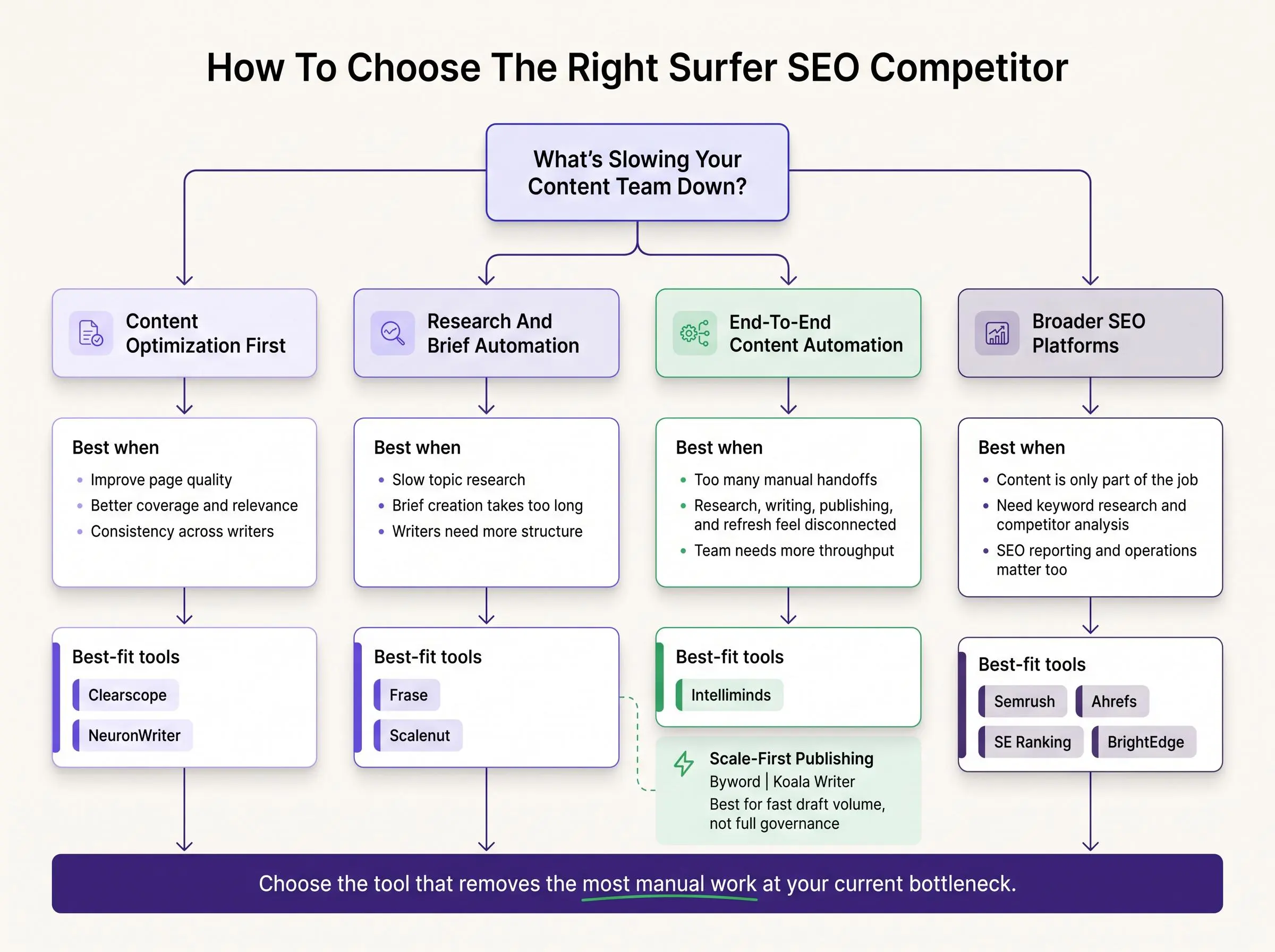
Most teams start with feature checklists. We don't recommend that. Start with the bottleneck.
The market splits into four buying paths:
Content optimization first
Clearscope and NeuronWriter are strongest when the main job is improving page quality and relevance.Research and brief automation
Frase and, to a degree, Scalenut work best when the friction sits between topic selection and draft creation.End-to-end content automation
Intelliminds is the better fit when you want the workflow to run from research through publishing and refresh with less manual involvement.Broader SEO platforms
Semrush, Ahrefs, SE Ranking, and BrightEdge make more sense when content is only one part of a larger SEO operation.
Then there are Byword and Koala Writer, which are really scale-first publishing choices. Helpful for volume. Less helpful if your problem is governance or strategy.
The best surfer alternative for teams usually isn't the one with the most features. It's the one that removes the most work.
What Actually Matters for Teams Scaling Organic Content

At scale, feature lists stop being useful. Workflow fit becomes the whole game.
Look at these five things:
Editorial workflow fit
Does the tool match how your team already works, or does it create extra manual steps between people?Automation depth
Some tools help with research. Some help with optimization. A few cover the full lifecycle from topic selection to refresh.Content governance
Can output stay on-brand across writers, clients, or internal stakeholders? This gets painful faster than most teams expect.Strategic visibility
You need to know what to create next, not just how to tune the page that's already open.Team use case
Startups usually need speed. Agencies need repeatability. In-house SEO teams need broader intelligence. Enterprise teams need governance and reporting.
A tool with more features can still create more work. That's not a better platform. That's just a longer demo.
Common Mistakes When Comparing Content Optimization Alternatives
This category gets confused because buyers compare unlike things as if they were direct substitutes. They aren't.
The mistakes show up in a few predictable ways:
- treating optimizers, planning systems, and content engines as the same type of product
- choosing based on a scoring model without checking whether throughput improves
- buying a broad SEO suite when editorial production is the real pain
- buying a writing tool when the deeper issue is strategy, refresh management, or governance
- ignoring how much manual work still sits between research, writing, publishing, and updating
- assuming a solo creator workflow will hold up for a multi-person team
- expecting every surfer seo competitor to look like Surfer
The last one catches people. A better fit often looks different because it's solving a different bottleneck. That's the point.
How We Evaluated These Tools
We evaluated and compared these tools based on how well each one fits a different content workflow, rather than trying to force every product into the same category.
Our review focused on a few practical questions:
- What problem does the tool actually solve? Some products are built for content optimization, while others are better for research, brief creation, publishing, or broader SEO operations.
- How much workflow it removes. We weighed whether a tool reduces manual steps across research, writing, publishing, and refresh work, or whether it mainly improves one stage.
- Where it fits best. We compared tools by team type and use case, including lean startups, agencies, in-house SEO teams, and larger organizations.
- How broad or specialized it is. Some tools are narrower and more focused, while others are designed as full SEO or content platforms.
- Whether it supports scale. We looked at how each option might work for teams that need repeatability, governance, or higher publishing volume.
We did not rank products by feature count alone. The goal was to compare what each tool is best at so readers can match the product to the bottleneck they are trying to solve.
Frequently Asked Questions About Surfer SEO Competitors
Which Surfer SEO competitor is best for end-to-end content automation?
For an end-to-end workflow, Intelliminds is positioned for research, article writing, publishing, and content refreshing with less manual involvement.
Which Surfer SEO alternatives are best for content optimization?
Clearscope and NeuronWriter are the strongest fits when the main goal is improving page quality, coverage, and relevance rather than automating the full content lifecycle.
Which Surfer SEO competitors are best for research and content creation?
Frase is suited to the path from SERP research to brief to draft. Scalenut also supports a research-to-draft-to-optimize workflow in one place.
When should you choose a broader SEO platform instead of a Surfer SEO alternative?
Semrush, Ahrefs, SE Ranking, and BrightEdge make more sense when content is only one part of a broader SEO operation. They support wider SEO needs such as research, reporting, competitor analysis, or organizational governance.
Conclusion
The right surfer seo competitor depends on what you're actually trying to fix. Better optimization points to Clearscope or NeuronWriter. Better research-to-writing flow points to Frase or Scalenut. Broader SEO operations point to Semrush, Ahrefs, SE Ranking, or BrightEdge. Scale-first publishing points to Byword or Koala Writer.
If your priority is reducing manual workload across the full SEO content lifecycle, Intelliminds is built for that job.
Don't start with the vendor. Start with the stage that's breaking down. Map your workflow across research, writing, publishing, and refresh, then shortlist only the tools that directly remove friction from that part of the system. That's how you avoid buying software and keeping the same bottleneck.
Article Record
ReferencesPrimary sources used for this article
- Byword
- Byword AI Pricing - Plans Starting at $99/month
- All-in-One AI Content Platform
- KoalaWriter - The Best SEO AI Writer for Blog Posts
- Features - NEURONwriter - Content optimization with #semanticSEO
- SEO Content Optimization - NEURONwriter - Content optimization with #semanticSEO
- Scalenut – AI-SEO & Expert-Led Services for Growth
- Pricing
- SEO Tools by SE Ranking | Keywords, Rankings, Backlinks, Audits
- SE Ranking Pricing Plans
- Make your business discoverable—in search, AI, and beyond
- Plans & pricing
- Content Optimization Platform | Clearscope
- Plans & Pricing
- SEO Content Optimization | Score & Rank as You Write — Frase | Frase.io
- SEO Research Tool — Topic to Ready-to-Write Brief | Frase.io
- Content Planning - MarketMuse
- Create the content that counts with MarketMuse
- Features | Semrush
- Plans & Pricing
Update HistoryMeaningful revisions to this article
- Updated pricing details for 12 Surfer SEO alternatives to make cost comparisons easier.
- Added a four-question FAQ section to help readers find answers about Surfer SEO competitors more quickly.
- Added a new section explaining how the tools were evaluated.
- Made the comparison easier to follow for readers choosing a content automation alternative.
- Clarified the review process so readers can better understand the basis for the recommendations.