
Affordable SEO for small business goes wrong when you buy a pile of tasks instead of work that brings buyers. Cheap packages can leave you with reports, random posts, and pages nobody finds.
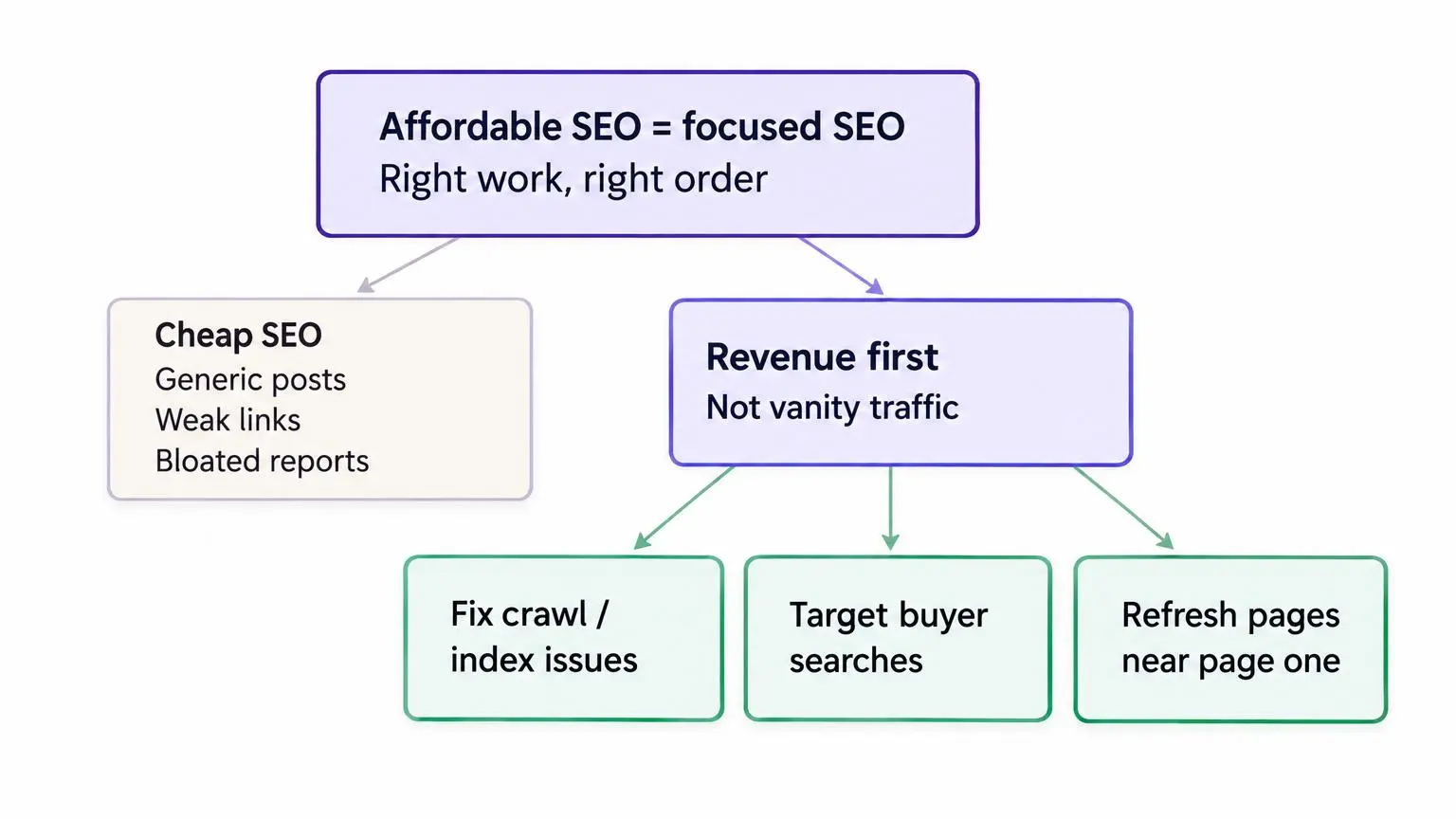
What matters is a clean site, clear service or product pages, and content built around real searches. Start where revenue lives—not vanity traffic.
Look for work that earns its keep:
- Fix pages Google cannot properly crawl or index
- Target specific buyer searches before broad keywords
- Refresh pages already sitting near page one
Spend smarter. Build search traffic you keep.
What Affordable SEO for Small Business Really Means
Affordable SEO for small business usually gets framed the wrong way. People hear "affordable" and assume it means stripped down, low grade, or somehow temporary. That's not the real choice.
Affordable SEO is focused SEO. It's a plan that fits a real budget without giving up relevance, clarity, or long term value. You don't need every possible SEO activity at once. You need the right ones, in the right order, done consistently enough to matter.
Cheap SEO is different. Cheap usually means generic blog posts, weak link work, bloated reports, or a pile of tasks that look active but don't move rankings or revenue. It feels productive right up until month four, when nothing useful has changed.
A better question is not "How little can we spend?" It's "How do we get measurable traction without wasting money?"
That shift matters because high quality SEO for less is absolutely possible when:
- the scope matches the stage of the business
- priorities are tied to revenue, not vanity traffic
- the work gets implemented, not just diagnosed
- the team keeps publishing and improving the pages that matter
The best SEO services for small businesses rarely promise the most deliverables for the lowest fee. That's usually a bad sign. Search performance doesn't come from volume alone. It comes from pages that deserve to rank.
And small businesses have more room here than people think. Google ranks pages, not payroll size. A tighter company with sharper service pages, better local details, and clearer answers can beat a bigger brand that publishes lazy content.
Better beats bigger more often than people expect.
Why Small Businesses Feel Trapped Between High Prices and Low Quality
A lot of owners feel cornered by a false tradeoff.
Either you pay an agency more than feels comfortable, often somewhere around $1,500 to $5,000 a month or higher, or you go cheap and get thin content that never compounds. Both options can be bad. We've seen that tension across local businesses, startups, and service companies trying to grow without hiring a larger marketing team.
Overspending fails when nobody has made the priorities clear. If the provider can't tell you which pages matter first and why, the retainer starts leaking value fast. You end up funding activity, not progress.
Underspending fails for the opposite reason. The work gets reduced to templates, ranking screenshots, and vague "optimization" with no real substance. Sometimes it's worse than doing nothing because you lose months and still need to rebuild the basics later.
The hidden costs are usually these:
- pages that never get indexed properly
- articles targeting low intent topics that don't lead to calls or demos
- weak service pages that need full rewrites later
- internal linking and structure problems nobody touched
- reporting that tells you where you rank, but not whether anything sold
That's why affordability is mostly a systems problem, not a price problem.
If your workflow wastes time, if your content process starts from scratch every week, if nobody refreshes pages that already have traction, costs rise whether the invoice is big or small. The goal is to remove waste. Not to remove quality.
What High Quality SEO for Less Actually Includes
You can keep scope lean without making the work flimsy. In fact, most small businesses do better when they stop pretending they need an enterprise program on day one.
The non negotiables are pretty simple:
- keyword targeting based on buyer intent
- a site that can be crawled and indexed cleanly
- solid titles, headings, internal links, and page structure
- useful content that answers the question early
- local signals if location matters to the business
- tracking tied to leads, calls, demos, or sales
Everything else is secondary until those pieces are working.
There is also a difference between work that compounds and work that expires. That distinction saves money.
Work that compounds
- evergreen service pages
- product or category pages built around real buying queries
- tightly related support articles
- internal linking between those pages
- refreshed content that gets stronger over time
Work that expires
- one time audits that never get implemented
- random blog posts with no role in the site structure
- generic traffic plays disconnected from the offer
- low quality link schemes you'll be cleaning up later
One strong page aimed at a real buying question can outperform ten generic posts. That's not a theory. It's how smaller sites get traction without trying to publish their way out of weak strategy.
Where Your SEO Budget Should Go First
If you're doing SEO on a budget for startups or small businesses, order matters more than ambition. The first dollars need to go where they unblock everything else.
Start here:
Budget priorities in order
- Technical fixes
Fix crawl, indexing, and page quality issues
- Money pages
Build or improve core money pages
- Supporting content
Expand into supporting content and authority signals
Technical basics come first because a page that isn't crawled or indexed properly can't rank. We've seen teams burn weeks on content while broken internal links, duplicate URLs, weak templates, or slow pages quietly hold the site back.
A practical early check looks like this:
- can search engines reach the important pages?
- are important pages indexed?
- are there duplicate or near duplicate versions competing with each other?
- do the core pages load well and make sense on mobile?
- can users move cleanly from one relevant page to another?
Then move to the pages tied directly to revenue. Service pages. Product pages. Core solution pages. Not broad awareness posts meant to chase traffic.
Each core offer usually deserves its own focused page. That's where buyer intent lives. A smaller business does not need to rank for the biggest trophy term in the market. It needs to rank for the searches that lead to quotes, bookings, and sales conversations.
For local businesses, Google Business Profile work belongs near the top. Accurate categories, services, hours, photos, and business details can create faster visibility than broad national SEO efforts. Local consistency is boring work, but boring work often pays.
Speed matters because local shoppers often make a shortlist quickly. In a 2026 survey of 1,227 U.S. consumers who had searched for a local business in the prior three months, 75% said they chose a business in under 30 minutes, and 72% looked at three or fewer businesses. That makes the basics more than administrative cleanup: your profile, reviews, hours, services, and core service page need to make sense before a buyer moves on.
And here's the part people forget: pages and assets you own keep working after the month ends. That's what makes affordable SEO actually affordable.
The Best Low-Cost SEO Opportunities Most Small Businesses Miss
Most small businesses don't have a traffic problem first. They have a targeting problem.
The easiest wins often sit in search gaps. Real questions buyers ask that the current results answer badly. You can find them in autocomplete, related searches, People Also Ask, and especially in Search Console impressions where your site is already hovering on page two.
A few signals are worth watching:
- the results are filled with vague list posts
- the ranking pages are old and haven't been updated in years
- nobody answers the question directly in the opening section
- the search is specific, but the results stay broad
That's your opening. You don't need to outspend larger competitors if you answer a more specific question better than they do.
For cheap SEO strategies for small companies that still want quality, this matters a lot. Publish fewer scattered articles. Build clusters instead. One strong service page supported by several tightly related pages usually outperforms a random posting schedule.
For local businesses, some of the best low cost opportunities are hyper specific:
- service plus city or neighborhood pages where the intent is clear
- FAQs about timelines, local expectations, or common objections
- pages that explain area specific concerns customers actually ask about
Another missed opportunity is content freshness. Updating a page that already has impressions is often cheaper and faster than starting a brand new article from zero. New stats, sharper headings, better internal links, clearer examples. Small changes, real lift.
What Different SEO Price Points Usually Buy You
SEO pricing is messy, but the market does settle into rough tiers. You don't need exact industry averages to see the pattern.
Entry level plans around $149 to $500 per month usually cover narrow local SEO, basic listings work, or limited visibility tasks. That can be fine if the scope is honest. It is not fine if someone claims full technical SEO, content, backlinks, and strategy at that price.
Lean small business plans around $500 to $1,000 per month often include technical basics, on page updates, and a modest amount of content or local work. This is where many businesses can get useful traction if the provider stays focused.
Around $1,000 to $1,500 and up, you start seeing more consistent content production, deeper research, stronger implementation, and better reporting. Senior led or broader managed SEO often starts well above $2,000 a month.
What changes across tiers is not just quantity. It's quality of thinking.
You tend to pay for:
- better research and prioritization
- stronger writing and page quality
- more implementation each month
- tighter strategy and oversight
- better authority work
- reporting tied to outcomes instead of busy tables
When comparing options, ask one blunt question: what exactly gets implemented each month?
Not how many tasks. Not how many keywords. What gets built, improved, published, fixed, or refreshed.
That's usually where the real value shows up, or doesn't.
| Tier | Monthly price | What you usually get |
|---|---|---|
| Entry level | USD 149 to 500 per month | Narrow local SEO, basic listings work, or limited visibility tasks. Fine if the scope is honest, but not realistic for full technical SEO, content, backlinks, and strategy. |
| Lean small business | USD 500 to 1000 per month | Technical basics, on page updates, and a modest amount of content or local work. Many businesses can get useful traction here if the provider stays focused. |
| Growth tier | USD 1000 to 1500 and up per month | More consistent content production, deeper research, stronger implementation, and better reporting. |
| Senior-led or broader managed SEO | Well above USD 2000 per month | Senior-led oversight or broader managed SEO. Higher tiers generally buy better research and prioritization, stronger writing and page quality, more implementation, tighter strategy, better authority work, and reporting tied to outcomes. |
Cost Effective SEO Solutions That Deliver the Most Return
Some SEO tasks punch above their weight. If budget is tight, these are the ones we'd protect first.
Commercial intent keyword research is near the top. Look for terms that signal a person is ready to compare, book, request a quote, or buy. Also check queries where you're already sitting on page two. Those are often faster wins than chasing untouched broad terms.
On page optimization is another one. Improve titles, headings, meta descriptions, internal links, image alt text, and especially the opening section. Too many pages spend the first paragraph clearing their throat instead of answering the search.
Good core content still matters. The pages that usually earn the most are:
- service pages
- product category pages
- comparison pages
- FAQ pages
- problem solution articles tied to buying intent
If you're a local service business or physical location, local SEO belongs in the return stack too. Business profile completion, review responses, consistent listings, fresh photos, and location specific proof can move visibility faster than people expect.
Then there are content refreshes. These are underused because they don't feel glamorous. But updating headings, examples, screenshots, and internal links on a page that already has traction is often one of the cleanest wins available.
Internal linking matters for the same reason. It helps related pages pass relevance to each other and helps new pages get discovered faster.
And before assuming a page has a ranking problem, check indexing. A page that isn't showing up at all has a different issue. We use quick visibility checks constantly for that reason. Even a simple batch check can save a lot of second guessing.
How to Do SEO on a Budget for Startups Without Burning Out
Lean teams don't need more chaos. They need a build order.
For the first 90 days, keep it simple.
Month 1
Handle technical cleanup, search intent research, and core page prioritization.
Month 2
Publish or improve the core service or product pages.
Month 3
Add support content, internal links, and refreshes to early pages.
That's enough to create traction without turning SEO into a side job nobody can sustain.
Two strong pages a month can beat eight rushed posts. We would take focused quality over volume almost every time, especially early. Publishing more doesn't fix weak targeting.
Founders and small teams should stay involved where their context matters most:
- customer language
- offer positioning
- real objections from sales calls
- common support questions
But the time heavy parts can be systemized. Topic research, draft generation, scheduling, and refresh workflows don't need to eat the week.
That's where content side automation helps. Our Intelliminds SEO Automation Software is built for teams that want support with keyword research, writing, publishing, and content refreshing while keeping a human approval step in place. That's an important line. The goal isn't fully hands off content spam. The goal is to free your team to think, review, and steer the message.
Red Flags That Signal Cheap SEO Instead of Affordable SEO
Some warning signs are obvious. Some are dressed up to look professional.
Watch for promises of guaranteed page one rankings or instant results. Nobody serious can promise that.
Be careful with one size fits all packages too. A local roofer, a SaaS startup, and an ecommerce store should not be handed the same monthly plan.
Other red flags show up in the deliverables:
- huge keyword lists with no prioritization
- dozens of backlinks with no explanation of quality
- generic blog output disconnected from customer intent
- reports built around ranking screenshots only
- lots of audits, very little actual implementation
Ownership matters more than many businesses realize. If a vendor controls your accounts, listings, or content access, that's a problem. You should own the assets you're paying to build.
And if the process leans heavily on spammy links, directory blasts, or unreviewed AI content, you're not buying efficiency. You're buying cleanup work for later.
If they can't explain who is doing the work and how often meaningful updates happen, assume the answer is not good.
How to Judge the Best SEO Services for Small Businesses
The best choice depends on what you actually need. DIY, freelancer, software, agency support, or some mix of those can all work when the fit is right.
Ask a short set of direct questions:
- What will be implemented in the first 90 days?
- Which pages or keyword groups come first, and why?
- How do you measure success beyond rankings?
- Who owns the content, accounts, and data?
- What gets refreshed over time?
A strong answer sounds specific. You should hear clear priorities, plain reasoning, realistic timing, and measurable milestones. Vague confidence is cheap. Good operators don't need to hide behind it.
Fit matters more than prestige. A service business may need local visibility and stronger service pages. A SaaS team may need content production around problem aware and comparison queries. An ecommerce brand may need category structure and collection page improvement first.
We'd also look for a workflow that balances speed with review. Pure manual content production is often too slow. Fully automated bulk posting is usually sloppy. A process that uses automation while keeping human approval before publishing is often the steadier option.
A Lean Content Workflow That Keeps Quality High and Costs Under Control
Small teams need a system they can repeat without dreading it.
The workflow is straightforward:
Lean workflow
- Keyword research
Research what buyers search
- Intent-matched pages
Create pages that match that intent
- Consistent publishing
Publish on a steady schedule
- Track performance
Monitor indexing and performance
- Refresh winners
Refresh the pages that start working
Content quality usually drops when too many tools and people are involved. One person researches in one place, another drafts somewhere else, someone forgets internal links, publishing gets delayed, refreshes never happen. The process breaks in the gaps.
Better standards fix a lot of that:
- search intent first
- clear headlines
- strong opening answers
- useful structure
- internal links to related pages
- real examples and current details
There are practical ways to lower production cost without lowering the bar. A headline ideation tool can speed up angle development. We built Blog Title Generator for exactly that kind of quick planning work. For visibility checks, a simple tool like our Google Index Checker helps verify whether new pages are indexed before you treat poor performance like a content issue. And if you're building content in batches around one topic cluster, you cut down a lot of wasted setup time.
Consistency beats bursts. A steady monthly cadence of useful pages and refreshes usually outperforms the team that disappears for six weeks and then dumps ten disconnected posts on the site.
Conclusion
Affordable SEO for small business is not about buying the cheapest option on the board. It's about putting budget into the work that actually builds visibility, trust, and customer acquisition, then cutting everything that only looks busy.
Start smaller than you think, but start sharper.
Fix the foundation. Go after buyer intent searches. Publish useful pages consistently. Refresh the pages that begin to earn traction. That's how you get high quality SEO for less without drifting into cheap shortcuts.
If you're trying to make this practical, audit where your current SEO spend is going, pick one high intent page or one tight topic cluster to improve first, and build a lean process you can keep running. Bloated plans usually die early. A focused system has a chance to compound.