
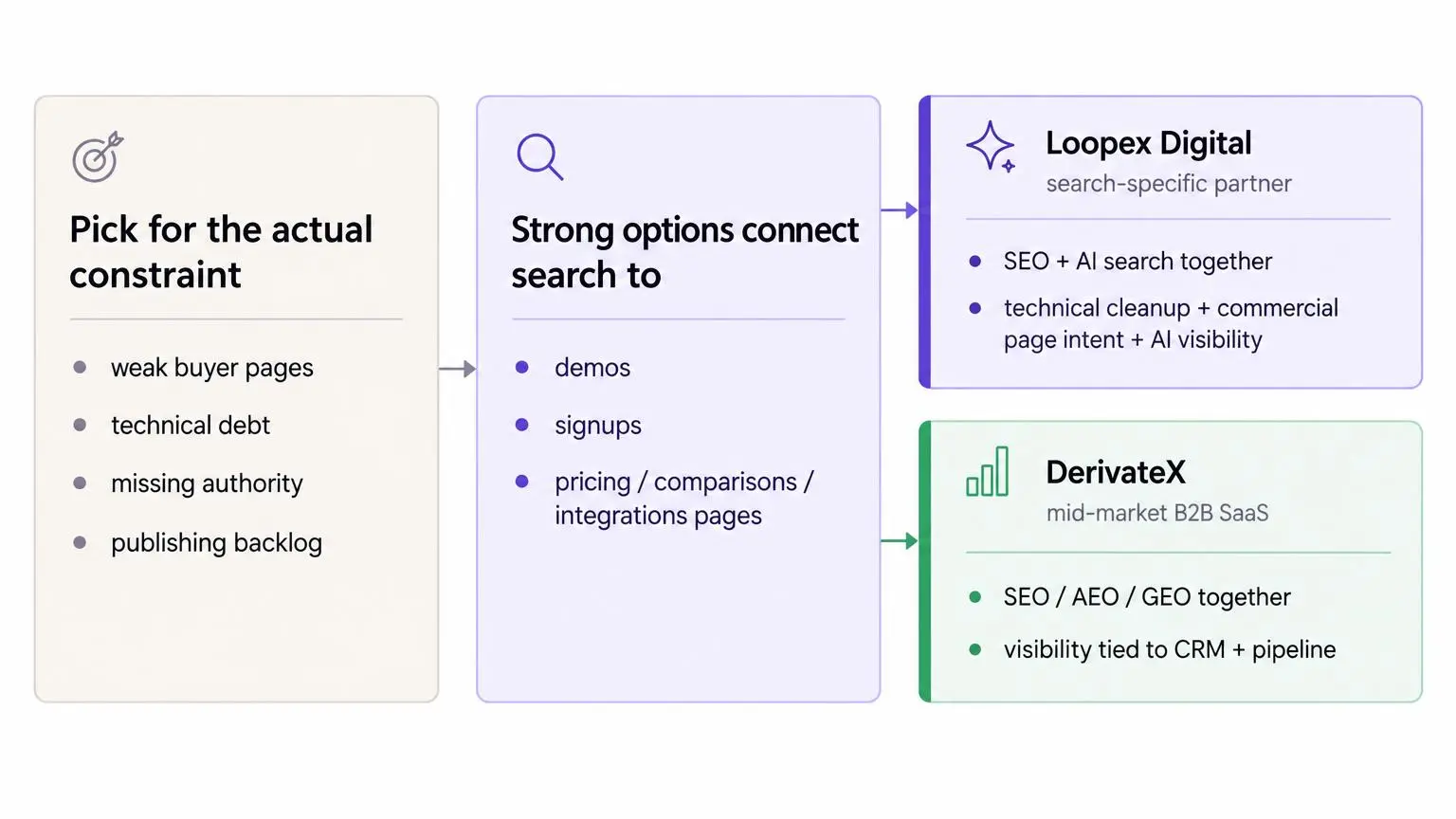
Picking a SaaS SEO agency gets messy when every option promises traffic, AI visibility, and pipeline. What matters is whether they can fix the actual constraint: weak buyer pages, technical debt, missing authority, or a publishing backlog that never ends.
The strong options don’t hide behind keyword charts. They connect search work to demos, signups, and the pages buyers check before they commit (pricing, comparisons, integrations).
We cut this to eight options worth your attention.
Show 5 more productsShow fewer products
1. Loopex Digital

- Combines SEO and AI search
- Strong technical and content coordination
- Weekly reporting with founder oversight
- Broader fit across SaaS and B2B
- Supports buyer-intent page optimization
- Less ideal for in-house control
- External pacing can create dependency
- Not a broader GTM partner
Loopex Digital is one of the cleaner fits for companies that want a specialist search partner, not a broad saas marketing agency trying to do everything at once. That difference matters more than most teams expect. When search is one line item inside a wider retainer, it often gets watered down.
Its positioning is fairly direct: SEO and AI search under one roof, with work spanning content strategy, technical SEO, citation research, LLM readability, and tracking across ChatGPT, Perplexity, Gemini, Claude, and Google AI Overviews. For SaaS teams, that usually means one partner handling the messy middle where rankings, site structure, and AI mentions start bleeding into each other.
A few things make it easier to place:
- It looks broader than B2B SaaS-only shops such as DerivateX or SAASY LINKS
- It stays more search-specific than GTM-heavy options like TripleDart
- It goes beyond link acquisition and authority work alone
The practical appeal is coordination. If your site needs technical cleanup, your commercial pages need better intent targeting, and you also want AI visibility to improve, Loopex Digital looks built for that bundle. According to its site, it reports weekly, keeps founders involved in strategy, and has examples of large organic growth plus AI visibility gains tied to client work.
Some teams don't need another channel partner. They need one search team that can actually connect the moving parts.
The tradeoff is control. If you're trying to build a tightly owned internal publishing machine, a traditional saas seo agency model will still mean external judgment, external pacing, and some dependency.
2. DerivateX
- Strong CRM-to-pipeline measurement
- Built specifically for B2B SaaS
- Combines SEO, AEO, and GEO
- Handles migrations and programmatic cleanup
- Includes content, citations, and PR
- Less suitable for early-stage teams
- May be too attribution-heavy
- Narrower fit than generalists
DerivateX is narrower by design, and that's a good thing if you're a mid-market B2B SaaS company that already thinks in pipeline, attribution, and CRM stages. If that sentence sounds like your team, this one will make more sense than a generalist.
The agency positions itself around B2B SaaS from $5M to $50M ARR and treats SEO, AEO, and GEO as one motion. That's not rare language anymore. The more important detail is that it claims to tie visibility back to CRM and pipeline rather than stopping at traffic or rankings. For some buyers, that's the whole game.
Its model leans into:
- keyword strategy and content from one team
- citations and digital PR alongside on-site work
- visibility across Google, AI Overviews, ChatGPT, Perplexity, Gemini, and Claude
- technical cleanup, including migrations and programmatic bloat
This is a stronger fit than Loopex Digital if your internal culture already expects channel performance to roll into revenue reporting. It's also more commercially strict than content-led firms that mainly sell better articles and better rankings.
That said, early-stage teams can overbuy here. If your problem is simply that you publish two articles a month, have no refresh cycle, and keep missing obvious topic clusters, a highly attribution-focused saas seo agency may be more system than you can use right now.
The quiet advantage is discipline. Agencies that obsess over pipeline tend to be less tolerant of vanity output. That's usually healthy.
3. Grow and Convert

- Prioritizes high-buying-intent topics
- Strong focus on signups
- Supports SEO and AI visibility
- Good fit for SaaS content
- Avoids fluff publishing quotas
- Weaker for heavy link building
- Less ideal for major rebuilds
- Not the broadest growth partner
Grow and Convert is for teams that think the benefits of saas seo come from conversion logic, not from traffic screenshots in a sales deck. We agree with that instinct. A lot of SEO programs look busy and still don't move signups.
Its angle is content first, but not in the soft sense. The firm positions itself around conversion-focused SEO and GEO, with services spanning SaaS SEO, AI SEO, content writing, technical SEO, and AI citation outreach. The thread running through all of it is buyer intent.
Here's where it stands out. Some agencies treat content marketing for SaaS companies like a publishing quota. Grow and Convert appears more focused on whether the topic attracts advanced users who can actually convert. That usually leads to fewer fluff topics and more commercial pages, bottom-funnel education, and decision-stage content.
It's likely a better fit when:
- content quality is the bottleneck
- you know your product well but need sharper intent matching
- signups matter more than broad awareness
- you want SEO content that can also support AI visibility
Its site points to examples around high-buying-intent prompts and monthly signup growth, which lines up with that focus.
If your biggest issue is off-site authority or a major technical rebuild, this probably isn't where you'd start. But for companies stuck with "we publish, but it doesn't convert," this kind of content-led agency usually asks the right question first: why would a serious buyer care about this page?
4. SAASY LINKS

- SaaS-only authority building focus
- Targets high-intent commercial pages
- Editorial dofollow links plus citations
- Supports Google and AI visibility
- Pairs well with content automation
- Limited strategy and technical depth
- Not ideal for full content ops
- Best after page priorities are clear
SAASY LINKS is the specialist pick. Not strategy-heavy. Not broad. Very specific. If your commercial pages already exist and they just don't have enough authority behind them, this is the kind of focused service that can be more useful than a full retainer.
The company is built only for B2B SaaS and centers its offer on editorial, in-content dofollow links plus citations that help pages show up in Google and AI search systems. The emphasis on page type is the important part. It isn't talking vaguely about "link building." It's pointing authority at product pages, pricing pages, alternatives, comparison pages, use-case pages, integration pages, and home or category pages.
That makes it relevant in a roundup like this because seo content automation tools don't solve authority. You can automate topic research, drafting, publishing, and refreshes all day. If no credible sites mention you and no links support the pages that matter, growth stalls.
A specialist like this makes sense when you already know:
- which pages drive pipeline
- which commercial terms matter
- that your main gap is trust, not output
Its published case material mentions gains in traffic, referring domains, authority, AI citations, and movement on comparison or alternatives terms. That fits the offer.
The caution is obvious. This isn't the right standalone choice if you need technical SEO, content operations, or strategic direction from scratch. But when the diagnosis is right, narrow beats broad.
5. Searchmaxxed

- Strong buyer-intent page focus
- Technical SEO plus AI visibility
- Comparison and integration page expertise
- Commercially prioritized gap analysis
- You keep site and data
- Limited top-of-funnel publishing focus
- Less ideal for blog-heavy plans
- Narrower than full-service agencies
Searchmaxxed seems built for teams that care more about buyer-intent pages than blog volume. That's a meaningful distinction. Plenty of SaaS companies don't need 200 top-of-funnel articles. They need stronger comparison pages, integration pages, and category pages that actually help close demos.
Its model combines technical SEO, on-page work, and AI-answer visibility, with language centered on winning the searches buyers make and getting named where competitors are named instead. That's commercially sharper than generic "more traffic" positioning.
A few signals stand out:
- strong attention to comparison, industry, and integration pages
- AI SEO across ChatGPT, Claude, Perplexity, Gemini, and Google AI Overviews
- visibility-gap analysis tied to commercial value
- emphasis on owning the site, code, content, and data
That last point is not trivial. Teams often wake up late to the fact that some agency relationships leave too much operational dependency behind them.
Searchmaxxed is probably a stronger fit for sales-led SaaS than for brands chasing large-scale editorial publishing. If your funnel leans on enquiries, demos, and shortlist behavior, intent-page strategy matters more than a bloated blog calendar.
The page that wins a demo is rarely the page with the prettiest traffic chart.
The limitation is just as clear. If your growth plan depends on heavy top-of-funnel content production, this may feel too concentrated on decision-stage assets.
6. SimpleTiger

- Connects SEO with paid channels
- Long-running SaaS-focused experience
- Tracks AI search share of voice
- Broad support across key channels
- Pipeline-oriented measurement approach
- Broader scope adds complexity
- May exceed search-only needs
- Less specialized than pure SEO firms
SimpleTiger is broader than most of the names here, which makes it easier to justify when SEO can't sit in a silo. Some companies need search tied directly to paid media, content, email, digital PR, and web work. If that's your operating reality, a narrower saas seo agency can become a coordination problem.
SimpleTiger positions itself as a B2B SaaS marketing agency founded in 2006, with more than 15 years of SaaS focus and a client base that is mostly B2B. It covers SEO, AEO, GEO, PPC, content marketing, digital PR, email marketing, and web design. That's a lot of surface area, but the firm frames it around pipeline growth rather than disconnected channels.
Its search angle includes:
- tracking traditional rankings and AI share of voice
- measuring citation frequency, competitor comparison, referral traffic from AI search, and conversions
- coverage across Gemini, ChatGPT, Perplexity, Claude, Grok, and Google AI Overviews
- treating SEO and GEO as one integrated strategy
This makes sense for teams that don't just need content or rankings. They need coordination.
The tradeoff is complexity. Broader channel support can be useful, but it can also be more than you want if organic search is the only active priority. Some teams really do just need search execution, not a fuller marketing system.
7. Skale

- Ties SEO to pipeline goals
- Strong decision-stage content focus
- SEO and GEO work together
- Technical and authority efforts aligned
- Needs mature attribution discipline
- May be heavy for smaller teams
- Less ideal for simple publishing gaps
Skale is one of the more disciplined options on the list if leadership wants organic growth tied directly to revenue planning. Its pitch starts from revenue, SQLs, pipeline, and MRR, then works backward into GEO and SEO. That framing won't matter to everyone. For the right team, it matters a lot.
What we like here is the system view. Skale talks about technical health, structured data, AI-readable pages, decision-stage content, AI brand mentions, and link building as one connected engine. That's closer to how scaling SEO strategies actually work in practice. Pages don't perform in isolation. Authority, structure, intent, and refresh cycles stack up over time.
It looks especially relevant for SaaS and tech brands that need:
- revenue-based prioritization
- better decision-stage content
- clearer attribution on organic work
- one organic program instead of separate SEO and GEO retainers
The company also leans hard into the idea that many agencies simply tack GEO onto old SEO playbooks. Fair point. A lot of firms now say they do AI visibility. Fewer seem to have rebuilt their operating model around it.
If your team is immature on attribution, this can be a harder fit. Not bad, just harder. A revenue-modeled system works best when the business can actually act on the model.
8. TripleDart

- Connects SEO, paid, and revops
- Strong continuous content refresh motion
- Supports BOFU and programmatic SEO
- Built for broader GTM coordination
- Overkill for lean teams
- Broader scope can slow decisions
- Less ideal for search-only needs
TripleDart is the widest-scope option here. It's less "hire a saas seo agency" and more "plug SEO into a larger GTM operating system." That can be exactly right if organic search is only one part of a broader growth mess.
The company groups AI Search + SEO, paid media, content and brand, and revops and analytics into one managed engine. It also talks about proprietary workflows, AI blocks, continuous drafting and refreshing, programmatic SEO support, and end-to-end technical work.
That makes TripleDart closer in spirit to automation and systems than most agency-first picks in this list. Not because it's a pure software play, but because it seems designed around repeatable operating motion rather than isolated deliverables.
The fit is strongest when:
- SEO must coordinate with paid and analytics
- content refresh needs to be ongoing, not occasional
- BOFU comparisons, alternatives, and clustered authority content all matter at once
- you need operational lift across GTM, not just organic execution
It may simply be too much for lean teams. That isn't criticism. Scope has a cost. If all you need is tighter search execution, buying a wider engine can slow decisions instead of speeding them up.
| Loopex Digital | DerivateX | Grow and Convert | SAASY LINKS | Searchmaxxed | SimpleTiger | Skale | TripleDart | |
|---|---|---|---|---|---|---|---|---|
| B2B SaaS-only positioning | × | ✓ | × | ✓ | × | × | × | × |
| Offers paid media management | × | × | × | × | × | ✓ | × | ✓ |
| Primarily a link-building specialist | × | × | × | ✓ | × | × | × | × |
| Explicit CRM or pipeline attribution | × | ✓ | × | × | ✓ | ✓ | ✓ | ✓ |
| Broader GTM partner beyond SEO | × | × | × | × | × | ✓ | × | ✓ |
How to Choose Between a SaaS SEO Agency and SEO Content Automation
This is the real decision. Are you buying strategic judgment, off-site authority, technical expertise, and AI search direction? Or are you trying to automate content production and content refreshing to remove the manual bottleneck?
A saas seo agency is usually the better move when you need work your team can't do well in-house:
- link building, digital PR, citations
- technical SEO or migration cleanup
- buyer-intent page strategy
- attribution setup
- AI visibility planning
- help deciding which growth levers matter most
Seo content automation tools make more sense when the strategy is already clear and execution is the bottleneck. That's where automated seo solutions actually earn their keep. If you know your ICP, know your funnel, and know which topics or page types matter, automation can take over the repetitive parts without removing judgment.
With our own Intelliminds SEO Automation Software, that's the layer we're trying to solve: automated keyword research, article creation, auto-publishing to your CMS, and content refreshing, while keeping a human in the loop. That's different from outsourcing the whole function.
The strongest model for many teams is hybrid:
- agency support for strategy, authority, and technical direction
- automation for research, drafting, publishing, and refresh operations
If your problem is speed, automation wins. If your problem is trust and visibility, agencies help more. If your problem is not knowing what to do next, buy strategy first.
What to Evaluate Before You Hire Any SaaS SEO Agency

Before you sign anything, pressure-test fit. Good SEO work looks very different in PLG SaaS, sales-led SaaS, and B2B with a long buying cycle. A slick agency can still be wrong for your model.
Use a short checklist:
- Do they optimize for traffic, or for signups, demos, SQLs, and pipeline?
- Can they build the pages buyers search before a trial or sales call?
- Do they show real thinking on alternatives, comparisons, pricing, integrations, and use-case pages?
- Are Google rankings and AI search both part of the plan?
- Will you own the content, site assets, and data?
The tradeoffs are the whole story here. Full-service breadth can mean weaker specialization. Revenue attribution can come at the cost of publishing velocity. Thoughtful strategy can feel slower than scaling seo strategies quickly. External execution can solve speed, while weakening internal ownership.
The same logic applies when you're judging seo content automation tools. Don't judge them on volume alone. If an automation layer can't support approvals, maintain message control, and refresh aging pages, you're just making more content faster. That's not the same as building a growth engine.
Common Mistakes Teams Make When Trying to Scale SEO
Most SEO mistakes aren't tactical. They're diagnostic.
Teams confuse output with progress. They hire a saas seo agency before naming the real bottleneck. They chase traffic when the business needs demos. They ignore AI search until competitors start showing up in answers instead of them. Then everyone gets urgent at once.
The common misses look like this:
- publishing more without fixing authority, intent, or technical issues
- buying an agency retainer when the real problem is internal production capacity
- treating content refreshing as optional
- expecting one vendor to solve strategy, execution, attribution, and internal workflow design with no tradeoffs
- assuming the only choices are expensive outsourcing or manual grind
Here's the sentence we'd keep in front of the team: content is not the system. The system is research, prioritization, publishing, authority, refreshes, and measurement working together.
That's why the agency versus automation debate is often framed badly. You don't need a belief. You need a diagnosis.
Conclusion
The best growth teams don't choose between strategy and scale. They choose the combination that removes the current constraint.
If you want specialist search breadth across SaaS, B2B, and ecommerce, Loopex Digital makes sense. If you need B2B SaaS pipeline attribution and AI visibility discipline, DerivateX is easier to justify. Grow and Convert fits teams that believe content marketing for SaaS companies should convert, not just rank. SAASY LINKS is the specialist when authority and citations are the missing layer. Searchmaxxed is the sharper choice for high-intent pages and AI recommendation visibility. SimpleTiger works when search has to coordinate with broader SaaS marketing. Skale is a stronger fit for revenue-modeled organic systems. TripleDart is the wide-operating-model option when SEO is only one piece of growth.
Your next step is simpler than it sounds:
Decision process
How to choose
- Find the blocker
Identify the actual blocker: strategy, authority, technical execution, or production capacity
- Choose the model
Decide whether you need a saas seo agency, a stronger automation layer, or both
- Make it sustainable
Build the process you can keep running six months from now
Because that's the real goal. Not more SEO activity. More controlled, compounding growth.
Article Record
ReferencesPrimary sources used for this article
- B2B SaaS SEO Agency for AI Search and SEO Pipeline
- SEO & AI Search Visibility Agency | Loopex Digital
- B2B SaaS Marketing Agency Driving Pipeline Growth | SimpleTiger
- Grow and Convert: A Content-Focused SEO and GEO Agency
- DerivateX: The B2B SaaS SEO + GEO Agency
- Skale | Organic Growth Engines For SaaS And Tech Brands
- B2B Marketing Agency Driving Sustainable Growth - Directive
- SaaS Link Building Agency | SAASY LINKS
- AI-Native B2B Marketing Agency | TripleDart
- Lucas Mondora