
Choosing a B2B SaaS SEO agency gets expensive when you buy traffic reports and receive pages that never help sales. Your buyers compare tools, check integrations, and bring security questions long before a demo.
What matters is whether the agency can turn those moments into useful, indexable pages—and keep improving them as data arrives. Don’t mistake a polished deck for an operating system.
Look for proof in the work:
- A plan for merging competing feature pages
- Reporting tied to demos, trials, and pipeline
- Clear owners for product review, publishing, and QA
Choose a partner that makes organic growth easier to run.
Why B2B SaaS SEO Is a Different Discipline

A lot of companies hire a b2b saas seo agency with the wrong comparison in mind. They judge it like local SEO, ecommerce SEO, or blog-led publishing for media sites. That usually ends badly.
SaaS has a different job to do. You aren't trying to get one visit and one purchase. You're trying to influence a buying process that often starts with one searcher and ends with product, security, finance, operations, and leadership all having opinions.
That changes what good looks like.
A page that brings 8,000 visits and no demos is less useful than a page that gets 200 visits from buyers comparing tools. In SaaS, traffic can lie to you if you let it. The pages that matter most are often integration pages, comparison pages, feature pages, use case pages, and objection-handling content that sales keeps repeating on calls.
Then there's the site itself. SaaS websites break in quiet ways. JavaScript-heavy frameworks, rendering issues, pages hidden behind poor internal linking, product updates that change page meaning, and indexation problems that leave published content half-seen or not seen at all. We've seen teams publish for months without realizing search engines weren't fully processing important pages.
A real SaaS program has to coordinate several moving parts at once:
- technical SEO and crawlability
- content mapped to buying stages
- internal linking that supports topic depth and conversion paths
- authority building that earns trust
- measurement tied to demos, trials, and pipeline
Miss one of those and the whole system gets weaker.
Hiring the wrong agency doesn't just waste budget. It wastes quarters.
That opportunity cost is the part people miss. While a generalist agency chases broad keywords or ships pages nobody needs, your category keeps moving.
What Sustainable Organic Growth Actually Means in B2B SaaS
Sustainable organic growth means the channel gets stronger as you keep working it. More qualified traffic. More product interest. More demos, trials, and customer acquisition from pages that keep earning their place over time.
It does not mean a short ranking spike, a glossy audit that dies in a folder, or 50 AI-written posts dumped onto your blog in six weeks.
The durable version usually comes from four repeatable motions:
- Smart topic and keyword research tied to buyer intent
- Strong content mapped to the funnel
- A publishing cadence you can actually maintain
- Ongoing refreshes, merges, and consolidation as data comes in
That fourth one gets ignored far too often. Good SaaS SEO is not just new production. It's content lifecycle management—editorial maintenance with a business reason behind it.
We've seen the biggest gains come from fixing structure before adding volume. One common example is feature page cannibalization. A company ends up with dozens of overlapping product pages competing for the same terms. Consolidating them into a smaller set of clearer pillar pages can lift rankings faster than publishing another month of thin content. That isn't theory. It's how some strong programs have improved positions and pipeline without increasing output.
In one 12-month B2B SaaS case study, the engagement consolidated 47 competing feature pages into 12 pillar pages. The case study reports that average position across target keywords improved by 14 places within six weeks.
A B2B SaaS case study reduced a set of overlapping feature pages from 47 pages to 12 pillar pages.
Sources
- This is a single agency-published client case study, not an independently audited benchmark.
- The source attributes outcomes to a broader SEO program, so the effect of page consolidation cannot be isolated.
- The source says only the start and end points of its pipeline curve are actual results; this proposal uses only the explicitly stated aggregate outcomes and page counts, not the illustrative curve.
| Stage | Pages |
|---|---|
| Before consolidation | 47 |
| After consolidation | 12 |
Across the full 12 months, the same provider-published case study attributes $2.4 million in qualified pipeline, a 62% reduction in cost per lead, and 7.1× return on SEO investment to the program. Treat this as a directional example rather than a benchmark or guaranteed outcome: the results are from one client engagement and do not isolate the effect of consolidation from the wider SEO work.
The same thing happens in content libraries. If your blog has years of half-useful posts, sustainable SEO strategies usually involve pruning, merging, rewriting, and redirecting, not just publishing more. More pages do not equal more authority. Sometimes they just create more confusion.
For SaaS leaders, this matters because paid acquisition keeps getting more expensive. A healthy organic engine lowers pressure on paid CAC and gives you an acquisition channel that gets more efficient instead of resetting every month.
For agency selection, ask candidates to quantify your current page overlap, identify which pages they would consolidate, and define how they will connect that work to pipeline—not just publishing output.
When It Makes Sense to Hire a B2B SaaS SEO Agency
Not every company needs an agency right now. Some need sharper positioning. Some need product marketing to stop hand-waving core buyer questions. Some just need to ship.
So start there. Be honest about the bottleneck.
It usually makes sense to hire a b2b saas seo agency when the strategy is plausible but execution keeps stalling, or when the site has enough raw material to win and nobody is turning it into a system.
Typical signs:
- organic search contributes little to pipeline even though product-market fit is real
- you have lots of pages but weak topical authority
- the blog exists, but qualified buyers rarely come through it
- paid CAC keeps rising and leadership wants another growth lever
- feature or solution pages compete against each other
- there is no clear roadmap, publishing workflow, or refresh process
- the team has ideas but can't maintain production consistency
Sometimes the right answer is a full-service partner. Sometimes it's narrower. You may need technical cleanup before content. Or content strategy before link acquisition. Or help getting your brand represented consistently across search, reviews, and AI-driven discovery.
This is really a resource allocation decision. Not just a channel decision.
One practical model we like is pairing agency oversight with workflow automation. The agency handles strategy, prioritization, QA, and measurement. The execution layer becomes more consistent, which matters more than people admit by month three.
What the Best B2B SEO Services Should Include
The best b2b seo services for SaaS should be judged by business effect, not by how long the service menu is.
If an agency can't explain how its work influences demos, trials, sales conversations, or customer acquisition quality, the rest is noise.
At minimum, you should expect capability in these areas:
- Technical SEO: crawlability, rendering, indexation, redirects, schema, site speed, CMS limits
- Content strategy tied to buyer intent, not just search volume
- On-page work for product, feature, integration, comparison, alternative, use case, and educational pages
- Content operations that can ship on schedule
- Internal linking that helps both ranking and conversion journeys
- Authority building through credible mentions and backlinks
- Refresh and consolidation workflows for underperforming pages
- Reporting tied to pipeline signals, not just rankings
One thing we push clients to understand: full-funnel content and bottom-funnel content do different jobs. Broad educational articles can build reach and topical depth. Comparison pages, alternatives pages, and integration pages often do more for pipeline.
A lot of agencies overproduce awareness content because it's easier to scale and easier to report on. More impressions, more clicks, nicer charts. But if your buyers are deep in evaluation mode, the page that answers "how do you compare to X?" or "does this integrate with Y?" can be worth more than twenty soft-intent blog posts.
The better agencies also look beyond traditional search now. Buyers ask AI tools for shortlists. They read review sites. They compare vendor claims across channels. If your brand story changes from place to place, trust drops.
The Qualities of an Agency That Can Deliver Long-Term Results
This is where a lot of selection processes go off track. Teams get impressed by polish, logos, and a good sales deck. None of that tells you whether the agency can operate.
A strong b2b saas seo agency usually sounds more like an operator than a performer.
Look for these signals:
- they start with your ICP, product motion, and sales reality
- they talk about demos, trials, SQLs, conversion rates, and revenue
- they have a clear method for auditing, prioritizing, executing, and measuring
- they can explain tradeoffs between technical fixes, new content, refreshes, and authority work
- they understand your site is both a marketing asset and a product-adjacent asset
The better SaaS specialists also ask better questions. About integrations. About compliance pages. About how buyers describe the problem. About which objections keep showing up late in deals. That's hard to fake.
Process clarity beats presentation quality. Every time.
Sustainable b2b growth marketing comes from repeatability. Not charisma. Not mystery. If an agency hides behind vague timelines or treats its method like a black box, assume you'll pay tuition while they figure your company out.
Search changes constantly. The right partner doesn't chase updates with panic. They build seo strategies for saas companies that can hold up through change because the fundamentals are right.
How to Evaluate an Agency’s Strategy Before You Sign
Before you evaluate them, get clear on your own goal. Are you trying to increase demos, free trials, SQLs, branded demand, category visibility, or recover from a technical problem? Are you building a long-term content engine, or fixing a near-term bottleneck?
If you don't know that, the agency conversation turns into theater.
When you're choosing an seo partner, stay on approach, not promises. Ask direct questions:
- How do you audit current content quality and site health?
- How do you find keyword cannibalization and content gaps?
- How do you decide whether to refresh, merge, rewrite, redirect, or remove a page?
- How do you balance bottom-funnel pages against awareness content?
- Do you build traffic and ROI projections, and what assumptions are behind them?
- How do you connect SEO work to CRM and funnel metrics?
- What should success look like at 90, 180, and 365 days?
One non-obvious thing to watch: can they describe an operating model that could actually be published and followed by a team? Strategy alone is cheap. Execution logic is harder.
We've found that the best answers are rarely flashy. They're specific. They admit tradeoffs. They show sequencing.
Give the Agency a Real Buyer Question, Not a Hypothetical Pitch Test
Here's a better test than asking for "your process."
Give the agency a real buyer question your team gets on calls.
For example:
- Does your product integrate with a specific system, and what data moves between them?
- How do you compare with a named competitor on a hard objection?
- What should a security-conscious buyer understand before booking a demo?
Then watch how they respond.
A strong agency will identify what your site already supports, what still needs product confirmation, and where that answer should live. Maybe that's an integration page. Maybe a feature page. Maybe a comparison page. They shouldn't invent certainty where the facts are fuzzy.
That matters. In SaaS, one sloppy claim can create legal, product, and sales cleanup later.
Ask them how they'd validate the impact after publication too. If they can't connect the page to intent, visibility, and conversion behavior, you're mostly buying writing.
This test reveals more than decks and portfolios. It shows whether they can turn real buyer questions into content that helps revenue move.
It also reveals whether your own team can support approvals. If nobody can confirm product details or release pages, more strategy won't save you.
How to Read Case Studies Without Getting Misled
Case studies are useful. They're also selective by definition.
An agency will show you its best wins. That's normal. The mistake is assuming a good result somewhere else means they can repeat it for your category, your funnel, and your internal setup.
Read them with a filter. Look for similarity in:
- sales cycle complexity
- buyer sophistication
- technical constraints
- growth stage
- goals tied to pipeline, demos, trials, or SQLs
The proof that matters is usually operational, not just numerical. Yes, pipeline from SEO matters. Demo growth matters. Lower cost per lead matters. Faster sales cycles matter. But you also want to know what changed.
Did they consolidate overlapping pages? Clean up architecture? Build comparison pages? Improve product-page conversion paths? Refresh weak content? Build authority around a specific topic set?
Those are repeatable motions. A giant traffic chart by itself isn't.
Some of the stronger examples in this space connect SEO to multimillion-dollar pipeline, higher demo volume, and lower dependence on paid acquisition. Useful. But the real value is understanding the mechanism behind the result.
Red Flags That Usually Lead to Wasted Spend
This part is less glamorous, but it saves money.
Watch for these red flags:
- guaranteed number one rankings
- reporting focused only on traffic and positions
- vague methodology
- generic proposals that could fit any company
- little curiosity about your buyers, funnel, or product
- obsession with volume over relevance
- thin AI content with no subject review process
- link building they won't explain clearly
- no refresh, pruning, or consolidation plan
- no ownership model for approvals, publishing, or QA
Cheap retainers can get expensive fast. Low-quality content debt is real. Misaligned pages take time to unwind. And lost momentum hurts twice because you still have to restart later.
A partner whose work can't compound is not a bargain.
The Agency Selection Checklist for SaaS Teams
If you're comparing options with leadership or procurement, use a simple scorecard. Keep it boring on purpose.
Score each agency on four areas: strategic fit, execution capability, communication quality, and measurement maturity.
Your checklist should cover whether they:
- understand your ICP and category language
- can map search intent to your real funnel
- know how to improve existing content, not just create new pages
- can explain how technical SEO affects SaaS visibility
- prioritize pages tied to demos, trials, and revenue
- have a realistic publishing and refresh workflow
- are clear about what your team must provide
- measure outcomes in business terms
- can support AI-era visibility without treating it like a gimmick
Bring in marketing, product, sales, and whoever owns the site. If those voices aren't in the room, selection gets distorted by presentation polish.
Agency, In-House, or Automation: Choosing the Right Operating Model
There isn't one right model for every team.
Agency-led works when you need strategy, execution, and specialist depth across technical SEO, content, and authority building. In-house works when your team is already strong and just needs focused help. Hybrid models often make the most sense for teams that want control without adding headcount.
This is where automation can help, if you use it with judgment.
Useful automation supports organic growth techniques like topic discovery, content planning, draft generation, scheduled publishing, and refresh workflows. It shouldn't replace editorial review or product accuracy. It should remove manual drag.
For teams that want a content-focused workflow layer, we built Intelliminds SEO Automation Software to handle keyword research, writing, publishing, and content refreshing while keeping a human in the loop. Intelliminds SEO Autoblogger is a fit when you want controlled article generation and publishing schedules instead of chaotic bulk posting.
That hybrid setup works well in b2b growth marketing because it reduces bottlenecks. You stop relying on heroic effort just to keep the calendar moving.
What a Strong First 6 to 12 Months Should Look Like
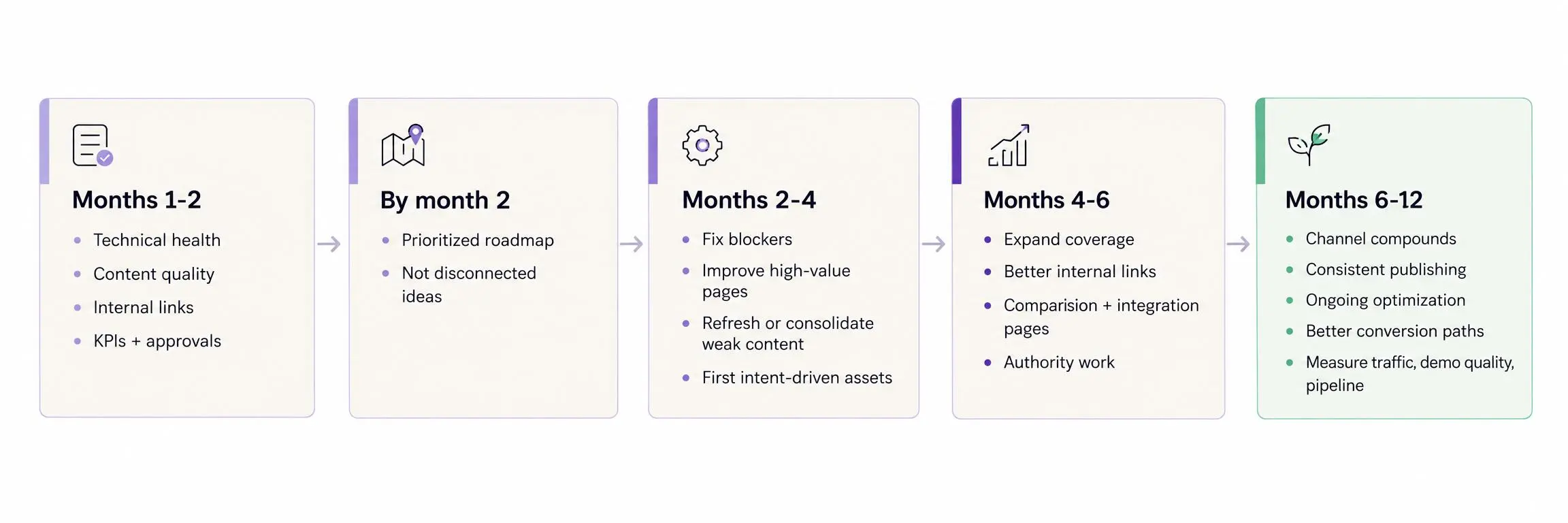
Good SEO should feel more systematic over time, not more chaotic.
In months 1 to 2, the work should focus on technical health, content quality, keyword overlap, internal linking, conversion pages, KPIs, and approval workflows. By the second month, you should have a prioritized roadmap, not a pile of disconnected ideas.
Months 2 to 4 usually involve fixing blockers, improving high-value existing pages, refreshing or consolidating weak content, and launching the first intent-driven assets.
Months 4 to 6 should expand coverage. More topic clusters. Better internal links. More comparison, alternative, use case, and integration pages. Authority work starts to matter more here too.
By months 6 to 12, the channel should begin compounding through consistent publishing, ongoing optimization, and better conversion paths. Measure traffic, yes, but also demo quality, pipeline contribution, and sales feedback.
In practice, smart execution often includes pruning old content, rebuilding feature page architecture to stop cannibalization, and refreshing pages based on actual performance instead of endless new production.
That's the shift you want. Less randomness. More system.
Conclusion
The right b2b saas seo agency should help you build a durable growth engine, not rent you a temporary ranking spike.
Choose for buyer understanding, process clarity, pipeline alignment, technical competence, and a content system that can keep producing, improving, and refreshing the right pages over time. Test agencies with real buyer questions. Push them on metrics that touch revenue. Make sure the operating model can actually run inside your team.
Then make the decision the calm way. Define the growth goal, score the options, and pick the partner or model that can sustain high-quality research, publishing, and content refreshes long after the sales call is over.
Article Record
ReferencesPrimary sources used for this article
- Zero organic traffic. 12 months later, a $2.4m pipeline
- B2B SaaS SEO Agency & Organic Growth Partner | YOYABA
- The SaaS SEO agency that started inside a SaaS company.
- B2B SaaS SEO Delivers 2.1M ARR Pipeline | OutReachFrog
- A SaaS SEO agency that (actually) cares about your growth
- Lucas Mondora
- B2B SaaS SEO Case Study - 5600% Increase in Organic Traffic