
Most teams try to automate content production by generating drafts faster. That just creates a bigger review pile, more vague posts, and a calendar nobody trusts.
What matters is removing the repetitive work while keeping strategy, product nuance, and final judgment close to the brand. Start narrow (one content lane), then make the workflow repeatable.
Watch for the pressure points:
- Topics chosen for revenue relevance, not search volume alone
- Briefs that give AI real sources, internal links, and intent
- Publishing and refreshes that happen on schedule, not when someone remembers
Less scramble. More pages that can earn.
Why Growing Brands Hit a Content Ceiling
Most growing brands do not run out of ideas. They run out of process.
We see the same pattern across SaaS, ecommerce, agencies, and service businesses. The strategy is usually fine. The team knows the audience, knows the product, and has a decent sense of what should get published. Then the machine breaks.
It breaks like this:
- topic research lives in a spreadsheet nobody trusts
- briefs get written differently every time
- drafting takes too long
- approvals drag because nobody knows what "done" means
- publishing happens in bursts, then goes quiet for two or three weeks
That is not a creativity problem. It is an operating problem.
For lean teams, this gets worse fast. One marketer is doing demand gen, product launches, lifecycle emails, social, and somehow also expected to grow organic search. We have seen versions of this where output quietly drops to one or two social posts a month, not because the team stopped caring, but because content kept losing to more urgent work.
And manual publishing work is sneakier than people think. Formatting, uploads, internal links, image handling, CMS cleanup, refresh tracking. None of it feels huge in isolation. Together, it eats the week.
So if you're asking how to scale SEO content without hiring writers, or how to run SEO content without content team bloat, start here: your bottleneck is probably not writing. It is the chain around writing.
You can automate content production without turning your site into junk. In fact, the brands that grow blog without hiring writers usually get there by reducing operational drag first, not by asking AI to do everything.
What It Really Means to Automate Content Production
A lot of teams think automation means "generate article."
That is too small. And honestly, it is where most setups disappoint.
To automate content production is to build a repeatable system that handles the repetitive parts of SEO content while your team keeps hold of strategy, judgment, and quality control. Text generation is one part of that. Useful, yes. Enough, no.
A real system can cover:
- topic discovery
- keyword grouping
- SERP informed outlines
- brief creation
- drafting
- internal link suggestions
- image suggestions
- scheduling
- CMS publishing
- content refreshing
The strong systems work as a loop. They plan, create, publish, measure, and improve. That loop matters because content is not finished when the draft is done. A draft that never gets published, updated, or tied back to performance is just expensive clutter.
Weak setups stop at draft generation. Then the team still has to do research, cleanup, uploads, optimization, and refreshes by hand. That is not automation. That is a prettier bottleneck.
The goal is not to remove humans. The goal is to remove drag.
A lean content marketing workflow should reduce handoffs, reduce publishing friction, and make output more reliable month after month. If it creates more review chaos than it removes, it is not working.
What the Best Automation Systems Keep Human
Not every part of content should be automated. Some decisions are too close to revenue, trust, and positioning.
The best setups usually keep these human led:
- brand positioning and differentiation
- product nuance and factual accuracy
- editorial standards and voice calibration
- final approval before publication
- prioritization based on business value, not traffic alone
This pattern shows up for a reason. Teams that get good results do not blindly publish at scale. They keep an editor, marketer, or owner in the loop. Sometimes that review is light. Sometimes it is strict. Either way, somebody close to the brand is still steering.
Automate the mechanics. Keep the judgment.
That split is healthier than it sounds. It means AI handles the work machines are good at, and your team keeps the calls that need taste, context, and restraint.
If you're trying to scale content production with AI, you do not need a full content department. But you do need one clear owner for strategy and QA. Without that, even decent drafts start drifting. Voice gets flatter. Claims get sloppier. The blog starts sounding like it belongs to nobody.
The Four Workflow Stages You Should Automate First
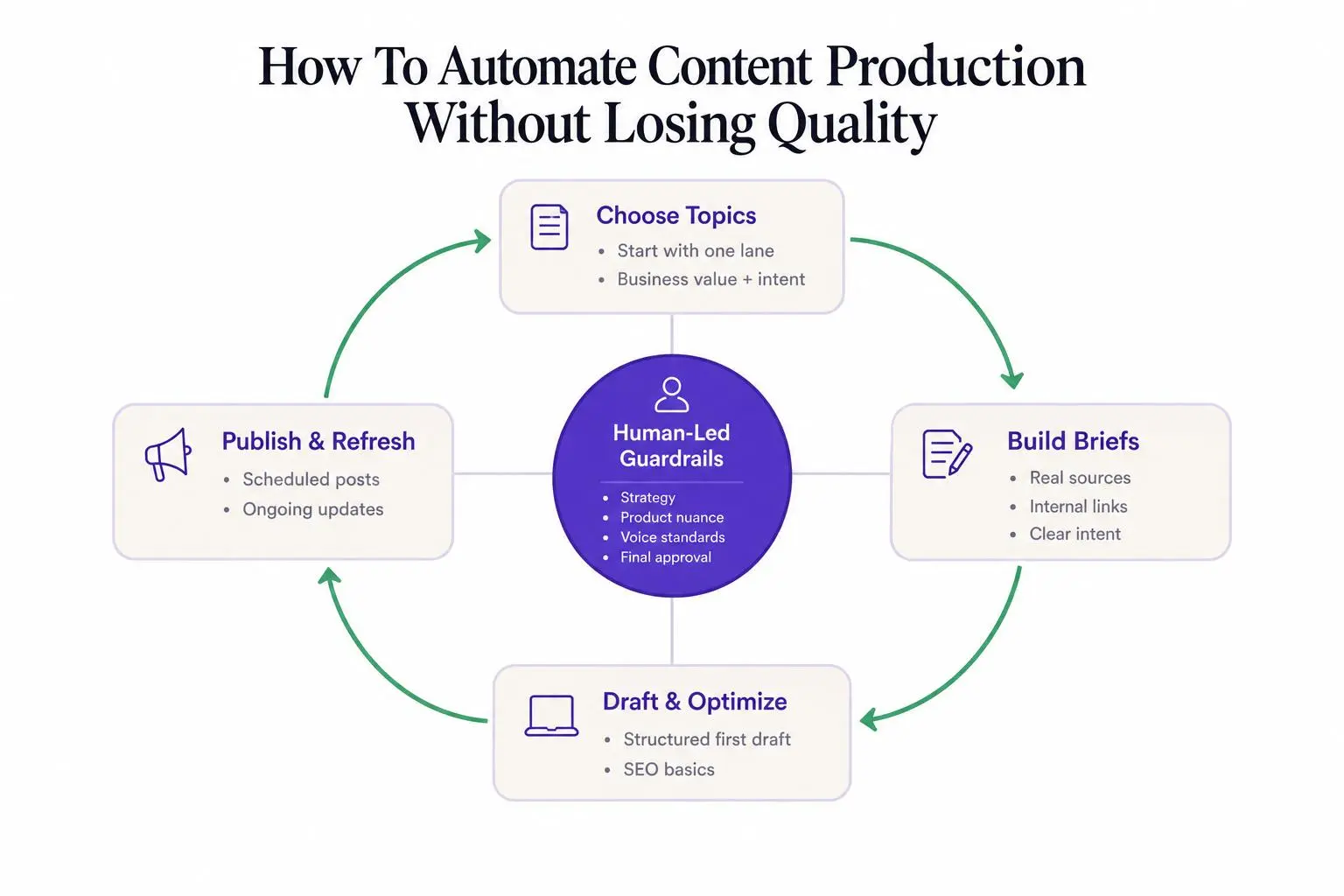
If you want this to stick, automate in order. Do not start at the middle.
1. Topic discovery and prioritization
Good content systems do not treat every keyword idea equally. They score topics based on search demand, buyer intent, product relevance, and content gaps.
That matters when you have fifty possible posts and capacity for eight. Mature systems often validate feasibility before writing starts. That alone saves a lot of wasted drafting.
2. Research and brief creation
This is where quality starts, not in the writing prompt.
A useful automated brief pulls in SERP patterns, competing angles, internal pages, and site context. Better research pipelines lower factual mistakes because the draft is built from source backed inputs instead of a blank page and a keyword.
3. Drafting and optimization
Now the writing engine actually has something to work with.
The draft should reflect structure, headings, metadata, internal links, and search intent. AI does better when it writes from a brief and style rules, not from "write a blog post about X." That prompt still haunts the internet.
4. Publishing and refresh cycles
This is where many teams still leak time. Someone has to format, upload, schedule, check links, and remember which older posts are slipping.
Publishing automation matters. Refresh automation matters just as much. Organic growth compounds when older assets improve instead of decay.
Build a Lean Content Marketing Workflow Before You Add More Volume
Before you increase publishing frequency, fix the workflow that will carry the load. Otherwise you are just scaling inconsistency.
Your content operating system does not need to be fancy. It needs to be clear. Document:
- content goals tied to business objectives
- topic selection rules
- voice and style guidance
- approval steps
- publishing cadence
- refresh rules
Automation works best when it mirrors a solid editorial process instead of replacing one. That is the lesson we keep seeing in stronger implementations. The better systems do not rely on one generic prompt. They break the work into separate functions that resemble how a good editorial team already thinks.
One advanced workflow used more than 20 skill modules because that is what the actual job required. Research is different from outlining. Outlining is different from editing. Editing is different from publishing.
You do not need 20 modules to start. But you should separate the logic.
A small team can still define different stages for research, outline quality, draft quality, review, and publishing. That is how you scale content production with AI without creating a mess nobody wants to own by month two.
A Step-by-Step Process to Automate Content Production Without Losing Quality
Start narrow. That is the move most teams resist, and it is usually the right one.
Core workflow
- Choose a lane
Pick one content lane. Choose a format with a clear audience and conversion path, like bottom of funnel blog posts, comparison pages, glossary entries, or category support articles. Automation is easier to control when the shape of the work is stable.
- Build inputs
Build source inputs. Gather brand guidelines, product details, pain points, approved claims, and your strongest existing posts. Systems grounded in real brand inputs produce less generic copy. This is not optional.
- Set intake rules
Set topic intake rules. Define what counts as worth publishing. Look at search intent, business relevance, difficulty, freshness, and whether the piece supports a product or service page.
- Standardize briefs
Standardize the brief. Include target keyword, audience, intent, internal links, proof points, outline goals, and conversion goal. If the brief is fuzzy, the draft will be fuzzy too.
- Generate drafts
Automate first drafts from structure, not guesswork. AI quality jumps when it gets a proper brief, examples, and page context instead of a keyword and hope.
- Review edits
Add editorial review. Check factual accuracy, voice, duplication, thin sections, and weak claims. This does not need to be a long meeting. It does need to exist.
- Schedule publishing
Automate publishing on a controlled schedule. Scheduled publishing beats random bursts every time. Consistency is not glamorous, but it wins.
- Plan refreshes
Create a refresh calendar. Revisit older posts, slipping pages, and content tied to changing search behavior.
One caution here: do not aim for fully hands off publishing on day one. Stable quality controls come first. Autopilot without guardrails is just a faster way to publish mistakes.
What Good Automation Looks Like in Practice

This gets easier to understand when you look at how strong systems actually behave.
One enterprise team replaced a fragmented video process with a continuous loop that planned, created, published, and improved output automatically. The interesting part was not the AI itself. It was the loop. The system could respond to trends faster because planning was no longer trapped in a static calendar.
In written content, another workflow got publish ready drafts down to roughly 6 to 12 minutes and used the same setup for new articles and updates. That is a very different thing from a novelty writing prompt. It is an operating model.
We have also seen campaign driven pipelines produce more than 100 pieces across multiple formats with zero manual publishing steps after approval. The phrase "after approval" matters more than people admit.
At larger scale, multi stage architectures have handled around 500 posts across several sites by splitting the work between queue management, research, drafting, SEO, and publishing agents. That sounds technical, but the core idea is simple: one system should not pretend to be every role at once.
And on the lighter end, there are teams that went from one or two posts a month to more than two posts a week without extra headcount. That is often the first real proof point. Not traffic yet. Not rankings yet. Just finally shipping.
The pattern is consistent. Automation works when it is structured, staged, and quality controlled. Not when it is treated like a magic text box.
The Metrics That Tell You Whether Automation Is Working
Do not judge this by output alone. More drafts means very little.
Start with production metrics:
- time from idea to published post
- posts shipped per month
- draft to approval turnaround time
- percentage of posts needing major rewrites
- publishing consistency by week or month
Then track SEO performance:
- indexed pages
- impressions and clicks
- rankings across target topic clusters
- internal link coverage
- traffic to product adjacent content
- refresh performance on older posts
Then connect it back to business outcomes:
- assisted conversions
- demo or trial visits from organic content
- performance of revenue influencing pages supported by blog content
A Fortune 50 content-production pilot illustrates why it helps to measure individual handoffs, not just total output. Its human-machine model reported time reductions at three separate workflow stages.
The results come from one provider-published case study, not a controlled experiment, and the client, baseline volumes, and measurement methodology are not disclosed. Treat them as useful workflow benchmarks rather than a promised outcome.
A meaningful gain might look like a 50 percent faster production timeline, a noticeable drop in review time, or much higher output without adding headcount. Those are real improvements.
Review the system at 30, 60, and 90 days. Early wins are often operational before they become visible in traffic. That is normal. If the workflow gets faster and cleaner first, you are usually on the right track.
Common Mistakes That Make Automated Content Fail
Most automation failures are not model failures. They are management failures.
Here is where teams usually go wrong:
- publishing at scale before setting editorial standards
- treating AI like a writer instead of a workflow component
- generating from keywords with no research inputs
- ignoring search intent and publishing generic pages
- removing human approval too early
- disconnecting content from product or customer acquisition goals
- overproducing drafts while neglecting internal linking, distribution, and updates
- assuming more content automatically means more growth
The best systems are rarely the most hands off. They are the ones with guidance, review, and learning loops built in.
If you want to grow blog without hiring writers, volume alone is not the win. Credibility still matters. So does usefulness. A hundred mediocre posts can waste more time than ten solid ones.
How to Choose the Right Setup for Your Team
There are three common paths, and they are not equally useful at the same stage.
A DIY prompt and docs setup works when publishing volume is low, the editor is deeply involved, and you do not need workflow automation or CMS scheduling. Fine for testing. Not great for scale.
A stitched tool stack works when your team has operations capacity. You can manage separate tools for keyword research, drafting, editing, and publishing. Some teams like that control. Some teams slowly drown in handoffs.
An end to end platform makes more sense when you want one system to handle topic discovery, article generation, scheduling, publishing, and refreshes without building the machinery yourself. Especially if you want approval control instead of blind bulk posting.
That is where our own setup fits. Intelliminds SEO Automation Software is built for the content side of SEO: automated keyword research, AI writing, auto publishing to your CMS, and content refreshing, while keeping a human in the loop. Intelliminds SEO Autoblogger is the tighter fit if your main goal is controlled blog automation tied to search intent and scheduled CMS publishing rather than draft only output.
The right choice comes down to workflow maturity. If your team wants scale without stitching together infrastructure, an end to end system usually removes more friction than it adds.
| Option | Best when | Handles | Key caveat or fit |
|---|---|---|---|
| DIY prompt and docs setup | Publishing volume is low, the editor is deeply involved, and you do not need workflow automation or CMS scheduling | Prompt and docs based drafting | Fine for testing; not great for scale |
| Stitched tool stack | Your team has operations capacity | Separate tools for keyword research, drafting, editing, and publishing | Some teams like the control; some teams slowly drown in handoffs |
| End to end platform | You want one system to handle the workflow without building the machinery yourself and you want approval control | Topic discovery, article generation, scheduling, publishing, and refreshes | Usually removes more friction than it adds for teams that want scale without stitching together infrastructure |
| Intelliminds SEO Automation Software | You want content side SEO automation while keeping a human in the loop | Automated keyword research, AI writing, auto publishing to your CMS, and content refreshing | Built for the content side of SEO |
| Intelliminds SEO Autoblogger | Your main goal is controlled blog automation tied to search intent and scheduled CMS publishing | Controlled blog automation and scheduled CMS publishing | Tighter fit than draft only output |
Small Automations That Remove Friction Immediately
You do not need a full platform to get quick wins.
A few smaller automations can save time right away:
- Use a title ideation tool to avoid wasting half an hour on headlines. Our Blog Title Generator gives multiple SEO friendly title ideas from a keyword and audience.
- Standardize URL slugs with a repeatable process so posts go live with clean, readable permalinks.
- Check indexing after publishing or refreshing. Do not assume Google picked up the page. Our Google Index Checker can batch check up to 20 URLs, which is handy when you publish in batches.
These are support tools, not substitutes for a full system. Still useful. Still worth doing.
What to Expect in the First 90 Days
Keep your expectations grounded. The first gains are usually operational.
In the first 30 days, audit the current workflow, choose one content lane, gather source inputs, and define style, QA, and approval rules.
From days 31 to 60, launch a controlled publishing cadence. Compare automated drafts to your current manual output. Tighten the brief, prompt logic, and review standards. This is where the system starts acting less like a tool and more like a process.
From days 61 to 90, expand only after quality stabilizes. Start measuring indexing, rankings, and production speed. Add refresh automation for older posts once the new content flow feels stable.
What usually improves first:
- turnaround time
- publishing consistency
- manual workload
- clarity around who approves what
Traffic gains often come later. That does not mean the system is failing. It means you are building the part that compounds.
If your goal is how to scale SEO content without hiring writers responsibly, this is the sensible path. Not flashy. Effective.
Conclusion
Scaling content does not have to mean more writers, more chaos, or more disconnected tools.
The better model is simpler: let AI handle repetitive research, drafting, publishing, and refreshing, while your team keeps strategy, quality, and brand judgment close. That is how you automate content production without hollowing out the work.
Start with one content lane. One approval process. One publishing rhythm.
If your team wants a cleaner path to a lean content marketing workflow, it is worth looking at whether an end to end platform like Intelliminds matches how you want to scale organic growth.
Article Record
ReferencesPrimary sources used for this article
- Fortune 50 Company Cuts Content Production Time by 50% While Staying On-Brand with New Seer-Crafted AI Content Model (SCAI)
- How I Do Content Engineering with Claude Code
- From 0 to 500+: How We Built an AI Content Pipeline That Generates Traffic | BattleBridge
- Bajaj Marketing Content GenAI: AI-Powered Content Generation for Automotive | AiSPRY Case Study · AiSPRY
- How we built AirIQ a Content Marketing System That Runs Itself — Aurora Designs