
Most teams treat seo for demand generation like a keyword quota. You publish, traffic ticks up, and pipeline barely moves.
What matters is the workflow behind the content: the buyer question, the next click, the handoff to revenue (that's the part people miss).
A few things worth getting right early:
- Problem-first topics usually beat broad traffic bait.
- Comparison and use case pages often do more than big blog posts.
- If publishing and refresh stay manual, scale stalls. Fix that, and you get cleaner pipeline.
What SEO for Demand Generation Really Means
SEO for demand generation is not just about catching people who already know what they want. It's about showing up earlier, when the buyer feels the problem but hasn't named the category yet, and later, when they're comparing options with real purchase intent.
Classic SEO mostly captures existing demand. Someone searches a known solution, vendor type, or category term, and you try to win the click. Useful, but incomplete. Demand generation SEO does more. It targets symptom-aware and early-research searches, helps shape how buyers define the problem, and influences what they look for when they finally evaluate solutions.
That matters because most buyers do a huge amount of research before sales ever sees them. By the time a demo request lands in your CRM, search has often done part of the selling already.
SEO is not just a traffic channel. It's a demand channel with a long memory.
The advantage is not publishing more articles. It's building a demand gen content process that turns research into content that actually moves pipeline.
Why Most SEO Content Programs Feel Busy but Do Not Create Pipeline
A lot of teams aren't failing from lack of effort. They're buried in effort. Too many topic ideas, inconsistent publishing, blurry ownership, and reporting that says plenty about traffic but almost nothing about revenue.
The structural problem is usually simple. SEO gets designed around rankings and search volume first. Pipeline gets bolted on later, if it gets added at all. So the team stays busy, but the business impact stays thin.
This is how traffic theater starts:
- the team celebrates rankings, sessions, and backlinks
- leadership asks where the demos and SQLs are
- informational content pulls in visitors who were never close to buying
We've seen this pattern enough to be blunt about it. If the workflow starts with keywords and ends with pageviews, you don't have a growth system. You have publishing activity.
The frustrating part is that organic search can be one of the strongest demand channels in the mix. Recent B2B datasets often report organic search driving more than half of inbound leads and around 44.6 percent of total B2B revenue in some cases. B2B SaaS research also keeps pointing to strong long-term ROI, with payback often showing up within months when attribution is tied to pipeline early.
A scalable organic pipeline content workflow starts with buyer decisions and measurement. Production comes after that. Not the other way around.
The Mindset Shift From Keyword Lists to Demand States
Keyword lists are not buyer intent. They're clues. Sometimes useful ones. Sometimes very misleading ones.
The better model is demand states. A buyer may be:
- unaware or only symptom-aware
- problem-aware
- solution-aware
- vendor-aware
- comparison and decision-ready
The same keyword can mean different things depending on where that person sits. A search like "improve customer retention" might come from someone diagnosing a churn issue, or from someone quietly building a shortlist for software. Same phrase, different buying motion.
That's why we prefer mapping content to questions and decisions instead of relying on broad funnel labels. Top, middle, and bottom sound tidy, but buyers don't move that cleanly.
Problem-first searches are where a lot of missed opportunity lives. People search what feels wrong before they search for a product. Stalled growth. Messy operations. Weak campaign performance. Inconsistent acquisition. Disengaged teams. Those searches often carry more commercial value than they look like on a volume report.
When you work from demand states, a few things improve fast:
- topic selection gets tighter
- internal linking becomes more strategic
- content aligns better with how buying actually happens
- high-volume but low-fit topics stop eating your calendar
That's a better operating model for seo for demand generation.
The Anatomy of a Scalable Demand Generation Content Workflow
Scale doesn't come from doing everything faster. It comes from sequencing the work so the system keeps moving without constant rescue.
A healthy seo content workflow for demand generation teams has five connected layers:
- audience and demand research
- topic prioritization
- content production
- publishing and distribution
- refresh and optimization
Each layer needs clear inputs, owners, outputs, and success metrics. If one of those is vague, the whole system starts slipping by the second week.
A solid workflow should give you:
- predictable topic selection
- a consistent publishing schedule
- content tied to intent and conversion paths
- refresh cycles for aging assets
- feedback loops from sales, CRM, and performance data
This is the bridge between strategy and execution for lean in-house teams, agencies, and growth marketers. And AI has a role here, but a specific one. It should reduce repetitive work, not replace judgment.
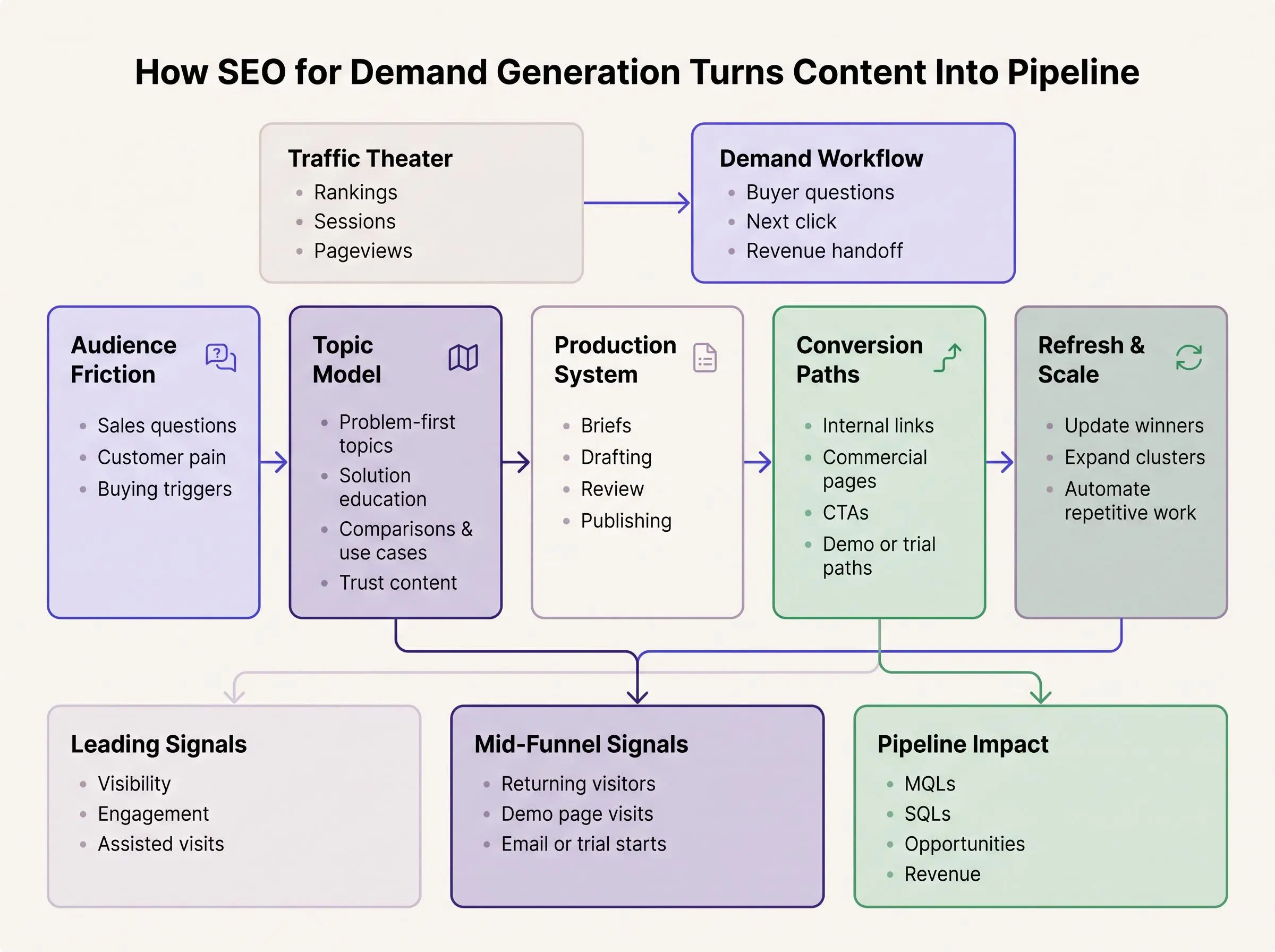
Start With Audience Friction, Not Content Calendars

Don't start with the calendar. Start with the friction.
The raw material for demand generation content is already around you:
- sales call notes
- onboarding questions
- customer success tickets
- objections from demos
- product or service FAQs
- site search queries
- keyword research that reflects real problems
You're looking for recurring patterns. What problem do people describe in their own words? What bad workaround have they already tried? What event made them start researching now? The language before category awareness is usually the most revealing.
Build a simple demand map for each audience segment:
- pains
- desired outcomes
- buying triggers
- decision criteria
- common alternatives
The specifics change by business type. Ecommerce teams care about product discovery, category demand, and acquisition efficiency. SaaS teams care about integrations, use cases, proof, and evaluation friction. Service providers need education, trust, and differentiation earlier in the journey.
This step narrows the field. That's the real benefit. A content system for lead gen teams gets easier when you're no longer choosing from 500 possible topics that all sound vaguely reasonable.
Build a Topic Model That Balances Demand Creation and Demand Capture
Most content plans lean too hard in one direction. Either they over-index on broad education that never converts, or they obsess over bottom-funnel pages and miss the chance to shape demand earlier.
A better topic model has four buckets:
- problem-first education
- solution education
- commercial evaluation content
- trust-building content
Problem-first education helps buyers name the issue. Solution education introduces frameworks, approaches, and categories. Commercial content handles comparisons, alternatives, use cases, and integrations. Trust content adds proof, lessons, and original insight.
Low-volume commercial topics often outperform high-volume awareness topics on pipeline. That's not a theory. It's a pattern. Comparison and use-case pages can produce far more pipeline per visit than broad educational posts.
Use a prioritization model that forces discipline:
- ICP relevance
- demand state
- conversion potential
- search evidence
- internal link fit
- refresh or expansion opportunity
Build clusters around revenue themes, not just big keywords. That's where the topic model starts acting like a growth system instead of a list.
If your topic universe is large and your team is small, automation helps here. Intelliminds can automate topic discovery and planning around your website, audience, products or services, and existing content, which makes this stage much more manageable without turning it into guesswork.
Turn Strategy Into a Repeatable Demand Gen Content Process
Strategy is only useful if it survives contact with the weekly workflow.
For each asset, the process should be straightforward:
- choose the demand state and target query
- define the business goal
- identify the conversion path
- create the brief
- draft the article
- review for positioning, proof, and relevance
- optimize on-page structure
- publish
- distribute
- monitor and refresh
A strong brief should answer a few basic questions clearly:
- who is this for
- what is the reader trying to understand or decide
- what misconceptions need correcting
- what examples belong here
- what next step should feel natural
For example, imagine a SaaS team choosing a problem-aware topic about inconsistent campaign performance. The strategist records the audience, demand state, target query, and business goal in the brief. The writer explains likely causes and links to solution education. The subject-matter reviewer checks the claims and examples. The SEO reviewer confirms the heading structure and internal links. Before publishing, the owner verifies the CTA, metadata, analytics event, and distribution handoff. After publication, the same asset enters the refresh queue with an owner and review date.
Use this handoff checklist for every asset:
- [ ] demand state and target query are documented
- [ ] business goal and conversion path are clear
- [ ] subject-matter and positioning review are assigned
- [ ] internal links connect the page to the next relevant decision
- [ ] CTA, metadata, tracking, and publishing details are checked
- [ ] distribution owner and refresh date are recorded
Bottlenecks usually show up in familiar places. Topic approval stalls. Draft review drags. Legal review appears late. Publishing handoff gets messy. Nobody owns refresh.
The best workflow for growth marketers separates judgment from repetition. Humans should own audience nuance, positioning, and offer framing. Systems should handle research synthesis, formatting, scheduling, and production support. If your senior marketers are still manually rebuilding briefs every week, something is off.
Create Content That Moves Readers From Curiosity to Consideration
Demand generation content should move the reader forward, not just answer the current question and leave them there.
Early-stage content should do four things well:
- name the problem clearly
- explain why it matters now
- help the reader diagnose causes
- introduce a better lens
Mid-stage content should help buyers evaluate the landscape. Frameworks, category education, evaluation criteria, and tradeoff-oriented guidance work well here. This is where you shape how the market judges solutions.
Decision-stage content needs less storytelling and more clarity. Comparisons, alternatives, integrations, use-case pages, and implementation expectations should remove friction, not add polish.
A good article should answer the next question before the reader leaves. Internal linking matters more than most teams think:
- problem pages should link to solution education
- solution education should link to use cases and comparisons
- commercial pages should point cleanly to conversion actions
Tone matters too. Your audience is usually short on time and already balancing three priorities at once. Be practical. Be specific. Don't write like you're trying to win an award.
Publishing Consistency Is a Workflow Problem, Not a Motivation Problem
Inconsistent publishing is rarely a creativity problem. It's usually an operating problem.
Search compounds through consistency. Teams also perform better when the rhythm is predictable. Once a publishing calendar becomes aspirational, output falls apart quietly.
The minimum system is not complicated:
- a topic queue by priority
- an editorial calendar
- status tracking
- a CMS publishing checklist
- post-publish QA
Cadence should match capacity. Solo marketers need fewer, better-prioritized assets. Agencies need repeatable standards across clients. In-house teams need clear role ownership across SEO, content, design, and RevOps.
If drafting, scheduling, and publishing are still manual, scale breaks fast. The operational drag sneaks up on you.
For teams that want less manual content work, Intelliminds can automate article creation, scheduling, and publishing while marketers stay focused on approvals, messaging, and growth priorities.
Refreshing Content Is Part of the Workflow, Not Cleanup Work
Published once and forgotten is not a content strategy. It's a slow leak.
A refresh program should catch things like:
- declining rankings
- outdated examples
- missing internal links
- weak conversion paths
- new buyer objections
- pages that rank but don't influence pipeline
The decision framework can stay simple:
- update if the topic still matters and has traction
- expand if the page can cover adjacent intent
- consolidate if overlap is diluting performance
- retire if the content no longer matches demand
Older articles often create first-touch awareness. Refreshed content can improve assisted conversions even when last-click numbers barely move. That's easy to miss if you're only looking at surface metrics.
Compounding growth comes from maintaining winners, not just producing net-new pages. Intelliminds is useful here too, because content refreshing is exactly the kind of repetitive work that becomes a burden as the library grows.
Measure Organic Search Like a Demand Channel
Sessions and rankings are useful, but they are not enough for seo for demand generation.
Use a layered measurement model.
Leading indicators
- indexed pages
- visibility
- engagement
- assisted visits
- internal click paths
Mid-funnel indicators
- returning visitors
- branded search lift
- email signups
- trial starts
- demo page visits
Pipeline indicators
- MQLs
- SQLs
- opportunities
- sourced pipeline
- influenced pipeline
- closed revenue
Buyers may first discover you through AI tools or an educational article, then come back later through Google, direct traffic, or branded search. If you only credit the final click, SEO looks weaker than it really is.
At minimum, do this:
- connect CRM stages to key URLs and conversion events
- add self-reported source fields on forms
- track first-touch and last-touch
- review assisted conversions for non-commercial pages
Early success often looks quieter than people expect. Stronger branded search. More repeat visits from target accounts. Better performance on commercial pages supported by educational clusters. That's real progress.
The New Workflow Needs an AI Search Layer Too
Search behavior is changing. Buyers now ask AI tools for recommendations, definitions, and shortlists before they click through to websites, if they click at all.
That changes the workflow in a practical way. Content needs to be clear, structured, specific, and trustworthy enough to be surfaced or cited in AI-generated answers. Category pages, comparison pages, and original insights matter more because they help shape recommendations upstream.
Think in two paths:
- traditional search captures active clicks and bottom-funnel intent
- AI-mediated discovery influences awareness and shortlisting earlier
Adjust the workflow accordingly:
- add concise definitions to relevant pages
- include clear use cases and business context
- keep factual consistency across the site
- refresh pages that support category understanding and comparisons
This doesn't replace classic SEO fundamentals. It expands the workflow so you can influence both search results and AI-assisted discovery.
Common Mistakes That Break a Demand Gen Content Workflow
A few mistakes show up over and over, and they usually break the system before anyone names the real issue.
- Chasing volume over buyer relevance. You get traffic that looks healthy and pipeline that doesn't.
- Publishing disconnected blog posts. Readers learn something, then hit a dead end instead of a commercial path.
- Treating intent as static. Buyers change questions as they move. The content should reflect that.
- Measuring last-click only. Awareness content gets undervalued and eventually cut.
- Skipping refresh cycles. Winners decay slowly, then suddenly.
- Letting approvals bottleneck the calendar. One delayed reviewer can quietly wipe out a month of rhythm.
- Assuming AI-generated content alone creates demand. It doesn't. Without strategy, it just creates more text.
- Building only top-of-funnel content. Education without comparisons, use cases, and alternatives rarely closes the loop.
- Writing for search engines first and the buying committee second. Rankings might improve. Trust usually doesn't.
If you recognize three or four of these in your current process, the problem is structural, not tactical.
A 90-Day Plan to Build Your Workflow for Growth Marketers
You don't need a year to fix the system. You need a disciplined first 90 days.
Days 1 through 15
- audit existing content, conversion paths, analytics, and indexation basics
- interview sales, success, and marketing stakeholders
- define ICPs, demand states, and revenue themes
- find quick wins on pages already attracting relevant traffic
Days 16 through 30
- build the topic model and prioritize clusters
- map internal links from education to commercial pages
- create templates for briefs, outlines, and review steps
- set reporting for first-touch, last-touch, and self-reported attribution
Days 31 through 60
- publish the first wave across multiple demand states
- improve the commercial pages that will receive those links
- establish a weekly publishing rhythm
- train team members on roles and handoffs
Days 61 through 90
- review early engagement and conversion signals
- refresh underperforming pieces quickly
- expand winning topics into clusters
- tighten CTA placement and conversion paths
Set expectations correctly. Technical stability and measurement come first. Demand generation through search compounds over time. In B2B SaaS, payback often lands around month 6 to month 12 when attribution is set up early.
How to Choose the Right System for Scaling Without Adding Manual Work
The right system should make the workflow calmer, not more complicated.
Ask a few direct questions about your current stack:
- can it surface topic opportunities from your site and audience context
- can it support consistent drafting and publishing
- can it help maintain cadence
- can it support refresh cycles as the library grows
- can it reduce manual work without removing editorial control
Keep these human-led:
- audience understanding
- brand positioning
- offer framing
- editing for trust and nuance
- conversion strategy
Automate the work that drains time without adding judgment:
- topic discovery
- outline generation
- first-draft creation
- scheduling
- publishing workflows
- refresh prompts
Intelliminds is a practical fit for brands and agencies that want help automating topic research, article writing, scheduling, publishing, and refresh support around their website and existing content. The real value is not speed for its own sake. It's a more reliable workflow for growth marketers, with less manual drag and more room for judgment.
Frequently Asked Questions About SEO for Demand Generation
What is SEO for demand generation?
SEO for demand generation targets buyers before they have fully named a category, as well as buyers comparing solutions with purchase intent. It uses search content to help buyers define problems, understand solutions, and evaluate options.
How do you start an SEO workflow for demand generation?
Start with audience friction rather than a content calendar. Use sales call notes, onboarding questions, customer success tickets, demo objections, FAQs, site search queries, and problem-focused keyword research to identify recurring pains, triggers, desired outcomes, decision criteria, and alternatives.
What types of content support demand generation SEO?
A balanced topic model includes problem-first education, solution education, commercial evaluation content, and trust-building content. Prioritize topics by ICP relevance, demand state, conversion potential, search evidence, internal-link fit, and refresh opportunity.
How should you measure SEO for demand generation?
Measure organic search with leading indicators such as visibility and engagement, mid-funnel indicators such as returning visitors and demo page visits, and pipeline indicators such as MQLs, SQLs, opportunities, sourced pipeline, influenced pipeline, and closed revenue. Connect CRM stages to URLs and conversion events, and review first-touch, last-touch, and assisted conversions.
How does AI search affect demand generation SEO?
The workflow should support both traditional search and AI-mediated discovery. Keep content clear, structured, specific, and trustworthy; add concise definitions, clear use cases, business context, and factual consistency across the site; and refresh pages that support category understanding and comparisons.
Conclusion
SEO for demand generation works best when it's run as a workflow, not a collection of isolated blog tasks.
Start with audience friction and demand states. Build a topic model that balances demand creation with demand capture. Standardize production and publishing. Refresh what works. Measure contribution to pipeline, not just traffic.
If you want a practical next step, audit one quarter of your existing content against demand states and conversion paths. You'll usually spot the gaps fast. Then identify where automation can remove repetitive work so your team can publish with more consistency and a lot less strain.
More content is not the goal. A compounding system is.
Article Record
ReferencesPrimary sources used for this article
Update HistoryMeaningful revisions to this article
- Added a practical example to show how to turn strategy into a repeatable demand generation content process.
- Added five frequently asked questions about SEO for demand generation to help readers find answers more easily.