
Most teams use an AI content brief generator like a faster outline tool. That usually breaks the handoff. You get headings and keywords, then drafts that miss intent or sound like everyone else.
What matters is whether the brief cuts rewrites and gives writers a real angle. If you run SEO for a SaaS brand, store, service business, or agency, don't skip this stuff.
Start here:
- Lock search intent before word count.
- Set the angle, not just the topic.
- Add links, conversion context, and must include points. The draft gets sharper fast.
What an AI Content Brief Generator Actually Does
An ai content brief generator turns a topic or keyword into a writer-ready plan. Done well, it doesn't just give you headings. It pulls together search intent, SERP patterns, related subtopics, and the practical instructions a writer needs to produce something that can rank and still make sense for the business.
There are really two jobs hiding inside that phrase.
First, there's the research and structure layer. That includes title direction, likely subtopics, common questions, entity coverage, and a draft outline based on what's already ranking. Most tools can do some version of this.
Then there's production support. This is where stronger workflows separate themselves. A good brief shouldn't die in a doc. It should feed drafting, internal linking, publishing, and later refresh decisions. Otherwise you're just automating a prep step and leaving the rest of the mess untouched.
That distinction matters because teams often confuse three different tools:
- An AI brief generator helps decide what the article should cover, for whom, and why
- An AI writer generates prose
- A basic outline generator lists headings, often without strategic context
Those aren't the same thing. A list of H2s isn't a content strategy.
For brands and agencies, the core benefit is straightforward:
fewer vague assignments, less rework, and a cleaner path from topic idea to publishable content
When the brief is solid, writers spend less time guessing. Editors spend less time fixing avoidable misses. And the whole workflow starts to behave like a system instead of a series of handoffs held together by Slack messages.
Why SEO Teams Get Stuck Without a Repeatable Brief System
Most teams don't fail because they lack ideas. They fail in the handoff between research and writing.
Manual brief creation quietly eats time. By the time someone reviews the SERP, checks competing pages, clusters supporting terms, and maps a structure, you're often 30 to 45 minutes into a single article. Multiply that across a weekly calendar and you start losing half-days to prep work before a draft even exists.
So people rush it. That's where the quality drift starts.
You'll recognize the symptoms:
- a keyword and word count passed off as a brief
- inconsistent output across freelancers, in-house writers, or agency contributors
- clarifying questions before drafting even begins
- articles that are technically on-topic but feel interchangeable
- a slow publishing calendar despite plenty of demand
The editorial pain is obvious. The business cost is usually worse.
If intent is off, rankings lag. If buyer context is missing, conversions suffer. If every draft needs heavy editing, content becomes expensive in a way most spreadsheets don't capture. And if your team keeps publishing isolated articles without a clear briefing standard, topical authority never compounds.
We've seen this enough to be blunt about it. The brief is not admin work. It's the leverage point between strategy and execution.
If that layer is weak, everything downstream gets noisier.
What a Writer-Ready SEO Brief Needs to Include
A useful brief is more than keywords and a word count target. That's not a brief. That's a vague assignment wearing SEO clothing.
A writer-ready brief should cover the essentials clearly:
- primary keyword and supporting keywords
- search intent classification
- target audience and knowledge level
- article goal and conversion context
- the angle that differentiates the piece
- must-cover questions, entities, and subtopics
- recommended heading structure
- internal links to include
- external references or proof points needed
- on-page direction such as title and meta notes
Audience definition is one of the most overlooked pieces here. It affects far more than tone. A SaaS buyer evaluating software needs a different article than a beginner learning the category. An ecommerce shopper comparing options doesn't need the same level of explanation as a service buyer trying to reduce risk. If you miss that distinction, the content may still rank, but it often won't move anyone forward.
Word count deserves a quick reality check too. Treat it as a SERP benchmark, not a ranking formula. Longer isn't better by default. Sometimes a bloated article is just a confused one.
It also helps to separate non-negotiables from optional ideas. Writers need to know what cannot be skipped versus what can be added if it strengthens the piece. That small distinction cuts revision cycles more than most teams expect.
Modern briefs also need to account for AI-driven discovery, not just traditional blue-link rankings. Increasingly, that means building in:
- direct answer sections
- strong question coverage
- extractable structure
- clean organization that machines can parse easily
The brief should make the article easier to understand before it exists. That's the job.
Brief Generator vs Outline Generator vs Full Content Workflow
A lot of disappointment with AI comes from buying one kind of tool and expecting another.
An outline generator answers one narrow question: what headings might this article include? A brief generator goes further. It addresses what to cover, why it matters, who it's for, and how the piece should win. A full workflow platform connects planning to execution.
You can think about the tooling in three levels:
Basic generators
Good for quick title ideas and header suggestions. Fast, but usually thin.SEO-first brief tools
Better at SERP analysis, subtopic coverage, and competitor pattern recognition.End-to-end platforms
These connect topic research, briefing, writing, scheduling, publishing, and refreshing.
The right choice depends less on feature lists and more on where your team actually breaks.
A solo marketer usually needs speed and consistency. An in-house team needs clean handoffs and governance. Agencies need repeatable article brief workflow standards across clients without turning every assignment into a custom research project.
This is where the bigger workflow question shows up. If your problem is broader than brief generation alone, disconnected tools start creating their own overhead. At Intelliminds, we built around that reality. For teams that need topic discovery, article writing, scheduling, and publishing in one operating flow, the brief works better when it isn't stranded in a separate document.
How to Automate Content Briefs and Outlines Without Losing Strategy
The fear is reasonable. Nobody wants faster briefs if the output sounds like every other AI article on the internet.
Automation should remove research friction, not replace judgment.
A practical way to handle how to automate content briefs and outlines looks like this:
- start with a keyword or topic tied to a real business priority
- pull live SERP patterns, ranking headings, related terms, and common questions
- review your existing site to avoid overlap and find internal link opportunities
- let AI synthesize that input into a brief and initial outline
- add the human layer: positioning, product context, first-hand expertise, and exclusions
That last step matters more than people admit. Tools can infer patterns. They can't cleanly infer what your company should not say, which use cases matter most, or where your point of view should sharpen the piece.
The best workflows start from the SERP, not instinct alone. But they don't end there either.
A strong system shifts human effort upstream. Your team should spend time on topic selection, angle-setting, and intent interpretation, not rebuilding the same research packet every Tuesday afternoon. That's where seo outline automation and content planning automation actually help. They reduce drag so judgment can move closer to strategy.
A Practical Article Brief Workflow for Smarter SEO Execution
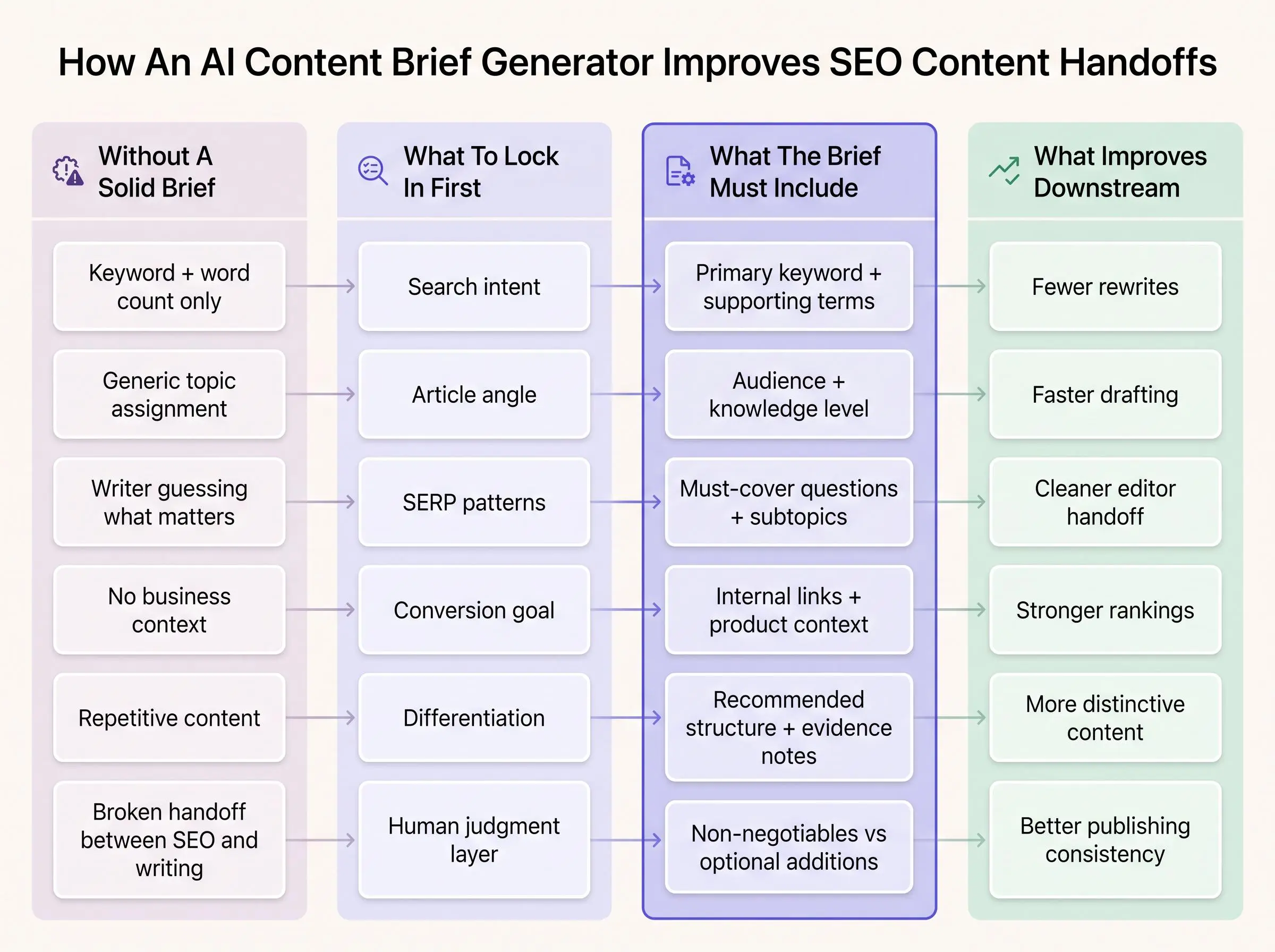
If your process feels loose, tighten it with a repeatable sequence. Not because process is exciting. Because inconsistency is expensive.
Here is an article brief workflow you can adopt immediately.
1. Choose topics with business relevance
Prioritize topics tied to customer questions, product categories, service lines, or high-value use cases. Avoid briefs for keywords that might bring traffic but don't fit the brand. Random traffic is not a growth strategy.
2. Classify dominant intent
Decide whether the query is informational, commercial, navigational, or transactional. Then look at the page types ranking today. Are they guides, comparison pages, templates, or product pages? The SERP usually tells you what format the market expects.
3. Analyze what ranks now
Look for recurring subtopics, heading patterns, answer styles, and depth expectations. Then look for the gaps. Outdated advice, weak examples, missing buyer context. That's usually where the opportunity lives.
4. Define the winning angle
Be explicit about how your article will be better. Clearer? More specific? More useful for a growth-stage SaaS team, an ecommerce operator, or an agency managing multiple sites? If you can't answer that, the brief is still half-built.
5. Build the brief
Include must-cover points, supporting terms, entities, structure, internal links, and conversion notes. Mark anything that needs subject matter input before drafting. Don't wait until the edit round to discover a missing example.
6. Generate or assign the outline and draft
Use the brief as the source of truth. The goal is to reduce subjective rewrites by making expectations explicit before writing starts.
7. Publish, measure, and feed learnings forward
Use performance data to improve future brief creation for seo. Publishing should create feedback for the next cycle. If it doesn't, your process stays static while the SERP moves.
What Good SEO Outline Automation Looks Like in Practice
Useful automation doesn't force every article into the same mold. That's one of the fastest ways to end up with bland content at scale.
A strong automated outline usually has a few clear traits:
- a clean H2 and H3 hierarchy
- logical progression from explanation to decision or application
- sections with distinct jobs and minimal overlap
- question coverage based on real user needs
- room for examples, comparisons, and decision criteria
The structure should also match the content type.
A SaaS article often needs pain points, workflow detail, and ROI framing. Ecommerce content usually benefits from selection criteria, use cases, and comparison logic. Service businesses need trust signals, process clarity, and sometimes local or industry nuance. Agencies often need repeatable templates, but those templates still have to flex around client goals.
One quiet sign of weak seo outline automation is when every piece starts looking structurally identical by the third or fourth article. Writers feel it. Readers feel it too.
Good automation separates essential sections from optional expansions. That helps teams prioritize what affects ranking and conversion instead of padding every piece to hit a length target. It also creates room for concise, answer-ready blocks that AI-driven search surfaces can extract cleanly.
And yes, outline quality affects downstream operations. Cleaner structure makes editing faster, internal linking easier, and publishing cadence more reliable.
How to Evaluate an AI Content Brief Generator Before You Commit
Most tools look good in a demo. The real question is whether the output reduces work once you're publishing every week.
Start with a few practical checks:
- does it use live search inputs or mostly generic model output
- how well does it identify intent and content type
- can it surface competitor coverage without just echoing it
- does it consider your existing content and internal link opportunities
- can non-technical team members use it consistently
Then test for workflow fit, which matters just as much:
- can it support a weekly publishing schedule
- can it standardize briefs across writers or client accounts
- does it help refresh old articles, not just create new ones
- can it connect planning with writing and publishing
Cost should be judged against total workflow savings, not subscription price alone. If a tool saves strategist time, reduces revisions, and helps you publish consistently, the math is different. If it generates polished-looking briefs that still leave writers guessing about audience, angle, or required evidence, then the polish is cosmetic.
For teams that want the brief to feed directly into article generation, scheduling, publishing, and ongoing planning, Intelliminds is relevant here for a reason. The benefit isn't just faster briefs. It's fewer broken handoffs.
Common Failure Modes That Make AI Briefs Useless
Bad AI briefs usually fail in familiar ways. The frustrating part is that they often look organized at first glance.
Failure: Treating the brief as the final output instead of the input to better content.
Fix: Frame the brief as a living guide—require writer edits, examples, and an approval step before publishing.
Failure: Automating only the easy research layer while leaving differentiation unresolved.
Fix: Add explicit prompts for unique angles, proprietary insights, or perspectives that require human input.
Failure: Copying the SERP too closely and reproducing the same article everyone else has.
Fix: Require a gap-analysis line in the brief: "What does the top result miss?" and instruct writers to fill that gap.
Failure: Using word count or keyword density as a stand-in for intent coverage.
Fix: Replace counts with intent-based checklist items (questions to answer, user tasks to complete).
Failure: Leaving out audience context entirely.
Fix: Include concise audience descriptors: needs, prior knowledge, objections, and a primary conversion goal.
Failure: Missing internal links, product context, or conversion goals.
Fix: List required internal links, relevant product details, and the desired CTA for the piece.
Failure: Handing off contradictory instructions or shallow subtopics.
Fix: Run a brief-consistency pass: one-line primary message, prioritized subtopics, and one clear style/voice rule.
Failure: Ignoring refresh opportunities after publication.
Fix: Add a refresh trigger and timeline (performance signals or calendar date) and assign ownership for updates.
One more subtle failure: teams generate a brief, publish the article, and never use performance data to improve the next brief. So the process feels systematic, but it never learns.
A brief should sharpen execution. If it creates false confidence instead, it's dead weight.
How an AI Content Brief Generator Fits Into Content Planning Automation

Single briefs matter, but isolated wins don't scale. The bigger advantage comes when briefing sits inside a broader operating system.
Content planning automation connects the full sequence:
- topic discovery
- prioritization
- brief generation
- outline creation
- drafting
- scheduling
- publishing
- refreshing
This matters most for growth-stage teams. If every article still depends on manual coordination across spreadsheets, docs, and scattered editorial notes, you don't really have a system. You have effort.
The brief sits in the middle of this. It's the handoff document that keeps strategy, writing, and publishing aligned. When it's connected to planning, teams can maintain a steadier cadence, build topic clusters instead of one-off posts, reduce overlap with existing content, and collaborate with less friction.
That's the real shift. You move from reactive content production to a more controlled, performance-minded workflow. Quieter, less chaotic, and usually faster by the second or third cycle.
When to Use AI, When to Use Human Judgment, and How to Blend Both
A balanced approach works best because the strengths are different.
Use AI for the repeatable layers:
- SERP synthesis
- repetitive data gathering
- first-pass clustering
- draft structure generation
- recurring brief templates
Keep humans in charge of the leverage points:
- topic prioritization
- audience nuance
- brand messaging
- contrarian insight
- first-hand examples
- final editorial standards
We've found the most useful shift is not replacing people. It's relocating their time. Instead of manually rebuilding research every week, your team spends more energy on the decisions that actually change outcomes.
automate the repeatable research layer, then apply human judgment where originality, relevance, and trust matter most
That's the operating principle.
Conclusion
A strong brief is not busywork. It's the strategic engine behind smarter SEO workflows.
The right ai content brief generator brings search intent, writer guidance, differentiation, and publishing execution into one repeatable process. It helps you reduce vague assignments, shorten revision loops, and turn content production into something more reliable than good intentions and scattered research.
If you're evaluating your current process, start with the brief template. Look for the friction. Where are writers guessing? Where are editors re-explaining the audience or angle? Where is manual research slowing the calendar? Automate that layer first.
And if your bigger issue is not just briefing, but the disconnected flow between planning, writing, scheduling, and publishing, Intelliminds is built for that next step. Not as a shortcut for generic content, but as a way to run content planning automation with less manual overhead and a lot more control.
Article Record
ReferencesPrimary sources used for this article
Update HistoryMeaningful revisions to this article
- Reworked the Common Failure Modes section to make it easier to scan and more actionable.
- Paired each failure mode with a concise practical remedy while preserving the original claims and tone.
- Kept the section structure intact while clarifying how to avoid ineffective AI briefs.