
Most SEO plans leak value by chasing traffic that never gets near a checkout, demo request, or contact form. Buyer intent keywords change the math: fewer casual readers, more people comparing options or ready to act.
For growing brands and lean marketing teams, the hard part is reading what the search actually means, then serving the right page. A pricing search does not want a 2,000-word explainer (obvious, but missed constantly).
Here’s where to look first:
- Queries with pricing, alternatives, reviews, and industry-specific use cases
- Search results that reveal whether buyers expect a page, comparison, or product collection
- Keywords tied directly to your highest-margin offers
Find the terms that bring customers, not applause.
What Buyer Intent Keywords Really Mean
Buyer intent keywords are search terms that tell you a person is getting closer to a purchase decision. Not just learning. Not casually browsing. Moving.
That doesn't mean intent is binary. It isn't "buyer" or "not buyer." It's a slope. Some searches show early commercial interest, like "best project management software for agencies." Others are almost at the checkout line, like "project management software pricing" or a branded search with "login," "demo," or "buy."
Here's the simple split:
- General informational keywords answer curiosity
- buyer intent keywords answer buying questions
The wording usually gives it away. Terms like:
- reviews
- best
- compare
- versus
- alternatives
- pricing
- buy
- near me
- brand names
- product names
Those modifiers matter because they reveal state of mind. A person searching "CRM" and a person searching "HubSpot alternatives for small business" are not in the same moment. Treating them the same is where a lot of SEO programs quietly waste time.
Search volume doesn't fix that. A keyword with 500 searches a month can be worth far more than one with 20,000 if the smaller term brings people who are ready to act.
Traffic potential and revenue potential are not the same thing.
The best keywords are rarely the biggest ones. They're the ones that show up right when a prospect is comparing, validating, narrowing down, or trying to make the final call.
Why Buyer Intent Matters More Than Raw Search Volume
A lot of teams still chase volume because volume is easy to report. It looks good in a spreadsheet. It feels like progress.
Then six months later, traffic is up, the content calendar is full, and sales is asking why none of it turns into pipeline.
Keywords that lead to sales usually have three things going for them:
- The buying journey is shorter
- The searcher's need is easier to match with a page
- The conversion path is more obvious
That's why intent-first targeting changes content ROI. You stop trying to rank for everything remotely related to your market and start building pages for the searches that actually matter commercially.
This is where a lot of SEO strategy gets cleaner. You don't need every possible click. You need qualified clicks from people whose search behavior lines up with what you sell.
There is a tradeoff. High intent SEO keywords are often tougher. They're more competitive. In paid search, they usually cost more too. That's not a reason to avoid them. It just means prioritization matters more than enthusiasm.
We think of SEO as a customer acquisition system. Every keyword should earn its place. If it can't realistically create pipeline, sales, or qualified leads, it might still have a role, but it shouldn't be driving the plan.
The Four Intent Types and Where Sales Usually Happen
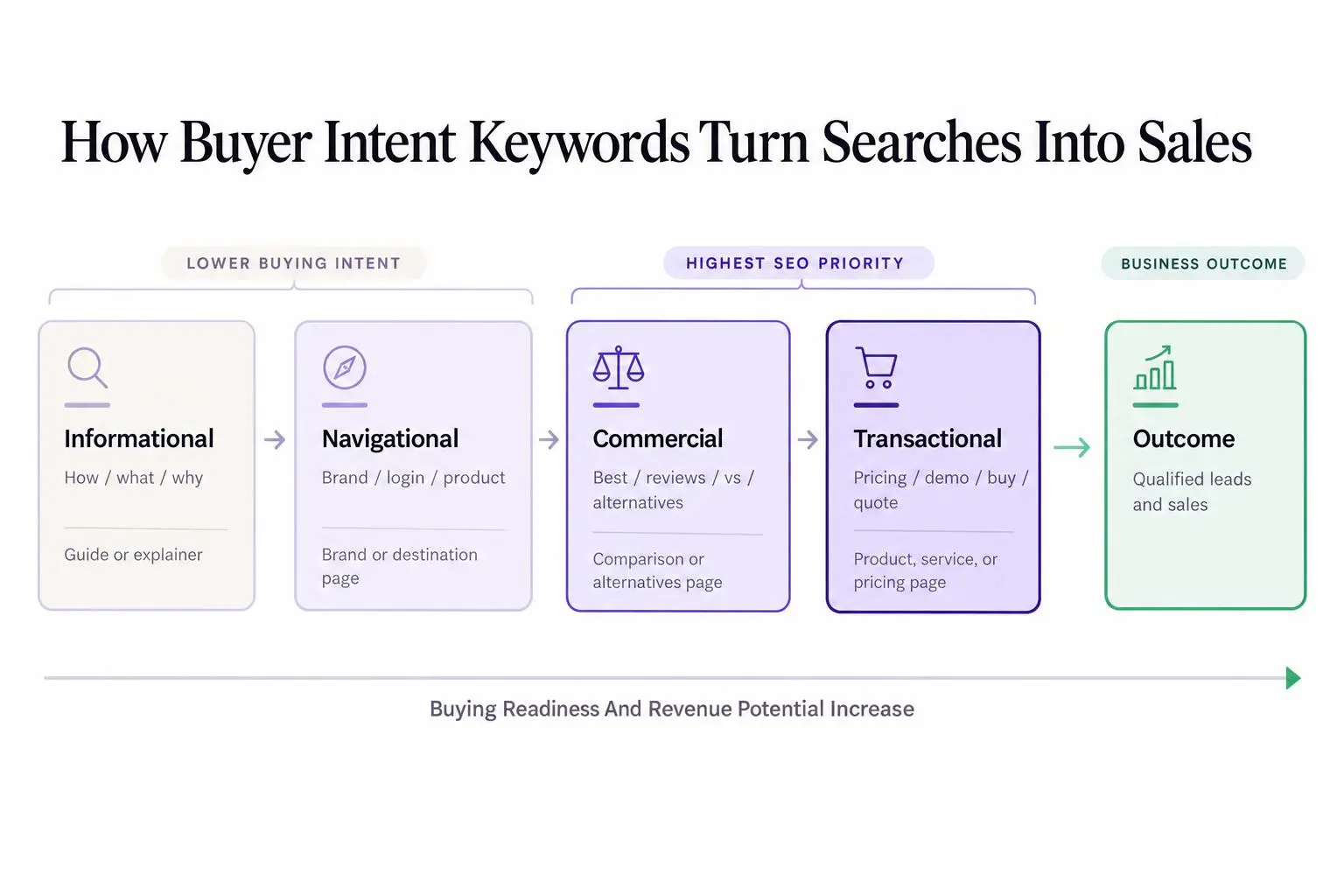
Not all intent types deserve equal weight if your goal is revenue. They each have a place, but they don't all pull with the same force.
Informational intent
These are "how," "what," "why," and problem-based searches. People are learning, diagnosing, or trying to understand the category.
Useful? Yes. Fastest route to revenue? Usually not.
Informational content is often the entry point. It builds reach and trust. But if your whole SEO strategy lives here, you're running a media program, not a demand capture program.
Navigational intent
This is when someone wants a specific site, page, or brand. They're searching for a destination, not a topic.
These can convert well because the searcher already has context. They know who they're looking for. The mistake is treating navigational terms as boring just because they don't look strategic in a keyword tool.
Commercial intent
This is where a lot of the best SEO keywords for leads sit.
Think:
- best [category]
- [brand] reviews
- [tool] alternatives
- [brand A] vs [brand B]
- top [category] for [use case]
These searches come from people actively narrowing the field. They want proof, comparison, reassurance, and fit. That makes commercial intent one of the strongest places to invest.
Transactional intent
This is decision-stage search. Buy, order, book, sign up, request service, get a quote.
Usually, these are the clearest keywords that lead to sales, especially when the query includes a brand, product, location, or specific service.
Informational intent still matters. But as search behavior moves from learning to evaluating to acting, the business value usually rises with it.
The Signals That Separate Browsers From Buyers
Intent shows up in wording, specificity, urgency, and context. Volume won't tell you that. The query itself often will.
Look at the progression:
- email marketing software
- best email marketing software for ecommerce
- email marketing software reviews
- email marketing software pricing
Same category. Very different intent.
Specificity usually raises the temperature. When a search adds industry, use case, feature need, or brand context, the person is often closer to a decision. Not always, but often enough that it should change how you prioritize.
Common high-intent modifiers include:
- reviews
- best
- alternatives
- compare
- versus
- pricing
- buy
- near me
- brand names
- product names
Branded keywords are especially important. If someone searches your brand or a known product by name, they've already done some filtering. They may still need reassurance, but they're not at the beginning.
Local intent can be just as strong. Searches like "plumber near me" or "family lawyer in Austin" don't need much interpretation. The person is usually looking for a provider now, not next quarter.
And not every strong keyword includes an obvious action word. Sometimes a product category term or branded query carries heavy purchase intent because the context is already clear.
Read the psychology, not just the numbers.
How to Find Buyer Intent Keywords in Your Market

Start with revenue paths, not blog ideas. That's the difference between content that attracts readers and content that attracts buyers.
List out:
- products or services
- categories
- use cases
- industries you serve
- buying objections
- comparison points
- pre-purchase questions
Those become your seed topics.
Then mine the language people use near the point of decision. Sales calls are great for this. Demo requests, comparison questions, support tickets that reveal hesitation before purchase, reviews that mention why someone chose you or almost didn't. This is where real conversion focused keyword research gets sharper.
Build keyword sets around intent patterns instead of random ideas:
- problem-aware terms
- solution-aware terms
- comparison terms
- brand and competitor terms
- transactional terms
Add modifiers deliberately. Use "best," "reviews," "pricing," "cost," "service," "software," "for [industry]," "near me," and branded variations. Don't guess what people mean. Force the query to reveal more.
Then check the search results. This step saves a lot of wasted work.
If the results page is full of product pages, Google expects transactional intent. If it's comparison lists and alternatives pages, the searcher is researching options. If it's guides and explainers, the query is still early.
A quick operator's rule: if the current results don't match the page you planned to make, your plan is probably wrong.
For lean teams, speed matters. Our SEO Automation Software is built to automate keyword and topic research while keeping human review in the loop. That's useful when you need scale without giving up judgment, which is where most automation breaks down.
How to Choose Keywords That Drive Conversions
Once you have a list, don't sort by volume and call it strategy. Score the keywords like an operator.
We use five filters:
- Intent strength
- Relevance to the offer
- Ability to satisfy the query with the right page type
- Ranking difficulty
- Expected business value if ranked
Relevance should outrank volume almost every time if your goal is leads or sales. A keyword can look important and still be commercially weak for your business. That's a trap, especially in SaaS and services where broad category traffic can be noisy.
Try grouping opportunities by funnel depth:
- Must-win decision-stage terms
- High-value comparison terms
- Mid-funnel commercial education terms
- Supporting informational content
This makes prioritization less emotional. Some keywords deserve immediate focus because they line up tightly with your solution and can produce qualified leads in a realistic window. Others can wait.
One more thing. High CPC can be useful signal. If advertisers keep paying for a term, there's often real commercial value there. It doesn't mean you should automatically target it, but it does mean the keyword probably matters.
Match Each Keyword to the Right Page and Content Format
Intent only becomes revenue when the page format fits the reason for the search. That's where a lot of content misses. The keyword is right. The page is wrong.
A few clean pairings:
- Transactional terms -> product pages, service pages, category pages, landing pages
- Commercial terms -> comparison pages, alternatives pages, reviews, buying guides
- Navigational terms -> brand pages, destination pages, product hubs
- Informational terms -> educational articles that lead naturally to deeper commercial pages
Misalignment kills performance quietly. A broad blog post won't satisfy a pricing-intent searcher. A hard-sell landing page usually won't work for someone still trying to understand the problem.
The right format also changes by business model.
For SaaS, think pricing pages, alternatives pages, use-case pages, integration pages, comparison articles.
For ecommerce, category pages, product collections, buyer guides, branded collections.
For service businesses, service pages, location pages, cost pages, provider comparison content, and qualification guides.
Internal linking matters more than people admit. If your informational content doesn't move readers into comparison, pricing, category, or service pages, you've built traffic with no handoff.
Our SEO Autoblogger is relevant here for one reason: it isn't built to stop at drafts. It finds buyer keywords, generates intent-matched articles, and publishes on a controlled schedule. That matters when you're trying to turn a strategy into an operating rhythm instead of a pile of unpublished docs.
| Intent | Best-fit page formats | What the searcher needs |
|---|---|---|
| Transactional | Product pages, service pages, category pages, landing pages | A direct path to buy, sign up, book, request service, or get a quote |
| Commercial | Comparison pages, alternatives pages, reviews, buying guides | Proof, comparison, reassurance, and fit while narrowing options |
| Navigational | Brand pages, destination pages, product hubs | A specific site, page, or brand destination |
| Informational | Educational articles that lead naturally to deeper commercial pages | Learning, diagnosis, or category understanding before moving deeper |
Use Competitor Results to Sharpen, Not Imitate, Your Keyword Strategy
Competitor research is useful, but only if you use it with discipline.
Look at the commercial and transactional pages they already rank with:
- comparison pages
- alternatives pages
- category terms
- feature-led searches
- branded demand capture pages
You're not looking for headings to copy. You're looking for demand patterns, missing angles, and weak execution.
Sometimes a competitor ranks for a term but doesn't really answer the buying question. Their comparison page is vague. Their category page is thin. Their location page exists but doesn't help someone decide. That's an opening.
Also pay attention to what the results page rewards. Some keywords favor long-form comparisons. Others favor category pages, local pages, or direct product pages. Let the market show you the preferred page type.
One important filter gets ignored all the time: if a competitor ranks for a term that doesn't fit your offer, margin, or audience quality, it's still the wrong keyword for you.
Decide Whether SEO, PPC, or Both Should Target the Keyword
Not every buyer intent keyword should be pursued the same way.
SEO tends to work best for evergreen commercial research terms, category keywords, and comparison topics with steady demand. These pages can compound over time. Once they rank, they keep working.
PPC is useful when:
- the keyword is extremely high intent
- you need visibility now
- the term is too competitive to wait on
- you want to test conversion value fast
Sometimes the smartest move is both. Paid search can validate whether a keyword actually converts before you invest heavily in organic content. That's practical. It saves months of guessing.
We've seen teams overcommit to SEO for terms that looked important but didn't produce revenue once traffic arrived. A small paid test would have exposed that in a week.
Use SEO to build durable acquisition. Use PPC to cover urgency and contested space.
Build a Conversion-Focused Keyword Research System You Can Repeat
One-off keyword research feels productive for about two days. Then it goes stale.
You need a repeatable system:
Repeatable workflow
- Start
Start with revenue categories and buyer questions
- Expand
Expand keyword sets by intent type
- Validate
Validate intent through the results page
- Score
Score by business value and ranking realism
- Match
Match each keyword to the right page type
- Publish
Publish in a sequence that supports the buyer journey
- Refresh
Refresh pages as rankings, offers, and search behavior change
Clusters work better than disconnected articles. Build awareness content that feeds commercial pages. Build commercial pages that support decision-stage searches. Make the internal path obvious.
Consistency matters here. Not because publishing more is automatically better, but because intent coverage compounds when your content library gets deeper and more connected.
For lean teams, this is where automation helps if it's used correctly. Intelliminds can automate topic discovery, writing, scheduling, publishing, and content refreshing around your site and offers. But the principle stays the same: automation should remove manual workload, not remove judgment.
How to Measure Whether Your Keywords Are Leading to Sales
If you're only tracking rankings and traffic, you're still measuring SEO like a visibility project.
Watch commercial signals instead:
- qualified organic sessions
- demo requests
- form fills
- product or service page visits from organic search
- assisted conversions
- revenue or lead value by landing page
Then segment results by intent group. Your commercial and transactional keywords should outperform broad informational terms on business outcomes. If they don't, something is off. Usually intent match, page type, or offer clarity.
It's also worth checking page-to-conversion paths. Which informational pages actually move people into pricing, comparison, category, or service pages? Which ones just absorb traffic and stop there?
For underperforming pages, don't guess. Recheck:
- intent match
- page format
- internal links
- comparison depth
- offer details
- freshness
And after publishing or refreshing important pages, confirm they're indexed. Our Google Index Checker can help with that, especially when you're working through batches of newly updated intent-driven content.
Common Mistakes That Keep Buyer Intent Content From Converting
Most failures here are not mysterious. They're operational.
Teams:
- target only top-of-funnel topics and call it strategy
- choose volume over buying relevance
- treat all commercial terms as equally valuable
- publish the wrong page type for the query
- ignore branded, alternatives, and comparison searches because they look small
- fail to link informational content to decision-stage pages
- copy competitors without checking fit
- let high-intent pages go stale
- over-automate content without enough editorial judgment
The ugly version of this is familiar. You publish steadily. Traffic grows. Revenue doesn't. People start blaming SEO when the real issue was keyword quality from the start.
Bad keywords create fake progress.
Conclusion
buyer intent keywords change the job of SEO. You're no longer publishing just to be seen. You're publishing to capture demand from people who are already moving toward a decision.
The opportunity isn't finding more keywords. It's finding the moments where search behavior signals trust, comparison, urgency, or readiness to act.
A strong system is pretty straightforward: do conversion focused keyword research, match the keyword to the right page, prioritize by business value, and keep refreshing the pages that matter. Then measure the work like a customer acquisition channel, not a traffic hobby.
If you want a practical next step, audit your current keyword list. Split it into traffic keywords and revenue keywords. Build the next content plan around the terms most likely to turn searches into sales.
Article Record
ReferencesPrimary sources used for this article
- Buyer Intent Keywords Convert Better. Here's How to Find Them
- Informational, transactional, and navigational need of information: relevance of search intention in search engine advertising
- Understanding Buyer Intent Keywords - Search Engine Journal
- Buyer intent keywords 101: What they are, how to identify them ...