
Publishing more posts won’t fix a site that looks like 40 unrelated conversations. Topic clusters for SEO give your content a job: answer connected buyer questions, link them properly, and stop competing with itself.
For growing brands, SaaS teams, ecommerce shops, and agencies, structure matters more than brute volume. The hard part is choosing where one page ends and another begins (that’s where most clusters break).
Start by checking for:
- Pages chasing the same search intent
- Missing questions buyers ask before converting
- Orphan articles with no useful internal links
Build one connected system. Make every post pull its weight.
Why Topic Clusters Matter More Than Ever
Old SEO let teams get away with a pretty sloppy model: one keyword, one page, one shot. That model breaks down once search engines start reading relationships instead of just matching strings.
Now search is far more topic-aware. Google reads intent, context, and how pages connect. AI-driven search experiences push this even further. If your site has one decent article on a subject and then nothing around it, you don't look authoritative. You look accidental.
That's the frustration a lot of brands feel. They keep publishing, but traffic plateaus, authority stays weak, and pipeline barely moves. The issue usually isn't effort. It's fragmentation.
Topic clusters for SEO fix that by turning content into a system:
- fewer random keyword bets
- clearer signals about what your site actually covers
- better internal alignment between educational and commercial content
- more durable organic growth over time
We've seen this especially with SaaS teams, ecommerce brands, and agencies. They don't have a content shortage. They have a structure problem.
What Topic Clusters for SEO Actually Are
A topic cluster is a broad pillar page supported by narrower cluster pages that cover subtopics, questions, use cases, and related intent. Simple idea. Easy to overcomplicate.
In pillar and cluster SEO, the roles are pretty clean:
- Pillar page: the broad entry point
- Cluster pages: focused pages on specific subtopics
- Internal links: the signals that connect the whole system
Some teams call this hub-and-spoke or content clusters. The label doesn't matter much. The structure does.
A working cluster usually looks like this:
- the pillar links to the relevant spokes
- each spoke links back to the pillar
- related spokes link to each other when it helps the reader
This is different from blog categories. Categories are often just filing cabinets. Clusters are built around intent, coverage, and deliberate internal linking.
It's also different from publishing ten slight keyword rewrites. A real cluster maps unique search intents. If every page answers the same question with slightly different wording, that's not a cluster. That's duplication with a nicer name.
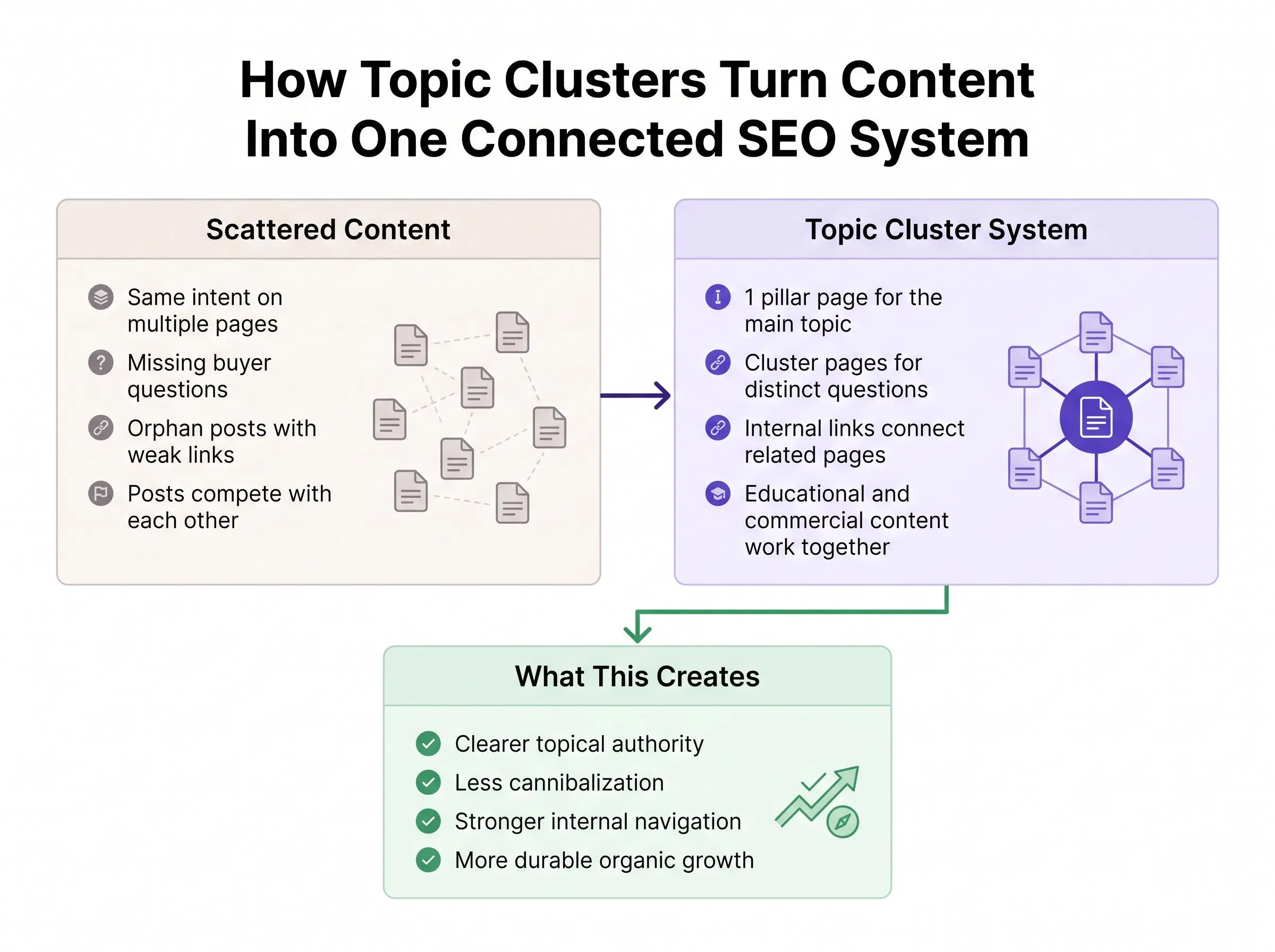
How Topic Clusters Build Topical Authority Faster
Topical authority is how convincingly your site covers a subject area. Not in theory. In actual published pages, internal links, and useful depth.
It compounds because each good page makes the others stronger. A new spoke doesn't sit alone. It adds another layer of relevance to the network around the pillar. Over time, you depend less on one lucky post and more on a stable topic footprint.
That helps solve some very familiar problems:
- multiple pages competing for the same keyword
- thin coverage that skips important subtopics
- weak internal linking
- educational content that never leads readers anywhere useful
There's also an operating benefit people underestimate. Clusters make planning easier. Forecasting gets cleaner. Briefs get sharper. Editorial calendars stop feeling like a pile of disconnected ideas.
Random publishing creates noise. Clusters create memory.
This works across business models because the mechanics are the same. SaaS, services, ecommerce, publishing, finance, travel. Different products, same principle. Faster doesn't mean instant, but structured coverage usually beats scattered output because it builds cumulative relevance.
What the Strongest Real-World Examples Actually Show
The public examples are useful, but only if you read them like an operator and not like a hype thread.
One major inbound marketing company reorganized a large blog around topic clusters after realizing search had moved beyond isolated long-tail targeting. That shift wasn't just about rankings. It was about making the site easier to understand for both users and crawlers. That's the part people skip.
A smaller EdTech restructuring example makes the lesson even clearer. Around 120 posts were audited, mapped into eight core topics, overlapping pieces were merged or redirected, and internal links were tightened. More than 60 keywords improved within six weeks. No new domain. No dramatic backlink story.
The repeatable pattern shows up again and again:
Typical cluster rollout sequence
- Audit
audit what already exists
- Group
group by topic and intent
- Consolidate
consolidate duplicates
- Build pillar
build or strengthen pillar pages
- Link
tighten internal links
- Refresh
keep refreshing and expanding
Recent agency case studies also report gains in AI-search visibility, a metric that conventional ranking case studies usually miss. A student-lending program reported a 400% increase in Google AI Overview visibility over eight months, while a cruise-line program reported a 261% increase in AI Overview mentions in three months. These are useful directional examples, but neither isolates topic clusters from the wider SEO program.
| Program | Reported AI Overview gain | Measurement window (months) | New content pieces | Optimized existing pages |
|---|---|---|---|---|
| Student lending | 400% | 8 | 162 | 62 |
| Cruise line | 261% | 3 | 70 | 23 |
The underlying work was substantial: the lending case combined 162 new content pieces, 62 re-optimized pages, and 455 backlinks; the cruise case included 70 new content pieces and 23 optimized landing pages. Treat these as reported outcomes from multi-tactic programs, not as a forecast for a cluster rebuild alone.
One caution though. A lot of case study numbers are self-reported or based on third-party estimates. Don't obsess over copying someone else's lift. Copy the structure.

How to Choose the Right Topics to Cluster Around
A good cluster topic sits where business relevance, search demand, customer questions, and content depth overlap. Miss one of those and the whole thing gets shaky.
The best topics are:
- broad enough to support a pillar and several spokes
- close enough to your offer to influence revenue
- narrow enough that you can actually become useful
Different business types should choose differently. SaaS brands usually do well clustering around category terms, workflows, integrations, and use cases. Ecommerce brands should lean into product education, comparisons, care guides, and buyer questions. Service businesses tend to win with service lines, processes, outcomes, and industry-specific decision content. Agencies often have room around service categories, frameworks, and implementation questions.
This is where teams get pulled off course by volume. Big search volume can look attractive right up until you realize the topic is too broad, too far from conversion, or full of irrelevant intent.
We prefer a simple tier model:
- Tier 1: core revenue topics
- Tier 2: adjacent pain points and decision-stage topics
- Tier 3: supporting educational content
Go deeper on fewer clusters first. Spreading across twelve themes too early usually creates twelve weak starts.
If your team knows the market but doesn't have time for heavy manual research, Intelliminds can automate topic discovery around your site, audience, products, services, and existing content. That's useful when the strategy is clear but the research workload is the bottleneck.
How to Cluster Keywords for Topical Authority
If you want to know how to cluster keywords for topical authority, start here: keyword clustering is not a spreadsheet exercise. It's intent mapping.
A practical keyword grouping strategy looks like this:
- pull seed terms from product language, sales calls, customer questions, search data, and topic patterns already working in your market
- expand into modifiers, problem-based phrases, and comparison terms
- separate informational, commercial, navigational, and transactional intent
- group keywords by the page they belong on, not just by wording
The hard part is knowing when similar phrases should split. Some keywords look almost identical but deserve different pages because the searcher wants different outcomes. Others look different and belong together because one page can satisfy the underlying question.
A useful test: if one page can answer the primary need behind all terms, group them. If the reader would expect meaningfully different answers, split them.
Common cluster page types include:
- beginner guides
- strategy pages
- tools or templates
- comparisons
- optimization questions
- industry or use-case adaptations
If multiple existing pages chase the same intent, pick a primary page and consolidate the rest. Keeping internal competitors alive is how cannibalization survives for years.
Intelliminds SEO Automation Software can help with automated keyword research and planning, while still keeping human approval in the loop. For lean teams, that matters.
Building a Pillar and Cluster SEO Architecture That Makes Sense
Once the research is done, this becomes a site structure decision. That's where good plans often go sideways.
A pillar page should give the broad overview, introduce the major subtopics, and create a clear reading path. It doesn't need to answer every edge case in full. It needs to orient the reader and point them to the right next page.
Cluster pages do the opposite. They go deeper on one subtopic, one use case, or one question. They should link back to the pillar and, where helpful, across to nearby spokes.
A simple content map helps keep this clean. Ours usually includes:
- pillar topic
- target intent
- audience segment
- supporting keywords
- existing pages to keep, merge, or retire
- internal link targets
- next-step conversion path
Legacy content matters here. Often the fastest way to build topical authority faster is not publishing more. It's reorganizing what you already have.
Keep strong pages. Merge overlapping ones. Redirect weak duplicates. Fix vague anchor text. The cleanest cluster often starts with subtraction.
Publishing the Cluster Without Creating More Chaos
Publishing order matters more than most teams think. Dumping fifteen related drafts into a CMS in one week is not strategy. It's backlog transfer.
A better sequence looks like this:
Recommended publishing order
- Publish anchor
publish the pillar or another strong anchor page
- Launch spokes
launch the most important spokes early
- Add long-tail support
add supporting long-tail pages next
- Update pillar
update the pillar as new spokes go live
Cadence beats brute force. Consistency makes quality control easier. It also makes internal linking discipline easier, which is where many clusters quietly fail.
A few operating rules keep things sane:
- every new page needs a defined role
- every page should connect to a pillar
- every page should serve a distinct intent
- every draft should be checked for overlap before publishing
Lean teams feel the friction fast. Research drags. Briefing stalls. Writing piles up. Scheduling gets missed.
This is where Intelliminds SEO Autoblogger can help in a practical way. It can find buyer keywords, generate editorial-style articles, and publish on a controlled schedule. The real value isn't mindless bulk posting. It's reducing repetitive content ops work without giving up approval control.
Internal Linking Tactics That Strengthen the Whole Cluster
Internal links are not cleanup work. In pillar and cluster SEO, they're part of the core architecture.
The rules are simple, but they need actual attention:
- the pillar should link to every meaningful spoke
- every spoke should link back to the pillar
- spokes should link to related spokes when the connection helps the reader
Anchor text matters too. Keep it descriptive. Tell the reader what they'll get. Don't hammer the exact same keyword into every link just because a tool says it's "optimized." That gets robotic fast, and readers feel it.
Good internal links do two jobs at once. They help crawlers understand relationships, and they help people keep moving through the topic. A broad educational page can lead into a tactic page, then into a comparison, then into a commercial page. That's how content starts pulling its weight.
Check for these regularly:
- orphan pages
- broken links
- redirect chains after merges
- important spokes with very little internal support
A simple maintenance rule works well: every time you publish a new spoke, update the pillar and at least a few related pages.
Measuring Whether Your Topic Cluster Strategy Is Working
Don't judge a cluster by one vanity keyword. That's how good systems get killed too early.
Measure the cluster as a unit. Look at:
- total impressions across the topic
- ranking spread across related queries
- organic sessions
- click-through rates
- assisted conversions
- indexed page coverage
- internal click paths between related pages
Early wins usually show up before traffic really moves. More keywords enter the top 50 or top 20. Cannibalization drops. New cluster pages index faster. Rankings across related terms get less jumpy.
The lagging signs take longer:
- bigger traffic gains
- more page-one rankings
- stronger non-brand visibility
- more branded search activity
Compare cluster performance before and after restructuring. Also compare refreshed legacy pages against isolated net-new posts. That contrast tells you a lot.
If pages aren't indexed, don't blame the strategy too quickly. Check coverage first. A simple tool like Google Index Checker helps teams quickly verify whether important cluster pages are actually indexed before they start second-guessing the whole plan.
Why Content Refreshing Is Part of Topical Authority, Not a Separate Task
A cluster isn't finished when it's published. That's the mistake. Search shifts, SERPs change, and competitors fill gaps you ignored.
Refresh work should include:
- updating facts, examples, and screenshots
- adding internal links as the cluster grows
- merging overlapping underperformers
- adding new spokes when fresh subtopics appear
- tightening the path from informational content to commercial next steps
This protects rankings you already earned. It also reduces the urge to keep producing redundant new content just to feel active.
Growing teams need SEO to behave like a maintained asset. Not a publishing sprint that burns hot for one quarter and then collapses under its own mess.
Integrated workflows help here because refreshes are where fragmentation creeps in. Intelliminds SEO Automation Software includes content refreshing as part of the workflow, which fits naturally with cluster maintenance when teams want one system instead of scattered research, writing, publishing, and update processes.
Common Mistakes That Undermine Topic Clusters
Most failed clusters don't fail because the model is wrong. They fail because execution gets lazy in very predictable ways.
Watch for these:
- publishing multiple pages for slight keyword variants with the same intent
- building a thin pillar page that can't function as a hub
- choosing topics that are too broad or too disconnected from revenue
- treating internal linking as optional
- creating new clusters without cleaning up old overlap
- reporting page by page instead of cluster by cluster
- chasing volume while ignoring sequence and refreshes
- assuming a public case study proves clusters alone caused the result
And then there's the biggest one. Forgetting the human reader.
If the pages only exist to fill keyword gaps, the cluster won't feel useful. It will feel mechanical. Search engines are getting better at detecting that, but honestly your buyers already can.
A strong cluster should feel like a guided path, not a pile of articles.
Conclusion
The shift is pretty clear. Isolated keyword publishing creates occasional wins. Topic clusters for SEO create a connected system that builds authority, relevance, and customer acquisition over time.
The operating model is straightforward:
- choose topics tied to the business
- use a real keyword grouping strategy based on intent
- build a clean pillar and cluster SEO structure
- publish in sequence
- maintain strong internal links
- keep refreshing as the topic evolves
If you want a practical next step, don't start with a giant content plan. Audit one high-value topic already on your site. Look for overlap, weak links, and missing subtopics. Then build your first cluster like a system.
That's usually when SEO starts feeling less chaotic and more like an engine.
Article Record
ReferencesPrimary sources used for this article
- Topic Cluster Strategy Increases AI Overviews and Brand Mentions - 97th Floor
- Topic Clusters Drive 261% Growth in AI Search Results for Cruise Line - 97th Floor
- Topic clusters: The next evolution of SEO
- Link best practices for Google
- Importance of link architecture
- What are impressions, position, and clicks?
- How We Used the Pillar-Cluster Model to Transform Our Blog
- A Topic Cluster That Ranks for 1000s of Keywords (Case Study)
- Topic Cluster Case Study | Noble Studios
- Topic Clusters SEO Case Study: How a US EdTech Blog Improved Rankings for 60+ Keywords in 6 Weeks