
Most content plans still treat Google as the whole battlefield. Search everywhere optimization fixes that blind spot before you spend another month publishing pages buyers never see.
What matters is how your audience moves: AI for shortlists, YouTube for proof, forums for doubts, Google for confirmation. You need source content that travels without creating a manual workload nightmare.
Start by checking:
- Which buyer questions repeat across AI prompts, search results, and Reddit threads
- Where comparison pages need proof, not another vague feature list
- Which older winners can be refreshed into real acquisition assets
Plan where decisions happen.
What Search Everywhere Optimization Means for Content Planning
Search everywhere optimization means planning for how people actually research now, not how we wish they did three years ago. Your audience doesn't stay inside one search box. They bounce between Google, AI assistants, YouTube, Reddit, social platforms, and review sites depending on the question.
For content planning, that changes the first two questions we ask before creating anything:
- Where does the buyer research this problem?
- What kind of asset does that surface reward?
Old-school SEO planning mostly asked, "What keyword should this page rank for?" That's too narrow now. A stronger approach is to build a topic system that can feed several surfaces at once: a useful article for Google, a clean answer block for AI summaries, a walkthrough for YouTube, and supporting discussion angles that match what people ask in forums.
That's the shift.
Buyers now ask ChatGPT or Gemini for shortlists, watch a few product videos, scan Reddit for objections, then come back to Google to sanity check what they found. The path isn't linear and it definitely isn't clean. If your planning model still treats content like a one-page bid for one keyword, you're planning for a market that no longer exists.
The goal isn't to publish more blog posts. It's to create source material that can be crawled, summarized, cited, discussed, and revisited.
Good content now has to work twice: for people and for systems that summarize people.
The upside for teams is that smarter planning actually reduces waste. When topics are aligned to real research behavior, and production runs through AI-assisted workflows with review in place, content starts acting like an asset base instead of a pile of isolated posts.
Why Single-Engine SEO Planning Breaks Down
Most teams feel the problem before they can name it. Traffic is uneven. New channels keep appearing. The algorithm changes again. Everyone wants more output, but nobody agrees on what to prioritize.
That frustration is real because search behavior has fragmented. People don't use one interface for every question anymore. They might use Google for a broad query, YouTube for proof, Reddit for honesty, and an AI assistant for synthesis. In practice, many buyers touch seven or more platforms and spend hours each day across these surfaces. A Google-only plan misses too much.
Here's the business risk:
- discovery happens outside traditional search
- trust often gets built off-site
- AI answers may mention competitors even when your pages rank
- strong rankings can still produce weak brand recall in conversational search
We've seen this pattern enough that it's hard to ignore. A brand can hold decent positions in classic search and still disappear when someone asks, "What are the best options for this?" in an AI interface. That usually happens because the content isn't structured for extraction, isn't reinforced in the places models pull from, or doesn't answer the recommendation-style question clearly enough.
Keyword lists alone won't show you that.
They also won't show citation gaps, forum objections, or which topics need a video, a comparison page, or a proof asset instead of another generic article. Single-engine planning gives you a map with half the roads missing.
Where Your Audience Actually Searches Before They Buy
Smarter planning starts with decision journeys, not channel checklists. We care less about "being everywhere" and more about knowing which surfaces shape the decision.
Different surfaces do different jobs:
- Google and Google AI Overviews catch broad demand, category learning, and comparison-stage research.
- AI assistants help users frame problems, get recommendations, and compress a lot of reading into one answer.
- YouTube is where people go when they want to see the thing work.
- Reddit and forums surface objections, side effects, hidden tradeoffs, and blunt comparisons.
- TikTok and short-form social drive inspiration, quick discovery, and visual proof.
Not every brand needs every platform. Usually the right set is four to six surfaces that actually influence purchase behavior in your category.
The useful part is reading demand clues correctly. Repetitive how-to questions usually point to tutorials or implementation content. Recommendation-style prompts often call for comparison pages, category pages, or strong shortlist content. Skeptical forum threads point to rebuttal pages, trust content, and clearer FAQs. Short-form discovery behavior often reveals which product angles deserve sharper hooks.
A few examples make this easier:
- SaaS buyers compare workflows, integrations, implementation time, and team fit.
- Ecommerce buyers want demos, reviews, and use-case proof before they trust a product page.
- Service businesses need location relevance, clear proof, and a reason to believe your version is different.
Younger audiences often start on TikTok. Broad research still leans on Google, YouTube, and AI tools together. Both can be true at once, which is why rigid channel thinking breaks so quickly.
How to Use AI Search for Content Planning Without Chasing Hype
If you're figuring out how to use AI search for content planning, treat it as a research layer, not a strategy substitute. AI is useful here because it shows how questions are phrased naturally, which attributes matter in comparisons, and where the answers are weak or generic.
That last one matters more than people think. Weak model output often points to a content gap you can own.
Use prompts to extract planning inputs such as:
- recurring entities and subtopics
- missing angles in your current library
- questions tied to awareness, evaluation, and decision stages
- brands, frameworks, or product types that keep showing up around the topic
There's a difference between brainstorming with AI and diagnosing visibility with AI. Brainstorming gives you ideas. A visibility diagnostic tells you what the system consistently retrieves, synthesizes, and cites when users ask adjacent questions.
Run prompt sets across a few categories:
- category explanation prompts
- product comparison prompts
- implementation prompts
- best-tool or best-provider prompts
- local or use-case recommendation prompts
Then compare those outputs against classic search results. That's where the useful tension shows up. If Google ranks one type of page and AI answers pull from another set of sources, you've found a gap in your current content strategy for AI answers.
Watch for repeated domains, concise definitions, structured lists, and brand mentions supported by off-site discussion. Also pay attention when answers stay vague. Sometimes the topic is too broad. Sometimes it is so commoditized that nobody has produced a clean, differentiated source.
Don't treat every AI-generated suggestion as demand validation. Models can generate endless plausible nonsense. The real signal is consistency.
Build a Topic Map for LLM Search, Google AI Overviews, and Classic SEO
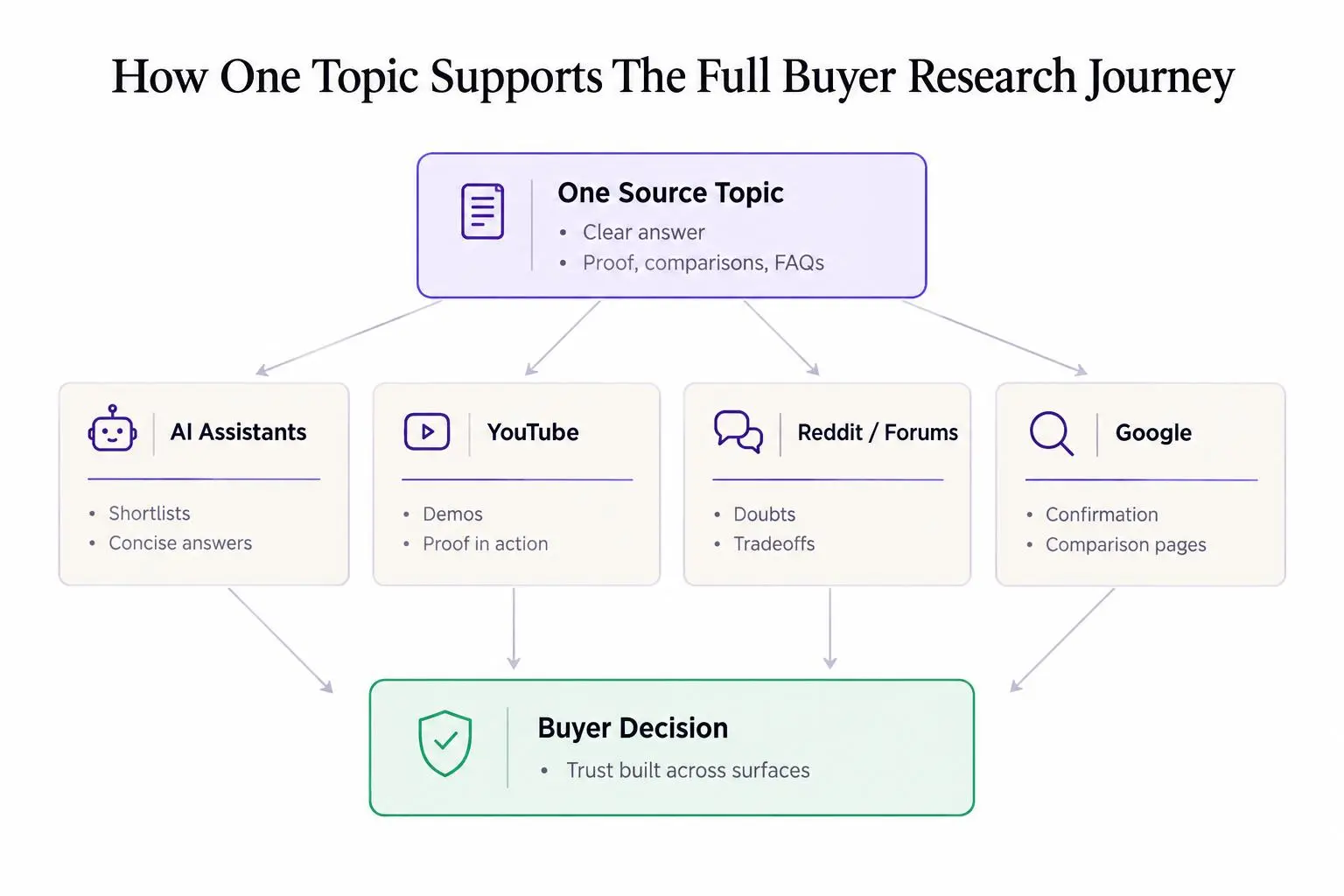
Topic planning for LLM search works better when you build around decision-critical questions, not endless keyword variants. One core topic should support direct clicks, AI summaries, featured answers, comparisons, and supporting citations from related pages.
A practical topic map looks like this:
- a pillar topic for the main problem or category
- cluster articles for subproblems, objections, workflows, and alternatives
- proof assets such as templates, examples, checklists, or benchmarks
- off-site amplification targets where the topic gets discussed or validated
That structure gives a single idea multiple ways to earn visibility.
When we prioritize topics, we weight them against five filters:
- buyer intent
- how often the question repeats across platforms
- likelihood of citation or summarization
- fit with our real expertise
- refresh potential over time
Google AI Overviews content strategy
Google AI Overviews content strategy rewards pages that answer broad questions clearly, then support the answer with useful depth. That means:
- lead with concise, factual definitions
- make steps and comparisons easy to extract
- include quick summaries before long explanation
- cut fluff that buries the main answer
Pages that try too hard to sound smart often become harder to summarize. That's not a writing win. It's a retrieval problem.
Classic keyword research still matters. We still need volume, intent, and competition signals. But now it needs extra inputs from prompt-style questions, forum language, and comparison intent. Search everywhere optimization is really a planning upgrade, not a replacement for SEO.
For teams that need to scale this without turning research into another spreadsheet graveyard, Intelliminds can automate topic discovery and turn it into a workable publishing plan while keeping review in human hands.
Create Content That Is Easy for AI to Retrieve, Quote, and Trust
If you want to optimize for AI search visibility, think in three layers: retrievability, clarity, and corroboration. Most content that performs well in AI systems is easy to parse, tightly structured, specific, and clearly tied to a question.
The building blocks are straightforward:
- a strong opening definition or thesis
- subheadings that match real questions
- concise summaries before deeper detail
- lists, comparison sections, and step-by-step formats
- consistent terminology across related pages
- visible topical expertise across the site
Helpful now also means machine-legible. That's the part many teams resist.
Ranking content and cited content overlap, but they aren't identical. A page can rank because the domain is strong and the page is relevant. A cited page also needs extractable answers and support from the wider web. If nobody mentions your brand outside your own site, AI systems have less reason to trust you in recommendation-style outputs.
A 10-month SteelSeries AI-search case study reported a 23x increase in AI-referred traffic, 27x growth in AI-driven conversions, and 3.7x growth in revenue from AI-referred traffic after the company restructured content, product pages, and product feeds for machine readability. It is one company result, not a universal benchmark, but it makes the measurement point clear: AI visibility should be evaluated against conversions and revenue, not mentions alone.
Formats that travel well across search and AI surfaces include:
- definition pages and glossaries
- comparison pages
- implementation guides
- troubleshooting articles
- templates and checklists
- evidence-backed explainers
A simple rule helps here: write source assets, not filler. If the page contains clear examples, decision criteria, and real distinctions, it has a better chance of being quoted, linked internally, reused in social snippets, and referenced in answers.
Turn One Topic Into a Multi-Surface Content System
This is where search everywhere optimization gets practical. One validated topic should become several useful assets, not one blog post and a hope.
A workable flow might look like this:
- start with a high-intent pillar article
- pull out a concise answer section for AI-friendly intros
- convert the steps into a YouTube tutorial outline
- turn objections into a Reddit-ready FAQ angle
- turn benefits or myths into short-form social hooks
- turn comparisons into decision-stage landing pages
Each asset needs to feel native to the platform. A pasted blog paragraph usually dies on contact. A clean video outline, a sharp FAQ response, or a tighter comparison page does much better because it respects the format.
This matters because real buyers hop surfaces before they convert. They may get an AI shortlist, watch a tutorial, scan a forum thread, then come back through branded search. Every derivative asset becomes another citation source, another trust touchpoint, or another route back to your site.
A few guardrails keep this from turning into noise:
- repurpose only topics with clear demand or conversion relevance
- keep core messaging consistent
- adapt depth and tone to the surface
- update connected assets when the source facts change
Going viral once is overrated. Publishing on a controlled schedule is usually the better bet.
Set Up a Publishing Workflow That Can Keep Up With Search Everywhere
Content operations need to act like a living acquisition system, not a quarterly batch project. If the workflow stops at research, you collect insight debt. If it stops at publishing, you create content waste.
For lean teams, the process can stay simple:
Repeatable workflow
- Collect signals
gather demand signals from search, AI prompts, forums, support, and sales calls
- Group themes
group them by theme and decision stage
- Choose format
assign a core format and primary surface
- Publish
publish on a steady schedule
- Track outcomes
track what gets indexed, discovered, cited, and revisited
- Refresh
refresh based on performance and changing intent
That's enough structure to stay sane.
For growing brands and agencies that need scale without chaos, Intelliminds can support the content side of SEO by automating topic research, article writing, scheduling, publishing, and refreshing. It also keeps a human in the loop, which matters a lot more than people admit, especially in technical, regulated, or high-consideration categories where one bad paragraph can create cleanup work for weeks.
Editorial calendars should mix a few content types instead of leaning on one:
- evergreen demand capture
- new AI-answer opportunities
- comparison content
- refreshes of older winners
- platform-native experiments tied to the same topic clusters
Refreshing Content Is Now a Core Growth Lever

Refreshing content used to be an annual hygiene task. Not anymore. In a search-everywhere environment, buyer language shifts faster, product comparisons change faster, and answer systems adapt faster.
Refresh priority usually belongs to pages that:
- still rank but lost clicks
- drive conversions but look dated
- cover changing products, workflows, or rules
- appear in important topic spaces where your brand isn't mentioned in AI answers
- gain impressions but underperform on engagement
A meaningful refresh goes beyond changing the year in the title. It often includes clearer definitions, tighter sections, updated examples, stronger internal links, new FAQs pulled from current prompt patterns, and better alignment between title, slug, and intent.
Sometimes the fix is surprisingly small. A stronger intro and cleaner comparison table can do more than 1,500 new words.
Refreshing is often more efficient than endless net-new publishing because the topic may already have authority. For teams with large archives, that can recover performance without hiring more people. Intelliminds SEO Automation Software supports content refreshing as part of the workflow, which fits teams treating content as an ongoing acquisition asset rather than a one-off deliverable.
What to Measure When Visibility Is Spread Across Search, AI, and Social
Rankings still matter. They just aren't enough on their own.
A better measurement model ties visibility back to planning decisions:
- search impressions and clicks
- page-level conversions and assisted conversions
- AI referral traffic where you can see it
- branded search lift
- citation presence across recurring prompts
- engagement on supporting video or social assets
- internal linking impact and crawl uptake
Some AI visibility is hard to measure directly. Waiting for perfect attribution is a good way to do nothing. Directional indicators are fine if they help you make better decisions.
A simple reporting lens works well:
- which topics gained discoverability
- which surfaces influenced conversions
- which formats earned the strongest engagement
- which refreshed pages improved
And don't skip indexing checks. Pages that aren't indexed can't help your visibility system at all. Intelliminds' Google Index Checker is useful here because teams can check important pages in batches during rollout audits.
One more point that saves a lot of confusion: separate visibility metrics from business metrics. More mentions don't automatically mean more revenue.
| Measurement area | Track | Helps answer |
|---|---|---|
| Search demand visibility | search impressions and clicks | which topics gained discoverability |
| Brand and citation visibility | branded search lift; citation presence across recurring prompts | which topics gained discoverability |
| Conversion outcomes | page-level conversions and assisted conversions | which surfaces influenced conversions |
| Observable AI referral traffic | AI referral traffic where you can see it | which surfaces influenced conversions |
| Format engagement | engagement on supporting video or social assets | which formats earned the strongest engagement |
| Refresh and crawl signals | internal linking impact and crawl uptake | which refreshed pages improved |
| Indexing status | indexing checks on important pages in batches during rollout audits | whether important pages can help your visibility system at all |
Common Mistakes That Make Search Everywhere Content Plans Fail
Most failures aren't caused by a bad tool. They're caused by bad planning discipline.
The mistakes show up fast:
- publishing the same article format everywhere
- treating AI search as separate from SEO when the overlap is obvious
- chasing every new platform instead of the few that shape buying decisions
- pushing high volume content with weak standards or no refresh plan
- ignoring off-site trust signals
- optimizing for traffic headlines instead of commercial relevance
- running research without a closed-loop workflow
- waiting for certainty before testing
The last one is brutal because it feels responsible. It isn't. While one team waits for perfect clarity, another team publishes usable source material, gets cited, and becomes familiar. Search everywhere optimization rewards consistency more than hesitation.
Invisible brands rarely lose because they lacked ideas. They lose because they never turned insight into output.
Conclusion
Search everywhere optimization isn't about showing up on every platform at once. It's about planning around how buyers actually research, then building content that can rank, get cited, and stay useful as intent changes.
The next move is simple enough: audit your top topics, map them to the surfaces that influence buying decisions, and build a publishing plus refresh cadence around them. Once you do that, content stops feeling like a guessing game and starts acting like a durable growth system.