Most teams asking how many words for an SEO article are chasing a number because production needs a target. That’s how you end up with 2,000 words of throat-clearing while the actual answer is buried halfway down the page.
Length should follow the searcher’s job: learn, compare, or act. Get that right, and your content is easier to scale, update, and turn into qualified traffic.
- Check what ranking pages answer before setting a word target
- Cut repeated explanations that slow readers down
- Add missing decision details, not filler
Publish pages that earn the click and keep it.
The Short Answer: There Is No Perfect SEO Word Count
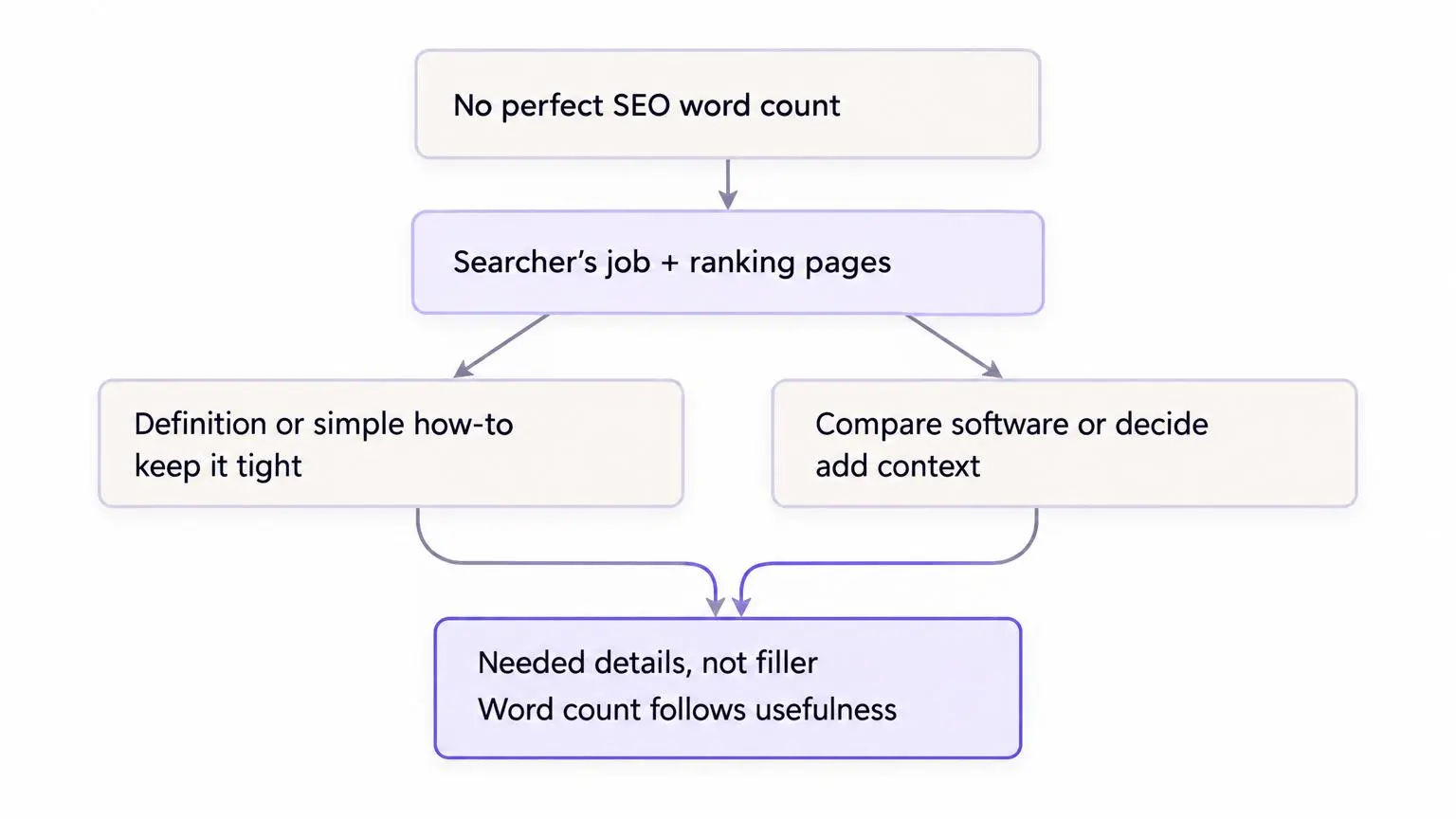
Let's kill the myth first. There is no magic number for how many words for seo article success.
A 700 word page can outrank a 2,500 word page if it answers the searcher's question faster, more clearly, and with less friction. The reverse is also true. Some topics simply need more room because the reader needs context, examples, objections handled, and a clear next step before they trust what they're reading.
The real variables are simpler than people want them to be:
- What is the searcher trying to get done?
- How complex is the topic?
- What kind of pages already rank?
- What does the reader need before they can act?
If someone searches for a definition, they usually don't want a mini ebook. If they're comparing software, evaluating a service, or trying to make a high stakes decision, thin content usually falls apart fast.
So when people ask how long should SEO blog posts be, we don't start with a number. We start with intent, coverage, and usefulness. Word count is the result of doing that well, not the plan.
A good article is as long as it needs to be and no longer.
Why Content Length for Ranking Matters, but Not in the Way Most People Think
Content length matters, but mostly as a signal of how much ground a page covers. That's a very different thing from saying "longer ranks better."
Longer pages often do well because they have room to do work:
- answer the main question
- cover common follow up questions
- include examples and comparisons
- add internal links to related pages
- help the reader make a decision, not just consume a paragraph
That's useful. But long content also fails all the time. Usually for boring reasons. It repeats itself, hides the answer under a slow intro, adds sections nobody asked for, and turns a simple query into a chore.
We've seen this pattern constantly in content programs. Teams chase a target like 2,000 words, then wonder why the piece feels heavy by paragraph six. The problem wasn't the topic. It was the quota.
Shorter pages can work extremely well for:
- focused informational queries
- definition style searches
- simple how to answers
- product or service pages where clarity matters more than explanation
This is where people get confused about content length for ranking. Length can help if it reflects better topic coverage. It hurts when it creates drag.
And rankings aren't the only output that matters. If a page ranks but doesn't build understanding, move readers deeper into the site, or support conversions, it's not doing enough for the business. A right sized article is easier to maintain, easier to update, and usually easier to trust.
Best Article Length by Intent Starts With the Searcher
If you want the best article length by intent, stop looking at averages and start looking at the job the page has to do.
Different intent types ask for different levels of depth.
Informational intent
This is where people are trying to understand something. They often need a direct answer first, then a little support around it. Definitions, examples, common mistakes, and related questions all help.
If the topic is simple, keep it tight. If it's layered, earn the extra length.
Commercial investigation intent
These readers are closer to a decision. They want distinctions. They want criteria. They want to know what matters, what doesn't, and where the traps are.
This is usually where longer content earns its keep. Comparisons, pros and cons, alternatives, pricing factors, implementation concerns, and fit all matter here. A thin article on a buying query doesn't feel efficient. It feels evasive.
Transactional intent
This reader wants to act. Extra paragraphs can get in the way.
A strong transactional page needs speed, trust, proof, and a low friction path to the next click. Sometimes a shorter page converts better because it respects the moment. Nobody needs 1,800 words when they're ready to book a demo or buy a product and just need confirmation.
Navigational or branded intent
This one is blunt. People want the right page. Don't trap them inside an essay.
The tricky part is that intent shifts inside the same topic. A first time buyer and an experienced operator can search almost identical terms and need very different things by the end of the page.
When we're planning content, we ask three questions:
- What does the reader need to understand?
- What do they need to believe?
- What do they need to do next?
For brands, ecommerce teams, SaaS companies, and agencies, this matters more than vanity metrics. You don't need the longest page in the category. You need the page that matches revenue intent cleanly.
| Intent | Reader need | Length approach | Page priority |
|---|---|---|---|
| Informational intent | Understand something and get a direct answer first | Keep it tight for simple topics; earn extra length for layered topics | Definitions, examples, common mistakes, and related questions |
| Commercial investigation intent | Compare options, evaluate criteria, and avoid traps | Usually where longer content earns its keep | Comparisons, pros and cons, alternatives, pricing factors, implementation concerns, and fit |
| Transactional intent | Act now and get confirmation | Often shorter works better when extra paragraphs create friction | Speed, trust, proof, and a low friction path to the next click |
| Navigational or branded intent | Reach the right page quickly | Keep it direct and do not turn it into an essay | Help people get to the right page without trapping them in long copy |
Match Content Depth to Topic Scope, Not to a Quota
A narrow topic usually wants a narrow article. A broad topic usually needs layers. That sounds obvious, but it's where a lot of content goes sideways.
A post on "how to fix duplicate title tags" has a tighter scope than a post on "how to build an SEO content strategy." If both end up the same length, one of them is probably wrong.
Topic scope is not the same thing as keyword difficulty either. A competitive query doesn't automatically require a bloated article. It requires sharper coverage, cleaner structure, and stronger usefulness. That's harder than adding 800 extra words, which is why people avoid it.
Audience sophistication changes depth too. Beginners need terms explained. They need context. Experienced buyers don't need a textbook. They need frameworks, examples, tradeoffs, and proof that you understand what actually matters.
Before drafting, map the page like this:
- the primary question
- the supporting questions
- the likely objections
- the decision points
- the next action you want the reader to take
Once that's clear, length gets easier to estimate section by section. Some topics naturally need examples. Others need comparisons. Others need implementation steps or common mistakes. Let the topic decide.
Here's the operator version: if you're using a target word count to replace outlining, the article will usually feel padded by the second half. Good pages feel complete. They don't feel stuffed.
Long Form vs Short Form SEO: When Each Format Wins
The long form vs short form seo debate gets framed like a winner take all fight. It isn't. Both formats work when used on the right job.
Long form means the page goes deep enough to teach, compare, or guide a decision. Short form means the page stays focused on a direct answer or a narrow action. You don't need rigid word thresholds to know the difference when you read it.
Long form works well when the reader needs:
- a full walkthrough
- a decision framework
- multiple examples
- comparisons or objections handled
- enough context to trust the recommendation
It also gives you more room for internal linking and related search coverage. That can help, especially in a structured content program.
But long form has real costs. It takes longer to produce, edit, and maintain. It creates more places for filler to creep in. And if the structure is weak, completion rates drop because readers feel the sprawl.
Short form has its own strengths. It's faster to publish. It's easier to update. It stays clear when the query is straightforward. For many service pages, FAQ pages, and focused blog posts, that sharpness wins.
The risk is undercoverage. Short content can miss important subtopics, fail to build trust on nuanced subjects, or leave a commercial reader unconvinced.
A simple rule works well here:
Use long form when the reader needs help thinking. Use short form when the reader needs a clear answer or action.
The best content programs use both. Treating one format as always superior is how you end up with a blog full of content nobody finishes.
How to Decide How Long Your SEO Blog Post Should Be Before You Write
Most overlong drafts are planning failures. Not writing failures.
Start with the main query and define the exact job of the page. Is it supposed to educate, compare, persuade, or convert? Each one changes the structure and the ideal length.
Then look at the search results. Not to copy them, but to understand the shape of the query:
- What type of pages are ranking?
- How direct are they?
- What questions do they answer?
- Where do they feel thin or repetitive?
- What would a stronger version need to include?
After that, list the must cover subtopics. This is where strong content gets built. You want the article to answer the main query and the follow up questions a sensible reader will have five minutes later.
Don't choose a total word count first. Estimate depth section by section. If each section earns its place, the final length usually makes sense on its own.
For teams producing at scale, this is where consistency matters. Clear briefs and intent mapping prevent both extremes: thin posts that never compete, and oversized drafts that waste production time. Tools can help, but only if they support judgment instead of replacing it.
We built Intelliminds around that workflow problem. Our SEO Automation Software handles keyword and topic research, AI writing, publishing to a CMS, and content refreshing, while keeping human approval in the loop. That's useful when your issue isn't one article. It's the operational drag of doing this well every week.
A 2021 crawl of 24,774 keywords shows why a SERP average is a context check, not a writing quota. Across the top 10 results, average meaningful word counts were clustered rather than rising neatly with rank: position 1 averaged 2,855 words, while position 9 averaged 2,230. Use a live SERP review to understand the depth competitors provide, then decide what your reader actually needs.
Average meaningful word count for pages ranking in Google's top 10 across 24,774 keywords in Embryo's 2021 study. The series is not a causal ranking rule.
Sources
Embryo, Word Count Content Study 2021
- The study is observational, so it does not establish that word count causes ranking.
- The dataset combines a mixture of keyword types and does not provide a query-specific recommendation.
- The figures are averages of meaningful on-page text among pages already ranking in the top 10.
| Google position | Average meaningful word count |
|---|---|
| 1 | 2,855 |
| 2 | 2,923 |
| 3 | 2,683 |
| 4 | 2,479 |
| 5 | 2,422 |
| 6 | 2,363 |
| 7 | 2,267 |
| 8 | 2,244 |
| 9 | 2,230 |
| 10 | 2,242 |
This is an observational benchmark across a mixed keyword set, not evidence that adding words causes a page to rank. The study also measured pages already in the top 10, so it cannot tell you the right length for a specific query, audience, or content format.
What High-Performing SEO Articles Get Right Besides Word Count
When an article performs, it usually isn't because it hit some perfect number. It did the basics unusually well.
A strong page tends to get these things right:
- The answer appears early. Readers shouldn't have to dig through a slow intro to confirm they're in the right place.
- The structure makes sense. It moves from the core answer into useful support without losing the thread.
- The subtopics are real. They reflect what readers care about, not just keyword variations pasted into headers.
- Examples do actual work. They clarify tradeoffs, not just fill space.
- Formatting helps scanning. Good headings, short paragraphs, and clean transitions matter more than people admit.
- Internal links are useful. They help readers go deeper or move closer to a conversion.
- There is a point of view. Generic content dies in crowded search results.
- The page gets updated. Search intent shifts. Competing pages improve. Old examples go stale.
This is where many brands miss the mark. They think authority comes from sounding polished. Usually it comes from being clear, specific, and obviously helpful. There's a difference.
Signs Your Article Is Too Short
Short isn't bad. Underdeveloped is bad.
If an article is too short for the query, you'll usually feel it before you measure it. It answers the top level question, then stops right where the useful part should begin.
Watch for signs like these:
- the main query is answered only at a surface level
- key terms, tradeoffs, or decision criteria are missing
- competing pages clearly do more useful work for the same search
- the article feels like a placeholder, especially on strategy or comparison topics
- there are no examples or practical applications
- the page earns impressions but readers don't move deeper into the site
- the brand comes off as underprepared on a topic where expertise matters
A too short article often sounds fine on first read. That's the trap. It reads clean because it skipped the hard parts.
Signs Your Article Is Too Long
This one is more common than people want to admit.
An article is too long when extra content stops helping the reader make progress. Not when it crosses an arbitrary word count.
You can usually spot it in a few places:
- the direct answer is buried under scene setting
- sections exist only because the draft needed more length
- the page tries to rank for every related idea and loses focus
- important takeaways are hidden inside repeated explanation
- editing and updating the piece becomes a chore
- readers have to scroll through paragraphs that don't move them toward understanding or action
Overlong content often gets mistaken for authority. It usually points to weak planning. If the outline is loose, the draft grows in all the wrong directions.
A good edit often removes more than it adds.
A Smarter Workflow for Producing Right-Sized SEO Content at Scale
Scaling content isn't about making every post longer. It's about matching the right topic to the right depth over and over without creating chaos for your team.
Where teams struggle is predictable. They don't have a repeatable process for topic selection, intent matching, outlining, drafting, publishing, and refreshing. So they either overproduce thin content or overinvest in oversized articles that take forever to ship.
A stronger workflow connects the whole chain:
A practical content workflow
- Topic selection
choose topics with real business value
- Intent mapping
map intent before writing
- Question-led outline
build the outline around must cover questions
- Outline-based draft
draft to the outline, not a word quota
- Scheduled publishing
publish on a schedule
- Content refresh
refresh pages that slip or age out
That operational layer matters more than another debate about ideal length. If your process is messy, your content will be inconsistent no matter how talented the writer is.
For teams that want less manual drag, Intelliminds SEO Automation Software and the SEO Autoblogger are built for the content side of SEO. They can automate topic and keyword research, article creation, scheduling, and publishing, while still giving your team approval control. That's the real advantage: more consistency without turning the blog into a content factory with no judgment.
Refreshing Content Often Beats Simply Making New Articles Longer
A lot of underperforming pages don't need to be replaced. They need to be fixed.
Older articles often lose ground because they no longer match intent, miss newer angles, or sit next to sharper competing pages. Their problem isn't always that they're too short. Sometimes they're just stale. Sometimes they're bloated in the wrong places.
Before rewriting from scratch, audit the page:
- tighten weak or repetitive sections
- update examples
- add missing subtopics
- improve the structure
- cut filler that slows the page down
- strengthen internal links and next steps
A refresh can regain relevance faster than a brand new article can earn trust. That's one of those lessons teams usually learn after publishing a lot of net new content that doesn't move much.
When refreshing is built into the workflow, the whole content program gets easier to manage. That's why Intelliminds includes content refreshing alongside research, writing, and publishing. Keeping ranking pages current shouldn't require a separate cleanup project every quarter.
Conclusion
The best answer to how many words for seo article performance is not a fixed number. It's the amount of content needed to satisfy intent, cover the topic with the right depth, and help the reader take the next step.
So when you're asking how long should SEO blog posts be, don't start with a rule of thumb. Start with the searcher, the topic scope, and the business purpose of the page. That's where good decisions come from.
Replace arbitrary word targets with better briefs, stronger outlines, and a refresh habit. Then test what actually helps pages rank, get read, and move readers forward.
If you want a practical next step, pick one existing article this week. Cut what feels bloated. Add what is clearly missing. Build the next one around relevance before length. That's usually where better rankings start.
Article Record
ReferencesPrimary sources used for this article
- Word Count Content Study 2021 | Embryo
- How Long Should Blog Posts Be? [The Real Answer]
- Short-Form vs. Long-Form Content: Which Is Better for SEO?
- What is the best content length for SEO?
- What's The Ideal Blog Post Length For SEO?
- The Anatomy of a Shareable, Linkable & Popular Post: A Study of Our Marketing Blog
- Word count and SEO: how long should an article or page be? • Yoast