
Most seo article writer AI tools look impressive until you need research, usable drafts, approvals, and publishing to happen every week. Growing brands often buy a writer, then discover they still own the entire SEO workload.
The tools worth using understand search intent and fit real content operations. Clean prose alone doesn’t move traffic. Boring, but true.
We cut the noise. These are the options worth your attention.
Show 5 more productsShow fewer products
1. Intelliminds SEO Autoblogger

- Covers research through publishing
- Matches content to search intent
- Scheduled posting with approvals
- Reduces manual SEO workflow steps
- Supports links and images
- Less useful for draft-only needs
- May exceed simple team workflows
- Needs editorial oversight to shine
If you're evaluating a seo article writer ai, this is the category most buyers miss at first. They think they're buying faster writing. Usually they're actually trying to fix a content operations problem.
Intelliminds SEO Autoblogger is built for brands and agencies that want one system to handle the full loop, from finding buyer keywords to publishing on the site. On our side, that means automated keyword research, search intent matching, editorial style article generation, link and image support, scheduled publishing, and human approval before anything goes live.
That combination matters more than people expect. A lot of teams don't struggle with "writing" in isolation. They struggle with all the steps around it.
- research gets delayed
- briefs stay half-finished
- drafts pile up in docs
- formatting takes longer than it should
- nobody hits publish on time
A draft only tool doesn't solve that. It just moves the bottleneck.
We've built this around the idea that ai generated seo articles only help if they fit a repeatable publishing system. That's the real difference. The platform is positioned around matching content to keyword intent, then carrying the workflow through publishing instead of stopping at a draft. It also keeps a human in the loop, which matters if you don't want the usual autoblogger problem of junk going live just because the system can publish.
Choose this when your issue is throughput with control. Skip it if you already have research, editorial workflow, and CMS publishing locked down and only want a blank page assistant.
The best automation removes steps, not judgment.
2. Jasper
- Structured marketing content workflows
- Strong for recurring SEO programs
- Supports multiple campaign content types
- More consistent team output
- Better than open-ended chat
- Not end-to-end publishing focused
- Still needs separate SEO process
- Less ideal for simple autoblogging
Jasper fits teams that want a dedicated AI writing platform, not just a chat box with a nicer prompt. That's a meaningful distinction once content operations become recurring, not occasional.
For marketing teams producing long form SEO content, campaigns, and supporting assets across channels, Jasper usually feels more structured than open ended assistants. That structure is useful when multiple people need consistent output. By the second or third content sprint, that starts to matter more than raw model quality.
Where Jasper makes sense:
When the writing workload is broad
It works well for teams creating:
- SEO articles
- campaign copy
- emails and landing page support
- repeatable marketing content with shared standards
That makes it broader than tools that are mainly article generators. But it also means you should judge it as one part of a larger SEO process. It can help you write blog posts that rank, but it doesn't make rankings happen by itself.
Compared with nearby options, Jasper is more marketing platform oriented than Claude, broader in workflow framing than Rytr, and less tied to end to end publishing than Intelliminds SEO Autoblogger. That's the tradeoff. You get a stronger marketing workspace, but you'll still need the rest of your SEO system around it.
If your team runs ongoing content programs, Jasper deserves a close look. If you just want to publish blog posts automatically, it's probably not the cleanest fit.
3. Writesonic

- Clear SEO article writer positioning
- Guided workflow reduces blank-page friction
- Good fit for scaling article output
- Easier than broader AI suites
- Supports research and citation workflows
- Still needs strong editorial standards
- Less automated than end-to-end systems
- Can create generic-looking drafts
Writesonic is one of the easier tools to evaluate because the positioning is fairly direct. It's built around AI article writing, and for a lot of marketers that's exactly the buying intent.
That clarity helps. Some platforms are trying to be everything at once. Writesonic is usually a simpler conversation: can this help us scale article creation for organic traffic without making the workflow annoying?
The answer is often yes, especially for teams that want guided article generation rather than a fully open ended experience. It sits closer to SEO content production than tools aimed more at governance, brand controls, or conversion copy. That makes it relevant if your immediate goal is search optimized article writing at higher volume.
A few practical notes:
- it's easier to understand than broader AI suites
- it maps more cleanly to SEO article use cases than general chat tools
- it still needs editorial standards if you care about quality
That last point is where teams get sloppy. A clearly packaged article writer can create false confidence. You still need a point of view, topic discipline, and someone willing to reject mediocre drafts. Otherwise you get output that looks finished and performs like wallpaper.
In this list, Writesonic sits closer to Frase than Claude in search use case, though with a stronger article writer identity. It's less enterprise controlled than Writer and less full funnel automated than Intelliminds SEO Autoblogger. For many teams, that middle ground is exactly the appeal.
4. Claude
- Strong nuanced long-form drafts
- Natural tone and reasoning
- Flexible beyond rigid templates
- Good for thought leadership pieces
- Not SEO-platform first
- Limited publishing workflow support
- Needs separate research process
Claude is the tool people pick when they care about the quality of thought inside the article, not just whether the workflow moves fast. That's a valid priority. Sometimes it's the right one.
For long form drafting, thought leadership, category explainers, and nuanced first drafts, Claude is often a strong partner. If your team already knows the keyword, the angle, and the brief, it can help turn that into something that actually reads like a person wrote it. That's not a small thing.
Still, it's not an SEO platform first. That's the dividing line.
Where Claude helps most
Claude tends to work best when:
- tone matters
- reasoning matters
- the article needs substance, not just structure
- a content lead wants flexibility instead of rigid workflow templates
Compared with Frase, it's less search process driven. Compared with Intelliminds SEO Autoblogger, it's far less publishing oriented. Compared with Writer, it cares less about governance and more about drafting quality.
This is the part many teams learn the hard way: strong drafting doesn't replace keyword strategy, internal linking, SERP analysis, or refresh planning. Good paragraphs are nice. Rankings are a system.
If your team already has the search process and just needs better long form development, Claude is a smart addition. If you're hoping it will become a full ai blog writer for organic traffic by itself, you'll still have gaps.
5. Frase

- Search-informed briefs guide drafting
- Stronger alignment with ranking intent
- Reduces topical coverage guesswork
- Bridges research and writing well
- Less compelling with strong research workflows
- Not built for publishing automation
- Output still needs editorial review
Frase is for marketers who don't want writing to begin with a blank prompt. They want the search context first, then the article. That's a much healthier instinct.
Its strongest angle is the bridge between research and drafting. Instead of treating AI content as pure generation, Frase pushes teams toward SERP informed briefs and topic coverage. For SEO work, that's often where the real lift comes from. Weak briefs create weak articles, even when the writing looks fine.
What makes Frase useful here:
It starts with structure
Frase is a good fit when your team needs:
- clearer content briefs
- stronger alignment with ranking intent
- less guesswork around what the page should cover
That makes it more SEO native than general AI tools like Claude or Rytr. It also gives it a different job than Intelliminds SEO Autoblogger. Frase helps tighten the research to writing handoff, while Intelliminds goes further into workflow automation and publishing.
If your content team already has strong research systems, Frase may feel less necessary. But if your writers keep missing the query, drifting off intent, or producing pages that look polished yet never move, weak briefing is probably the issue. Frase is one of the cleaner fixes for that.
6. Rytr

- Affordable entry point for AI
- Fast first drafts for blogs
- Supports multiple languages and tones
- Low-friction fit for solo marketers
- Limited SEO workflow depth
- Needs stronger editing for rankings
- Light on approvals and control
Rytr is the practical budget pick. No drama. No giant platform commitment. Just a faster way to get a first draft moving.
That's exactly why it stays in these conversations. Solo marketers, early stage startups, and service businesses testing AI content workflows often don't need a heavy system yet. They need speed, lower cost, and less blank page friction.
Rytr works best when the content motion is still light:
- short blog posts
- simpler educational content
- early experiments with AI drafting
- small teams where one person does everything
The limitation is obvious, and it's worth saying plainly. Rytr is a speed play, not a full SEO operating system. It's less search driven than Frase and Intelliminds SEO Autoblogger, less platform oriented than Jasper, and less controlled than Writer.
That doesn't make it weak. It just makes it specific.
If you're trying to validate whether AI can reduce content workload at all, Rytr is a reasonable starting point. If you're serious about consistent rankings, you'll outgrow draft speed as the main problem pretty quickly.
7. Writer

- Strong governance for large teams
- Approval workflows support compliance
- CMS integrations streamline publishing
- Built-in keyword research included
- More system than small teams need
- Less focused on automated blogging
- Can feel heavy for speed
Writer belongs in this roundup for a different reason than most of the others. It isn't the obvious "article writer" brand. It's here because some teams care less about speed and more about control.
Larger organizations often have multiple stakeholders touching the same content pipeline. Legal reviews, brand checks, approvals, publishing handoffs, and consistency standards can slow everything down. In those environments, lightweight drafting tools stop being enough.
Why teams choose Writer
Writer makes sense when your content process needs:
- governed creation environments
- stakeholder control
- approval discipline
- workflows that hold up across larger teams
It's more governance centered than Claude, Rytr, and Writesonic. For some buyers it's also more enterprise oriented than Intelliminds SEO Autoblogger, though less clearly focused on buyer keyword discovery and automated blogging. And it's less conversion copy centered than Anyword.
This kind of platform is best when control is not optional. If a lot of people can alter content before publication, process matters just as much as prose. Small businesses usually don't need this much system. Big teams often do, whether they like it or not.
8. Anyword

- Strong conversion-focused messaging
- Useful across articles and landing pages
- Good fit for demand gen teams
- Supports revenue-oriented content workflows
- Less suited for long-form scale
- Not end-to-end publishing focused
- Lighter governance than enterprise tools
Anyword is the option for marketers who think beyond traffic and ask the harder question: if this page ranks, will it actually move pipeline?
That's where it earns its place. Anyword leans toward performance driven messaging and web copy quality, which makes it useful for growth marketers and demand gen teams working across articles, landing pages, and offer pages. Some SEO teams ignore this until later. Usually later is expensive.
It's distinct in this list because it's not just about blog drafting. It's about marketing copy that needs to perform.
A few cases where it fits:
- article programs tied closely to landing pages
- search content that feeds lead generation
- teams optimizing messaging as much as rankings
Compared with Claude and Frase, it's more conversion minded. Compared with Intelliminds SEO Autoblogger, it's less focused on end to end blogging automation. Compared with Writer, it's less about governance and more about performance output.
If your only job is producing long form search articles at scale, this may not be the first tool you'd pick. If SEO content has to support offers, signups, and revenue, Anyword gets more interesting fast.
| Intelliminds SEO Autoblogger | Jasper | Writesonic | Claude | |
|---|---|---|---|---|
| Integrated keyword research | ✓ | × | ✓ | × |
| Search intent or SERP-driven optimization | ✓ | ✓ | ✓ | ✓ |
| Human review before publish | ✓ | × | ✓ | ✓ |
| Direct publishing workflow | ✓ | × | ✓ | × |
| Supports source citations | × | × | ✓ | ✓ |
| Built for broader marketing content beyond SEO articles | × | ✓ | × | ✓ |
How to Choose the Right SEO Article Writer AI
Most teams ask the wrong opening question. They ask which tool writes the best paragraph.
That's rarely the real decision.
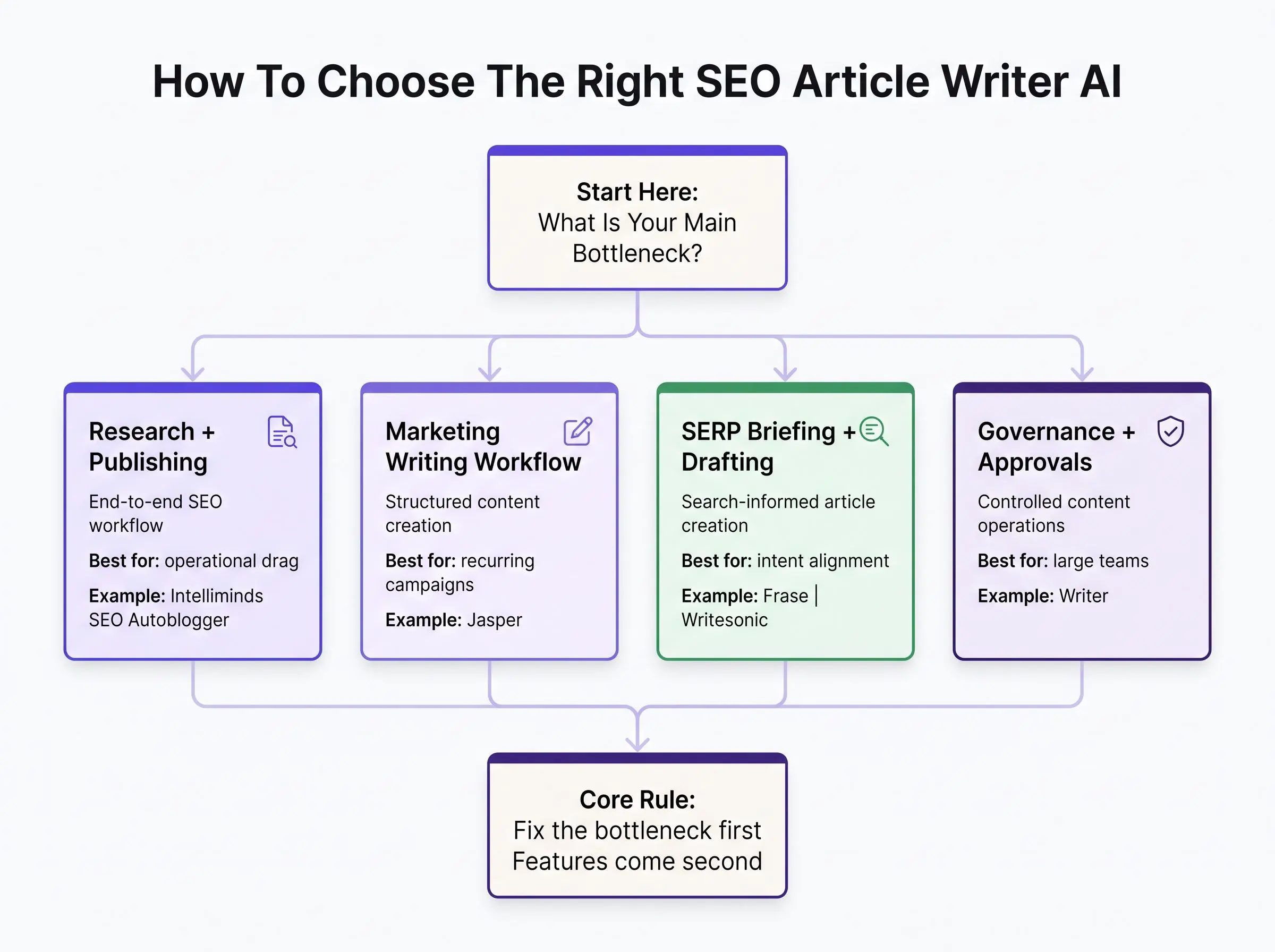
The best seo article writer ai is the one that removes your biggest bottleneck in the workflow you repeat every week. Start there. Then the shortlist gets much clearer.
You can break the market into four buyer paths:
Research to publishing automation
Best if your problem is operational drag across keywords, drafts, formatting, and publishing.Marketing workflow writing
Best if your team needs a dedicated writing platform across recurring campaigns and content formats.SERP informed briefing and drafting
Best if your articles fail because the brief is weak or the content misses intent.Enterprise governance and approvals
Best if compliance, approvals, and consistency control the buying decision.
Use these filters when comparing tools:
- do you need keyword discovery, or do you already have research covered?
- does the tool write from search intent or from generic prompts?
- can it support publish ready workflows or only drafts?
- will it fit a solo marketer, an agency, or a multi stakeholder team?
- will it still hold up when content volume doubles?
A simple shortcut helps:
Fix the bottleneck first. Features come second.
If content ops are the problem, prioritize end to end systems. If draft quality is the problem, prioritize long form writing strength. If ranking alignment is the problem, prioritize research informed tools. If approvals are the problem, choose governance.
What Actually Helps AI Generated SEO Articles Rank
This is the part that cuts through most of the noise. AI does not rank pages. Systems rank pages.
Readable output is not the same thing as search optimized article writing that earns traffic and customers. Teams confuse those two constantly, then wonder why the dashboard looks busy while revenue stays flat.
The ingredients that usually matter most are pretty familiar:
- keyword and topic selection
- search intent alignment
- article structure that actually answers the query
- internal links and on page completeness
- editorial review and factual cleanup
- publishing consistency
- content refreshes when older pages start slipping
That last one gets ignored too often. Fresh publication feels exciting. Refresh work feels boring. Boring work is where a lot of organic growth comes from.
We see the same anxieties come up again and again. You don't want to waste months on articles that never rank. You don't want to scale low quality posts that create clean reporting and no customers. And you don't want to buy a writing tool when what you really need is a content system.
Human judgment still decides the important parts:
- which topics deserve effort
- what the brief should say
- whether the draft is good enough to publish
- when an article needs updating
AI helps with speed. Judgment protects outcomes.
Which Tool Fits Your Team and Growth Stage
Feature grids are fine, but buying decisions usually get clearer when you look at the team behind them. Different teams fail in different places.
For lean in house teams, operational drag is usually the enemy. Intelliminds SEO Autoblogger, Writesonic, and Frase are stronger fits because they reduce steps and keep content moving.
Agencies need repeatability across multiple content streams. Intelliminds SEO Autoblogger, Jasper, and Writer make more sense there because workflow consistency matters as much as draft speed. One messy process multiplied across clients turns into a real problem.
Content marketers focused on high quality long form drafts should look hard at Claude and Jasper. If the article has to sound sharp before anything else, that priority should drive the choice.
Budget conscious businesses testing AI should keep it simple. Rytr is often enough to prove whether faster drafting will help at all before committing to a heavier system.
Performance marketers tying SEO to conversion should lean toward Anyword. Ranking without message performance can still leave the funnel weak.
Larger organizations with approvals and governance needs usually belong with Writer. Once risk and control enter the room, the buying criteria change fast.
Pick the tool that supports the part of the workflow you repeat every week, not the feature set that looks best in a demo.

Conclusion
The best seo article writer ai is rarely just a writing tool. In practice, you're choosing how your team turns search demand into publishable content, and whether that process can hold up month after month.
Choose Intelliminds SEO Autoblogger when you want research, article creation, and publishing in one controlled workflow. Choose Jasper when your team needs a dedicated marketing writing platform. Choose Writesonic or Frase when SEO specific article workflows are the priority. Choose Claude when draft quality and nuance matter most. Choose Writer when governance matters. Choose Rytr when budget and speed matter. Choose Anyword when SEO content also needs to support conversion goals.
Then make the decision simpler than most teams do. Identify whether your real bottleneck is research, drafting, approvals, or publishing. Shortlist the tool that solves that bottleneck in a way your team can actually sustain. That is usually the right answer.
Article Record
ReferencesPrimary sources used for this article
- The only article agent that wins Google AND AI search.
- Positive Surfer - AI
- AI Article Writer — Write a Full, Ranked Article | Frase.io
- Create Genuine, SEO-Friendly Blogs with Anyword’s AI
- The Content Brief AI Agent purpose-built for marketing | Jasper
- AI Content Writer for SEO Articles That Rank | ChatSEO
- Writer SEO: SEO AI Writer
- AI Article Writer Overview
- Positive Surfer - Content Editor
- Platform
- Get the AI built for better marketing results
- What is ChatGPT? | IBM