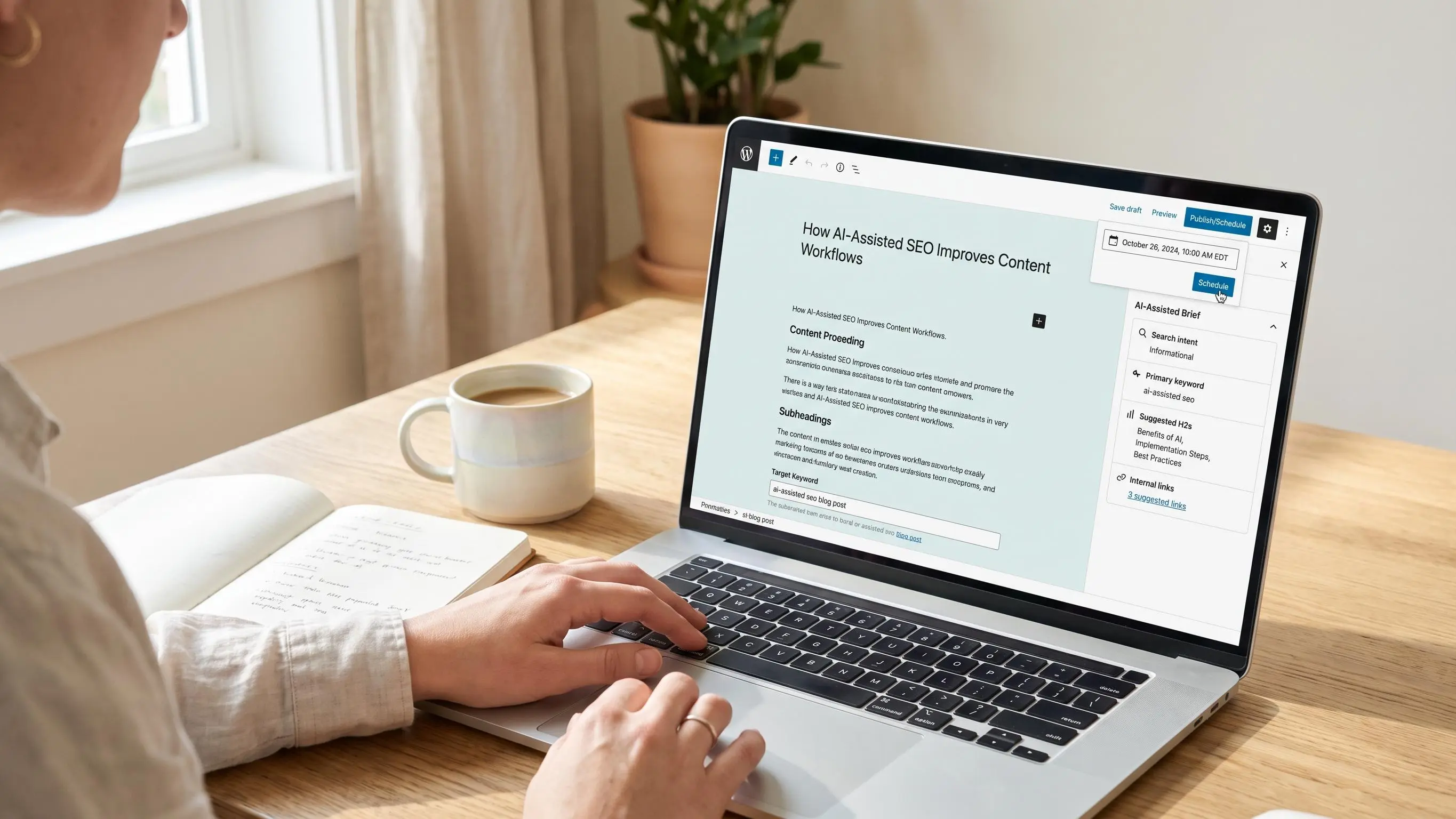
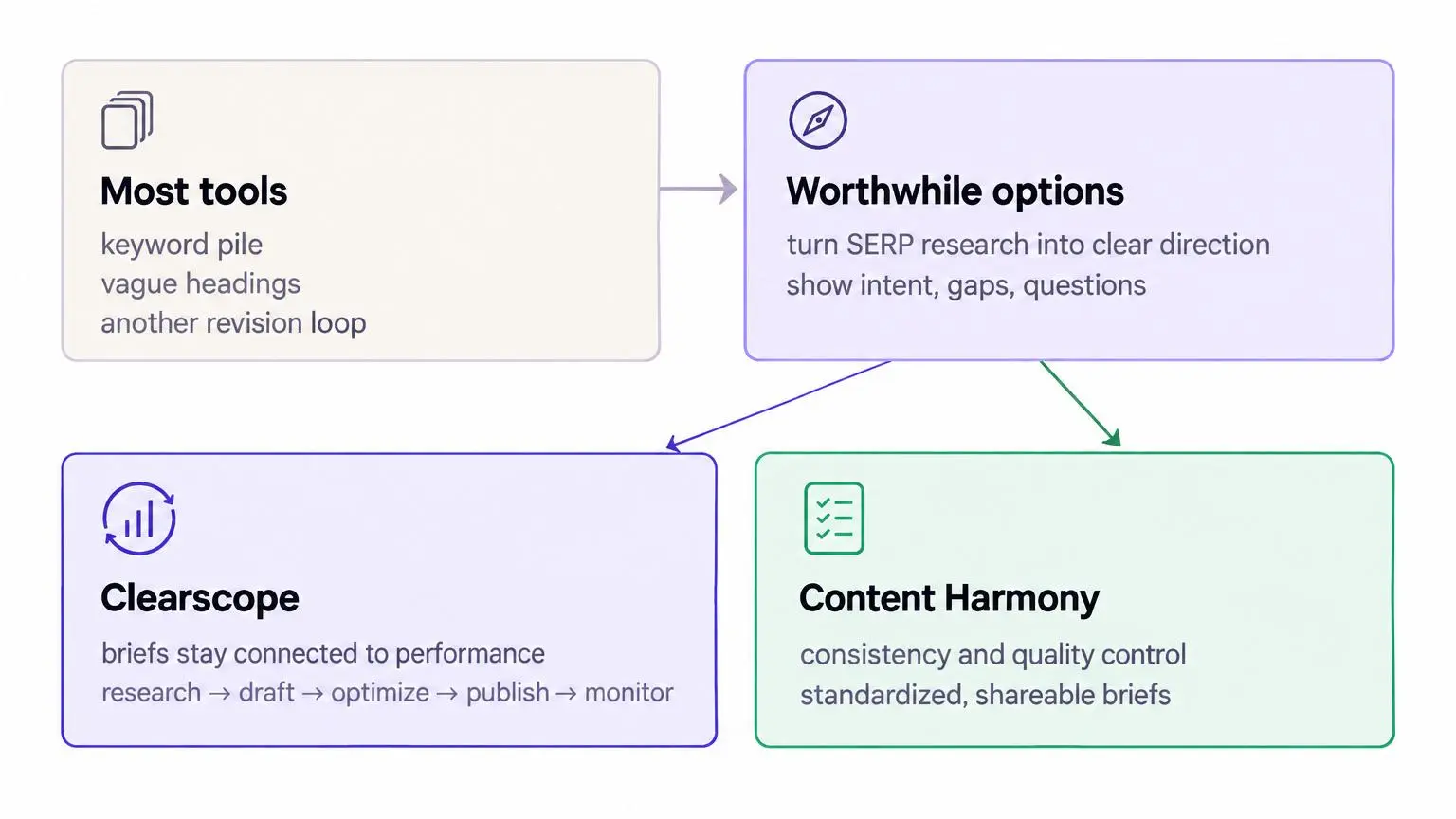
Most SEO brief generator tools look useful until you hand the output to a writer. Then you get a keyword pile, vague headings, and another revision loop.
The worthwhile options turn SERP research into clear direction. They expose intent, gaps, questions, and the details that keep briefs from feeling generic (or worse, unusable).
We cut this list to eight tools worth your attention.
Show 5 more productsShow fewer products
1. Clearscope
- Connects briefs to full lifecycle
- Strong intent and question research
- Live grading catches gaps early
- Works in Docs, Word, WordPress
- Post-publish decay monitoring included
- May feel heavy for basics
- Best value needs ongoing refreshes
- Less lightweight than brief-only tools
Clearscope makes sense when you don't want the brief to live in a folder and die there. It treats the brief as the start of a working system: research, draft, optimize, publish, then monitor what happens after the page goes live.
That changes the buying decision. You're not just picking an seo brief generator. You're choosing whether briefs should stay connected to performance.
Clearscope is strongest for teams that want one thread from search intent to refresh. It discovers buyer questions with volume and intent, helps start drafts from the query and your brand tone, then grades the draft before publication so gaps are obvious early. That last part matters more than people admit. A weak brief usually shows up two weeks later as a messy draft and a slow editing cycle.
A few things stand out in real use:
- It works inside Google Docs, Word, and WordPress, which lowers friction for teams that already have established writing habits.
- It tracks mentions across Google and major AI engines like ChatGPT, Gemini, and Claude.
- It connects Search Console data back into the workflow so you can watch page grade, clicks, SEO value, and decay over time.
A brief that can't age with the page is only doing half the job.
Compared with Content Harmony or Dashword, Clearscope is less about the handoff document itself and more about the full content lifecycle. Compared with SE Ranking, it's much more content-workflow deep and much less about being your broader SEO operating system.
The catch is simple. If you only want lightweight automated content briefs, Clearscope may feel like more machine than you need. Its value shows up when the team actually revisits content instead of treating publish day like the finish line.
2. Content Harmony

- Consistent, standardized writer handoffs
- Deep research across intent and entities
- Strong source and visual planning
- Shareable briefs for team collaboration
- Draft grading improves content QA
- Less useful for full execution
- Slower than lightweight brief tools
- Best with existing writers/editors
Content Harmony is for teams that care about consistency more than novelty. If you run an agency, manage multiple writers, or need every brief to hit the same standard, this one is built for that pressure.
Some tools help you write faster. Content Harmony helps you brief better.
It standardizes the messy research work strategists usually do by hand across tabs, docs, and half-finished templates. The platform covers search intent, overlapping keywords, entities, competitor structure, reader questions, sources, and even visual requirements. That's a lot of the real work behind briefing writers with AI, and it's exactly the stuff teams skip when deadlines get tight.
Where it earns its keep
- Standardized brief formats for repeatable handoffs
- Shareable briefs for clients, editors, writers, designers
- Competitor document structure review
- Outline building based on reader questions
- Citation and source guidance
- Draft grading against an AI-driven topic model
The practical difference between this and faster, lighter tools is quality control. Content Harmony is less interested in giving you a brief in five minutes and more interested in making sure that brief doesn't create downstream confusion. Agencies usually feel that pain first.
It also handles visual planning better than many brief tools. That sounds minor until your writer submits a draft that clearly needs a chart, a product screenshot, or a comparison table, and nobody asked for it upfront.
Compared with Frase or Scalenut, Content Harmony stays more focused on inputs than execution. It assumes you already have writers and editors. That's a strength if your workflow is healthy after the handoff. It's a limitation if you want the tool to keep pushing through drafting, publishing, and refresh.
3. Dashword

- Briefs generated in minutes
- Easy one-click writer sharing
- Helpful pre and post-publish workflow
- Competitor outlines speed topic selection
- Lightweight for lean content teams
- Less deep strategic planning
- Can feel thin at scale
- Not the strongest enterprise option
Dashword is for teams that want momentum. You give it a topic, it compiles the ranking-page research, pulls in competitor outlines, surfaces keywords and FAQs, and gets you to a shareable brief without much ceremony.
That matters when content operations are understaffed, which is most teams.
Dashword's Content Brief Builder is clearly designed for speed. You can create briefs in minutes, edit them in an interactive builder, and share them with writers in one click. It also adds real-time scoring before publish and monitoring after publish, including traffic alerts, update notifications, weekly keyword reports, and rank tracking.
This makes Dashword more useful than a lot of "quick brief" tools that disappear once the draft starts moving.
Why smaller teams tend to like it
- Fast topic selection through competitor outline collection
- Easy editing and organization without heavy process
- Pre-publish optimization plus post-publish monitoring
- Automated page import via crawler if you're managing existing content too
Dashword sits in a useful middle ground. It's lighter than Clearscope or MarketMuse, but it still gives you enough structure to avoid the usual chaos of brief docs floating between Slack, email, and Google Drive. For lean in-house teams, that's often enough.
The tradeoff is depth. If your problem is strategic planning at scale, Dashword can feel a bit thin. But if your problem is "we need better briefs this week without adding another operator," it's a practical answer.
4. Frase

- Connects briefs to full workflow
- Reduces handoff and tool switching
- Researches live ranking pages automatically
- Supports brand-voice drafting and refreshes
- Human approval stays in control
- Broader than a simple brief tool
- May feel heavy for basic needs
- Best with strong editorial review
Frase is relevant if you're asking a bigger question than "how do we make briefs faster?" It's for teams asking how to create SEO briefs with AI and then keep going all the way through writing, publishing, and refresh.
That's a different category of need.
Frase treats the brief as part of an AI agent workflow. It researches the topic by reading current ranking pages, writes in your brand voice, checks the content against what is winning on Google and what AI engines are quoting, publishes, and then comes back when performance starts slipping. It can run inside Frase itself or through assistants like Claude and Cursor.
What changes in practice
With Frase, the handoff shrinks because more of the work stays in one system. Instead of building a static ai seo content brief and tossing it to a writer, you're moving through a draft-and-approve loop with human control built in.
That approval layer matters. Most teams don't want fully autonomous publishing, and they shouldn't. The gap between "AI can produce something" and "this is safe for our brand to ship" is still real.
Frase is more automation-forward than Content Harmony, Dashword, or WriterZen. It's closer to an operating model than a classic brief builder. That's either exactly what you want or more than you need.
If you're already good at editorial review and want to reduce orchestration across research, drafting, and refresh, Frase earns attention quickly. If all you need is a standalone brief document, it may feel broad.
5. MarketMuse

- Strong topic prioritization guidance
- Finds competitor weakness opportunities
- Briefs emphasize depth and expertise
- Useful for larger content portfolios
- Heavy for lightweight workflows
- Less handoff-focused than specialists
- More planning than execution
MarketMuse is for teams where the real bottleneck happens before the brief. You don't need help filling sections in a template. You need help deciding what content is worth producing in the first place.
That's a more expensive mistake when you scale.
MarketMuse leans into strategy, topic depth, and differentiation. It gives AI-based guidance on what content to write and how much of it to create, identifies areas where competitors are weak, and adds brief recommendations around structure, expertise, editorial integrity, and depth. It also brings in link recommendations and broader content inventory support.
A fast brief for the wrong topic is still wasted work.
This makes MarketMuse stronger for content leads and mature teams than for scrappy execution-focused teams. Compared with Dashword or WriterZen, it is more strategic. Compared with Content Harmony, it is less centered on standardized handoff templates. Compared with Frase and Scalenut, it spends more energy on planning than execution.
The upside is confidence. If your leadership team keeps asking why a topic matters, why now, and why your page should win, MarketMuse is built for that conversation.
The downside is weight. Teams that just want a content outline with AI and a cleaner workflow may find it heavy. But if you're managing a larger content portfolio, "heavy" can also mean "finally someone is solving the right problem."
6. Scalenut

- Connects briefs to execution
- Tracks AI search visibility
- Built-in writer and optimizer
- Surfaces gaps and citation opportunities
- Offers optional managed support
- Broader than brief-only tools
- Services layer may feel unnecessary
- Less ideal for strong in-house teams
Scalenut is for operators who don't just want briefs. They want movement from brief to rankings, plus visibility into how content performs in AI search environments.
That makes it different from tools that stop at the writer handoff.
Scalenut ties brief creation to a broader growth blueprint. It tracks brand mentions, prompt coverage, historical trends, and competitor share across AI search. It also includes an article writer, optimizer, audit tools, GEO score, keyword planning, and a choice between self-serve software and expert-managed services.
Where it fits best
- Teams that care about search results and AI-generated answers
- Operators who want recommendations around content gaps, citations, and prompt opportunities
- Companies that may want software now and extra execution help later
Compared with Content Harmony or WriterZen, Scalenut pushes much further into execution. Compared with Dashword and MarketMuse, it has a sharper focus on AI visibility. Compared with Clearscope, it has more service flexibility, which some teams will like and others won't need.
That last point matters. Some buyers want a tool only. Others want a tool with backup. If your internal team is thin, Scalenut's model can make sense. If your team is already strong and just needs better systems, the services layer may be irrelevant.
7. SE Ranking

- Unifies content and SEO data
- Strong integrations and automation support
- Useful built-in content editor
- AI visibility adds extra insight
- Less specialized for content briefs
- May feel too broad
- Overkill if your stack works
SE Ranking is not the purest seo brief generator on this list. It's here because some teams are not really buying a brief tool. They're trying to stop stitching content work onto a separate reporting and SEO stack.
If that's your situation, SE Ranking becomes a lot more interesting.
It combines keyword suggestions, competitive research, and SERP analysis with on-page checking, content marketing tools, a Content Editor, and AI Writer. It also supports API access, MCP, workflow automation, and integrations with GA4, GSC, Data Studio, Make, n8n, Zapier, and reporting tools. On top of that, it includes AI visibility analysis across major AI engines.
Why teams choose it anyway
- Shared data across content and SEO workflows
- Useful if reporting and automation matter as much as writing support
- Easier to keep one source of truth when multiple teams touch content
SE Ranking is broader than Dashword, WriterZen, or Content Harmony. It is less specialized in briefing than Clearscope or Content Harmony. That's the tradeoff in plain English.
For teams already drowning in tool sprawl, consolidation has real value. For teams that already have strong rank tracking, audit tooling, and dashboards elsewhere, SE Ranking may be too much platform just to solve briefing writers with AI.
8. WriterZen

- Strong topic clustering and discovery
- Useful intent and headline insights
- Suggested briefs speed outlining
- Affordable upstream research workflow
- Limited post-publish optimization depth
- Less lifecycle support than rivals
- Briefing features feel secondary
WriterZen is strongest before the brief. It helps you map the topic, cluster related queries, read intent signals, and gather headline angles from what is already ranking. Then it helps turn that research into a suggested brief and outline.
That upstream work is where a lot of SEO content quietly wins or loses.
WriterZen surfaces topic clusters, search intent from Google Suggest and Related Search, keyword opportunities, and headline ideas from top-ranking articles. It also includes content research, outline creation, an AI assistant, content generation, analysis, and plagiarism checking.
Instead of being lifecycle-heavy, it stays research-centric. That's useful when your team already knows how to write and edit but struggles to choose the right angle or build a sensible cluster strategy.
A few practical notes:
- It's stronger on clustering than Dashword or Content Harmony.
- It's less connected to post-publish optimization than Clearscope or Frase.
- It can be a better fit than SE Ranking if your goal is research and briefing rather than platform consolidation.
WriterZen is often the right answer when the real bottleneck is not output. It's judgment. You need a better map before you start writing.
| Clearscope | Content Harmony | Dashword | Frase | MarketMuse | Scalenut | SE Ranking | WriterZen | |
|---|---|---|---|---|---|---|---|---|
| Research-first emphasis | × | ✓ | × | × | ✓ | × | × | ✓ |
| Writer-handoff emphasis | × | ✓ | ✓ | × | × | × | × | × |
| Connected content-lifecycle emphasis | ✓ | × | ✓ | ✓ | × | ✓ | × | × |
| Broader SEO-suite emphasis | × | × | × | × | × | × | ✓ | × |
How to Choose the Right SEO Brief Generator
Most teams shop by feature list and regret it later. Start with the failure point in your workflow instead.
If research is messy, look harder at tools with strong topic discovery and SERP analysis, like WriterZen or MarketMuse. If briefs are inconsistent, Content Harmony is built for that problem more directly than most. If output is slow, look at lifecycle tools like Clearscope or Frase that connect the brief to drafting and optimization. If published pages keep decaying, don't ignore monitoring and refresh support.
A clean way to narrow the list
How to choose
- Map workflow
Map your process from topic selection to refresh.
- Spot bottlenecks
Mark where work stalls or gets redone.
- Pick tool type
Decide whether you need a brief-first tool, a lifecycle tool, or a broader SEO suite.
- Set AI limits
Be honest about how much AI control your brand can tolerate.
- Check integrations
Check integrations last, but don't skip them.
The team structure matters too. Agencies usually need standardized, shareable briefs and repeatable QA. Lean in-house teams often need automated content briefs with built-in optimization. Strategy-heavy teams need better prioritization before anyone writes a sentence.
And don't overbuy automation. Some teams just need better briefs. Others need the whole loop connected.
What an AI SEO Content Brief Should Include

A good ai seo content brief doesn't read like a keyword dump. It gives a writer enough direction to produce something useful on the first pass.
That means the brief should cover a few non-negotiables:
- Search intent: what the reader wants, and whether the query is informational, commercial, or comparison-driven
- Topic coverage: core keywords, overlapping terms, entities, expected questions, and important subtopics
- Structure: a practical content outline with AI support, shaped by what already performs
- Writer guidance: tone, conversion goals, source expectations, citations, and visual needs
- Optimization checkpoints: scoring or grading before the draft goes live
- Post-publish thinking: whether the page will be monitored and refreshed later
The non-obvious part is this: learning how to create SEO briefs with AI is not mainly about speed. It's about reducing decisions that shouldn't be made from scratch every time. Clear briefs create cleaner drafts, faster edits, and more predictable performance. That's the real payoff.
Common Mistakes When Briefing Writers With AI
Most failures aren't caused by the tool. They're caused by bad assumptions about what a brief is supposed to do.
The first mistake is treating the brief like an SEO checklist. Keywords matter, but a writer still needs direction on angle, structure, and what the page must do for the reader.
The second mistake is overvaluing term scores. A high content score can still produce a forgettable page. Expertise, source quality, and differentiation still matter. Search engines aren't blind, and readers definitely aren't.
Other mistakes show up later in production:
- Skipping competitor structure analysis, so expected sections never make it into the draft
- Leaving out sources, proof points, or visual requirements, which creates editing friction later
- Running one tool for research and another for everything else without a real workflow
- Assuming every team needs full automation when many just need cleaner inputs
We've seen this a lot in content operations. The brief is where teams either remove uncertainty or hide it. If the brief is vague, the draft won't save you.
Conclusion
The best seo brief generator is the one that fits your workflow, not the one with the longest product page.
Choose Clearscope or Frase if you want the brief tied to a broader content lifecycle. Choose Content Harmony or Dashword if your main issue is faster, clearer writer handoffs. Choose MarketMuse or WriterZen if topic strategy and research depth matter more than speed. Choose Scalenut or SE Ranking if you want the brief connected to wider execution, AI visibility, or a broader SEO stack.
The next step is practical. Map your current process from topic research to refresh, find the point where delays and inconsistency keep showing up, and shortlist the tool category that fixes that specific gap first.
A better brief won't fix a broken system on its own. But in a healthy workflow, it's often the part that makes everything else move.
Article Record
ReferencesPrimary sources used for this article
- Write: Write what gets mentioned | Clearscope
- Knowledgebase & Docs - Content Harmony
- MarketMuse Knowledge Base - Get Help With Our Platform
- Rank on Google. Get cited by AI.
- What is Surfer? | Surfer
- Blog Post Outline | Writing SEO Optimized Outlines With Outranking
- WriterZen - Proficient SEO Content Workflow Software
- Dashword — Make Your AI Write Content That Ranks
- Scalenut's AI-powered SEO and Content Marketing Platform Overview
Update HistoryMeaningful revisions to this article
- Expanded the feature matrix to all 8 ranked products.
- Clarified the selected pair shown in the diagram without changing the image.