Most brands chasing how to rank in Google AI Overviews make the same mistake: they publish more pages while their best answers sit buried under fluff. If Google can’t lift a clean, credible passage, page-one rankings alone may not get you cited.
For growing SaaS, ecommerce, and service teams, this is a practical guide to earning citations without adding manual content workload. Answer-first pages, tight topic coverage, and smart refreshes matter more than volume.
Start by checking:
- Which page-one queries already trigger AI Overviews
- Whether your answer appears in the first 50 words
- Which outdated pages can become citation-worthy wins
What Ranking in Google AI Overviews Actually Means
If you're trying to figure out how to rank in Google AI Overviews, start with the right mental model. This isn't a new blue link position you can "win" and hold. It's a citation game.
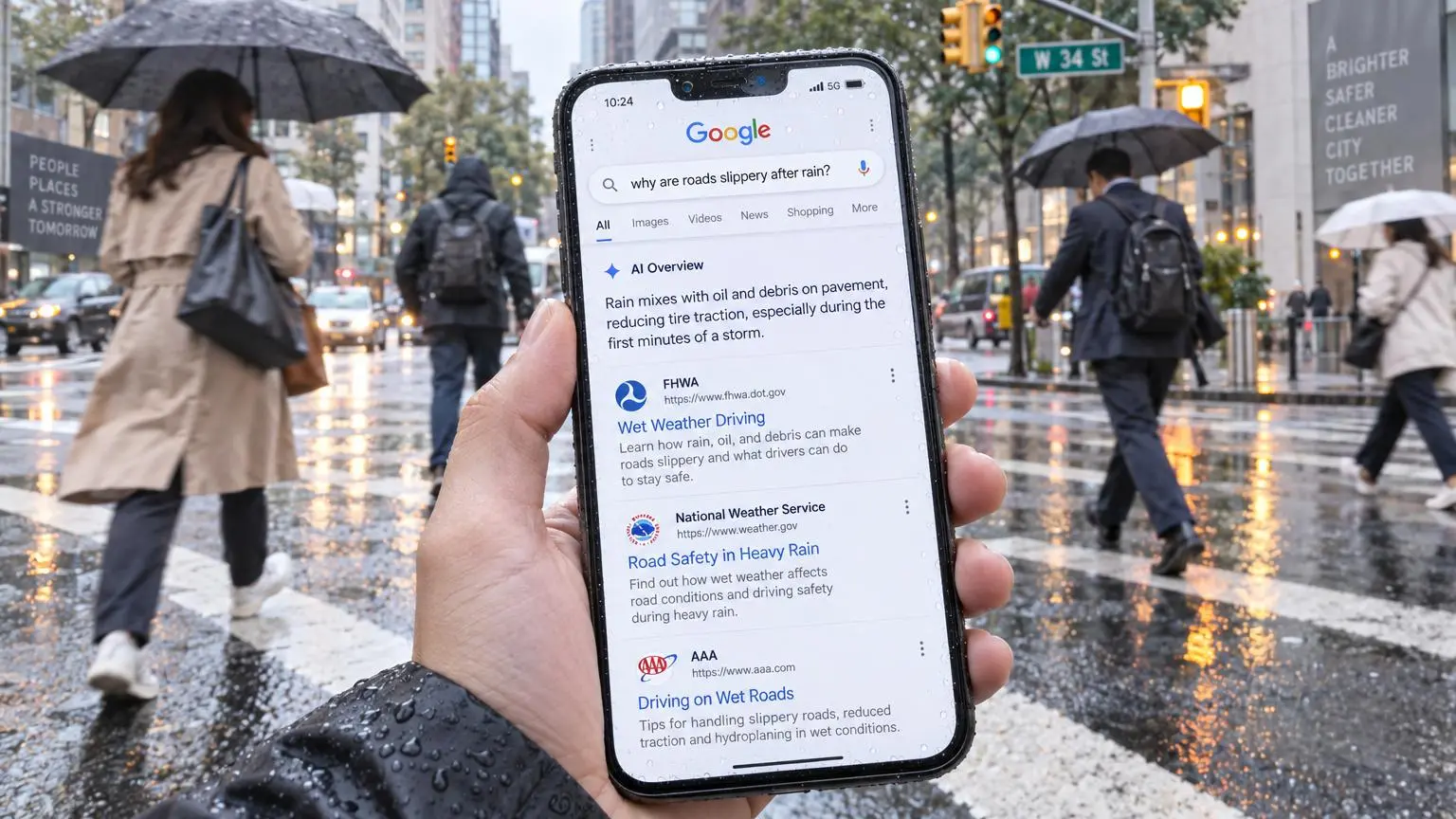
Google AI Overviews are AI-generated summaries that pull from multiple web pages and show linked sources. When your page appears there, Google's system has decided your content is useful enough, clear enough, and trustworthy enough to support part of the answer.
That is different from traditional rankings. A normal result gives one page one position. A Featured Snippet usually pulls one short answer from one page. AI Overviews are looser. Google can pull one definition from your page, one comparison from another site, and one step list from a third source, all in the same answer.
That changes the job.
You still need strong organic rankings. But to appear in Google AI answers, your page also has to work at the passage level. A great page with muddy sections can lose to a simpler page with cleaner answer blocks.
In AI search, pages rank, but passages get cited.
This is also why older "search generative experience SEO" advice still matters. The label changed. The challenge didn't. You're trying to earn visibility inside AI-shaped search results, where users often get part of the answer before they decide whether to click.
For brands that depend on informational traffic, that matters a lot. If the answer shows up without the click, weak content gets squeezed. Strong content still has a job to do: become the source Google trusts.
What the Current Evidence Says About AI Overview Visibility
The current evidence is less mysterious than people make it sound. Most AI Overview citations still come from pages that already rank well organically.
Research patterns show that 76% of cited pages are already in the organic top 10, and the median cited URL sits around position 2. That should calm you down a little. AI Overviews did not delete SEO. They raised the standard for what happens after page-one relevance.
Here's the practical read:
- Traditional SEO is still the base layer
- Ranking well increases your odds
- Ranking well alone does not guarantee inclusion
We've seen the same pattern in case data. One outdoor living brand improved owned AI Overview references by 2.8x after optimizing 39 pages for cleaner answers and tighter structure. Its impression-weighted CTR also improved. That wasn't magic. It was better extractability.
A healthcare publisher went much further, reworking 680 pages. The result was a 92% inclusion rate, a 38% CTR lift from AI Overviews, and 4.2x AI-referred conversions. The changes were not exotic. Better structure, more factual density, and stronger authority signals.
The interesting part is what happens at the smaller end. Newer sites can still earn citations when they answer narrow questions cleanly, make entity signals obvious, and write in a way that's easy to lift into a summary. They usually won't brute-force broad terms early. But they can pick off specific questions faster than people expect.
That tension matters. Big domains have reach. Smaller sites can still win precision.
So the working rule is simple enough:
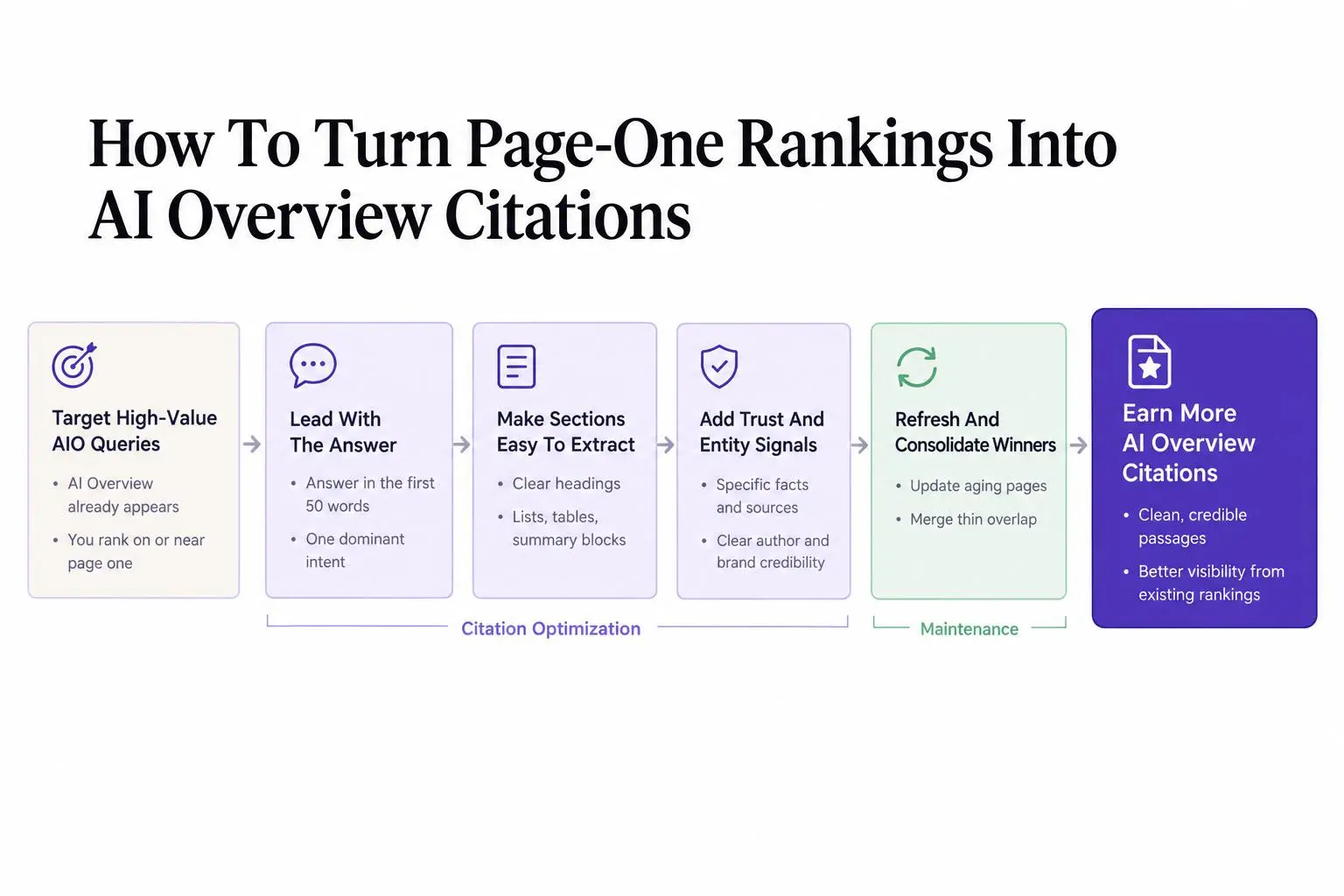
- Get page-one relevance
- Make the page easy to extract
- Add enough factual specificity to trust
- Support the page with credible site and brand signals
If one of those pieces is missing, you may rank and still never show up in an overview.
| Evidence | What it shows | Scale | Reported outcome |
|---|---|---|---|
| Citation pattern research | Most cited AI Overview pages were already strong organic results | 1.9 million AI Overview citations analyzed | 76% of citations came from pages already in the organic top 10, and the median cited URL ranked at position 2 |
| Trex case study | Cleaner answers, tighter structure, and machine-readable formatting improved extractability | 39 pages optimized | 2.8x increase in owned AI Overview references and 0.58 percentage-point growth in impression-weighted CTR |
| Healthcare publisher case study | Content restructuring, factual density improvements, entity optimization, and authority concentration improved citation-worthiness | 680 pages optimized | 92% AI Overview inclusion rate, 38% CTR lift from AI Overviews, and 4.2x AI-referred conversions |
Start With the Right Queries, Not the Entire Keyword Universe
Not every keyword deserves AI Overview effort. Trying to optimize everything is how teams burn time and call it strategy.
Focus on queries where AI Overviews already appear and where being cited could still change behavior. That might mean clicks. It might mean branded search later. It might mean assisted conversions from users doing research before they buy.
The best candidates usually sit in a few buckets:
- definitions and explanations
- comparisons
- step-by-step questions
- product education terms
- decision-stage research queries
Before touching content, audit the live SERP. Look at what Google is actually doing now, not what it did three months ago.
Check for four things:
- Does an AI Overview appear?
- What subquestions is it trying to answer?
- What kinds of pages are cited?
- Are those citations going to guides, tools, product pages, category pages, or editorial content?
This part is easy to skip because it feels slow. Don't skip it. A lot of content misses because the page type is wrong before the writing even starts.
We'd prioritize keywords where your site already ranks on page one, or just outside it. Those are usually the fastest path to AI Overview gains because Google already sees your page as relevant. You're not starting from zero. You're cleaning up a near-win.
Then group those queries into clusters. Don't treat every keyword like a separate campaign. If five related questions all live under one buying problem, they should support each other. That's how an AI overview SEO strategy turns into actual authority instead of scattered pages.
For business teams, the filter should be blunt:
- Is the topic tied to revenue?
- Can we realistically rank or improve from where we are?
- Does our page match the query's intent?
- Will visibility here help customer acquisition later, even if first-click attribution looks thin?
Some keywords are interesting. Fewer are worth operating around.
Build Pages That Deserve to Be Cited
A lot of pages fail before formatting even matters. They try to answer three intents at once, circle the point for 200 words, and then wonder why Google cites someone else.
Make each page answer one dominant intent cleanly. Mixed-intent pages confuse users and AI systems for the same reason: the core answer is buried.
Front-load the answer. The best-performing examples often answer the main question within the first 50 words or in a short opening block that can stand on its own. That's not a trick. It's basic clarity.
After that, earn the trust needed to cite you. Expand with actual substance:
- clear definitions
- supporting facts
- practical steps
- tradeoffs
- examples
- exceptions
- comparisons
This is where most "AI content" falls apart. It says a lot while committing to almost nothing. AI Overviews tend to reward pages that make specific, verifiable claims section by section.
Here's the operator version: vague pages are hard to quote.
Your edge as a brand is not generic summaries. It's expertise with some scar tissue on it. You know the customer objections, the implementation problems, the tradeoffs inside the decision, the details that don't show up in thin content. Put that on the page.
A useful test we use internally is simple. If the AI Overview disappeared tomorrow, would this page still be worth bookmarking? If not, it's probably too light.
Use Content Formatting for AI Overviews That Helps Humans Too
Content formatting for AI Overviews is really passage design. You're making the best parts of the page easy to find, easy to understand, and easy to quote without stripping the page of personality or depth.
Use headings that match search behavior and intent. Question-led headings work well when the query is explicit. Intent-led headings work better when the user wants help deciding, comparing, or acting.
Under each major heading, start with a direct answer. Then expand. That one move fixes more weak pages than most teams realize.
Formats that tend to work well:
- short definitions
- step-by-step lists
- comparison tables
- summary bullets
- decision frameworks
The reason is boring, which is usually a good sign. These formats isolate one subquestion at a time.
Keep paragraphs tight. If the only useful sentence in a section is buried in the fourth line of a chunky paragraph, you've made extraction harder for no good reason.
For complex topics, add short summary sections. AI systems often prefer compact passages that resolve one issue cleanly. So do busy readers, especially the ones comparing vendors between meetings.
A quick formatting standard
When we optimize for AI overviews, we want each section to do three things:
- answer the subquestion fast
- add enough detail to be trusted
- stand alone if Google lifts it out of context
That's not writing for robots. It's writing so your best information survives scanning, summarization, and citation.
Strengthen Entity Clarity, Trust, and Supporting Signals
Two pages can say similar things and get different outcomes because one page is attached to a clearer, more credible entity. That's the part many teams underplay.
Make it obvious who you are, what you do, and why you're qualified to speak. Keep your organization details, author signals, expertise markers, and contact or about information consistent across the site. If your identity is fuzzy, your content has to work harder.
Use structured data to reinforce what's already visible. There is no secret schema type that unlocks AI Overviews. But schema still helps Google understand page type, organization context, and relationships between pages.
When you make factual claims, anchor them in recognized sources and established terminology, especially in technical or sensitive categories. Loose claims are expensive now.
Off-page corroboration still matters too. Brands that appear in AI Overviews often show up elsewhere in the category conversation:
- editorial mentions
- reviews
- forum discussions
- industry lists
- other pages Google already trusts to map the market
That doesn't mean chasing random mentions. It means becoming legible across the web.
When two pages are both good, corroboration often breaks the tie.
Consolidate Thin Content and Refresh Winners Before Publishing More
Publishing more pages is not always the fastest route to more visibility. In a lot of content libraries, it's the opposite.
Thin, overlapping, or outdated pages dilute authority. They split links, impressions, and relevance across multiple weak assets that all sort of answer the same thing. Google then has to guess which one you meant to lead with. Usually, it guesses wrong.
We've seen better outcomes from consolidation than from blind expansion. One example reduced 180 weak pages into 45 stronger guides. Fewer pages. More depth. Better concentration of authority.
Before you queue new topics, look for pages that deserve a refresh:
- pages ranking well but losing CTR after AI Overviews appeared
- pages with the right topic but a buried answer
- pages with old stats, examples, or structure
- pages that no longer match current SERP intent
A useful refresh is not cosmetic. It usually includes rewriting the intro, tightening headings, adding better supporting facts, improving internal links, updating examples, and clarifying entity signals.
This is where many teams get impatient. They'd rather publish ten new articles than fix three aging winners. That's backwards.
Scalable brand growth in AI search comes from compounding quality and freshness, not endless net-new output.
Build an AI Overview SEO Strategy That Scales With Your Team
If your process depends on heroic manual effort, it won't last. An AI overview SEO strategy needs to run like an operating system, not a one-off sprint.
The workflow is straightforward:
Scalable workflow
- Topics
discover priority topics
- SERP check
qualify SERPs for AI Overview presence
- Clusters
map clusters and page roles
- Drafting
draft answer-first content
- Editing
edit for quality and extractability
- Publishing
publish consistently
- Monitoring
monitor results
- Refreshing
refresh based on performance
Cluster planning matters because it lets one topic do more work. You cover the core question, the supporting education, and the adjacent decision-stage queries together. That helps with rankings, but it also helps the brand sound coherent. Users notice when a site actually understands the topic.
Set editorial standards that multiple writers can follow without guesswork:
- answer-first openings
- intent-led headings
- factual depth
- useful comparisons
- internal linking rules
- refresh intervals
Automation helps most with the heavy lifting: topic research, drafting, optimization support, publishing, and refreshing older content. Human review still matters where judgment matters. Brand positioning, claim accuracy, decision-stage nuance, and customer acquisition logic should not be outsourced to a button.
For teams that need that kind of system, Intelliminds SEO Automation Software fits naturally here. It handles keyword and topic research, AI writing, publishing, and content refreshing while keeping a human in the loop. If you want more end-to-end blog workflow support with controlled scheduling and intent-matched article generation, Intelliminds SEO Autoblogger is the more direct fit. The point isn't automation for its own sake. It's removing the manual drag that keeps good strategy from shipping.
How to Measure Whether You Appear in Google AI Answers and Whether It Matters
Rank tracking alone won't tell you enough. You need to know whether you appear in Google AI answers, which pages are being cited, and whether those citations lead to outcomes anyone on the revenue team cares about.
Track at the query and page level. Domain-level views hide too much.
Split outcomes into three groups:
- cited and clicked
- cited but not meaningfully clicked
- not cited at all
Then compare before-and-after movement across metrics that show real business effect:
- impression share
- organic CTR
- branded search interest
- assisted conversions
- AI referral traffic where you can see it
Use query-set tracking so you know how often AI Overviews show for your target keywords and how often your brand is included. Otherwise you're looking at noise.
One small but practical step gets missed all the time: after refreshing pages, check that they're indexed and eligible for reevaluation. If you've updated batches of URLs, a simple tool like Intelliminds Google Index Checker is useful because you can check up to 20 pages at once without turning the task into a spreadsheet project.
Your monthly dashboard should stay tied to business relevance:
- number of target queries with AI Overviews
- citation rate
- top 10 organic coverage
- pages refreshed
- CTR change
- conversion impact
A Seer Interactive study of informational and educational query sets found a meaningful CTR advantage where the tracked brand was cited in an AI Overview. That makes citation rate a useful leading indicator—but not a substitute for measuring clicks and conversions.
Q3 2025 monthly-average organic CTR for informational and educational queries where an AI Overview appeared, grouped by whether the tracked brand was cited.
Sources
- The source reports observational, query-set averages and explicitly says it cannot prove that citations caused the CTR difference.
- The chart uses Q3 2025 results for informational and educational queries; it should not be treated as a universal CTR benchmark for every industry or intent.
- AI Overview presence and citation status may change over time, so teams should benchmark their own tracked query set.
| Citation status | Organic CTR |
|---|---|
| Brand not cited | 0.52% |
| Brand cited | 0.70% |
This is an association, not proof that the citation itself caused the higher CTR. Brands with stronger authority or higher baseline click-through rates may also be more likely to be cited. Use a consistent query set and compare cited and uncited pages over time before crediting a content change with the result.
Common Myths That Keep Brands Stuck
There are a few myths that waste more time than algorithm updates.
Myth: AI Overviews need a completely different playbook from SEO.
Reality: the foundations still carry most of the weight. Top-10 relevance, topic authority, and content quality still do the hard work.
Myth: structured data alone is enough to optimize for AI Overviews.
Reality: schema helps search engines understand the page. It does not turn a weak answer into a strong one.
Myth: only giant domains can appear in Google AI answers.
Reality: smaller sites can earn citations when structure, focus, and entity clarity are strong. They just need to be more precise.
Myth: more AI-generated content means more visibility.
Reality: low-value output scales the thin-content problem faster than humans ever could.
Myth: AI Overviews make content marketing pointless.
Reality: they punish lazy content and reward disciplined content operations.
Myth: once you get cited, you're done.
Reality: citation sets rotate. Intent shifts. Fresher pages enter the field. Maintenance is part of the game now.
The brands that get stuck usually aren't under-informed. They're overreacting.
A 90-Day Plan to Improve AI Overview Visibility
You do not need a giant rebuild to make progress. You need a tight 90-day operating plan.
Days 1 to 30
Start with the audit work that actually narrows the field:
- identify priority keywords that trigger AI Overviews
- find pages already ranking in or near the top 10
- map topic clusters and overlap problems
- choose the highest-value refresh targets first
For lean teams, the order matters. Start closest to revenue, closest to page one, and closest to topics where you already have some authority.
Days 31 to 60
Now improve the pages most likely to move:
- rewrite openings for direct answer clarity
- tighten heading structure and section independence
- add more specific facts, examples, and decision-stage detail
- improve internal linking and visible trust signals
- clean up page structure and relevant schema
This is usually the point where teams realize how much weak content was really just badly organized.
Days 61 to 90
Then make the gains hold:
- consolidate duplicate or thin content
- publish supporting cluster pages around priority topics
- monitor citation presence and CTR movement
- adjust based on which formats and pages are actually being cited
Don't chase a single citation win and call it progress. The goal is to build a system that compounds authority, visibility, and customer acquisition over time.
Conclusion
Ranking in Google AI Overviews usually comes from doing core SEO well, then packaging your expertise so AI systems can extract, verify, and trust it.
There isn't a gimmick hiding here. The strongest path is a durable system built on the right queries, stronger page structure, deeper factual value, broader brand corroboration, and steady refreshes.
If you're deciding where to start, keep it narrow. Pick one high-value topic cluster. Improve the pages already closest to visibility. Turn optimize for AI Overviews from a reactive experiment into a real content operation.
That's when this stops feeling unstable. And that's when organic growth starts to compound.
Article Record
ReferencesPrimary sources used for this article
- How to rank in AI Overviews: what the citation data says — SEOBRO® Blog
- AI Overview Case Study: 92% Inclusion | SEOFrancisco
- AIO Impact on Google CTR: September 2025 Update
- From Traffic Declines to Increased Brand Authority: How Trex Turned AI Overviews Into a Traffic Driver
- AIO Impact on Google CTR: 2026 Update
- How to rank in AI Overviews: What 60+ B2B Brands Taught Us — Above Apex
- How to Rank in AI Overviews: An Implementer's Playbook (2026) — Automaton
- How to Rank in Google AI Overviews: The 2026 Playbook | Outline Technologies
- The 5W Citation Source Audit