
Most teams searching for how to use AI for blog writing start in the wrong place: a blank prompt. You get fast drafts, then wonder why the post reads fine and still goes nowhere.
What matters is the workflow behind the draft. If you want organic traffic, you need search intent, a tight brief, and edits that strip out the weird filler AI loves (yes, that part).
Watch these before you publish:
- Pick keywords with buying intent, not broad traffic bait.
- Check the SERP first; format mismatch kills decent articles.
- Refresh pages before they slip. That is how you keep traffic.
Why AI Blog Writing Works for SEO and Why It Often Fails
AI can absolutely help you scale content that ranks. It can also help you publish a lot of pages that go nowhere, or worse, disappear after a short lift. Both outcomes are real, and the difference usually has very little to do with the model itself.
Search performance still comes down to usefulness, originality, and intent match. Google doesn't care whether a human or AI typed the first draft. It cares whether the page helps the searcher better than the alternatives.
The upside is clear in real-world tests. On an established site, AI-assisted articles generated nearly 555,000 impressions and more than 2,300 clicks over time. Half of those pieces reached top 10 organic positions. Several were also cited in AI-generated search experiences.
The downside is just as clear. A large-scale test on brand-new sites published 2,000 AI-written articles and saw about 71% of pages indexed in the first month, plus more than 122,000 impressions. By months two and three, impressions climbed past 526,000 and clicks more than tripled. Then the floor dropped. The share of pages ranking in the top 100 fell from 28% to 3%, with little recovery more than a year later.
AI can create momentum. It does not create durability on its own.
That's the lesson worth keeping. AI content can earn traction, especially on sites with existing authority and an editorial process. Bulk publishing generic articles without ongoing improvement is fragile. If you're learning how to use ai for blog writing, the goal isn't to produce more words. It's to build a repeatable traffic engine.
What Using AI for Blog Writing Actually Means
Most teams still think of AI as a drafting shortcut. That's too narrow, and it leads to bad decisions. Strong AI assisted article creation is a workflow.
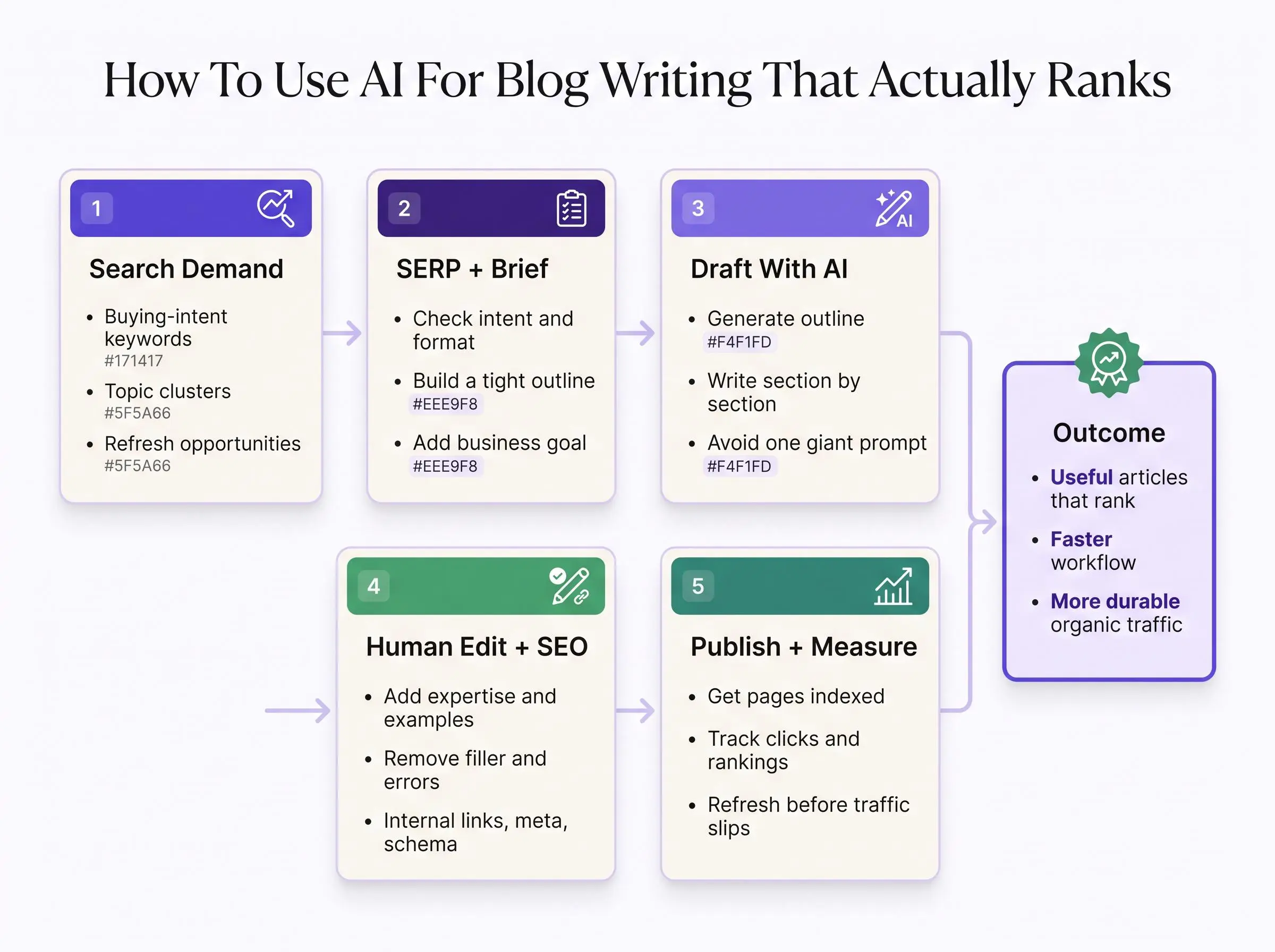
Here's the full process behind how to use ai for blog writing well:
- Discover search demand
- Select topics with business value
- Analyze the search results
- Build a brief and outline
- Draft the article
- Optimize for on-page SEO
- Publish and get it indexed
- Measure results and refresh
That is very different from dumping a keyword into a chatbot and asking for 1,500 words.
The best AI SEO article writing setups are chained systems. Each step feeds the next. Topic research shapes the brief. The brief shapes the structure. The structure shapes the draft. Then human review sharpens the piece before it goes live. One giant prompt usually collapses under its own ambition.
Human judgment still matters in a few places that teams often underestimate:
- Choosing topics worth investing in
- Spotting weak or crowded angles
- Adding expertise, examples, and nuance
- Fact-checking claims
- Protecting brand voice
- Approving what actually gets published
We've seen this over and over. Lean teams don't need AI to think for them. They need it to remove the manual drag so they can write optimized articles faster without lowering the bar.
Start With Search Demand, Not a Blank Page
Most SEO wins are decided before the first paragraph exists. Topic selection does more work than clever writing ever will.
Start by prioritizing topics with real business intent:
- Problems your buyers actively search for
- Keywords tied to your product, service, or pain point
- Topic clusters that build authority over time
- Lower-competition angles with clear intent
- Older pages worth refreshing
Broad vanity topics look attractive in a spreadsheet. They usually waste time. Specificity wins more often than teams expect. A niche article for a defined audience tends to outperform a bland catch-all post because it matches intent more tightly and gives you room to say something useful.
A practical way to organize the pipeline:
- Top-of-funnel educational topics
- Comparison and alternative topics
- Use case and industry topics
- Bottom-of-funnel buyer keywords
- Refresh opportunities from older content
Don't ignore the easy wins hiding in your existing site. Pages with impressions but weak click-through rate, rankings sitting on page two or three, and posts that used to perform well are often better bets than chasing net-new head terms.
If your team is small, this is where automation helps. Intelliminds SEO Automation Software is positioned to automate keyword and topic research, which makes it easier to keep a strong pipeline moving without turning content planning into a weekly fire drill.
Analyze the Search Results Before You Write
A polished article can still fail if it solves the wrong problem. That's why SERP review matters so much.
Before writing, inspect the results and answer a few blunt questions:
- Is the query informational, commercial, navigational, or mixed?
- What format is dominating? Guides, comparisons, definitions, tools?
- How deep are the top-ranking pages?
- Which related questions keep showing up?
- Are AI summaries or rich results present?
This step saves you from expensive mistakes. We've seen teams write broad beginner guides when searchers clearly wanted step-by-step tutorials. We've seen list posts miss because the SERP favored product-led explainers. The writing wasn't bad. The target was wrong.
AI works especially well on straightforward informational topics. Complex narratives, original research, and strong point-of-view pieces usually need heavier human involvement. Not because AI can't produce text, but because those formats depend on judgment and lived context.
Before drafting, collect observations from the top results:
- Recurring headings
- Missing subtopics
- Weak examples
- Outdated stats
- Unanswered objections
- Internal pages you can link from and to
A good article doesn't just compete for one keyword. It strengthens the rest of the site.
Build a Brief That Keeps AI Focused on Ranking Goals
The quality of AI output usually reflects the quality of the content brief. Weak prompt, weak page. It's not more complicated than that.
A working brief should include:
- Primary keyword and intent
- Secondary keywords and semantic variations
- Target reader and awareness stage
- The article's business goal
- Core angle or differentiator
- Required sections and subtopics
- First-party insights or examples to include
- Internal pages to link to
- Voice and style instructions
- Accuracy constraints and things the model must not invent
The important part is separation. Don't ask AI to research, structure, write, optimize, and edit in one pass. Break the workflow apart so you can see where quality falls off.
That's a real operating advantage. Better systems expose each step, which makes them easier to improve. When a draft fails, you should know whether the problem came from topic selection, SERP analysis, the brief, or the writing prompt. If everything happens in one black box, you can't fix much.
If headline creation slows the team down, Intelliminds' Blog Title Generator can help generate multiple SEO-friendly title directions based on the keyword and audience. Useful for getting unstuck, not a replacement for judgment.
Draft in Stages So the Article Sounds Useful, Not Machine-Made
If you want better output, stop asking for the whole article at once. Stage the draft.
A reliable process for how to write seo articles with ai looks more like this:
- Generate a search-aligned outline
- Draft each section separately
- Add FAQs, summaries, title tags, and meta descriptions after the main body
This gives you tighter control over structure, tone, and accuracy. It also cuts repetition, which is one of the fastest tells in AI-written content.
A practical example comes from Ran the Builder, whose AI writing setup proposes a title, abstract, and table of contents for approval before generating the content. That kind of checkpoint keeps the writer in control of the article's structure and message instead of handing every editorial decision to one prompt.
Ask AI to help with specific jobs:
- Openings that reflect the reader's real tension
- Clear definitions where needed
- Practical examples
- Short summaries after dense sections
- Comparison bullets for decision-heavy topics
Don't confuse fluency with quality. AI can produce smooth, confident nonsense in seconds. That's the trap. Some teams reduce draft creation from days to hours, sometimes minutes for straightforward article types, but that speed only works when the editorial logic is already solid.
AI should speed up the first solid draft, not excuse weak thinking.
That's the real frame for seo blog posts with ai.
Add the Human Layer That Makes SEO Blog Posts With AI Worth Ranking

This is where average content falls apart. The draft may be clean, readable, even well structured. But if it says only what everyone else says, it has no reason to win.
The human layer is what makes the page memorable and credible. Add things AI won't naturally invent well:
- Firsthand examples from campaigns or customers
- SME input and practical quotes
- Screenshots, workflows, or real scenarios
- Caveats for different industries
- Clear opinions on tradeoffs
Teams that build around in-house expertise consistently create stronger articles. We've found the fastest way to do this isn't a giant research process. It's usually a short interview, a few sales call notes, or support questions that keep repeating.
Good sources of usable expertise:
- Short recordings with internal specialists
- Sales objections turned into article sections
- Onboarding or proposal examples
- Customer questions that surface the same friction every week
This matters even more now because AI-driven search experiences often pull concise, well-explained passages. Clear, quotable sections have a better chance of being surfaced. Generic summaries, even polished ones, rarely deserve that visibility.
Optimize the Draft for Organic Search Without Making It Robotic
Optimization should clarify the page, not flatten it. Too many teams still treat on-page SEO like a mechanical checklist.
Get the basics right:
- Use the primary keyword naturally in the title, introduction, and relevant subheads
- Work in secondary keywords where they improve meaning
- Write a compelling meta description
- Keep the URL short and readable
- Improve scanability with bullets, short sections, and tables when useful
Depth matters when the SERP expects it. In fast-growth case studies, thin content under 800 words often underperformed, while more complete pieces around 1,200 words or more were better aligned with ranking goals on many topics. Not always. But often enough that it should shape your standard.
Internal linking isn't optional. A practical benchmark is linking each article to at least three related pages when relevant. That helps search engines understand the site, and it helps readers keep moving.
Structured data can support visibility too, especially for FAQ and article content types. It's not magic. It just improves clarity for machines.
If slug creation slows your publishing flow, the SEO Permalink Generator can help create short, keyword-focused URLs. Handy, but the real gains still come from topic coverage and clean execution.
Edit Like an Editor Because AI Errors Are Usually Subtle
Most AI failures don't look like spam. They look almost right. That's why they slip through.
Common quiet failures include:
- Invented details
- Vague claims
- Wrong product descriptions
- Repetitive phrasing
- Unsupported certainty
- A tone that sounds polished but empty
Even good research workflows can still produce unusable drafts if the voice is off or the AI confidently makes up capabilities. We've seen that happen enough that we don't treat editing as cleanup. It's risk control.
- Verify every statistic and factual claim
- Remove duplicate ideas and filler
- Tighten intros and transitions
- Replace generic examples with real ones
- Confirm internal links and calls to action
- Check that the article actually satisfies the query better than current results
Then run a brand safety pass:
- No exaggerated promises
- No fabricated case study details
- No contradictions with your actual offer
High-trust categories need a human approval step before publishing. Honestly, most B2B teams do too.
Publish Consistently and Make Sure the Content Gets Indexed
Publishing is an operations problem as much as a writing problem. Teams often generate drafts just fine, then lose consistency in approvals, formatting, uploads, and scheduling.
Set a cadence you can sustain with quality. Eight strong pieces per month can outperform a flood of thin articles. More isn't always better. Better, repeated consistently, usually is.
Your calendar should also reflect clusters and seasonality. One article should strengthen the pages around it, not live alone and hope for traffic.
For indexing, keep it simple and disciplined:
- Submit priority URLs in Google Search Console
- Monitor whether key pages are indexed
- Investigate blockers quickly if they're not
Intelliminds' Google Index Checker is useful for quick spot checks when you want to review the index status of multiple URLs at once, up to 20 URLs per batch. Fast checks matter because publishing does not equal visibility.
Early indexing can look encouraging. It doesn't guarantee durable rankings.
Measure What Matters So You Can Improve the System
If you don't measure the right things, AI content stays a guessing game. You need page-level data and system-level patterns.
Track these metrics for ai assisted article creation:
- Indexed pages
- Impressions
- Clicks
- CTR
- Rankings by position band
- Internal link performance
- Conversions and assisted conversions
- AI-driven citations or appearance in AI-generated search experiences
Some signals matter earlier than others. Indexing and impression growth tell you the page is discoverable. Stable top 10 rankings and conversions tell you the page is actually working.
Review performance at the page level and cluster level. That's how you see whether you're building topical authority or just collecting disconnected URLs. Also look for patterns:
- Which intents perform best with AI support
- Which formats earn clicks
- Which updates lift rankings
- Where cannibalization is emerging
Measurement is what turns ai seo article writing from output into a growth system.
Refresh Content Before Rankings Slip
Refreshing content is often the highest-leverage use of AI. Not net-new drafts. Refreshes.
A good refresh can include updating statistics, expanding weak sections, improving SERP alignment, adding internal links, tightening titles and descriptions, fixing outdated product references, and rewriting muddy passages that might limit AI visibility.
This is really two jobs:
- Audit what's stale or missing
- Make surgical edits without breaking what already works
That second part matters more than people think. Refreshing is not rewriting for the sake of activity. It's controlled improvement. The research is pretty clear here: unsupported content bursts may earn early traction, but durable performance requires maintenance.
Intelliminds SEO Automation Software is positioned for this part of the workflow too, including content refreshing inside a broader SEO content system. For lean teams, that's often where automation saves the most time.
Common Mistakes That Keep AI-Written Articles From Ranking
A lot of failure is predictable. The pattern repeats.
- Publishing raw AI drafts with minimal editing
- Treating AI as a replacement for strategy
- Chasing broad keywords instead of intent-matched topics
- Ignoring the SERP and using the wrong format
- Skipping internal links, schema, and indexing follow-up
- Equating more pages with more traffic
- Going heavy on AI content on brand-new domains without enough support
- Leaving out expertise and real examples
- Letting tone, claims, or product details drift away from reality
- Waiting too long to refresh slipping pages
None of these are technical mysteries. They're process failures.
A Practical Workflow for Teams That Want to Write Optimized Articles Faster
If you want a repeatable system, keep it simple enough to run every week. Complexity looks smart right up until it breaks.
The workflow we recommend:
- Find opportunity keywords
- Group them into clusters
- Analyze the SERP
- Create a detailed brief
- Draft in stages with AI
- Edit and optimize
- Publish on schedule
- Measure and refresh
On a lean team, responsibilities can split cleanly:
- The strategist owns topic selection and prioritization
- The writer or editor shapes the brief and adds expertise
- AI handles research synthesis and first drafts
- A reviewer checks quality and approvals
- Marketing ops handles publishing and reporting
The emphasis shifts by business type. SaaS teams often win with use cases, alternatives, integrations, and pain-point education. Ecommerce brands can build strong clusters around buying guides, comparisons, and problem-solving content. Service businesses should lean into local, industry, and solution-specific searches. Agencies can repeat the same system across multiple client calendars.
At a certain point, stitching separate tools together becomes the bottleneck. If topic discovery, writing, scheduling, publishing, and refreshing are breaking across too many manual steps, an end-to-end platform starts making sense. Intelliminds SEO Automation Software is relevant there because it brings keyword research, AI writing, CMS publishing, and refreshes into one workflow while keeping humans involved in approvals.
Conclusion
Learning how to use ai for blog writing is really about learning how to connect search demand, editorial discipline, useful writing, and consistent optimization into one operating system.
The balanced view is the right one. AI can help content rank and scale. But the teams that win combine smart topic selection, intent matching, human editing, internal linking, steady publishing, and refresh cycles. That's the part people want to skip. It's also the part that makes the results hold.
Start smaller than you think. Choose one topic cluster. Build one SERP-informed brief. Publish one genuinely useful AI-assisted article. Then measure what happened and improve the process before you scale it. That is how you write optimized articles faster without turning your blog into noise.
Article Record
ReferencesPrimary sources used for this article
Update HistoryMeaningful revisions to this article
- Added expert-sourced guidance on drafting articles in stages so they sound more useful and natural.
- Helped readers create AI-assisted blog content that feels less machine-written.