AI writing prompt examples usually fail because teams ask for a blog post before they lock search intent, audience, or format. You get clean copy that still misses the keyword, the buyer, and the point.
What matters is the prompt doing a real job in your SEO workflow, not just spitting out text. If you want to scale content without more manual drag, this is where things either click or don't.
A few things worth fixing first:
- Assign the model a role before you ask it to write.
- Give one search intent, one audience, and one outcome.
- Split research, drafting, and refreshes into separate prompts. You'll waste less time.
Why Most AI Prompts Fail in SEO Blog Workflows
Most AI writing prompt examples fail for a simple reason. They ask for words before they define the job.
That sounds small, but it changes everything. If you tell AI to "write a blog post about email marketing" or "create an SEO article on project management software," you'll usually get something polished, broad, and forgettable. It may read cleanly. It still won't carry search intent, product context, audience nuance, or a useful point of view.
We've seen the same pattern across prompt research. Weak prompts underperform less because the model is broken and more because the instruction is incomplete. In one prompt-quality dataset, the average prompt scored 21.8 out of 100. Nearly 9 in 10 scored below 50. And 89 percent didn't assign the AI any role at all. Another larger analysis found structured prompts improved first-attempt success by 62 percent over unstructured ones.
That gap matters when your team is trying to reduce rewrites, not just generate text.
The hidden cost of weak chatgpt prompts for blog posts isn't bad prose alone. It's the cleanup after.
- Fixing positioning that doesn't match your offer
- Reworking sections that miss the keyword's real intent
- Removing repetition that shows up every third paragraph
- Adding examples the draft should've included the first time
- Rebuilding the CTA because the article has no commercial context
For brands, SaaS teams, ecommerce operators, and agencies, the real problem is workflow friction. Prompts are often treated like one-off requests instead of operating instructions inside a repeatable system.
A good prompt doesn't just ask for an article. It tells AI what job it's doing.
That's the shift. Prompting for SEO isn't copywriting theater. It's workflow design.
What an SEO-Ready AI Prompt Actually Includes
An SEO-ready prompt should carry enough structure that the model can make good decisions without guessing. Not every prompt needs to be long, but it does need the right parts.
The core components are practical:
- Role: who the AI should act like
- Task: what it needs to produce
- Context: your company, offer, audience, and goal
- Search intent: what the reader is trying to solve
- Format: article type, length, headings, output structure
- Constraints: what to avoid, what to include, how to handle uncertainty
- Inputs: keywords, product notes, source material, existing content
- Success criteria: what a good output must accomplish
Role matters more than people think. A generic "writer" tends to default to safe filler. An SEO strategist, editor, or subject-matter explainer makes different choices. That's not cosmetic. It changes depth, structure, and judgment.
Format isn't cosmetic either. If you specify H2 sections, FAQs, examples, or CTA placement, the draft gets easier to use and easier to edit. The best ai blog writing prompts for seo reduce ambiguity before the model starts writing.
We've found specificity beats length alone. Research suggests many writing tasks work well with prompts around 150 to 300 words. That's usually enough to supply context and constraints without turning the prompt into a messy wall of instructions.
A reusable formula helps:
- Who the AI is
- Who the article is for
- What keyword and intent to target
- What angle to take
- What structure and formatting to follow
- What evidence, examples, and exclusions to respect
For example, a brief for an article about inventory forecasting could become:
Act as an SEO content strategist and practical ecommerce operations writer.

Task: Create a content brief for an article targeting "inventory forecasting methods."
Audience: Ecommerce operations managers at growing brands dealing with stockouts and excess inventory.
Intent: Problem-aware and instructional; readers want to understand workable forecasting approaches before evaluating software.
Angle: Compare practical methods, explain when each fits, and identify common implementation mistakes.
Format: Include the primary keyword, related subtopics, a recommended H1, six H2s, FAQs, internal-link ideas, and a CTA direction.
Constraints: Avoid generic ecommerce advice, unsupported statistics, and product claims. Flag any point that needs expert review or source material.
Success criteria: The brief should give a writer a distinct purpose for every section and keep tool selection secondary to process improvement.
Before using a prompt, check that it answers five questions: Who is the reader? What are they trying to do? What should the output contain? What must it avoid? How will an editor judge whether it stayed on brief? If one answer is missing, add it before asking AI to write.
Examples can help, especially for structure and voice. But they don't replace a clear brief. If the strategy is fuzzy, examples just make the wrong output more consistent.
The Difference Between a Generic Prompt and a Workflow Prompt
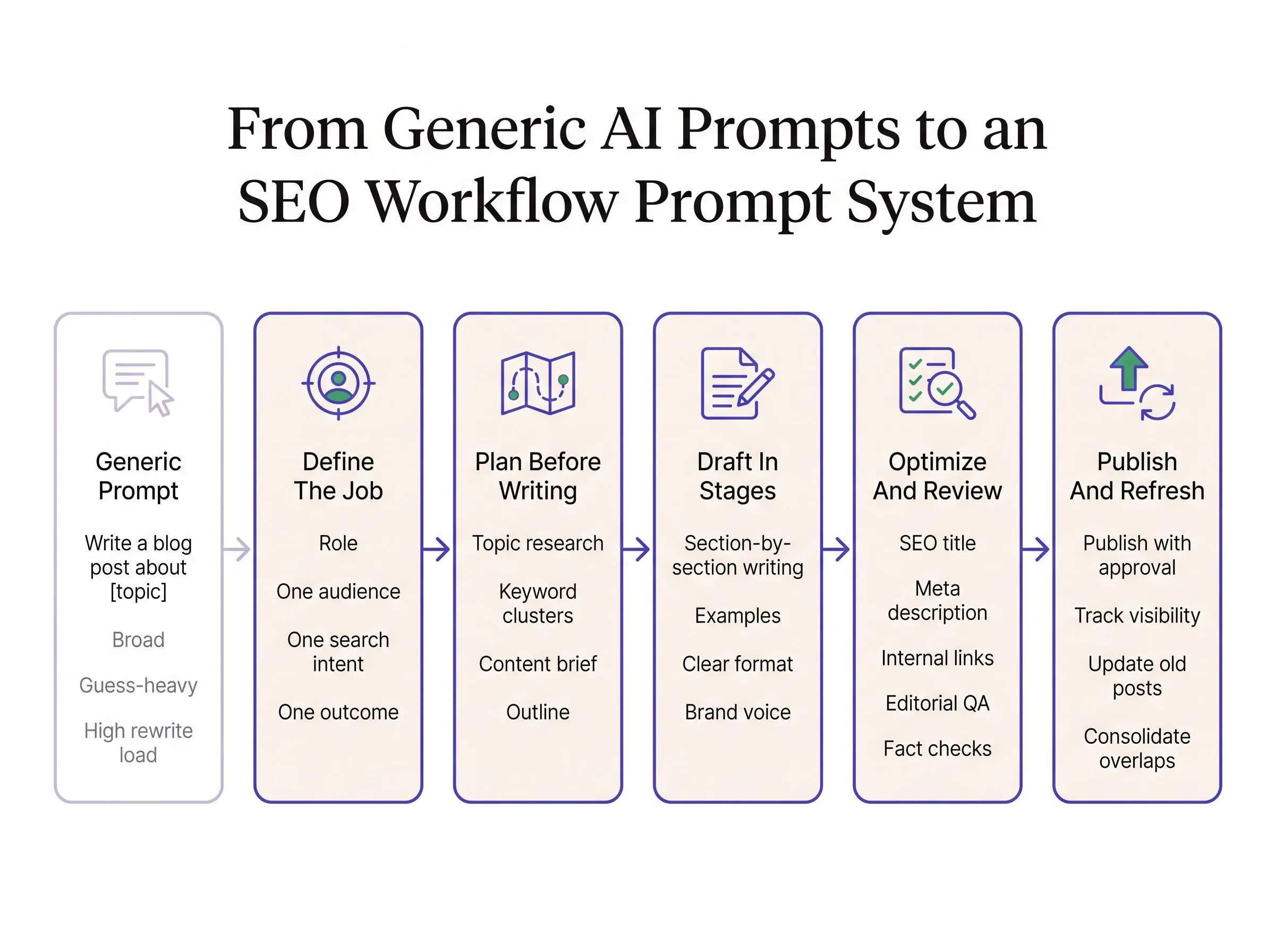
Here's the real divide. A generic prompt asks for content. A workflow prompt assigns responsibility.
A weak request sounds like this: write a blog post about inventory management for ecommerce brands.
It leaves too much unstated. Which reader? What stage of awareness? Is the searcher looking for a definition, software options, process fixes, or operational templates? Should the tone be instructional, commercial, or comparative? Nobody knows. The model guesses. Then your team edits for an hour.
A stronger workflow prompt might say:
- Write for ecommerce operators dealing with stockouts and forecasting issues
- Target a problem-aware search intent
- Explain workflow fixes before tool selection
- Use a direct, practical tone
- Include named sections on causes, process gaps, software signals, and implementation mistakes
- Avoid generic ecommerce advice and unsupported claims
That's not fancier. It's clearer.
Content prompts for marketers should also match funnel position, not just keyword target. A bottom-funnel comparison piece needs different framing than an early-stage educational guide. If the prompt doesn't reflect that, the article often feels relevant to search and useless to the business.
SEO performance isn't about dropping the primary keyword into headings and hoping for the best. Relevance, clarity, and conversion context have to line up. The best prompt isn't the cleverest sentence in your notes app.
It's the clearest operating instruction.
AI Writing Prompt Examples for Topic Research and Keyword Planning
This is where strong SEO prompts start. Before drafting. Before outlines. Before anyone asks the model to "write."
If your topic research is loose, everything downstream gets expensive.
Prompt examples to use early
Topic expansion prompt
Ask AI to generate blog topics from your product category, audience pain points, and current site themes. Then make it group ideas by awareness stage, urgency, and likely business value. Tell it to exclude topics that are too broad, too news-driven, or disconnected from your offer.
Buyer-intent keyword prompt
Ask AI to surface likely commercial and problem-aware keyword angles around a product, service, or category. Have it separate informational topics from comparison, solution, and use-case content. That split matters by the second planning session, when everything starts looking equally "interesting."
Keyword clustering prompt
Give AI a keyword list and ask it to group terms into pillar pages, supporting articles, and refresh opportunities. Make it flag clusters that are so close they'll create cannibalization risk.
Audience-segment prompt
Ask the model to map topics differently for SaaS buyers, ecommerce teams, local service businesses, or agencies. The same keyword theme often needs a different angle depending on how the buyer actually evaluates the problem.
Existing-content gap prompt
Provide your blog categories and ask which subtopics are missing, underdeveloped, or outdated. This is one of the fastest ways to stop publishing "new" content that overlaps what you already have.
Editorial calendar prompt
Ask AI to turn topic clusters into a publishing plan based on funnel stage, seasonality, and effort. A plan that looks good in a spreadsheet can still fail in production if every article is heavy-lift.
If you want less manual topic ideation, this is where Intelliminds SEO Automation Software fits naturally. It's positioned around automated keyword research as part of a larger workflow, not just a drafting tool.
Strong seo prompts for ai writing begin before writing. That's the part many teams skip.
AI Writing Prompt Examples for Search Intent and Content Briefs
This stage decides whether the draft will be useful or annoying. If the brief is wrong, the article can sound excellent and still miss.
Search intent needs to be named, not assumed.
Prompts that sharpen the brief
- Search-intent diagnosis prompt: Ask AI to infer the dominant intent from the keyword and likely ranking page types. Have it classify whether the reader wants a definition, how-to, comparison, template library, tool list, or workflow breakdown.
- SERP pattern prompt: Ask it to predict common article structures, recurring subtopics, freshness expectations, and gaps a better article could fill. Make it separate actual reader needs from patterns competitors repeat out of habit.
- Content brief prompt: Request a brief with primary keyword, secondary terms, audience pains, objections, angle, section recommendations, FAQs, and CTA direction.
- Outline-generation prompt: Ask AI to build an outline where each section has a distinct job. That's how you avoid the common AI problem where three headings say the same thing with different wording.
- Evidence-planning prompt: Ask which sections need data, screenshots, internal review, product context, or stronger examples before publication.
- Internal-link planning prompt: Ask what existing pages should support the article and what anchor concepts fit naturally.
For briefs and outlines, examples help more than they do in many other tasks. Supplying one to three examples of preferred structure can materially improve first-pass relevance. Once you pile on five, six, eight examples, the gains usually flatten while the prompt gets cluttered.
This is the bridge between keyword strategy and chatgpt prompts for blog posts that actually stay on brief.
A Small Number of Examples Can Improve First-Pass Results
Examples are most useful when they demonstrate the output pattern you want—not when they are added as generic inspiration. In an analysis of 10,000 anonymized prompt sessions across eight AI platforms, prompts with one to three examples had a 74% first-attempt success rate, compared with 47% for prompts without examples, according to Prompt Architects’ analysis.
First-attempt success rates reported for prompts with no examples and prompts containing one to three examples.
Sources
Prompt Architects, analysis of 10,000 anonymized prompt sessions.
- The analysis reports an association from anonymized sessions, not a controlled experiment proving that examples alone caused the difference.
- The reported result covers prompts across eight platforms and general tasks; it is not specific to SEO blog briefs.
- “First-attempt success” depends on the study's own outcome definition.
| Prompt setup | First-attempt success rate |
|---|---|
| No examples | 47% |
| 1–3 examples | 74% |
That does not make examples a substitute for a clear brief. Use one to three examples when you need to demonstrate a format, voice, or output pattern; keep the examples relevant to the task and retain explicit audience, intent, and constraints.
AI Writing Prompt Examples for Drafting SEO Blog Posts That Are Useful, Not Generic
The goal of a drafting prompt is a strong first version. Not a fantasy where the first output is publish-ready.
That distinction saves a lot of disappointment.
Prompt types that work in practice
Full-article draft prompt
Ask AI to write for a defined audience and intent. Require a clear point of view, practical examples, strong transitions, and no generic throat-clearing. Tell it to note uncertainty instead of inventing specifics.
Introduction prompt
Ask for an opening that names the reader problem, explains why common AI outputs fail, and previews the workflow-based solution. Tell it to avoid cliché hooks and empty hype.
Section-writing prompt
Provide one H2, audience context, and the goal of that section. Ask AI to write only that part, include one concrete example, and avoid repeating earlier points. This is often better than asking one giant prompt to do research, strategy, drafting, and optimization in one pass.
FAQ prompt
Ask for common objections and decision questions a reader will have before adopting AI blog writing prompts for SEO. Keep answers concise and commercially aware.
Example prompt
Ask the model to explain a concept once for a working marketer and once for a more advanced operator. That usually produces clearer teaching than asking for "more depth."
Brand-voice prompt
Supply a tone brief like practical, direct, informed, non-hyped. Instruct it to avoid robotic transitions, sales language, and unsupported superlatives.
CTA prompt
Ask it to end with the next useful move, not a hard sell. Readers can feel the difference.
Editor safeguard prompt
Tell AI not to fabricate case studies, statistics, product claims, or tool features unless those are supplied in source material.
One job at a time. That's the rule most content teams learn the hard way.
AI Writing Prompt Examples for On-Page SEO Elements and Publish-Ready Assets
A good article still needs packaging. If the title is vague, the slug is bloated, and the meta description says nothing, the draft won't carry its weight.
These prompt templates for SEO articles are meant to finish the asset, not decorate it.
Useful prompt examples
- SEO title prompt: Ask for multiple headline variations by intent style, such as how-to, examples, templates, or mistakes. Require clarity first and curiosity second.
- Meta description prompt: Ask for descriptions that reflect the article's promise, include a natural keyword, and invite the right click.
- URL slug prompt: Ask AI to create short, readable, keyword-focused slugs with filler words removed.
- Featured snippet prompt: Ask which sections should open with direct answers, step lists, definitions, or comparison blocks.
- Internal-link anchor prompt: Ask for anchor text ideas and destination-page relationships that feel editorially natural.
- Image brief prompt: Ask for visuals that improve comprehension, such as workflow diagrams, before-and-after prompt examples, or checklists.
- Social excerpt and CMS summary prompt: Ask for a concise summary, newsletter blurb, and social promo lines aligned with the article angle.
If you want fast headline ideation, the Blog Title Generator is useful here because it generates multiple SEO-friendly title ideas from a keyword and audience. For cleaner slugs before publishing, the SEO Permalink Generator fits that narrow job well.
Small assets. Real leverage.
AI Writing Prompt Examples for Editing, Publishing, and Content Refreshing
Most AI content guides stop at drafting. That's where the real workflow usually starts to wobble.
Prompts matter just as much after the draft.
Post-draft prompts that save time
Editorial QA prompt
Ask AI to review the article for repetition, weak logic, thin sections, tone drift, keyword stuffing, unsupported claims, and vague CTA language. Require a fix list prioritized by impact.
Fact-risk prompt
Ask it to flag statements needing human verification, examples that feel invented, and places where the argument outruns the evidence.
Human-review handoff prompt
Ask AI to summarize what an editor or subject-matter expert should check before approval. Useful when you want speed without giving up control.
Publishing checklist prompt
Ask it to confirm headline, slug, internal links, meta description, image brief, and CTA alignment before the post goes live.
Refresh prompt
Feed AI an older article and ask which sections likely need updating for freshness, changed terminology, stronger examples, new questions, or better conversion context.
Content consolidation prompt
Ask whether overlapping posts should be merged, differentiated, or linked more clearly.
Repurposing prompt
Ask AI to turn the article into an email, LinkedIn post, FAQ block, or support content so one asset feeds multiple channels.
After publishing, Google Index Checker is a useful follow-up for quick batch checks since it supports up to 20 URLs at once. That kind of small operational tool matters more than people admit.
Compounding SEO isn't just about producing more. It's about maintaining quality over time.
Which Prompting Techniques Are Actually Worth Using for SEO Content
Prompt engineering has a long list of named methods. Most content teams don't need most of them.
You need the few that reliably improve output without slowing production.
The techniques worth keeping
Zero-shot prompting
Good for simple tasks like title rewrites, meta descriptions, or cleaning formatting. Weak for nuanced briefs and full drafts.
Few-shot prompting
Usually one of the highest-ROI upgrades for content work. Best for teaching format, voice, and structure with one to three examples. Often still effective up to around three to five, then cost and clutter start to rise.
Role prompting
Very useful in SEO content because it changes perspective and editorial judgment. Switching between strategist, editor, explainer, and conversion writer roles can noticeably improve outputs.
Structured-output prompting
Strong for briefs, outlines, refresh plans, keyword clusters, and QA reports where clean fields matter more than prose.
Chain-of-thought prompting
Helpful for planning and diagnosis, like intent analysis or gap mapping. Usually unnecessary for routine drafting, where it can add verbose filler.
Self-consistency
Useful when comparing multiple titles, angles, or outlines. Less practical for everyday article production because it uses more tokens.
Tree-of-thought style prompting
Interesting for hard reasoning. Too slow and expensive for normal blog workflows.
For most seo prompts for ai writing, the best stack is role, context, structured task, clear format, and a few strong examples when needed.
That's enough to do serious work.
From Prompt Hacking to a Repeatable SEO Content System

At some point, the problem stops being prompt quality alone. It becomes operational drag.
You'll recognize the signs:
- Topic research lives in one document
- Briefs live somewhere else
- Draft prompts keep getting rewritten from scratch
- Publishing stalls in handoffs
- Old posts never get refreshed
- Nobody can tell what's actually scheduled
The better sequence is straightforward:
- Discover topics
- Group keywords
- Build the brief
- Draft in sections
- Optimize on-page elements
- Review with a human
- Publish on schedule
- Check visibility
- Refresh as performance changes
A prompt library gives you standardization. A system gives you execution.
If you're evaluating workflow solutions, be practical about it. Can it support keyword research and planning, not just text generation? Can it publish into your CMS without removing human review? Can it keep refreshes in the same process? Can it maintain a controlled cadence instead of flooding your site with thin posts?
That's where our platform is relevant, but only if those are the problems you're actually solving. Intelliminds SEO Automation Software is positioned for teams that want the content side of SEO automated across research, writing, publishing, and refreshing while keeping a human in the loop. Intelliminds SEO Autoblogger fits teams that want buyer keyword discovery, article generation, links and images, and scheduled publishing with approval control rather than fully hands-off bulk posting.
The best ai writing prompt examples get more valuable when they stop living in scattered chat history and start living in a defined editorial workflow.
Conclusion
Strong ai writing prompt examples aren't magic phrases. They're structured instructions that guide research, planning, drafting, optimization, publishing, and refreshing.
The priorities are simpler than people make them. Define the role. Clarify audience and intent. Specify format. Add constraints. Use examples selectively when they improve structure or voice.
Don't rely on one oversized master prompt. Build a small prompt stack for each stage of your SEO blog workflow. Briefs need one kind of instruction. Drafts need another. Refreshes need another again.
That's how you reduce cleanup and manual chaos. Start by standardizing prompts for briefs, drafts, and refreshes. Then move those steps into a system that can keep content production consistent as your organic program grows.
Article Record
ReferencesPrimary sources used for this article
Update HistoryMeaningful revisions to this article
- Added a practical example to show how to create an SEO-ready AI writing prompt.
- Added a chart showing how using a small number of examples can improve first-attempt results.
- Made the benefits of examples easier to understand for readers building AI writing workflows.