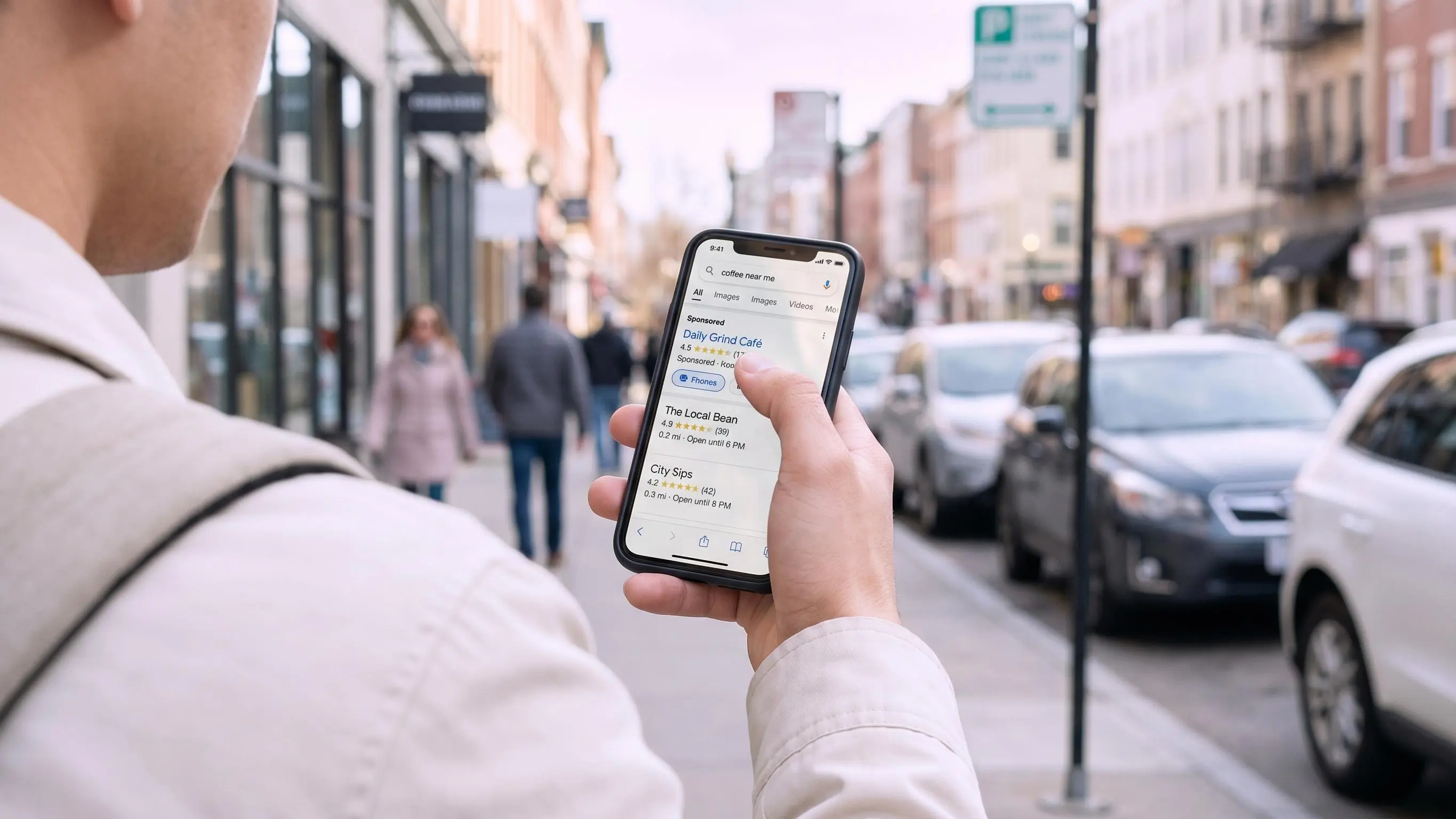
Organic traffic vs paid traffic trips up a lot of teams because the numbers lie at first — and in 2026 the measurement landscape makes early signals noisier. AI Overviews and search features drive more zero‑click behavior, shrinking raw clicks; privacy and consent changes (GA4 shifts and attribution gaps) mean many conversions must be modeled instead of directly observed; and rising CPCs make weak landing pages much more costly. Read those signals with context.
What matters is timing, margin, and how your buyers actually search. You don't need a channel debate. You need to know where fast wins help, where compounding pays off, and where both should work together. Start with these:
- Paid traffic is useful when you need leads now, but weak landing pages burn cash fast.
- Organic traffic takes longer, but one solid page can keep pulling in demand months later.
- The right split lowers guesswork and gives you a clearer growth plan.
What Organic Traffic and Paid Traffic Really Mean
When people compare organic traffic vs paid traffic, they often flatten the difference into "free clicks" versus "ad clicks." That's too shallow to be useful.
Organic traffic is the traffic you earn from unpaid search visibility. In practice, that comes from good topic selection, strong content, internal linking, technical site health, and enough authority around a subject that search engines trust you to rank. It's not free. It just isn't billed one click at a time.
Paid traffic is traffic you buy through platforms like Google Ads or Microsoft Advertising. Your visibility depends on bids, auction dynamics, ad relevance, and whether the landing page actually matches the search. You can turn it on fast. You can also turn it off by accident if the economics go sideways.
Here's the plain business version:
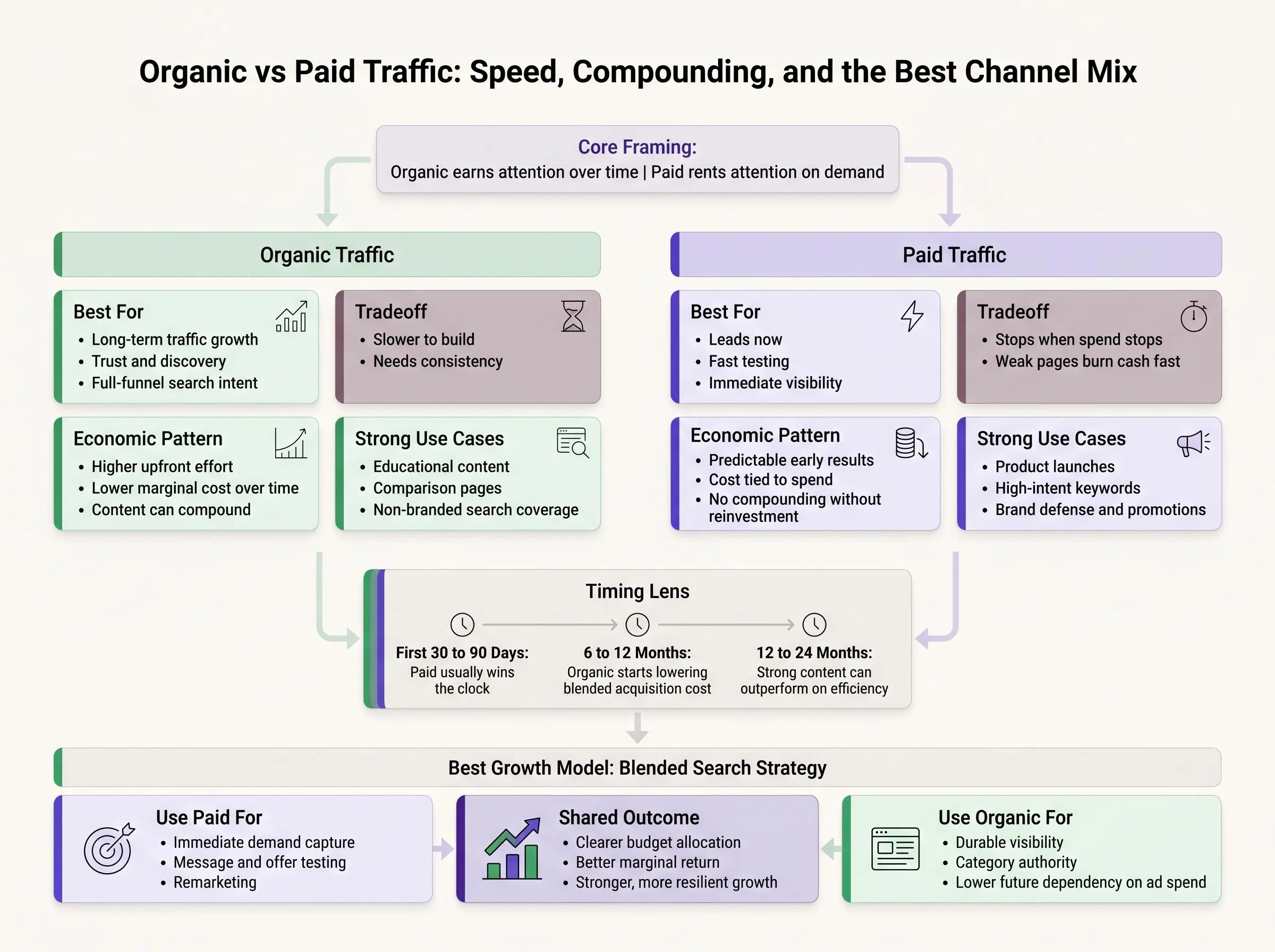
Organic earns attention over time. Paid rents attention on demand.
Both channels target existing demand. Someone is already searching. The difference is timeline, economics, and trust. Paid can put you in the market this afternoon. Organic usually needs a build period before the graph starts to move in a way the team can feel.
That sets up the real decision. The smartest brands usually don't choose one in isolation. They get clear on what each channel is best at, then use both with intent instead of letting them fight over budget.
| Decision factor | Organic traffic | Paid traffic |
|---|---|---|
| Speed to results | Requires a build period before results compound | Can generate traffic and leads immediately |
| Cost model | Invest in research, content, optimization, and refreshes | Buy visibility through clicks or impressions |
| Durability | Strong pages can keep attracting demand over time | Visibility usually stops when spending stops |
| Demand coverage | Can support the full buyer journey | Often strongest for high-intent, bottom-of-funnel searches |
| Best early use | Build a durable acquisition foundation | Test demand, messaging, and landing pages quickly |
| Measurement window | Evaluate across 6 to 12 months and beyond | Produces clearer signals in the first 30 to 90 days |
Why This Comparison Matters More in 2026
The old SEO versus PPC debate was simpler when the search results page was simpler. It isn't anymore.
Search now has AI Overviews, more zero-click behavior, more crowded layouts, and more ways for a user to get partial answers without ever reaching your site. Early 2026 research put zero-click searches at 68%. That changes the conversation. Visibility still matters, but a click is no longer the only signal of value, and traffic isn't the full story.
Paid has gotten less forgiving too. In a lot of categories, ad costs keep climbing. If your landing page is weak or your conversion rate is soft, paid doesn't just underperform. It leaks money fast.
A 2026 reported-spend benchmark illustrates why a single “average CPC” can lead to bad planning: the listed search CPC ranges from $2.34 in arts and entertainment to $23.19 in legal. Even among categories relevant to many growth teams, B2B SaaS was $11.07 per click, while ecommerce general was $2.97. Treat these as planning reference points—not forecasts—because query mix, geography, account quality, and margins can move the economics substantially.
| Industry | Search CPC | Conversion rate | Cost per conversion |
|---|---|---|---|
| Legal | $23.19 | 7.94% | $292.33 |
| Insurance | $18.68 | 6.84% | $273.32 |
| Financial services | $15.04 | 4.94% | $304.39 |
| B2B SaaS | $11.07 | 4.21% | $263.04 |
| Home services | $6.88 | 6.42% | $107.26 |
| B2B services | $5.54 | 5.42% | $102.13 |
| Travel and hospitality | $4.84 | 4.06% | $119.18 |
| Fashion and apparel | $3.12 | 4.42% | $70.71 |
| Ecommerce general | $2.97 | 4.18% | $71.20 |
| Arts and entertainment | $2.34 | 3.42% | $68.38 |
We've seen teams blame the channel when the real issue was offer-market fit or a page that never had a chance.
Organic search still tends to account for the largest share of website traffic in many benchmarks, often around half or more. Paid contributes a meaningful but smaller share. That doesn't make organic "better." It means the channel mix has different jobs.
The tension is real:
- Paid gives immediacy and control
- Organic builds durable discovery and trust
- Most brands need short-term performance and long term traffic growth
- The wrong measurement model makes both channels look worse than they are
This is really a customer acquisition channels comparison for brands that need growth now without creating a permanent tax on future growth.
How the Economics Change Over Time
The economics are where most bad decisions start.
Organic doesn't charge you per click, but it absolutely has a cost structure. Research, writing, optimization, technical fixes, publishing, and refresh cycles all take budget. Paid is simpler on the surface. You buy distribution through cost per click or impression-based models, so traffic is tightly tied to spend.
That difference matters more over time than in the first few weeks.
The timeline most operators actually care about
In the first 30 to 90 days, paid usually wins on speed and predictability. If you need traffic and leads this quarter, that's hard to argue with.
Over 6 to 12 months, SEO starts producing indexed assets, rankings, and non-branded entry points that can bring down blended acquisition cost.
Over 12 to 24 months, the content compounding effect can change the math completely. A page you paid to create once may still be producing qualified traffic a year later. Paid never does that on its own.
Some benchmark ranges put organic programs around $8,000 to $15,000 per month and paid programs around $5,000 to $20,000 per month depending on scope and competition. Those ranges are directionally useful, but they're not the decision. What matters is return, payback period, and what happens when spending stops.
That leads to the real comparison: cost per acquisition SEO vs ads.
- Paid CAC is easier to model early because spend, clicks, and conversions show up quickly
- SEO CAC often looks worse at the start because you're front-loading the investment
- Later, SEO CAC can improve sharply because the same content keeps working after the initial spend
Some benchmarks show SEO acquisition costs ending up dramatically lower than PPC over time. But that only happens when execution is solid. Bad SEO doesn't compound. It just sits there.
Organic Usually Wins the Traffic Share, but Paid Wins the Clock
If you look across brands investing in both channels, organic search usually ends up as the larger traffic engine. Paid is usually the faster one.
Directional benchmarks tell the story well enough. One places organic at 53% of website traffic and paid at 27%. Another shows a split closer to 62% organic and 21% paid. The exact numbers will move by industry, but the pattern is stable.
Here's how to read that without fooling yourself.
Organic is usually the bigger source of ongoing discovery because it creates more entry points into your site over time. Each useful page is another way to get found. Paid is the opposite. It scales quickly, but only while budget is actively feeding it.
Buyer behavior makes the distinction more obvious. Paid can get you in front of a ready-to-buy searcher today. Organic can capture that same high-intent demand, then extend upward into educational, comparison, and problem-aware searches that paid teams often skip because the immediate conversion rate looks too low.
One thing we'd say out loud in a growth meeting: traffic share is interesting, but margin pays the bills.
Lead quality, sales cycle length, average order value, and conversion path matter just as much as volume. A smaller paid program can still be the right call if it closes faster and feeds the quarter. A larger organic program can be the better bet if you want a stronger base six months from now.
Traffic Quality, Trust, and Buyer Intent Are Not the Same Thing
A click is not a customer. Some clicks are just expensive curiosity.
Users often trust organic results more than ads, especially when they're researching a solution instead of trying to complete a quick transactional action. Search still plays a major role in buying decisions for most people, and nearly all surveyed consumers used a search engine in the past week. But only a small minority say they click paid ads often or always. Add in the continued use of ad blockers, especially with younger audiences, and the trust gap becomes practical, not theoretical.
The intent split matters:
- Paid often performs best on bottom-of-funnel keywords with clear commercial intent
- Organic can capture top, middle, and bottom-of-funnel demand across the full buying journey
- Helpful content builds trust before the buyer is ready to convert
- Authority content reduces friction later, even if it doesn't get credit in last-click reporting
For ecommerce, paid often wins on product-focused and promotional searches because the user knows what they want and the path is short.
For SaaS and services, organic often carries more strategic weight. Buyers need education, comparison, reassurance, and proof. They don't wake up ready to book a demo after one ad click. Usually they read, compare, disappear, come back branded, then convert after a second or third touch.
That's why traffic quality can't be judged by channel label alone. It depends on the query, the page, and where the buyer is in the decision.
The Content Compounding Effect Is What Makes Organic Different
This is the part too many teams underestimate.
The content compounding effect means one well-targeted article can continue earning impressions, clicks, links, and conversions long after it's published. Not because it got lucky, but because a strong page usually ranks for a cluster of related searches, supports internal linking, and reinforces authority around a topic.
Paid doesn't work like that. Once spend pauses, visibility usually disappears almost immediately. Clean break. No mystery.
Compounding in organic comes from a few things working together:
- One page can rank for many related terms, not just one keyword
- Strong articles pass value across the site through internal links
- Older content can be refreshed instead of rebuilt from zero
- Existing assets can keep producing pipeline while new ones expand reach
For lean teams, this difference is massive. Organic creates a growing asset base. Paid creates a recurring media expense. Both can work, but only one tends to get more efficient as the library deepens.
A non-obvious point here: refreshing content is part of the model, not cleanup work you do when someone remembers. Teams that systemize topic research, creation, publishing, and updates are far more likely to realize compounding gains across the whole buying journey, not just the terms you can afford this month.
This matters a lot for the kinds of brands we work with:
- SaaS companies need to answer nuanced evaluation questions
- Service providers need authority before they ask for contact details
- Ecommerce brands benefit from category, buying guide, and comparison content beyond product pages
- Agencies and startups need efficient acquisition without endlessly expanding ad budgets
Some benchmarks show stronger organic conversion or close-rate performance than paid when the visitor arrives through high-intent search and the page closely matches the problem being solved. That tracks with reality. A buyer who finds the exact answer they were searching for often arrives with more trust than someone interrupted by an ad.
Even with rising zero-click behavior, strong organic visibility still matters. It can influence branded search, direct visits, assisted conversions, and category perception. Sometimes the page doesn't get the first click, but it still shapes the next action.
Organic builds traffic. It also builds familiarity. That's a different kind of asset.
SEO vs PPC for Startups and Lean Growth Teams
For founders and heads of growth, seo vs ppc for startups usually isn't about channel loyalty. It's about runway, urgency, and whether the learning will still be useful six months from now.
If you need leads immediately to validate demand, paid deserves an early role. If budget is tight and you need compounding return, SEO usually becomes the better long-term bet. If product-market fit is still fuzzy, use paid to test demand and messaging before scaling content production. If the offer is already validated, start building your organic base early so you don't get trapped in permanent paid dependency.
The sequencing can be simple:
- Use paid in the early months to learn which offers, audiences, and keywords convert
- Feed those insights into the organic roadmap
- Build content around proven demand instead of guessing
- Keep paid focused on high-intent capture and remarketing
By model, it usually looks like this:
- B2B SaaS: paid for high-intent terms and remarketing, organic for problem, solution, comparison, and integration content
- Ecommerce: paid for promotions and product demand, organic for categories, product comparisons, and buyer education
- Service businesses: focused paid campaigns for immediate inquiries, organic for trust-building and expertise-led content
Startups don't need ideological purity. They need signal, speed, and a path to efficiency.
The Best Growth Model Is a Blended Search Strategy
The strongest setup is usually a blended model, not a winner-take-all choice.
Use paid to capture immediate bottom-of-funnel demand. Use organic to build category authority and lower future acquisition costs. Use paid search query and conversion data to prioritize organic topics. Use organic content to improve landing page relevance for paid campaigns. Use remarketing to bring back people who first discovered you through search content.
Search works better when you run it as one system:
- Paid creates speed
- Organic creates staying power
- Together they cover more of the buyer journey
- Shared insights improve both channels
One of the more expensive mistakes is letting SEO and paid operate like separate departments protecting their own budgets. The user doesn't experience your brand that way. Neither should your growth model.
This gets easier when topic research, publishing cadence, and refresh work are managed as a repeatable engine instead of scattered manual tasks and overdue docs.
How to Measure Organic vs Paid Without Misleading Yourself
A lot of channel comparisons fall apart because the measurement model is weak.
Average CTR and total clicks without context are shallow metrics now. Search result pages include AI overviews, local packs, shopping units and other features that change click behavior. Paid platforms also increasingly limit raw query transparency in automated campaign types. So broad averages can hide the real signal — and last-click reporting is especially limited for understanding overlap and incrementality.
At minimum, always split performance into:
- Branded organic
- Branded paid
- Non-branded organic
- Non-branded paid
Branded traffic behaves and converts differently; mixing it with non-branded traffic creates fake clarity.
Measurement realities and techniques for 2026 you should adopt
- GA4 adoption and modeled conversions: GA4 is now the baseline for web+app measurement. Expect modeled conversions when user-level signals are reduced; treat modeled conversions as directional but include them in totals and in attribution modeling rather than ignoring them.
- Attribution / conversion modeling: Use algorithmic or rules-based attribution in combination with modeled conversion data to fill gaps. Compare several attribution views (last click, data-driven, linear/time decay) to surface differences and avoid overreliance on any single view.
- Server-side / consent-friendly tagging: Move to server-side or consent-aware tagging to improve data fidelity while respecting privacy controls. This reduces loss from adblockers and browser restrictions and keeps UTM and event data more reliable.
- Consistent UTM naming and link hygiene: Enforce strict UTM standards across paid channels and internal links so paid and organic landing patterns aren’t misattributed. Use consistent campaign, source, medium, and content keys.
- Combine Search Console + Ads query tools: Use Search Console for organic query trends and Ads/Performance reports for paid query insights; reconcile them to understand query overlap and rising opportunities. Expect less full-query transparency from some paid channels — model or sample where necessary.
- Use modeled conversions, LTV and cohort payback: Measure both short-term conversions and modeled conversions, and layer on LTV and cohort payback to capture long-term value differences between channels.
- Instrument assisted conversion metrics and impression/share: Track assisted conversions, impression share (or share of voice), and visibility changes over time to see how channels interact rather than viewing them in isolation.
Incrementality and lift testing
- Run holdout or geographic experiments to measure the true incremental impact of paid spend on conversions and organic behavior. Simple lift tests (holdout vs exposed groups) reveal cannibalization vs net growth.
- Use cohort payback from these tests: measure how long it takes a cohort acquired by paid vs organic to repay CAC and contribute margin to distinguish profitable short-term capture from longer-term value.
Recommended metrics (updated)
- Modeled conversions (include alongside observed conversions)
- Last-click conversions (for continuity)
- Assisted conversions and conversion paths
- Cost per acquisition (CPA) by granular segment (branded/non-branded)
- Blended CAC and cohort LTV / payback period
- Incrementality / lift (test results)
- Impression share / visibility metrics
- Conversion rate by landing page and user intent
- Content decay (impressions/clicks/conversions over time)
A 6-step practical checklist (repeat monthly or after major test/campaign)
- Export aligned datasets: pull GA4 event conversions (include modeled conversions flag), Ads spend/clicks/metrics, and Search Console query/visibility data for the same date range.
- Apply consistent UTMs and clean link mapping so paid and owned links are comparable; fix any tagging gaps using server-side tagging if available.
- Split every dataset by branded vs non-branded before computing rates and CPAs.
- Group/report by landing page and search intent (awareness, research, purchase) to see where each channel performs best.
- Run a quick incrementality check: compare recent paid-exposed cohorts to holdout or historical baselines (even a simple geographic or time-based holdout can reveal major cannibalization).
- Flag pages for action: mark pages with dropping impressions/clicks/conversions for content refresh, pages where paid outperforms non-branded organic for paid capture, and pages where organic is winning for content expansion.
Remember: CTR and total clicks are shallow signals, and last-click views understate cross-channel influence. Use modeled data, experiments, and consistent tagging to reach defensible conclusions about organic traffic vs paid traffic, and focus on incremental return rather than absolutes.
Common Mistakes Brands Make When Choosing Between Organic and Paid
Most brands don't lose because they picked the wrong channel. They lose because they picked with the wrong assumptions.
A few mistakes show up over and over:
- Treating the choice like a permanent either-or decision instead of a stage-based allocation
- Expecting SEO results without a clear topic strategy, consistent publishing, or refresh discipline
- Running paid before messaging, offer, or landing page fit is strong enough to convert
- Measuring paid on immediate revenue and SEO on vanity metrics
- Comparing CTR without separating branded from non-branded queries
- Stopping SEO investment before rankings have had time to mature
- Assuming organic means free, then under-resourcing content and technical work
- Ignoring trust-building content in high-consideration buying cycles
- Overpaying for clicks that stronger organic coverage could reduce over time
- Publishing once and never updating, which kills compounding
The costly version of this is simple: paying forever for traffic you could've owned.
Building a Search Engine for Sustainable Growth

If you want search to become a real growth engine, not a series of disconnected tasks, you need an operating model.
Start with actual search demand and topic research. Prioritize keywords by business value, intent, and difficulty. Build clusters that cover educational, comparison, and bottom-of-funnel searches. Publish consistently enough to create topical momentum. Refresh decaying or underperforming pages before chasing endless net-new output. Then connect all of it to landing pages, conversion paths, and revenue goals.
For lean teams, the win is operational as much as strategic. Research, writing, publishing, and updating shouldn't live in separate workflows with separate owners and separate delays. Run them as one continuous loop.
Platforms like Intelliminds help teams automate topic research, article production, publishing, and refreshing so organic growth becomes more systematic and less dependent on manual coordination. That matters because compounding results rarely come from isolated bursts of effort. They come from consistent execution, even when the team is busy and the quarter gets messy.
Organic Traffic vs Paid Traffic FAQ
What is the main difference between organic traffic and paid traffic?
Organic traffic comes from unpaid search visibility, while paid traffic comes from buying visibility through platforms like Google Ads or Microsoft Advertising. In simple terms, organic earns attention over time, and paid rents attention on demand.
Which channel is usually faster: organic traffic or paid traffic?
Paid traffic is usually faster. It can put you in the market quickly, while organic traffic typically needs a build period before results become visible.
Is organic traffic really free?
No. Organic traffic is not billed per click, but it still requires investment in research, writing, optimization, technical fixes, publishing, and refresh cycles.
When does a blended approach make the most sense?
A blended approach usually makes the most sense because paid can capture immediate demand and organic can build durable discovery, trust, and lower future acquisition costs. The article recommends using paid and organic together instead of treating them as an either-or choice.
How should brands measure organic vs paid performance fairly?
Separate branded and non-branded traffic, then compare metrics like cost per acquisition, blended CAC, payback period, pipeline and revenue contribution, assisted conversions, and conversion rate by landing page and intent. Blending branded and non-branded together can hide the real signal.
Conclusion
Organic traffic vs paid traffic isn't really a debate about which channel is universally better. It's about which one fits your horizon, your economics, and your current growth constraints.
Paid is strongest when speed, testing, or immediate pipeline matters most. Organic is strongest when you want long term traffic growth, lower dependency on ad spend, stronger trust, and a more scalable acquisition engine.
The resilient move is usually both. Use paid to learn and accelerate. Use organic to compound that learning into lasting visibility and lower-cost acquisition over time.
Audit your current spend, traffic mix, and content coverage. Then build a search strategy that turns customer intent into repeatable growth, not one-time clicks.
Article Record
ReferencesPrimary sources used for this article
- Google Ads Benchmarks 2026: Real Numbers from $6M (£4.7M) of reported spend
- Organic Traffic vs Paid Traffic – First Page Sage
- Organic vs. Paid Marketing: Which Works Better and Why? [Based on Research with 130 Companies] | Databox
- Organic Search vs. Paid Search: What Delivers The Best ROI? | Fractl
- Incrementality vs. Attribution vs. MMM: A Decision Tree for What to Use When
- Organic Search vs Paid Search: How to use each
Update HistoryMeaningful revisions to this article
- Added a table comparing search costs across industries, including legal, B2B SaaS, ecommerce, and arts and entertainment.
- Made it easier to understand how paid traffic costs can vary when comparing organic and paid growth strategies.
- Rewrote the introduction to reflect current changes in search, privacy, and traffic measurement.
- Updated the measurement section with practical guidance on GA4, modeled conversions, and incremental testing.
- Clarified how to compare organic and paid traffic more accurately for smarter growth decisions.
- Added a practical example to show how to measure organic and paid traffic more accurately.
- Clarified how to compare both traffic sources without drawing misleading conclusions.
- Added a 5-question FAQ section to answer common questions more quickly.
- Expanded the article with clearer guidance to help readers compare the two traffic channels with more confidence.