
Content lifecycle management gets ignored until rankings slip, conversions soften, and nobody knows who owns the fix. If you run SEO for a growing brand, you have seen it.
What matters in practice is not publishing more. You need a working system for intent drift, stale proof, and weak internal paths before rankings turn into cleanup work.
Keep these in mind.
- A page can keep traffic and still lose revenue when pricing or screenshots age.
- Quarterly review doesn't mean quarterly rewrites; most wins come from small fixes.
- If two pages chase one term, merge and stop splitting results.
What Content Lifecycle Management Means in an Evergreen SEO Context
Most teams treat content like a launch project. We don't. In SEO, especially with evergreen pages, the real work starts after publication.
Content lifecycle management is the full operating system behind a page's useful life: planning, creation, publishing, maintenance, measurement, refreshing, repurposing, and eventually retirement. Basic content management handles storage, permissions, and publishing mechanics. That's administration. Content lifecycle management adds the decisions that actually protect performance: what to update, when to update it, how to spot decay, and when to merge, archive, or redirect.
That distinction matters because evergreen content doesn't fail dramatically. It fades. Search intent shifts. SERP layouts change. Product details, screenshots, stats, and examples get old. A page can stay live for years while becoming less accurate, less useful, and less competitive.
Evergreen content is not permanent content. It's content worth maintaining.
The better frame is simple: an evergreen page is a living asset. If it ranks, converts, or supports authority, it needs an owner and a lifecycle. That's the foundation of how to build an evergreen content update system that preserves rankings and customer acquisition without turning your team into a manual cleanup department.
Why Evergreen Content Decays After Publication
The biggest mistake is baked into the word evergreen. Teams hear it and assume self-sustaining. It isn't.
Content decays for predictable reasons:
- Search intent moves from broad education to comparison, workflow, or product-led answers
- New competitors publish stronger, tighter pages
- Examples, screenshots, pricing, features, and stats go stale
- Internal links break or stop supporting the right pages
- Titles, headings, and metadata no longer match how people search now
- Conversion paths get outdated even when traffic holds steady
We've seen this pattern a lot. Teams usually have ideation and publishing covered well enough. Maintenance and retirement get ignored because they don't feel urgent on a Tuesday afternoon. That's where performance slips quietly.
The business cost stacks up fast:
- rankings erode
- conversion rates soften
- good content budgets get wasted
- content teams keep producing net-new articles while proven pages weaken
- lean teams get pulled into reactive fixes instead of planned growth
A page doesn't need to disappear from search to become expensive. If it still gets visits but no longer drives action, that's decay too.
The Stages of the Evergreen Content Lifecycle
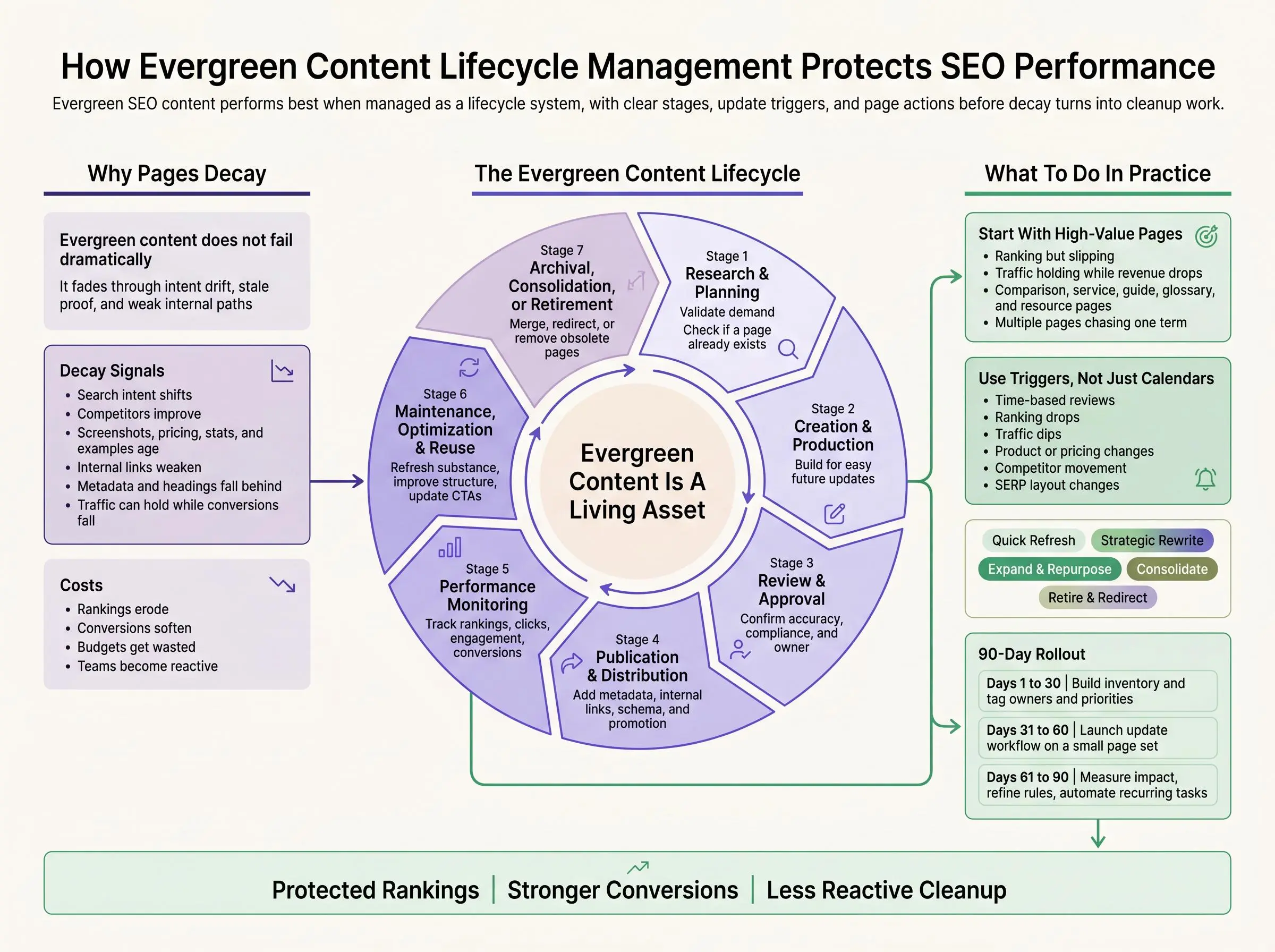
A practical content lifecycle management model should be simple enough to run and strict enough to prevent drift. We use seven stages.
1. Research and planning
Before writing, validate search demand, business relevance, and long-term usefulness. Also check if a page already exists that should be refreshed instead of replaced. A lot of content bloat starts with skipping that one decision.
2. Creation and production
Build pages in a way that makes future updates easier. That means clear search intent alignment, modular sections, reusable assets, and structure that won't collapse when you add a new subsection six months later.
3. Review and approval
Accuracy matters more over time, not less. Review for facts, brand consistency, compliance needs, and ownership. If nobody owns the page after publish, it will decay in silence.
4. Publication and distribution
Publishing isn't just hitting the button. Include metadata, internal links, schema where appropriate, and distribution through owned channels. Good pages need context around them.
5. Performance monitoring
Track rankings, impressions, clicks, engagement, conversions, and assisted revenue where available. You're not just monitoring traffic. You're monitoring whether usefulness is slipping.
6. Maintenance, optimization, and reuse
This is where evergreen content earns its label. Refresh sections, improve structure, expand winning angles, update CTAs, and repurpose useful material into derivative assets.
7. Archival, consolidation, or retirement
Some pages should be merged. Some should be redirected. Some should simply stop existing. Keeping obsolete pages live creates maintenance debt and keyword confusion.
Most evergreen pages loop through stages five and six many times before they ever reach retirement. That's normal. Healthy content libraries are iterative, not static.
Which Pages Should Enter Your Evergreen Content Update System First
Don't try to update everything. That sounds responsible and usually turns into nothing.
Start with pages that combine business value and recovery potential. The best candidates usually include:
- blog posts that already rank but are slipping
- SaaS or ecommerce comparison pages
- product or category guides
- service pages with stable commercial intent
- resource pages with strong backlinks and weak copy
- glossary or educational pages that support topic authority
A page deserves a closer look when you see signals like these:
- impressions or CTR declining
- rankings drifting off page one
- traffic holding while conversions fall
- weak engagement after SERP changes
- outdated year references, screenshots, pricing, or features
- multiple pages competing for the same keyword cluster
From there, sort pages into action buckets:
- Quick refresh
- Strategic rewrite
- Expand and repurpose
- Consolidate
- Retire and redirect
The bucket matters because the workflow changes. A SaaS comparison page that lost relevance after product updates usually needs a strategic rewrite, not a cosmetic edit. An ecommerce buying guide may just need seasonal availability fixes and updated recommendations. A service page may still rank well but need stronger proof points and a cleaner path to conversion.
Not all decaying pages need surgery. Some need honesty.
How to Build an Evergreen Content Update System That Scales

This is the operational answer to how to build an evergreen content update system. Keep it light, but make it real.
Start with a content inventory. Centralize every URL with its target keyword, publish date, last updated date, owner, funnel stage, and business goal. Teams lose more time than they realize because briefs, drafts, screenshots, and source material are scattered across drives, docs, and old Slack threads.
Then define update categories with decision rules:
- Light refresh for formatting, links, metadata, and factual corrections
- Medium update for new sections, intent alignment, and conversion improvements
- Full overhaul for rewrites, keyword repositioning, and page consolidation
Ownership is non-negotiable. Assign responsibility across strategy, editing, SME review, SEO QA, and publishing. Pages with no clear owner rarely fail loudly. They just get older and weaker.
Next, set refresh triggers. Use both:
- time-based reviews such as quarterly, biannual, or annual checks
- performance-based triggers such as ranking drops, traffic decline, product changes, content age, or competitor movement
A simple scoring model keeps prioritization from turning political. Score pages by:
- business value
- organic traffic potential
- decay severity
- ease of update
- conversion opportunity
Also standardize what "updated" means. In a good evergreen blog workflow, an update isn't swapping a date and changing two lines. It should usually include some combination of new research, stronger intent match, revised headings, better internal links, refreshed examples, and improved calls to action.
If your team is lean, keep the system narrow. If you're running multiple brands or clients, add more structure. Either way, the system has to be easier than chaos or nobody will follow it.
The Ongoing Article Update Process Step by Step
Once the system exists, you need a repeatable ongoing article update process. This is the part writers and marketers can run every week without reinventing the job.
Reassess search intent
Review the current SERP. Are searchers looking for a guide, comparison, template, workflow, list, or product-led answer? Don't update against last year's intent.Audit current performance
Check rankings, impressions, clicks, CTR, engagement, conversions, and assisted conversions. Decide whether the real problem is traffic, relevance, or conversion friction.Compare the page against current top results
Look for missing subtopics, shallow coverage, outdated examples, weak structure, or poor readability. This step keeps opinion from driving updates.Update the substance first
Refresh facts, examples, screenshots, terminology, use cases, and product references. Add sections that reflect current search intent before touching SEO polish.Improve on-page SEO
Refine the title tag and meta description if CTR is weak. Rework H1 and H2 structure, internal links, image alt text, and schema opportunities where relevant.Strengthen the business outcome
Improve CTAs, proof points, product mentions, and next-step pathways without disrupting informational intent. Traffic is not the finish line.Review and approve changes
Confirm accuracy, brand alignment, compliance requirements, and editorial quality.Republish and redistribute
Update the modified date where appropriate. Reshare via newsletter, social, and internal sales or customer education channels when useful.Measure post-update impact
Watch 30, 60, and 90 day changes. Feed those learnings back into the next update cycle.
This evergreen blog workflow removes guesswork because every update follows the same logic. That's the point. You want fewer debates and better decisions.
How Often Should You Update Evergreen Content
This question comes up early, usually right after a team decides they should have done this six months ago.
There is no universal schedule. Update frequency depends on volatility, competition, and business impact. High-competition SaaS pages and comparison content often need tighter review cycles. Ecommerce guides may need updates tied to pricing, stock changes, and seasonality. Stable educational explainers can go longer with lighter evergreen content maintenance.
A useful distinction:
- Review cadence is how often you inspect a page
- Rewrite cadence is how often it actually needs meaningful changes
Those are not the same. A page can be reviewed quarterly and still only need a substantive rewrite once or twice a year.
Trigger-based logic usually works better than rigid calendars alone. Watch for:
- ranking drops
- traffic dips
- new product releases
- industry regulation changes
- broken links
- competitor upgrades
- shifts in SERP layout
Waiting until a page collapses creates more work than steady maintenance. By then you're usually fixing rankings, trust, and conversion flow at the same time.
What a Strong SEO Content Upkeep System Tracks
Process without measurement turns into ritual. A strong SEO content upkeep system tracks both page performance and operational drag.
Core performance metrics include:
- organic impressions
- clicks
- keyword position trends
- CTR
- engagement signals
- conversion rate
- assisted pipeline or revenue where available
But don't stop there. Good systems also track efficiency:
- time from decay signal to update
- number of pages refreshed per month
- percentage of evergreen library reviewed on schedule
- approval turnaround time
And then the hygiene layer, which is where a lot of slow decay hides:
- broken links
- outdated references
- missing metadata
- orphan pages
- duplicate or overlapping content
If you're repurposing effectively, measure that too. Track how many source articles produce derivative assets and what lift comes after consolidation or expansion.
One operator rule here: if the system improves rankings but still burns too many team hours, it isn't finished. A real system should improve results and reduce manual drag.
CTR deserves separate attention when the SERP changes. A study summarized across 3,119 informational queries from 42 organizations and 25.1 million organic impressions found that queries with Google AI Overviews moved from a 1.76% organic CTR to 0.61%. That is why a lifecycle dashboard should flag a divergence between impressions, rankings, and clicks—not merely a ranking drop.
Reported organic click-through rate for informational queries with Google AI Overviews at the start and end of the study period.
Source: Study summary of 3,119 informational queries across 42 organizations and 25.1 million organic impressions.
- The reported analysis covers informational queries and may not generalize to commercial, local, or branded searches.
- The evidence is an observational multi-organization study summary, so it cannot isolate AI Overviews as the cause of every individual page's CTR change.
- The source excerpt does not provide page-level outcomes or a comparable conversion analysis.
View chart data
| Reported measurement | Organic CTR |
|---|---|
| Reported starting CTR | 1.76% |
| Reported ending CTR | 0.61% |
This does not mean every declining CTR requires a rewrite. It does mean that stable impressions or rankings can conceal a weakening acquisition path when the results page changes. Segment CTR by query type and SERP feature before assigning an update: some pages need a stronger snippet or more extractable answer, while others need a different business response because fewer clicks are available to win.
Where Automation Fits in the Evergreen Blog Workflow
Most growing teams don't need more content ambition. They need less manual coordination.
Automation fits best when it supports judgment instead of pretending to replace it. The high-value use cases are pretty clear:
- detecting decay signals and performance drops
- surfacing pages that need factual or SEO refreshes
- organizing update briefs instead of defaulting to net-new content
- drafting revised sections based on current search intent
- managing publishing queues and recurring review cycles
- tracking what changed and when
The practical advantage is hard to overstate for lean teams. Less time hunting for pages. Fewer update decisions made from memory or intuition. More consistency across a large library.
This is where an AI-powered platform like Intelliminds fits naturally. We use automation to connect topic research, article writing, publishing, and refresh workflows in one operating system. That means you're not deciding in one tool, drafting in another, and tracking updates in a spreadsheet that nobody trusts by the second month.
Still, the goal isn't "automate everything." The best system is the one that helps your team maintain relevance at scale with less manual effort and fewer dropped pages.
Common Mistakes That Break Content Lifecycle Management
Most broken systems fail in predictable ways. Not because the team doesn't care, but because the workflow quietly rewards the wrong behavior.
Common failure points include:
- treating publish as the finish line
- updating pages only after severe ranking loss
- refreshing wording without rechecking search intent
- creating new pages when an existing page should be improved
- leaving ownership unclear across SEO, content, product, and compliance
- focusing on rankings while ignoring conversion pathways
- failing to consolidate overlapping pages
- keeping obsolete pages live with no retirement plan
- using tools for storage and publishing, but not lifecycle decisions
Each one has a direct cost. Publish-first thinking creates decay. Late updates turn small fixes into rewrites. Intent-blind edits waste effort. Duplicate pages split authority and create cannibalization. Unclear ownership delays decisions until nobody remembers why the page existed in the first place.
A lot of content operations aren't underpowered. They're mismanaged at the maintenance layer.
A Practical 90-Day Rollout Plan for Your Update System
You don't need a perfect framework in quarter one. You need momentum and proof.
Days 1 to 30
Audit your evergreen content. Build the inventory. Tag pages by type, owner, and priority. Identify the first batch of high-opportunity pages, especially those with existing traffic or revenue potential.
Days 31 to 60
Launch the ongoing article update process. Set refresh cadences and trigger rules. Create simple templates for briefs, audits, and approvals. Update a small but meaningful set of pages so the team can feel the workflow, not just talk about it.
Days 61 to 90
Measure results. Refine the prioritization model based on what actually moved. Automate recurring tasks where possible. Then expand the evergreen blog workflow to more page groups, products, or business units.
The first quarter is not about perfection. It's about building an operating system that compounds.
If the process feels a little plain, that's usually a good sign. Durable systems are rarely dramatic.
Conclusion
Content lifecycle management turns evergreen SEO from reactive rescue work into a disciplined system for protecting rankings, relevance, and conversions. That's the shift. Not more content for its own sake, but better stewardship of the content that already has value.
The strongest organic programs don't just publish more. They maintain, measure, refresh, consolidate, and retire with intent.
If you want a practical next step, start with your evergreen inventory. Define update triggers. Then focus on the pages that already show proven traffic or revenue potential. That's usually where the fastest gains are hiding.
When research, writing, publishing, and refreshing are managed as one connected lifecycle, maintaining relevance at scale stops feeling endless. It becomes manageable. And then it becomes a growth system.
Article Record
ReferencesPrimary sources used for this article
- Content Refresh Strategy for AI Citations
- Understanding Temporal Query Dynamics
- How to Start a Content Audit
- Optimizing the content lifecycle | Contentful
- Content lifecycle management: Ensuring quality from creation to distribution | Contentful
- Siteimprove Quality Assurance wins popularity contests for a reason
- What is evergreen content? | Brandwatch Social Media Glossary
Update HistoryMeaningful revisions to this article
- Added a chart to show how changes in search results can reduce clicks even when a page remains visible.
- Clarified why click-through rate should be tracked alongside rankings and impressions when maintaining evergreen content.