
Most brands treat schema for AI search like a plugin setting, then wonder why product details, services, or locations get misunderstood. Machines don’t fill in the blanks the way your customers do.
What matters is clean, current information tied to the pages that drive revenue. We’ve seen stale prices and vague service pages create confusion fast, especially at scale.
Start by checking the parts of your site that matter most:
- Product offers match live prices and availability
- Service and location pages name exactly what you provide
- JSON-LD updates when page content changes
Make your brand easier to understand.
What Schema for AI Search Actually Means
Most brands hear "schema" and think review stars or product snippets. That's too narrow now.
Schema for AI search is structured data that tells machines what a page is about, which entities it mentions, and how those entities relate to each other. Product, service, organization, author, location, offer, review. The point is simple: remove guesswork.
AI systems don't read your site the way a person does. They don't pause on the headline, skim the body, then decide what feels credible. They infer meaning from structure, context, and repetition across pages. If your site is inconsistent, vague, or outdated, they still form an opinion. It just may be the wrong one.
That is why schema matters beyond snippets:
- It gives search engines and AI systems a cleaner model of your content
- It reduces ambiguity around commercial details and brand facts
- It helps machines connect related pages instead of treating them like isolated documents
- It improves the odds that your brand is surfaced accurately, not loosely summarized
If you're feeling behind, don't overcomplicate it. Schema isn't some separate AI-only discipline. It's technical SEO extended into a world where machines summarize, compare, and retrieve answers more aggressively.
Good schema doesn't make your site smarter. It makes your site easier to understand.
We also wouldn't treat schema as a one-off fix. It works best when it sits inside a real content system: research what matters, publish clearly, keep pages current, and structure the important details so machines can trust what they find.
Why Schema Matters More in AI Search Than Traditional SEO Alone
Traditional SEO could get pretty far on keyword targeting, links, and decent page structure. AI search changes the pressure.
When engines synthesize answers instead of just ranking ten blue links, keyword matching alone gets shaky. A page can mention the right phrase and still be misunderstood. That's the part many teams miss.
Schema helps by explicitly labeling the high-value elements on the page:
- products and offers
- services and locations
- organizations and authors
- reviews, ratings, and pricing
- dates, availability, and publisher details
That explicit labeling matters a lot when the page could be interpreted in more than one way, or when your site has hundreds of pages with overlapping language.
There's also a brand defense angle here. One major financial institution dealt with an AI-generated claim that a branch had permanently closed because a decades-old article was misread as current. That's not a traffic problem. That's an accuracy problem with real business consequences.
For healthcare, finance, local services, and any category where trust is fragile, the cost of machine confusion is higher than most teams want to admit. Wrong branch status, stale pricing, outdated service area, old policy language. These don't just look messy. They hurt conversion.
Schema helps define what is current, official, and relevant. Not perfectly. Not automatically. But without it, you're asking machines to infer too much from messy page copy and scattered signals.
Is There a Special AI Mode Schema Markup
Let's make this easy: no, there is no dedicated AI mode schema markup standard you can rely on today.
Terms like ai mode schema markup, structured data for AI mode, and ai mode rich results markup usually mean standard schema.org markup used well enough to improve machine understanding. That's it. No secret tag. No hidden markup class reserved for AI answers.
What moves the needle is usually boring:
- accurate markup
- clear entity definitions
- fresh data
- consistency between schema and visible content
- sane site structure
A smaller, accurate script beats a bloated mess every time. We've seen teams throw every available property into JSON-LD because a plugin made it easy. That often creates weak signals, duplicate signals, or flat-out contradictions.
And expectations matter here. Schema can improve eligibility and understanding. It does not guarantee AI Overview inclusion or citations inside LLM responses. Anyone promising that is selling certainty they don't have.
Schema.org vs. Google Rich Results vs. AI Understanding
A lot of confusion comes from mixing three different things together.
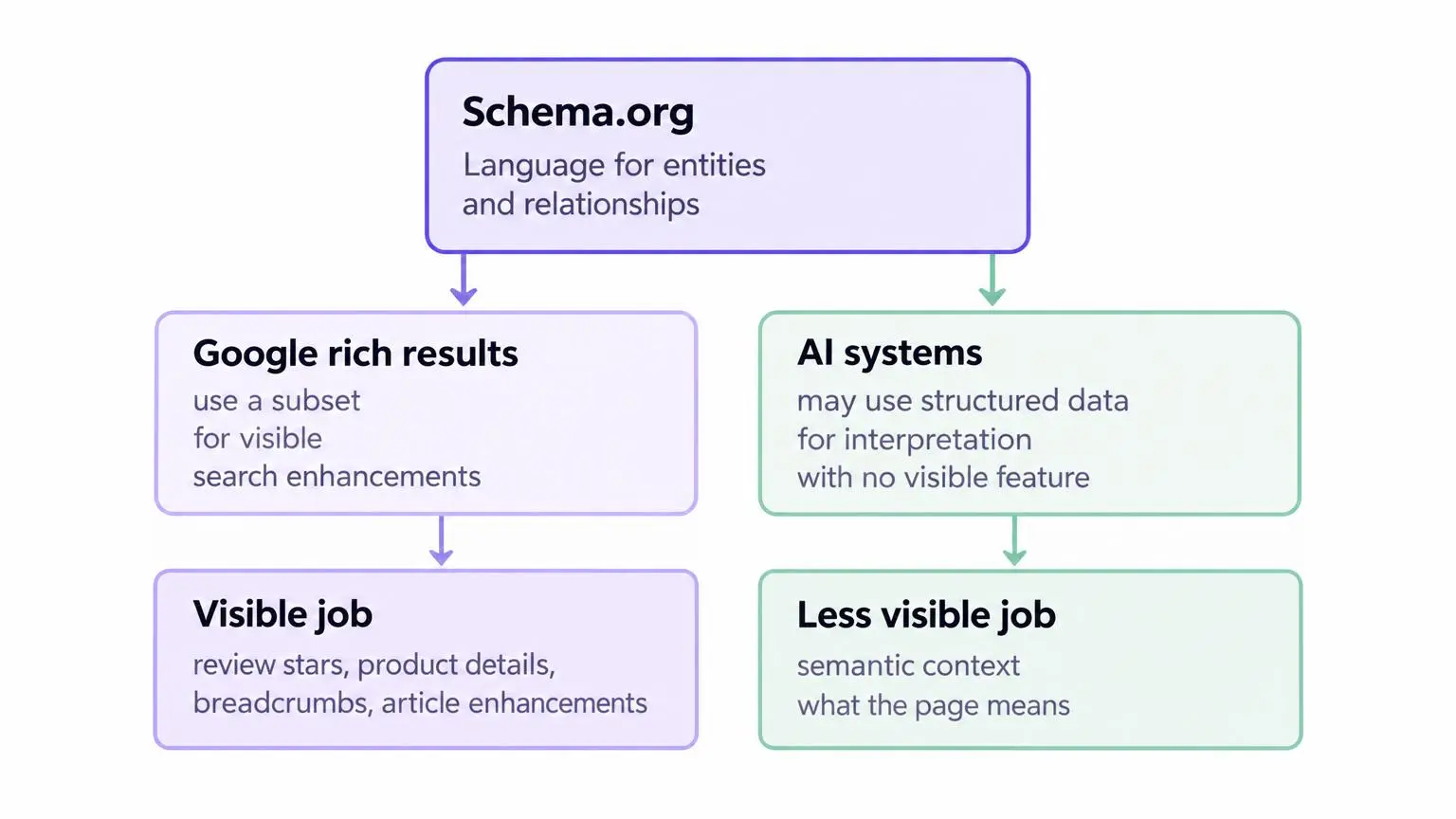
Schema.org is the vocabulary. Google rich results are a limited set of search features that use parts of that vocabulary. AI understanding is broader than either one.
Here's the clean distinction:
- Schema.org gives you the language to describe entities and relationships.
- Google rich results use a subset of that language for visible search enhancements.
- AI systems may use structured data for interpretation even when no visible feature appears.
That means schema has two jobs.
First, the visible one: review stars, product details, breadcrumbs, article enhancements.
Second, the less visible one: semantic context. This is where you tell machines what the page means, not just how it might render in search.
That's why it helps to stop thinking in checklists built only for snippets. Google supports a subset of schema types for visible results. Schema.org includes far more types and properties than Google turns into SERP features. Some of that extra context still matters because machines use it to reduce ambiguity.
We'd be careful not to chase decoration and ignore meaning. Search features change. Support gets reduced. The pages that hold up are the ones with clean structure and clear entities, not the ones optimized for one temporary display feature.
What the Evidence Says About Schema and AI Visibility
The evidence is strong enough to take seriously and messy enough to stay humble.
In one controlled test, three nearly identical pages were published: one with strong schema, one with weak schema, and one with none. Only the page with well-implemented schema appeared in an AI Overview. It also performed best in traditional organic rankings. That's the useful part. Good implementation may support more than one layer of visibility.
Another test on travel pages expanded AggregateOffer markup with more pricing detail. The result was a 12 percent increase in OpenAI bot hits on the test pages while the control pages declined. ChatGPT-User activity also rose by 12 percent while control pages fell. That's not proof of revenue, but it does suggest stronger retrieval demand.
Enterprise examples push the point further:
- A healthcare organization saw a 454 percent CTR increase when review snippet features were awarded
- Another saw a 32 percent CTR increase on targeted queries after entity linking was applied
- A third saw a 113 percent increase in clicks and a 119 percent increase in impressions across targeted pages where entity linking was used
Google also documents separate publisher case studies with higher click-through rates for pages enhanced with structured data or shown as rich results. The size of the observed gap varied substantially across the two examples, which is a useful reminder to treat CTR as an outcome to test, not a promised return.
Two Google Search Central case studies reported higher click-through rates for pages enhanced with structured data or shown as rich results. The comparisons are observational and use different page cohorts.
Sources
Google Search Central structured-data case studies.
- Both figures are case-study comparisons rather than randomized experiments, so they cannot isolate schema as the sole cause of the CTR differences.
- The two cases use different comparison groups: structured-data-enhanced pages versus pages without structured data, and rich-result pages versus non-rich-result pages.
| Case study | Reported CTR difference (%) |
|---|---|
| Rotten Tomatoes | 25% |
| Nestlé | 82% |
These are observational comparisons, not controlled causal estimates: the page cohorts, rich-result eligibility, and search contexts differed. They do, however, add real-world evidence that machine-readable page enhancements can coincide with materially different search engagement.
None of this means schema is magic. It means schema is measurable.
Well-implemented schema tends to help the pages that were already worth understanding.
Content quality still matters. Authority still matters. Crawlability still matters. But if you want a practical takeaway, it's this: schema is one of the few technical levers that can improve both presentation and interpretation at the same time.
The Schema Types Most Brands Should Prioritize First
Most brands don't need more schema. They need the right schema on the right pages.
Start with the pages tied to revenue, leads, or strong commercial intent. Usually that means your core templates, not the 47th blog post no one updates.
For most sites, the foundation looks like this:
- Organization
- WebSite
- WebPage
- BreadcrumbList
For editorial and educational content, add:
- Article or BlogPosting
- Person for author entities when appropriate
- ImageObject or VideoObject when media is central to the page
For ecommerce:
- Product
- Offer
- AggregateOffer
- Review or AggregateRating when the data is accurate and policy compliant
For service and local businesses:
- LocalBusiness
- Service
- FAQPage, but only when the FAQs actually exist on the page and help the user
This is where structured data for AI mode becomes practical. The right types strengthen entity clarity on the pages that matter most. Product pages need explicit commercial signals. Service pages need clear service definitions and local relevance. Educational content benefits from authorship, dates, and media context.
Don't choose types because your plugin lets you tick extra boxes. Choose them because they match the page's job.
Build an Entity Foundation Before You Chase AI Features
If schema is the label, entities are the thing being labeled.
Your products, services, people, authors, locations, policies, topics, and use cases are the core entities that define what your brand actually knows and sells. Strong schema for AI search comes from connecting those entities across the site, not sprinkling isolated markup on random pages.
We'd start with an entity-gap audit. Not glamorous, but very revealing. Look for:
- missing entities tied to buying decisions
- ambiguous terms a machine could misread
- claims that aren't supported clearly in the page content
- weak coverage across pricing, policies, authorship, and locations
A useful way to do this is to map key clusters: product details, use cases, pricing, policies, authors, service areas, educational support content. That's where content strategy and schema meet. If the entity isn't clear in the page itself, markup can't invent credibility for it.
This is usually the uncomfortable part. Teams discover they don't really have a source of truth. Product says one thing. Sales says another. The website still shows last quarter's version. Schema just exposes the mess faster.
How to Implement JSON-LD for AI Mode the Right Way
JSON-LD is the format most brands should use. It's easier to manage, easier to audit, and much easier to scale than microdata or RDFa threaded through the HTML.
And to clear up another common confusion: json ld for AI mode is not different from regular JSON-LD. It's standard JSON-LD applied accurately to the right page types.
A good implementation usually follows this pattern:
- start with the required fields for any rich result you want
- extend with relevant properties that improve understanding
- keep every field aligned with visible page content
- update dynamic values automatically where possible
That alignment point matters more than people think. If your page says one price and the schema says another, trust drops fast. Same with availability, dates, location details, author information, or publisher data.
For larger sites, manual upkeep gets ugly. Dynamic CMS template fields are a better path. When a content manager updates a product page, the structured data should update with it. Otherwise your schema becomes stale by the second afternoon.
Regulated sites need tighter governance still. Change control, deployment rules, ownership. Boring systems save you from very public errors.
A Practical Workflow for Adding Structured Data at Scale
At scale, schema fails when no one owns the workflow.
Here's the sequence we recommend:
Implementation workflow
- Audit current setup
Audit current schema coverage, plugin output, page templates, and conflicting scripts.
- Prioritize page types
Prioritize page types by business value first. Product discovery, lead generation, local intent, conversion support.
- Map types and fields
Map each page type to the right schema types and define where each field lives in the CMS or source data.
- Build reusable templates
Build reusable templates instead of hand-coding page by page.
- Validate markup
Validate before rollout with schema and rich result testing tools.
- Launch in batches
Launch in batches so you can compare test groups to controls.
- Assign ownership
Assign ownership across SEO, content, development, and operations.
- Keep schema updated
Refresh schema whenever the page content changes.
That last step gets neglected constantly. Outdated structured data is worse than no structured data when it states the wrong thing with confidence.
On the content side, consistency helps a lot. Our Intelliminds SEO Automation Software supports the research, publishing, and content refreshing side of this process, which makes it easier to keep live content and schema aligned over time. That's the actual win. Cleaner operations, fewer mismatches.
What Good Structured Data Looks Like on Different Site Types
The best setup depends on the commercial role of the page.
For ecommerce, product clarity is everything. Use Product, Offer, AggregateOffer, and review-related markup when eligible. Keep price and availability accurate. AI systems are far more confident when commercial details are explicit instead of buried in page design.
For SaaS, the stack is different. Organization, WebSite, WebPage, Article or BlogPosting, and selective FAQPage usage usually do more than forcing software markup onto pages that don't really support it. Authorship, publish dates, and update dates on educational content pull more weight than many teams expect.
For service businesses and agencies, start with LocalBusiness, Service, BreadcrumbList, and practical location details. Mark up service pages before lower-priority blog content. Traffic is nice. Service intent pays the bills.
For healthcare, finance, and other YMYL categories, governance becomes part of the implementation. Accuracy, authorship, location data, and organization trust signals need tighter control because the downside of bad markup is higher.
For publishers and content-heavy brands, Article, author entities, media objects, breadcrumbs, and date management matter most. Freshness signals are often the first thing to drift when no one owns updates.
| Site type | Priority schema | Page focus | Key control |
|---|---|---|---|
| Ecommerce | Product, Offer, AggregateOffer, review-related markup when eligible | Make commercial details explicit on product pages | Keep price and availability accurate |
| SaaS | Organization, WebSite, WebPage, Article or BlogPosting, selective FAQPage | Use educational content markup rather than forcing software markup onto unsupported pages | Preserve authorship, publish dates, and update dates |
| Service businesses and agencies | LocalBusiness, Service, BreadcrumbList, location details | Mark up service pages before lower-priority blog content | Emphasize clear service definitions and practical local relevance |
| Healthcare, finance, and other YMYL categories | Accuracy, authorship, location data, organization trust signals | Treat governance as part of the implementation | Apply tighter control because the downside of bad markup is higher |
| Publishers and content-heavy brands | Article, author entities, media objects, breadcrumbs, date management | Support content understanding with authors, media context, and breadcrumb structure | Own updates so freshness signals do not drift |
Common Schema Mistakes That Hurt AI Search Performance
Most schema problems aren't technical. They're operational.
Common failures include:
- markup that doesn't match visible content
- wrong schema type chosen because it sounds more important
- incomplete required fields for rich result eligibility
- stale prices, hours, inventory, dates, or branch status
- duplicate or conflicting markup from plugins and hard-coded scripts
- treating schema as a one-time setup
- marking up entities that the content doesn't actually explain well
- assuming schema can rescue thin pages or weak internal linking
One more mistake gets ignored: teams deploy updates and never check whether those pages are indexed. Valid schema on a page Google barely sees won't tell you much. A quick pass with a tool like our Google Index Checker can help you verify whether updated pages are even in the working set before you draw conclusions.
How to Measure the Schema Impact on AI Mode and Organic Performance
If you can't isolate impact, you'll end up arguing from anecdotes.
Schema impact on AI mode should be measured with a mix of direct and indirect signals. Direct measures include rich result eligibility, actual rich result appearance, query-level changes on marked-up pages, and AI Overview appearances where you can track them.
Indirect signals matter too:
- changes in AI bot visits from logs
- growth in AI-assisted referral patterns
- better retrieval on high-intent product or informational pages
And yes, standard SEO metrics still count:
- impressions
- clicks
- CTR
- rankings
- page-level conversion behavior
We'd test by page type, not sitewide averages. Product schema behaves differently from article schema. Local business markup behaves differently from service markup. If you lump everything together, you'll hide the signal.
Connect the technical gains back to business outcomes. Demo requests, product engagement, lead quality, revenue per landing page. That's how schema earns priority instead of becoming another side project.
How Schema Fits Into a Repeatable Content Engine
Schema works best when it's sitting on top of disciplined content operations.
Topic research tells you which entities and questions matter. Content creation makes those entities explicit. Structured data labels and connects them. Publishing and refresh workflows keep the signals current.
That's why many brands don't have a schema problem alone. They have a content governance problem that schema exposes.
We'd tie schema planning directly to content briefs and page templates so new pages are born with the right structure. Retrofitting later is slower, messier, and easier to neglect.
This is also where operational consistency helps. Teams using Intelliminds to automate topic discovery, article production, publishing schedules, and content refreshing can sustain schema strategy more easily because the underlying content system is more stable. Structure is easier to maintain when the publishing process isn't chaotic.
Schema compounds when the content engine behind it is steady.
What Brands Should Do in the Next 30, 60, and 90 Days
If your team needs a plan, keep it tight.
In the first 30 days:
- audit current schema coverage and conflicts
- identify the highest-value page types
- verify that core brand, product, service, and location pages have accurate foundational markup
In the next 60 days:
- implement or clean up JSON-LD templates for priority page types
- close the biggest entity gaps in content and metadata
- run at least one controlled test on a meaningful page group
In the next 90 days:
- expand to secondary templates and support content hubs
- assign an owner for schema governance and refresh cycles
- track performance at the page-template level, not just sitewide
Stay calm here. You do not need to react to every AI headline. If you're steadily improving the machine readability of your most important assets, you're already doing the work that lasts.
Conclusion
Schema for AI search is not a secret markup trick. It's a clearer way to tell machines who you are, what your pages mean, and which commercial details they should trust.
The brands that benefit most are not the ones with the biggest script blocks. They're the ones with relevant, accurate, maintained markup tied to strong content and clean operations.
Start with your highest-value pages. Fix the foundation. Then build structured data into your ongoing content workflow so visibility and trust can improve over time instead of getting rebuilt from scratch every quarter.
Article Record
ReferencesPrimary sources used for this article
- Introduction to structured data markup in Google Search
- Structured data with schema for search and AI • Yoast
- AEO andGEO
- Do AI Models Reward Structured Data? Testing Schema in GEO
- How Wells Fargo Used Schema Markup to Solve AI Search Hallucinations
- What 2025 Revealed About AI Search and the Future of Schema Markup
- Web Data Commons - Microdata, RDFa, JSON-LD, and Microformat Data Sets
- How Henry Ford Health Outperforms Competitors in AI Search