
Keyword research automation sounds simple until your team is juggling product pages, buyer questions, old briefs, and a spreadsheet nobody trusts. The usual mistake is collecting more terms when the real problem is deciding what deserves a page.
What matters is turning search demand into a repeatable publishing rhythm without losing human judgment. Watch for the handoffs that quietly kill momentum:
- Clusters that prevent three articles from chasing the same query
- Buyer-intent gaps hidden behind low-volume long-tail searches
- Refresh triggers before rankings and relevance slip
Build fewer dead-end lists. Publish with purpose.
Why Manual Keyword Research Breaks as Brands Start to Grow

Manual keyword research works longer than it should. That's the trap.
A small team can get away with spreadsheets, a few exports, and a monthly planning session when the site is still narrow. Then growth kicks in. New products show up. New audience segments appear. Sales wants bottom of funnel pages. Content wants educational coverage. SEO is still trying to keep the calendar full with the same fragile process.
The failure points are usually boring, which is why they get ignored:
- keywords sit in disconnected docs and old sheets
- topic choices depend on who has time that week
- research goes stale before the article is even drafted
- teams chase isolated terms instead of building depth around a real topic
That creates real cost. You miss emerging searches. Publishing slows down. SEO priorities drift away from revenue priorities. Your cost per useful article goes up because every piece starts with fresh manual digging.
There is a measurable version of that bottleneck. In a Helium 10 case study, an agency managing four brands and roughly 100 SKUs reported that keyword research work that had taken weeks was completed in days after it consolidated research tasks into an automated workflow. The team reported a 2× productivity increase. That is one self-reported ecommerce case study—not a general benchmark—but it illustrates why workflow fragmentation becomes more costly as the number of products and accounts rises.
We've seen the same pattern over and over. Ambition is high, but the process feels reactive. Nobody trusts that the current keyword list is complete, current, or tied to what the business actually needs next.
The fix is not to remove humans from strategy. It's to stop spending human time on repetitive discovery, grouping, and sorting work that software can handle faster. Judgment still matters. It just needs better raw material.
Growth usually breaks the process before it breaks the team.
What Keyword Research Automation Actually Means
Keyword research automation isn't "type a seed term, get 5,000 keywords, good luck." That's just faster mess.
In practice, keyword research automation means using software or AI to do the repetitive parts of research that slow teams down:
- surface relevant keyword opportunities
- cluster related terms into topics
- identify intent patterns
- help prioritize what should be published next
- revisit opportunities as rankings, products, and demand change
It also matters what it doesn't mean. It does not mean scraping giant lists with no business context. It does not mean publishing generic pages at scale and hoping something sticks. And it definitely does not replace editorial judgment, positioning, or product knowledge.
There's a big difference between basic automation and strategic automation.
Basic automation collects terms faster. Strategic automation connects research to your audience, your site structure, and your publishing decisions. That's the difference between having a list and having a system.
A single ai keyword discovery tool can help with discovery, but discovery alone doesn't solve much. You still need prioritization. You still need production. You still need refreshes when pages age out or search behavior shifts. If those pieces live in separate handoffs, things stall.
The better model is end to end. Automated topic research feeds writing. Writing feeds publishing. Publishing feeds refresh decisions. That's how you scale without turning the whole thing into operational drag.
The Best Use Cases for Keyword Research Automation
Keyword research automation creates the most leverage once your content demand is wider than your team's available time. That's usually earlier than people admit.
It tends to work especially well for a few types of teams:
Where it pays off fastest
- SaaS companies expanding feature-led, use-case, and comparison content
- Ecommerce brands building out category, buying-intent, and product-adjacent education
- Service businesses covering core problems, objections, and conversion-focused education
- Agencies managing multiple content calendars without rebuilding the process every month
- Startups that need search traction before they can justify a bigger content team
The keyword work that benefits most from automation is pretty specific. New topic clusters. Long tail variations. Intent mapping. Gap analysis against your current library. Refresh signals on older pages.
The parts that should stay human-led are also pretty clear:
- final prioritization based on business value
- product and brand nuance
- approval before publication
- quality control for accuracy and positioning
A lot of teams worry that automation is only for companies publishing at huge volume. We don't think that's right. It's useful the moment manual research can't keep up with business complexity. That may be 10 articles a month. It may be 40. The number isn't the point. The bottleneck is.
How to Automate Keyword Research for SEO Without Losing Strategic Control
If you're asking how to automate keyword research for SEO without losing the plot, the answer is structure. Bad automation starts with vague inputs and ends with noisy outputs.
Here's the framework we use.
1. Define the strategic inputs first
Before anything gets automated, get clear on four things:
- your products or services
- your audience segments
- the problems buyers are trying to solve
- the job content needs to do, whether that's acquisition, education, or conversion support
If you skip this, the system will still return keywords. They just won't be the ones you needed.
2. Feed the system real context
The strongest results come from grounding research in what the brand already is, not what a generic tool thinks the market looks like.
Use inputs like:
- your website
- current content library
- category structure
- audience language
- core offers
This is where weak workflows fall apart. Teams try to automate from a blank seed list, then wonder why the output feels generic.
3. Use automation to find SEO keywords with AI across different intent types
Don't stop at obvious commercial terms. Strong systems pull from multiple opportunity types at once:
- buyer-intent keywords
- question-driven searches
- comparisons and alternatives
- supporting informational topics
- adjacent problems that naturally lead to your offer
This is where hidden growth often lives. Not in the highest volume phrase, but in the cluster around it.
4. Build clusters, not isolated targets
Every promising topic should expand into a small structure:
- a primary topic
- related subtopics
- long tail support
- internal linking paths
One keyword, one article planning is a slow way to stay shallow.
5. Prioritize with business logic
Good prioritization balances search data with operational reality. We look at:
- closeness to the product or service
- fit with current site authority
- likelihood of supporting pipeline or revenue
- whether the team can publish something materially better than what's ranking now
A keyword is not an opportunity just because it exists.
6. Turn research into a live publishing plan
The output shouldn't be a static export. It should become a schedule. Assign topics to publishing windows. Match keywords to article formats. Decide up front which pages may need refresh cycles later.
That's the real answer to how to automate keyword research for SEO: automate the repetitive work, then keep humans in charge of direction, standards, and tradeoffs.
The Core Jobs an AI Keyword Discovery Tool Should Handle
A useful ai keyword discovery tool should do more than hand you a bigger pile of terms. Speed matters, but leverage matters more.
At a minimum, the tool should handle four jobs well.
Discovery
It should surface buyer-relevant terms, not just phrases with traffic. It should expand from seed topics into related themes with clear intent. And it should uncover long tail support that helps build authority around the main topic.
Organization
It should cluster related keywords into usable groups. It should help you see how informational and commercial terms connect. It should also reduce duplicate work across campaigns, writers, or client accounts. If two people are unknowingly planning overlapping pieces, the workflow is already leaking.
Decision support
It should help prioritize what gets published first. It should show where your existing site already covers part of the topic. It should flag gaps and refresh opportunities instead of treating every idea as net new.
Workflow support
This is the part teams underestimate. A tool should connect research to writing and publishing, allow approval before anything goes live, and support a real cadence instead of random output bursts.
That's how you distinguish a simple keyword utility from a platform that can actually scale keyword research process across a growing brand.
From Keyword Lists to Topic Intelligence: How High-Growth Teams Win
Mature SEO teams stop planning around single keywords because the market doesn't search in isolated phrases. People circle a problem from different angles, at different moments, with different levels of intent.
Topic intelligence is just a practical way of seeing that pattern.
It means understanding the themes your audience returns to, spotting how educational and commercial searches connect, and planning content so pages support each other instead of competing with each other.
Here's a simple cluster logic example for a SaaS brand:
- a pillar page around the main problem area
- supporting educational articles answering setup, workflow, or troubleshooting questions
- comparison content for buyers evaluating alternatives
- evergreen pages that get refreshed as product language or market demand changes
Manual keyword gathering often produces a giant list with no shape. Automated topic research can turn that into an actual content plan. You see the cluster. You see the overlap. You see where an article should link, where it should rank, and where it fits in the buyer journey.
The non-obvious benefit is operational, not just strategic. Topic modeling reduces duplication and cannibalization before content gets assigned. By the second or third month, that alone saves a lot of editorial cleanup.
Traffic compounds when topic depth compounds. One-off posts rarely do much on their own.
What an Automated Workflow Looks Like From Research to Refresh
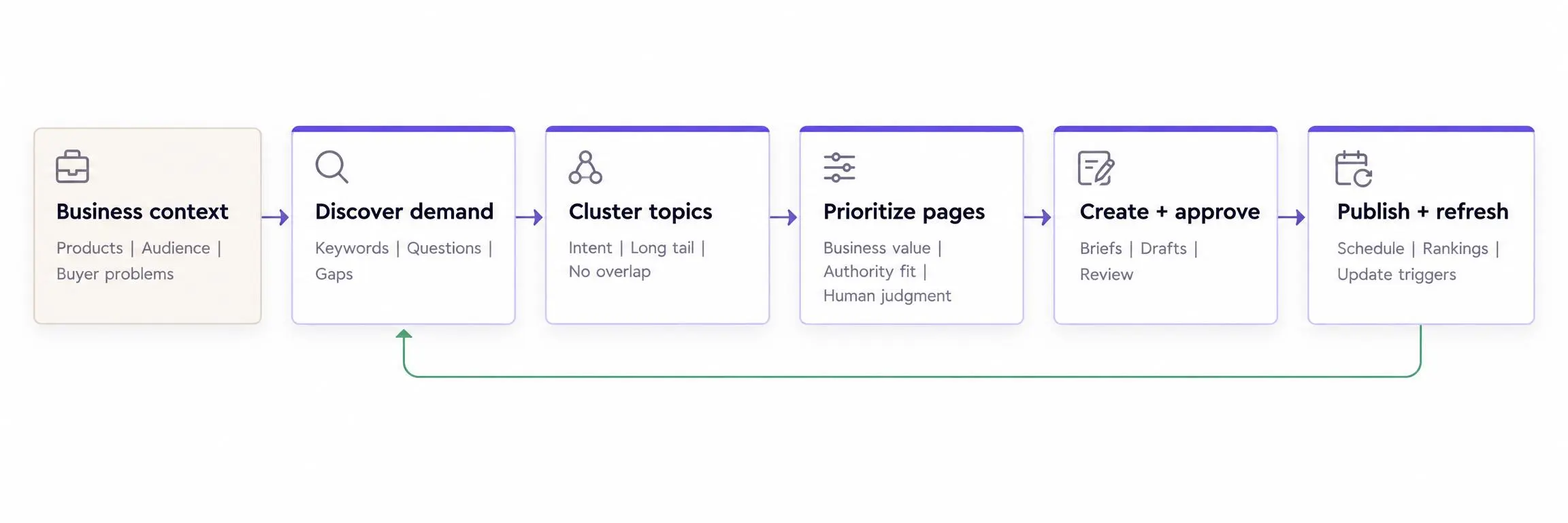
Keyword research automation has the highest ROI when it doesn't stop at research.
The workflow we want is straightforward:
End-to-end workflow
- Find
discover opportunities
- Prioritize
cluster and prioritize them
- Draft
create briefs or drafts
- Approve
review and approve
- Publish
publish on a schedule
- Refresh
monitor and refresh
That's the whole machine. If one step lives in a separate process nobody owns, output slows down.
A practical example: automated keyword and topic discovery identifies a cluster tied to a product category. That research feeds article creation. The team reviews and approves. Content publishes on a controlled schedule. Older pages in the same cluster get revisited as rankings move or the market language changes.
This is why we built Intelliminds SEO Automation Software as a content-focused workflow, not just a research layer. It handles keyword and topic research, writing, publishing to a CMS, refreshing content, and it keeps a human in the loop. For teams that want blog automation more specifically, Intelliminds SEO Autoblogger is geared toward buyer keyword discovery, article generation, approval control, and scheduled publishing.
The strategic point is simple: when research, creation, publishing, and refresh live in different tools, growth gets lost in the handoff.
How to Evaluate Keyword Research Automation Tools for a Growing Team
Most teams don't need more tools. They need fewer breaks in the workflow.
When you're evaluating keyword research automation software, look at the system through an operational lens:
- Does the keyword discovery feel relevant to your products and audience?
- Does it support automated topic research, not just raw exports?
- Can it map intent well enough to guide content type?
- Is it useful for planning, not just reporting?
- Does it connect to writing and publishing?
- Can a human review and approve before content goes live?
- Does it help refresh existing content, or only create new ideas?
Those questions matter more than flashy dashboards.
There is a real tradeoff between point tools and unified platforms. Point tools can be useful for narrow jobs. A lightweight title helper, for example, can speed up headline ideation after you've chosen the topic. That's where something like our Blog Title Generator fits. But scaling brands usually don't struggle because title ideation is slow. They struggle because discovery, planning, production, and publishing aren't connected.
Pick for continuity, not novelty.
Common Mistakes That Undercut Keyword Research Automation
Most failures with keyword research automation are not technical. They're judgment failures wrapped in workflow problems.
The usual ones:
- automating collection but not prioritization
- chasing search volume instead of business relevance
- publishing too much low-quality content too quickly
- ignoring intent differences inside the same cluster
- failing to connect new topics to existing content
- treating automation as set-and-forget
High-growth teams are especially vulnerable to one mistake: they scale output before they build a quality review process. That looks efficient right up until weak pages pile up and nobody wants to touch them.
Another quiet risk is using a tool that produces keywords without enough context from your site, offers, or audience language. The output looks plausible, but it drifts. Then your calendar fills with content that technically targets search demand and practically does very little.
Cannibalization is another common mess. When automation surfaces many close variations, don't assign each one as a separate article by default. Group them. Decide which deserve one page, which belong as sections, and which should support internal linking instead.
Keep a human in the loop for final approvals, brand fit, and factual review. Not because AI can't be fast, but because speed without judgment is just expensive cleanup later.
How to Measure Whether Your Automated Keyword Research System Is Working
Don't measure success by how many keywords the system found. That's vanity reporting in a nicer outfit.
Start with workflow metrics:
- time saved in discovery and prioritization
- number of publish-ready opportunities created each month
- consistency of the publishing calendar
- share of content tied to clear intent and business goals
Then look at SEO impact:
- keyword coverage across priority topics
- rankings for target clusters
- organic traffic to new and refreshed content
- conversions or assisted conversions from organic visits
Finally, watch for compounding signals. Are refreshes lifting older pages? Are internal links across clusters improving discoverability? Can the team respond faster when a new product theme or market shift appears?
There's also a simple operational check after publishing: make sure new pages are actually being discovered. Our Google Index Checker is useful here because you can check batches of up to 20 URLs quickly when you need a fast indexing check without turning it into a bigger reporting exercise.
The best systems improve speed and judgment together. More output alone doesn't count.
Building an Operating Rhythm That Keeps Research Useful Over Time
Automation works best as a rhythm, not a setup project you "finish."
A simple cadence is usually enough:
- weekly review of new opportunities
- monthly prioritization of topic clusters
- regular publishing windows
- periodic refresh cycles for older pages
That rhythm changes how the team sees the market. Patterns show up earlier. Content plans stay closer to audience demand. SEO gets less reactive.
Team structure matters here too. Founders or marketing leaders set priorities. SEO and content leads validate the topics. Writers and editors focus on clarity, accuracy, and positioning. Automation handles the repeatable heavy lifting.
That's the real shift. You move from scattered keyword chasing to a content intelligence system that keeps getting sharper over time.
Conclusion
Keyword research automation works when it helps the team discover, organize, prioritize, publish, and refresh without the usual manual drag.
The point isn't to remove human judgment. It's to stop wasting judgment on repetitive research work. Let the system handle discovery, clustering, and monitoring. Keep people focused on business fit, content quality, and revenue impact.
If you want a useful next step, audit your current workflow. Find where keyword research slows down, gets stale, or disappears into a spreadsheet. Then build a system that carries research all the way through publishing and refresh, because that's where growth stops feeling random.
Article Record
ReferencesPrimary sources used for this article
- Keyword Research - SE Ranking API Documentation
- How to do keyword research with Claude and Semrush
- Autonomous Agents: Solve SEO Bottlenecks with TrueFoundry
- This Agency Turned Multi-Brand Keyword Research Process from Weeks to Days with Helium 10 MCP | Helium 10
- Aliveo | Scaling Keyword Addition Recommendations with AI Agents