
If blog traffic looks fine but lead reporting feels wrong, your SEO attribution model is probably the issue. Last click makes good content vanish from the story.
What we care about is simple: which post brought the first visit, which page helped later, and whether that source survives the trip into your CRM. That's where teams usually lose the thread.
A few checks:
- Extend GA4 retention to 14 months.
- Store first landing page and source on every form.
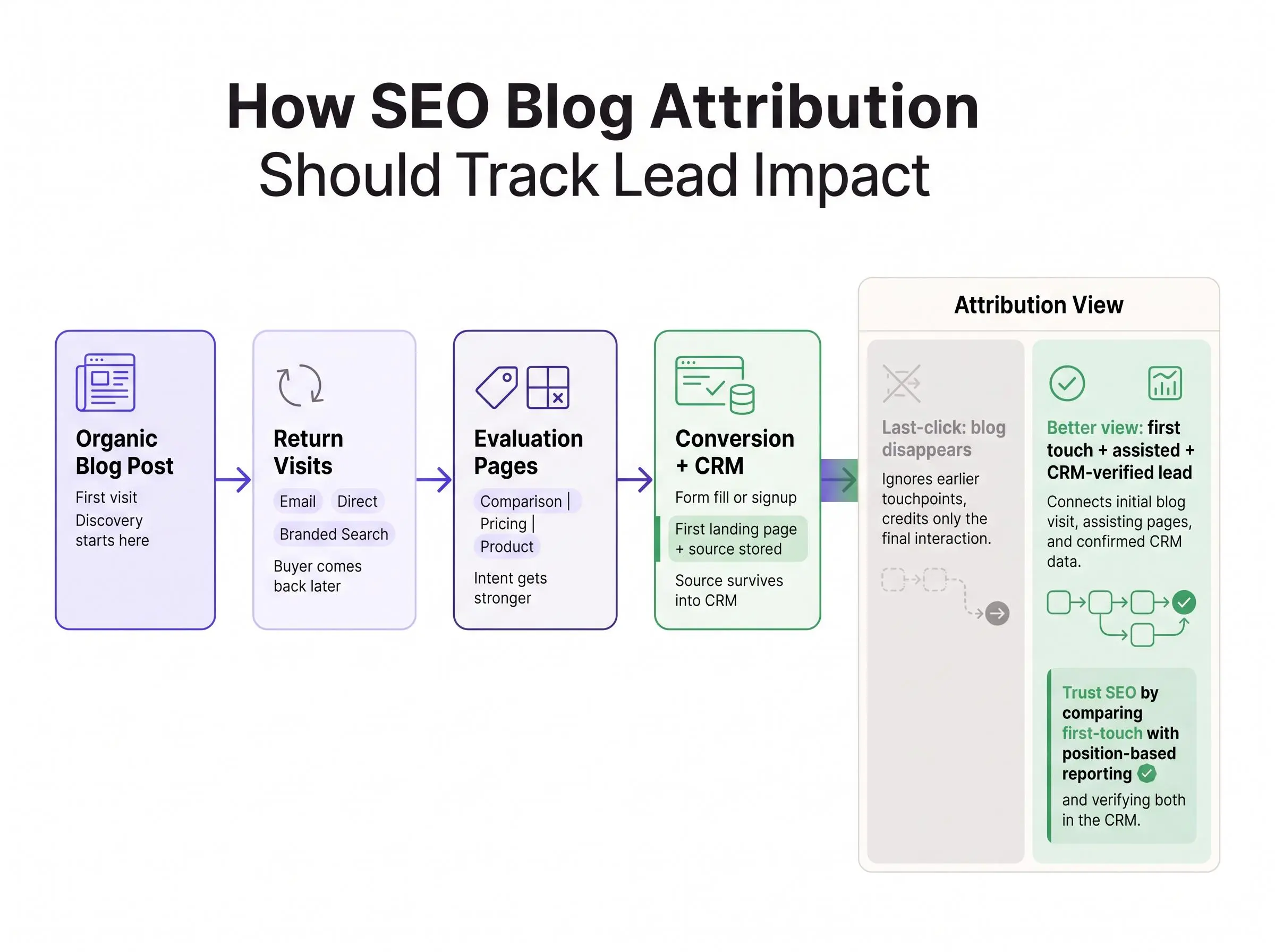
- Compare first touch with position based reporting, then verify it in the CRM so you can trust what SEO is doing.
Why Blog Lead Tracking Breaks Down So Often
Most teams can tell you how many sessions the blog got last month. They can usually pull rankings, pageviews, and maybe engagement time too. Then someone asks which posts actually influenced leads, pipeline, or revenue, and the room gets quiet.
That gap is the real problem. Traffic metrics measure activity. They don't measure business value.
A post with 20,000 visits can look like a win while a quieter article with 900 visits is the one pulling in qualified demand. We see this constantly with SaaS, ecommerce, and service businesses. The blog creates the first useful interaction, but the conversion happens later, somewhere else, under a different channel label.
A normal journey looks more like this:
- Someone finds an informational post through organic search
- They leave and come back later through email, direct, or branded search
- They visit a comparison page or pricing page
- They convert on a later session
If your reporting defaults to last-click, the blog loses most of the credit. It helped start the journey, maybe shaped the buying decision, but it doesn't appear to have done much because it didn't close the session.
That's how SEO gets pushed into the "awareness" bucket, even when it's clearly influencing acquisition. Paid channels often look cleaner because they close more visibly. Content looks fuzzy because the reporting model is fuzzy.
Good content doesn't just attract visits. It changes who shows up later and what they're ready to do.
That's the promise of blog lead attribution. Not proving that content got traffic. Proving that content assisted conversions across the full path.
What a SEO Attribution Model Actually Does
A seo attribution model is just a rule set for assigning conversion credit across multiple touchpoints before a lead, signup, or sale. Simple definition. Bigger implication.
This isn't just a dashboard toggle. It's the framework that decides how much credit your blog gets.
A few terms need to stay clean here:
- Touchpoint: any interaction before conversion, like an organic blog visit, email click, or pricing page visit
- Conversion event: the tracked action, such as a demo request, purchase, or trial signup
- Lead: a new contact or form fill
- Signup: a specific conversion action, often product or newsletter related
- Sales qualified action: something deeper, like a booked demo or vetted lead stage
- Closed revenue: actual won business tied back in the CRM
Blog lead attribution lives in the middle of analytics and CRM data. Analytics shows the path. CRM shows whether the person became real pipeline or revenue. If those two never connect, you're stuck with partial truth.
There's also a difference between measuring influence and proving sourced pipeline. If a blog post introduced the account, that's sourced influence. If you can connect that original source all the way to an opportunity or deal record, now you're closer to proving pipeline contribution.
No attribution model recreates reality perfectly. Buying journeys are messier than any report. People switch devices, forget tabs, come back through bookmarks, share links in Slack, search your brand later. The goal isn't perfect reconstruction. The goal is to choose the least misleading model for your business.
Most teams need more than one view. That's not indecision. That's just honest reporting.
Why Last-Click Reporting Undervalues Blog Content
Last-click attribution gives 100 percent of conversion credit to the final interaction before conversion. It's clean, fast, and deeply biased against blogs.
Blog content usually shows up early or mid-funnel. It introduces the problem, frames options, or educates a buyer before they're ready to act. The final conversion often happens on pricing, a branded search, a retargeting visit, or a direct return.
Take a common path:
- A buyer finds a how-to article through organic search
- A few days later they return through an email click
- They check a comparison page
- They come back via branded search and sign up from pricing
In a last-click view, branded search or pricing gets the win. The blog touch disappears from the lead story.
That's not a small reporting quirk. In longer B2B cycles, it materially understates SEO's role. Discovery and education often happen weeks before conversion. Sometimes longer. And once people know your brand, the final session tends to look branded, direct, or product-led.
Blog to signup tracking has to account for:
- return visits
- delayed conversions
- mid-funnel page progression
- multiple devices, when possible
Otherwise you're funding closers and starving discoverers. That happens all the time. Teams end up allocating budget toward channels that capture demand at the end, not the ones creating it earlier.
Last-click is fine as an operational diagnostic. It tells you what happened right before the form fill. It is not the main story for SEO.
The Main Attribution Models and What They Mean for Blogs
You don't need six dashboards and a data science project. You need to know what each model is good at and where it quietly lies.
First-touch attribution
First-touch gives 100 percent of credit to the first known interaction.
For blogs, this is strong when you're asking which posts and organic landing pages create discovery. If your question is how to attribute leads from blog content at the top of the funnel, first-touch is one of the clearest views you can use.
Its weakness is obvious. It ignores everything that helped nurture or close the lead after that first visit.
Last-touch attribution
Last-touch gives all credit to the final interaction.
It's useful when you need to know what converted now. Sales and performance teams often like it because it feels concrete. But for content, especially educational SEO content, it overweights the closer and underweights the discoverer.
Linear attribution
Linear splits credit evenly across every touchpoint.
For content assisted conversions, this is a practical middle ground. Every meaningful touch gets acknowledged. The tradeoff is that it treats a casual blog visit and a high-intent pricing session as equally important. Real journeys aren't that symmetrical.
Time-decay attribution
Time-decay gives more weight to interactions closer to conversion.
That can work if your buying cycle is short and recency matters a lot. For long research paths, it can still understate educational blog content because the first touch happened too early to retain much credit.
Position-based attribution
Position-based commonly gives 40 percent to the first touch, 40 percent to the last touch, and spreads the remaining 20 percent across the middle.
This is often the best fit for blog lead attribution because it values both discovery and conversion. It also happens to be easy to explain in a meeting, which matters more than most teams admit.
Data-driven attribution
Data-driven uses algorithmic weighting instead of fixed rules.
In theory, this can be more nuanced. In practice, many teams don't have enough conversion volume to trust it fully, and the weighting can be hard to defend when leadership asks why one touch got more credit than another.
The best model isn't the smartest one. It's the one your team can trust, explain, and act on.
Which Attribution Model Is Best for Better Blog Lead Tracking
For most brands, we recommend using first-touch and position-based views together.
First-touch tells you which blog topics, keywords, and entry pages are creating new demand. Position-based tells a more realistic story about how blog content contributes across the journey without pretending the closing channel doesn't matter.
That pairing covers most of what leadership actually needs to know:
- what introduced the lead
- what helped move the lead
- what closed the lead
If your tools are limited or your stakeholders want simpler reporting, linear is a decent fallback. It won't be perfect, but it usually misleads less than last-click alone.
Last-touch should stay in the mix as a diagnostic view. Just don't let it become the headline KPI for content.
Data-driven can come later if you have enough conversion volume and your team is comfortable with reduced transparency. Many aren't, and that's fine.
A few decision criteria matter more than the model itself:
- Long sales cycle vs short buying cycle: longer journeys usually need first-touch and assisted views
- Lead gen vs ecommerce: ecommerce can tolerate more last-touch visibility, lead gen usually can't
- Explainability vs algorithmic nuance: executives often trust simple logic they can follow
- CRM depth: if you can't connect anonymous visits to known contacts, your attribution ceiling is low
Use this quick selection rule before building the dashboard:
- If the main question is which content creates new demand, start with first-touch.
- If the journey includes several meaningful visits before conversion, add a position-based view.
- If the team needs a simple shared fallback and cannot support multiple views, use linear rather than relying on last-click alone.
- Keep last-touch as a diagnostic for the final conversion session, not as the main content score.
- Delay data-driven attribution until the team can explain its weighting and has enough conversion volume to evaluate it responsibly.
- If CRM fields do not preserve the original source, label the result as partial rather than treating it as complete pipeline attribution.
For example, a B2B team with a long buying cycle might report one table with first-touch blog leads, another with position-based blog influence, and a separate last-touch column showing which session completed the form. That keeps sourced, assisted, and closing activity visible without assigning all three jobs to one number.
At minimum, report two numbers:
- Provable sourced leads from blog content
- Assisted influence from blog content across the path
Those are different metrics. Treating them as the same creates bad decisions fast.
The Data You Need Before Attribution Can Work

Attribution is partly a reporting problem. It's also a data plumbing problem. If the source data breaks on the way to the CRM, the model doesn't matter.
Your minimum setup should include:
- GA4 configured properly
- Google Search Console linked to GA4
- consistent conversion event naming
- forms that store source and landing page data
- CRM fields that preserve original source details
One setting gets missed constantly: GA4 retention. Default retention is only 2 months unless you change it. Extend it to 14 months if you want year-over-year SEO analysis that isn't half-blind by the second quarter.
Also, GA4 and Search Console will never match perfectly. Different measurement methods, time zones, and attribution logic make that normal. Don't waste a week trying to force perfect parity.
On every form, capture these fields where possible:
- first source and medium
- latest source and medium
- first landing page
- current page
- session or client identifier
- conversion timestamp
Analytics can tell you a form happened. It can't tell you if that lead became qualified pipeline or revenue. That lives in the CRM. A lead is only truly attributable when the source data travels with the contact or deal record and stays there.
If that handoff is sloppy, your reporting will always drift toward guesswork.
How to Set Up Blog to Signup Tracking in Practice
This is where blog to signup tracking stops being theoretical. Keep the setup simple enough to maintain.
Start with the conversions that actually matter. Usually that means newsletter signup, trial signup, demo request, contact form, purchase, and if you have it, a qualified lead stage downstream.
Then separate blog-sourced from blog-assisted conversions. Sourced means the blog was the first known touch. Assisted means the blog appeared anywhere in the path before conversion. You need both views or you'll either under-credit or over-credit content.
Create content groupings that reflect the real journey:
- blog
- solution pages
- comparison pages
- pricing
- docs or product pages
Next, track both landing pages and next-step pages. You want to know which articles introduce users and which pages pull them deeper into evaluation. An article that never closes can still be doing valuable work if it consistently sends qualified readers to pricing or demos.
Then handle the mechanics:
- Configure event and form tracking so signups can be tied back to article-level entry points
- Pass attribution fields into the CRM
- Build reporting by article, topic cluster, keyword intent, and conversion type
A practical example helps. If a visitor lands on a how-to article from organic search, later returns via a comparison page, and signs up from pricing, the article should get first-touch credit and assisted credit even if pricing gets last-touch credit.
That is how to attribute leads from blog content without flattening the journey into one session.
What to Track at the Article Level
Most blog reporting is too top-line. Article-level tracking is where the signal starts to sharpen.
Watch these metrics:
- organic entrances by article
- assisted signups by article
- first-touch leads by article
- article-to-signup conversion rate over a realistic window
- clicks from article to product, pricing, demo, comparison, or signup pages
- return visit rate for readers who first arrived via the article
- branded vs non-branded organic entry
- topic cluster performance
- refresh impact on downstream conversion quality
That branded split matters more than people think. Branded search can inflate perceived SEO impact because the demand may have been created elsewhere first.
Indexation matters too. If an important lead-driving article isn't fully indexed, don't blame attribution or conversion quality before checking discoverability. For quick checks, tools like our Google Index Checker are useful because you can verify whether key blog URLs are indexed before going down the wrong path.
Some articles are discoverers. Some are persuaders. Some are quiet bridge pages that move buyers one step closer. If you only track traffic, those roles disappear.
How to Measure Content Assisted Conversions Without Overstating Them
Content assisted conversions are leads or sales where blog content influenced the path but didn't necessarily close it. For longer journeys, this is often the fairest way to measure leads from organic content.
But assisted reporting gets abused fast. Teams see one blog touch in a 90-day path and suddenly every later conversion becomes "SEO-driven." That's not attribution. That's wishful thinking.
Keep the distinction clean:
- a blog post may create the first visit
- a product or pricing page may convert the user later
- both matter, but they don't own the conversion in the same way
Measure assisted influence at three levels:
- individual article
- topic cluster
- blog as a channel within the broader funnel
Then compare assisted patterns by intent type. Informational content introduces the problem. Comparison content narrows choices. Bottom-funnel content supports action. Those jobs are different, so the same conversion expectations shouldn't apply to all three.
The useful move is tying this back into editorial planning. If certain topic clusters repeatedly assist high-quality signups, publish more around that demand. If a cluster drives traffic but never appears in meaningful paths, stop treating it as a growth asset just because it ranks.
The Real Limits of SEO Attribution You Need to Explain Up Front
Attribution has blind spots. Pretending otherwise makes the reporting look stronger and the strategy weaker.
Cross-device journeys are only partly visible unless you have strong user identification. Cookie-based tracking is imperfect. Privacy-focused browsers limit what you can retain. On iOS Safari, first-party cookies can be truncated after seven days, which means earlier blog touches may disappear from longer buying paths.
Direct traffic is also inflated more often than teams realize. Referrer data gets lost in apps, browsers, email clients, and some AI search experiences. That means "Direct" often includes traffic that came from somewhere else but arrived unlabeled.
A few recurring issues distort reporting:
- dark traffic hides origin
- branded search blurs true SEO-sourced demand
- GA4 default channel groupings can misclassify organic as Direct or Unassigned
- data-driven attribution can be hard to audit
So be explicit with stakeholders. Separate what you can prove from what you can only infer. Attribution should increase confidence, not create false certainty.
Honest attribution beats precise-looking fiction.
Turning Attribution Into Better Content Strategy
The point of attribution isn't prettier reporting. It's better decisions.
Once you know which content introduces leads and which content assists conversion, editorial planning changes. You stop funding article volume and start funding article roles.
Attribution helps answer practical questions:
- which article types deserve more budget
- which keywords bring buyers, not just readers
- where topic gaps exist between discovery and conversion
- which posts should be refreshed versus replaced
First-touch data often reveals the posts introducing valuable audiences. Assisted conversion data reveals something less obvious: articles that may never rank number one but repeatedly show up in buying journeys. Those are often some of the best assets in the library.
Publishing cadence matters too. Lead generation usually comes from systems of related articles, not isolated hits. A cluster works better when discovery posts, comparison content, and commercial pages support each other.
Refresh cycles matter for the same reason. Older posts can keep traffic while losing conversion relevance. When that happens, rankings can stay steady while lead quality quietly drops.
This is where operational discipline starts to matter. Our Intelliminds SEO Automation Software is built for teams that want to scale topic research, publishing, and content refreshing without losing human approval control. That's useful when you already know what content deserves to be expanded, updated, or deprioritized. More content isn't the goal. A tighter loop between research, production, measurement, and optimization is.
Common Blog Attribution Mistakes That Distort Lead Reporting
Most attribution problems aren't caused by the model. They're caused by bad setup and lazy interpretation.
The common mistakes are predictable:
- treating GA4 conversions as the full revenue story without CRM validation
- relying on default channel groupings without reviewing source and medium logic
- using last-click as the main executive KPI for content
- failing to separate branded from non-branded organic traffic
- counting every blog view as influence without a sensible lookback window
- ignoring anonymous-to-known user stitching on forms
- measuring posts one by one instead of by topic cluster and intent stage
- reporting traffic growth without checking qualified actions
- publishing more before fixing lead capture and attribution fields
- forgetting retention windows, Search Console links, and event definitions
We've seen teams build dashboards before they fix the handoff. That's backwards. A broken system with better charts is still broken.
A Simple Reporting Framework for Marketing Teams and Stakeholders
Keep the scorecard lean. If it needs a walkthrough every month, it won't survive.
A practical reporting view should include:
- blog first-touch leads
- blog-assisted conversions
- blog-influenced pipeline if CRM-connected
- top contributing articles
- top converting topic clusters
- branded vs non-branded organic lead split
Report by both page type and buyer intent. That helps leadership see how educational and commercial content work together instead of fighting for credit.
Use a monthly rhythm for movement and leading indicators. Use quarterly reviews for pipeline patterns, refresh decisions, and budget shifts. Monthly tells you what's changing. Quarterly tells you what it means.
When stakeholders want the straightforward version, answer three questions:
- What content introduced leads?
- What content supported conversion?
- What content should be scaled, refreshed, or retired?
If your team is still early, consistency matters almost as much as analysis. Tools like Intelliminds SEO Autoblogger can help operationalize a more reliable content engine around high-intent topics, especially when you need research through publishing in one workflow. But the priority still comes from attribution. Automation should follow signal, not replace it.
Conclusion
Better blog lead tracking starts when you stop asking which single page got the last click and start measuring how blog content creates, supports, and accelerates real conversion paths.
For most teams, the most useful seo attribution model combines clarity with realism. In practice, that usually means first-touch plus position-based reporting, with last-touch kept as a secondary diagnostic view.
When blog to signup tracking, CRM handoff, and content assisted conversions are set up properly, SEO becomes much easier to defend as a customer acquisition system instead of a traffic channel.
Start with the basics. Audit your current conversion tracking. Extend GA4 retention to 14 months. Confirm your source fields actually reach the CRM. Then pick the first five blog posts you want to measure for sourced and assisted lead impact.
That's usually where the fog starts to clear.
Article Record
ReferencesPrimary sources used for this article
- What is last-click attribution?
- SEO attribution models: Who gets the credit for SEO leads?
- How to Attribute SEO to Pipeline (B2B SaaS)
- SEO Attribution Modeling for B2B: How to Assign Credit Across Long Sales Cycles | LATT SEO
- Organic Search Attribution Tracking: A Complete Guide
- Attribution for SEO: How to Honestly Measure the SEO Contribution to Revenue (2026) | Learn SEO | The SEO Company
- SEO Attribution Models: Picking One That Doesn't Lie · CrawlSense Blog
Update HistoryMeaningful revisions to this article
- Added a practical example to show how to choose an attribution model for tracking blog leads more effectively.