
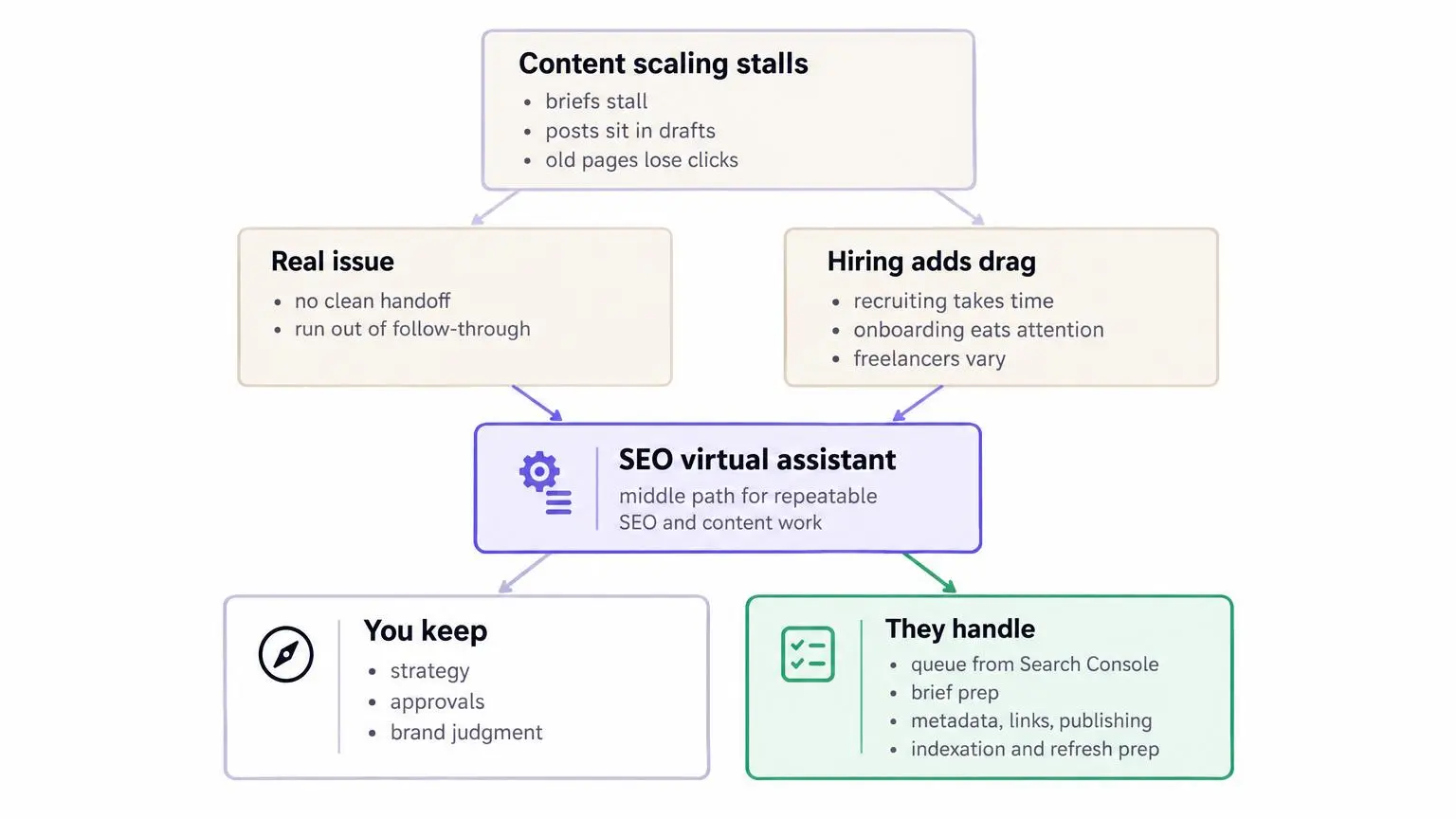
Content scaling rarely breaks because you need another writer. It breaks because your SEO virtual assistant—or whoever owns the work—has no clean handoff: briefs stall, posts sit in drafts, and old pages lose clicks unnoticed.
For growing brands, SaaS teams, ecommerce shops, and agencies, the fix is a repeatable operating rhythm, not more tabs or headcount. Start by removing the work that clogs the line (usually publishing and upkeep).
Watch for:
- A content queue ranked from Search Console signals, not random ideas
- Publishing checks for metadata, internal links, and indexation
- Weekly refresh work that keeps content moving without another hire
Why Content Scaling Usually Fails Before You Need Another Hire
Most teams don't run out of content ideas. They run out of follow-through.
The pattern is familiar: topic ideas live in three docs and a Slack thread, briefs take too long, articles sit in draft, internal links get skipped, and older posts slowly lose traffic because nobody owns refreshes. Then the conclusion feels obvious. "We need more people."
Usually, you don't. Not yet.
Hiring sounds like the clean fix, but it often adds new drag before it removes any. Recruiting takes time. Onboarding eats up your best operator's attention. Freelancers vary more than people admit. And if the workflow is still messy, adding headcount just gives the mess more places to hide.
That's the real issue. Scaling content production is usually an orchestration problem, not a staffing problem.
A good seo virtual assistant gives you a middle path between doing everything yourself and building a bigger internal team. You keep strategy, approvals, and brand judgment. They handle the recurring execution that keeps content moving.
If you're trying to outsource content marketing without losing control, this is where the model starts to make sense. You're not handing over the whole machine. You're fixing the parts that stall every week and quietly kill momentum.
More content rarely fixes a broken workflow. A steadier workflow produces more content.
What an SEO Virtual Assistant Actually Does
A seo virtual assistant is a remote operator who handles repeatable SEO and content tasks inside your existing tools. That usually means your CMS, Search Console, analytics, keyword tools, and content calendar.
They're there to keep the work moving.
Typical responsibilities include:
- keyword and topic research
- content brief prep
- title tag and meta description updates
- article formatting and publishing
- internal linking
- basic schema and on-page setup
- indexation checks
- Search Console monitoring
- performance snapshots
- refresh prep for older posts
This role matters because most SEO wins come from repeated, slightly unglamorous work. Not heroic sprints. Weekly execution.
It's also worth being clear about what this role is not.
An SEO VA is not automatically a senior strategist. They're not your brand voice. They're not a ranking guarantee. If you expect them to set content direction, own messaging, and solve every traffic problem alone, you'll be disappointed fast.
Here's the practical distinction:
- A general VA handles admin work.
- An SEO specialist should own higher-level prioritization and strategy.
- A writer gives you drafts, but may stop before optimization, publishing, and maintenance.
- Software can automate repeatable work, but it still needs review and judgment.
A virtual assistant for SEO tasks sits in the operational middle. That's a useful place to be. Especially for SaaS teams, ecommerce brands, service businesses, and agencies that already know what they should be doing, but aren't doing it consistently enough for search to compound.
The Highest-Leverage SEO Tasks to Hand Off First
Don't delegate everything on day one. That's how simple help turns into management overhead.
Start with three to five recurring tasks that remove the most drag from your current workflow. In practice, these are the handoffs that tend to pay off first.
Research and planning
This is one of the easiest places to start because it's structured work.
An SEO VA can:
- collect keyword ideas from Search Console and research tools
- cluster topics by intent
- spot obvious content gaps
- turn scattered ideas into a ranked publishing queue
A lot of teams think they have a content problem when they really have a queue problem. They don't know what should be published next.
Brief prep and on-page setup
Once topics are chosen, hand off the repeatable prep:
- suggested headings
- target keyword and supporting terms
- search intent notes
- title tag and meta drafts
- internal link suggestions
- slug recommendations
That alone can save hours each week. It also makes writer output more usable because the article arrives with direction instead of becoming a second project.
Publishing and maintenance
This is where content often dies.
A capable VA can upload articles into WordPress, format headings and images, add categories and SEO fields, schedule posts, and check that links actually work. None of this is hard. It just gets skipped.
Then layer in maintenance:
- identify older posts losing clicks
- update facts, sections, and links
- prep refreshes for republishing
- monitor indexing and flag pages that need resubmission
- add internal links from new posts to older relevant pages
If you want to improve website traffic with assistance, this is one of the least flashy but most reliable ways to do it. Fresh pages matter. Maintained pages matter more than many teams think.
Refresh Cadence Should Match Search Intent
Content maintenance is not one uniform task. In a study of 17,749 phrase-match keywords, the average last-update date of ranking pages varied sharply by query type: competitive “best software” results were updated far more recently than the overall sample. That makes refresh prep a useful first assignment for an SEO VA, but the review queue should be prioritized by the intent and volatility of the query rather than page age alone.
The figures describe the pages currently ranking in that study’s sampled SERPs, not a required refresh schedule or proof that updating caused a ranking outcome.
For a practical workflow, have the assistant flag pages in faster-moving commercial categories first, then bring the proposed changes to an in-house reviewer for accuracy, positioning, and approval.
Where a Virtual Assistant Fits in Your Content Creation Strategies
A good content workflow isn't just about writing articles. It's about moving work from idea to live page, then keeping it useful after publish.
That's where an SEO VA fits.
They can support the full lifecycle:
Typical workflow
- Research
Research what buyers are searching for
- Opportunities
Turn that into content opportunities
- Briefs
Prep briefs and on-page direction
- Publish
Publish on schedule
- Refresh
Maintain and refresh older content
Most teams are better at ideation than execution. They brainstorm well, then miss deadlines, publish late, and forget what already exists on the site. It feels busy, but not productive.
A VA adds reliability to your content creation strategies in a very unglamorous way:
- fewer missed publish dates
- less last-minute formatting
- a steadier blog cadence
- a cleaner feedback loop between performance and future topics
And the role doesn't need to stop at article support. Depending on the setup, they can also manage content calendars, proofread for consistency, coordinate assets, and repurpose blog content into other channels. One idea can become a blog post, a short social thread, a customer email, and a refreshed landing page note. That kind of reuse is where small teams stop wasting effort.
The best content systems use division of labor well. Leadership keeps strategy. The business keeps brand voice and final approval. Repetitive execution gets delegated.
That's not losing control. That's finally using it.
The Smartest Model Is a Hybrid One, Human Execution Plus Automation
If you want the blunt version, here it is: VA alone helps, but VA plus automation scales better.
Software is good at repeatable, high-volume work. Topic discovery. Draft support. Scheduling. Spotting content that needs a refresh. Humans are still better at prioritization, review, nuance, and knowing when a page should not go live yet.
That balance matters because both extremes break in predictable ways.
Manual-only systems stay small. Fully automated systems often publish faster than they think.
We built Intelliminds for this middle ground. Our SEO Automation Software handles the content side of SEO, including keyword and topic research, writing support, publishing, and content refreshing. It keeps a human in the loop, which is the part many teams care about most. You still review. You still decide.
For teams that want a tighter blogging workflow, Intelliminds SEO Autoblogger is built for end-to-end blog production with approval control and scheduled publishing. It finds keywords, generates articles, adds supporting elements, and publishes to your site on a controlled cadence.
The practical advantage of the hybrid model is simple:
- your VA spends less time on repetitive research and formatting
- your team publishes more often without adding full-time headcount
- quality review stays with people who understand the brand
The bottleneck stops being effort. It becomes workflow design.
That's a much better problem to have.
How to Use an SEO Virtual Assistant to Scale Content Step by Step
This only works if the handoff is clear. You don't need a giant process doc. You need a workable one.
1. Audit where content gets stuck
Look at the current flow and be honest. Is the slowdown happening in research, briefs, edits, publishing, linking, or refreshes? Separate strategic work from repeatable work.
2. Choose one workflow first
Pick a lane you can repeat weekly, such as:
- keyword research and queue updates
- article upload and on-page setup
- refreshes for declining posts
- Search Console checks and reporting
One clean workflow beats six vague ones.
3. Build a simple handoff system
Set a source of truth for tasks. Define naming rules, due dates, approvals, and publishing standards. Use checklists. Long manuals usually don't get read after the second afternoon.
4. Give tool access without giving away strategy
The usual stack includes:
- CMS access
- Search Console
- GA4 or a reporting view
- keyword tools
- internal content calendar
They need enough access to do the work, not full ownership of business priorities.
5. Set weekly output expectations
Track output that matters:
- briefs prepared
- posts formatted and published
- internal links added
- refreshes completed
- issues flagged for review
6. Keep approvals light but real
Review direction and brand-sensitive copy. Don't review every tiny formatting choice. Delegation dies when every task comes back to the founder or marketing lead.
7. Check whether drag is actually going down
Look for faster publish cycles, fewer missed updates, more live pages, and better upkeep of older content.
One well-scoped assistant can create more momentum than another part-time writer because they remove friction from the whole system, not just one draft.
What to Keep In-House and What to Delegate
This is where quality gets protected.
Keep these in-house:
- content strategy and business priorities
- final messaging and brand voice decisions
- product or service claims
- approval on sensitive pages
- campaign direction tied to sales goals
Delegate these to an SEO VA:
- research collection and organization
- first-pass briefs
- title, meta, and on-page updates
- CMS formatting and scheduling
- internal link implementation
- index checks
- traffic snapshots
- refresh preparation
The goal isn't to remove humans from the process. It's to move humans toward judgment work instead of repetitive execution.
A lot of teams fear that delegation will lower quality. In practice, quality usually drops when work lives in people's heads, standards aren't documented, and tasks get done differently every time. A repeatable process often improves quality because the basics stop slipping.
That's one of the real benefits of virtual assistants. More continuity. Less patchwork. Better operating discipline.
How to Know If You Need a VA, an Agency, or Software Instead
Not every bottleneck needs the same fix. Here's the clean decision framework.
A seo virtual assistant is usually the best fit when you already believe in content, have some direction, but can't keep up with weekly execution. You want one person in your tools, handling recurring work, without paying for a full agency retainer.
An agency fits better when you need senior leadership across strategy, technical SEO, reporting, and off-site work, and you don't have strong internal direction yet.
Software is the stronger choice when the bottleneck is repetitive, high-volume content work. If topic discovery, article generation, scheduling, and refreshes are consuming too much manual time, software can take a real chunk out of that load.
The best setup for many growing teams is a hybrid. Software handles the repeated parts. A VA or internal reviewer handles priorities and quality.
For teams trying to outsource content marketing in a controlled way, that's often the most stable path. Intelliminds can support the repeatable content workflow while your VA or internal team keeps standards aligned with the brand.
Be honest about the tradeoff. If you need leadership, hire for leadership. If you need execution, don't overbuy strategy.
| Option | Best when | Strongest at | Tradeoff |
|---|---|---|---|
| SEO virtual assistant | You believe in content, have some direction, and cannot keep up with weekly execution. | Recurring work inside your tools and weekly execution. | Best for execution, not senior leadership or full strategy. |
| Agency | You need senior leadership and do not have strong internal direction yet. | Strategy, technical SEO, reporting, and off-site work. | Can be more than you need if the real gap is execution. |
| Software | Your bottleneck is repetitive, high-volume content work. | Topic discovery, article generation, scheduling, and refreshes. | Still needs human prioritization, review, and nuance. |
| Hybrid | You want a controlled way to scale content while keeping human review. | Software handles repeated parts while a VA or internal reviewer handles priorities and quality. | Requires a human in the loop for standards, priorities, and quality. |
The Metrics That Show Whether Your SEO VA Is Actually Working
Don't judge the role by busyness. Judge it by movement.
Start with operational metrics:
- publishing consistency
- turnaround time from idea to live article
- number of refreshes completed
- internal links added
- percentage of pages indexed after publish
- backlog reduction
These usually improve before traffic does. That's normal.
Then watch SEO outcomes over time:
- impressions
- clicks
- rankings for target topics
- traffic to refreshed pages
- growth across content clusters
- conversions or assisted conversions where you track them
A strong assistant should also help surface what needs attention next. That's the difference between task completion and operational support.
On indexing, keep it simple. Newly published pages should be checked to make sure they're discoverable. We offer a Google Index Checker that can batch-check up to 20 URLs, which makes basic post-publish verification quicker when you're managing a queue.
Early wins often look boring. Fewer missed updates. Faster refreshes. Less neglected content. Good. That's how compounding starts.
Common Mistakes That Cancel Out the Benefits of a Virtual Assistant
The role works well when the scope is narrow and repeatable. It falls apart when expectations get sloppy.
Common mistakes include:
- delegating without a clear workflow
- expecting strategic leadership from an execution role
- piling on unrelated tasks like SEO, admin, design, outreach, and analytics at once
- having no approval structure
- measuring only rankings and ignoring workflow gains
- treating the VA like a temporary fix instead of part of the system
- overusing AI without editorial review
- keeping rules and preferences in someone's head
The failure mode is usually not the assistant. It's the setup.
We've seen teams block every decision in review, then complain that delegation is slow. We've also seen teams approve nothing and assume software or a VA will somehow guess the brand line. Both lead to the same outcome: messy output and frustration.
The better path is boring on purpose. Clear ownership. Weekly rhythm. Repeatable scope.
What the First 30 Days Should Look Like
The first month should reduce chaos, not chase miracle traffic gains.
Week 1
Audit the backlog and current workflow. Pick the top-priority pages or categories. Define tool access, reporting, and success metrics.
Week 2
Start one recurring lane, such as keyword clustering, brief prep, or article publishing. Create templates for titles, metas, internal links, and refresh notes.
Week 3
Publish or refresh on a predictable schedule. Review quality, speed, and communication gaps. This is usually where small frictions show up. Better now than later.
Week 4
Assess operational wins. Refine task ownership. Decide whether to expand into reporting, refresh cycles, or broader content updates.
The point of the first 30 days is not volume for its own sake. It's building a reliable content machine.
If things feel calmer by the end of the month, you're probably on the right track. SEO gains usually come from sustained execution, not one burst of activity.
Conclusion
A seo virtual assistant helps you scale by taking recurring execution work off your plate. But the biggest gains don't come from delegation alone. They come from pairing that role with a clear workflow and the right automation.
That's the real shift. Stop treating growth as a hiring problem first. Treat it as a systems problem.
Start with one bottleneck, one delegated workflow, and one metric that tells you whether drag is going down. If your team is stretched thin, look for the repeatable parts of your content process that can be handled by a VA, then support that workflow with tools like Intelliminds where automation can remove manual work without removing judgment.
Article Record
ReferencesPrimary sources used for this article
- SEO Virtual Assistant for Small Business | AssistBPO
- Hire an SEO Assistant, Online VA Team
- SEO Virtual Assistants | Nomad VAs
- SEO Virtual Assistant Services from $3/hour | Hyperstaff
- SEO Virtual Assistant: Hire a Dedicated SEO VA From $400/mo
- 11 Proven Benefits of Hiring a Virtual Assistant - Prialto
- Lily Ray