
Clearscope is worth considering if your team already publishes content and needs better topic research plus on-page optimization without adding more editorial chaos. Its strongest case is a calm, inspectable workflow from topic discovery to draft improvement, not a sprawling all-in-one SEO suite.
The buyer caveats show up early too. Official list pricing starts at $129/month, key workflows are governed by plan allowances, and in the workspace used for this review both Pages and Analytics asked for a Google Search Console connection. The clearest hands-on result was simple and useful: one relevant 84-word paragraph moved the same draft from C- to B- while readability stayed at College. That shows fast recognition of a worthwhile edit, not proof of ranking gains.
At a glance
- Hands-on finding: Clearscope felt strongest as a focused research-and-optimization layer. The path from topic exploration to evidence to a live-scored draft was unusually calm and easy to understand.
- Most decision-relevant result: A clean 438-word draft started at C- with College readability. Adding one relevant 84-word paragraph moved it to B- with College readability unchanged.
- Official buyer caveats: Pricing starts at $129/month. Important workflows are allowance-based. Every plan lists unlimited users and projects, but Pages, Drafts, Topic Explorations, and tracked prompts still shape real cost.
- Hands-on boundary: In the tested workspace, Pages and Analytics required a Google Search Console connection. Drafts, Topic Exploration, and Prompt Tracking remained usable without that connection.
- Independent review pattern: G2 and Capterra both showed very strong ratings when checked, with repeated praise for ease of use and recurring complaints about price and usage limits.
- Bottom-line fit: Clearscope makes the most sense for growing brands, ecommerce teams, SaaS marketers, service businesses, startups, and agencies that already have content operations and want a clearer optimization layer, not a broader technical SEO platform.
How we tested
This review is built on task-based product use, plus official pricing and integration materials. Independent review sites are included only as attributed context.
Inside Clearscope, we worked through these flows:
- Ran Topic Exploration for “AI SEO software,” waited for 40 results, then opened a child query to inspect intent and SERP evidence.
- Used a clean unpublished 438-word fixture in Draft, recorded the baseline, added one useful 84-word paragraph, and compared grade, readability, and recognized concepts.
- Inspected the Term map and competitor evidence behind the recommendations.
- Added six watched brands and one real buying prompt to Prompt Tracking, then reviewed three Gemini responses.
- Opened Pages and Analytics to see what was available without Google Search Console.
- Verified pricing and integrations through official product materials alongside direct UI exposure.
That supports strong first-hand conclusions about:
- topic research and intent interpretation
- on-page optimization workflow
- how inspectable the scoring inputs feel in practice
- early AI-answer mention monitoring
It does not fully support claims about deeper performance analysis after connecting Google Search Console, or about how well Draft with AI preserves brand voice on a full-length article. Those remain open questions, and the verdict stays close to the workflows that were actually observed.
Who Clearscope Is For
Clearscope fits best when content production is already happening and the real problem is messiness: too much manual keyword interpretation, too many revision loops, or too much SEO friction between strategist, writer, and editor.
That can describe several teams:
- growing brands trying to scale organic traffic without turning every brief into a research project
- ecommerce teams that need clearer content coverage around product, category, and educational topics
- SaaS marketers balancing product-led pages with explainers, comparisons, and supporting articles
- service businesses and startups that want stronger briefs without buying a giant SEO suite
- agencies that need a shared optimization layer across multiple writers and editors
What stood out in use was how calm the core flow felt. Topic idea to intent evidence to live-scored draft was unusually easy to follow. That matters most when your writers are not all SEO specialists. A strategist can gather evidence, shape a brief, and hand it off without expecting the writer to decode a dashboard full of competing metrics.
That clarity comes from focus. Clearscope felt like a content discovery and optimization workspace, not a technical SEO platform, backlink database, or broad site-audit system. For many teams, that is a feature, not a limitation. A narrower tool is often easier to adopt, easier to teach, and easier to keep aligned with editorial goals.
The tradeoff is practical. Some buyers will still want a second tool for wider SEO work. If your brief is really about rank tracking depth, technical audits, link analysis, and consolidated reporting, Clearscope is probably only part of the answer.
One caution is worth calling out before teams rely on its monitoring features. The generated onboarding profile needed correction, including brand capitalization and company description. That does not undermine the whole product, but it does mean brand identity inputs should be reviewed before downstream tracking is trusted.
If your real decision is broader than this review, and you need side-by-side alternatives or a wider platform comparison, go to the Best AI SEO Software guide instead. Clearscope is easier to judge fairly when you treat it as a focused optimizer.
Topic exploration
Topic Exploration was the first place Clearscope felt genuinely decision-ready.
Using the seed term “AI SEO software,” the tool returned 40 results. At the surface level, those results carried familiar data points such as search volume, competition, CPC, and SERP-feature information where available. That alone would not be especially memorable. The better part came after opening a child query.
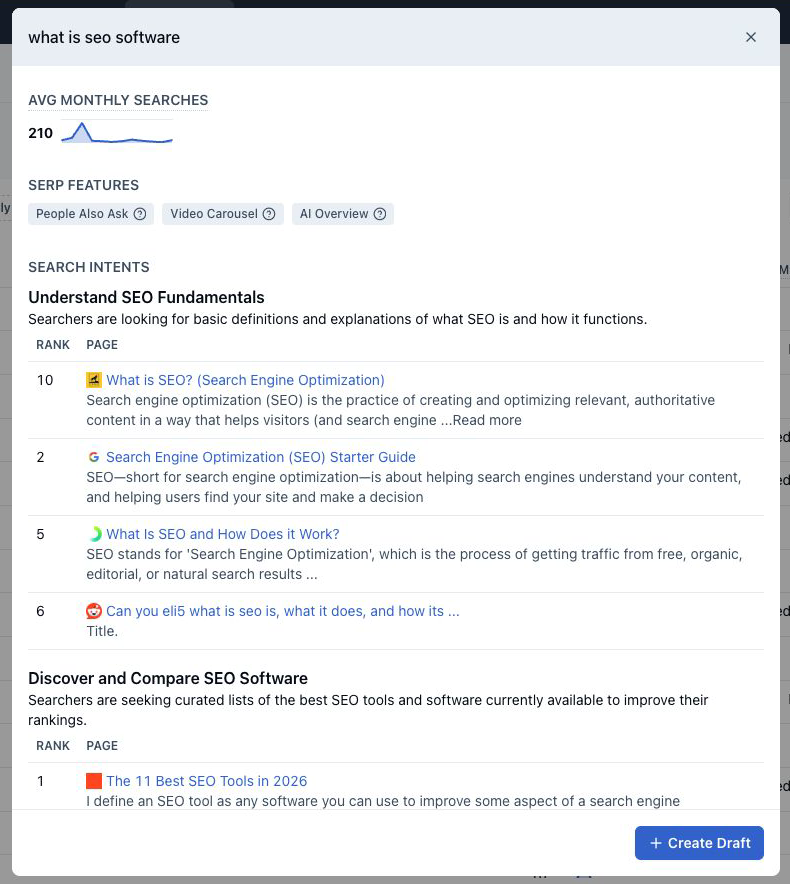
The strongest example was “what is seo software.” In that view, Clearscope showed:
- 210 average monthly searches
- People Also Ask
- Video Carousel
- AI Overview
- four plain-language intent groups tied to actual ranking pages
That combination matters. Instead of handing over a flat keyword list and leaving the strategist to infer what the searcher probably wants, Clearscope framed the query in human terms and kept the ranking evidence visible underneath. The result felt closer to a usable brief than a spreadsheet export.
For content teams, especially those trying to scale without adding more manual research, this shortens an annoying step in the workflow. You can move faster from “this keyword exists” to “this should probably be an explainer,” or “this looks more mixed-intent and may need comparison framing,” or “this topic belongs in support content, not a commercial page.”
That is the real productivity gain here. Not more data, but less interpretation work.
It also makes briefing easier. If you hand a non-specialist writer a topic with visible intent groups and supporting ranking pages, the writer starts from something concrete. They are less likely to produce an article that technically includes the keyword but misses the job the searcher is trying to get done.
The important boundary is that this section supports a claim about workflow quality, not about the absolute breadth of Clearscope’s keyword database. What the hands-on evidence shows is narrower and more useful: Clearscope helped turn a seed term into inspectable topic and intent evidence with less mental overhead than many SEO research tools create.
Draft optimization
The controlled Draft test is still the most persuasive part of the review because the change was small, the measurement was clear, and the reaction matched the result.
| Draft state | Words | Content grade | Readability |
|---|---|---|---|
| Baseline draft | 438 | C- | College |
| After adding one relevant 84-word paragraph | 522 | B- | College |
Several concepts that were previously missing or undercovered were recognized after that addition.
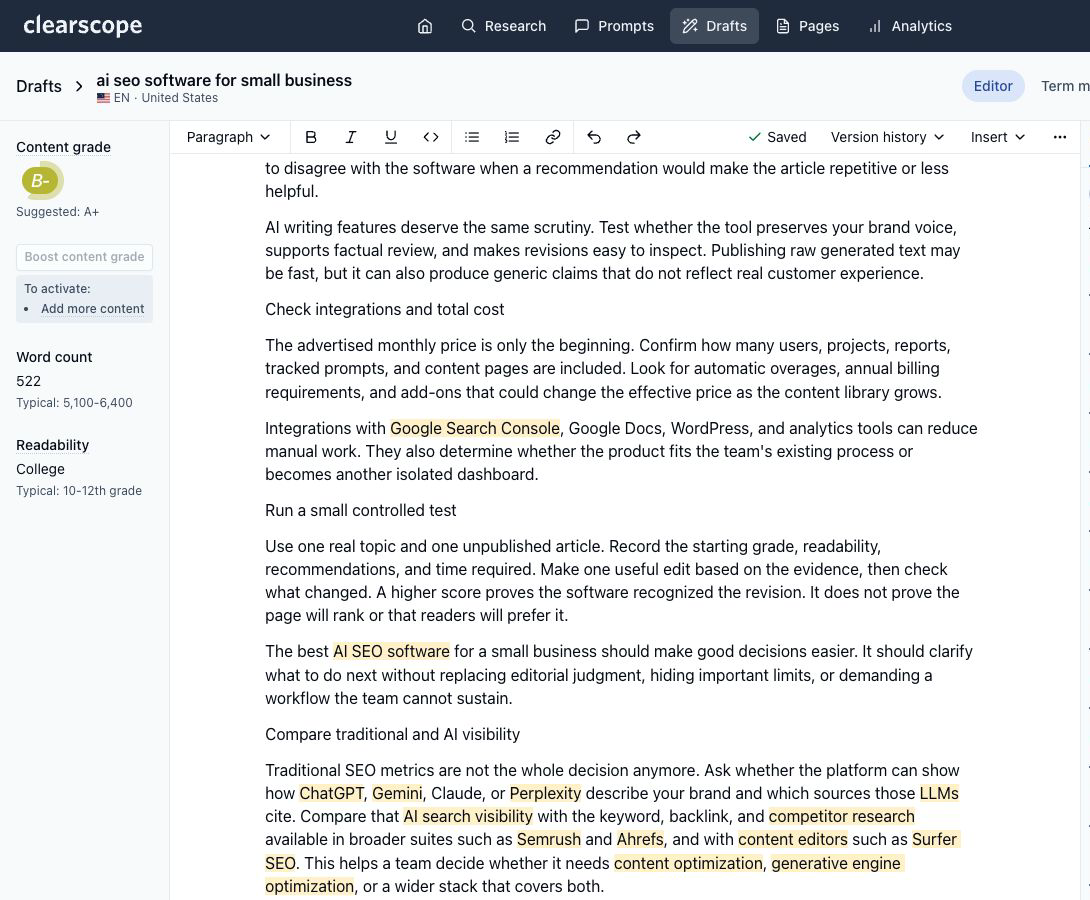
This was a good moment for Clearscope because it showed responsiveness without theatrics. The draft did not double in length. The writing did not get mechanically stuffed with terms. Readability did not move. Clearscope simply recognized that the revision improved coverage.
The editor reaction mattered here too, because it helps explain why the workflow felt usable rather than gamified. The score, recommended ranges, highlighted concepts, and saved state were all visible without turning the screen into a control panel. That sounds like a small interface point, but it changes the mood of the work. Writers can focus on the article and still see the optimization feedback, instead of feeling trapped in score-chasing.
That calm is valuable for teams with multiple writers. In many content operations, the pain is not that editors lack a grading system. The pain is that writers revise, editors respond, and nobody is sure whether the revision truly addressed the brief. If a useful change is recognized quickly and visibly, some of that back-and-forth disappears.
The interpretation still needs restraint. A C- to B- jump proves that Clearscope recognized a relevant edit on this draft for this query. It does not prove better rankings, better engagement, or better reader satisfaction. It also does not prove the same magnitude of change would happen on every topic.
Still, as a shared editorial instrument, the Draft view did its job well. It gave fast, visible feedback on whether the article was covering more of the important terrain. Used that way, it feels less like a ranking oracle and more like a faster revision language for content teams.
Term map evidence
The grade would be much less credible if Clearscope stopped at the grade.
It does not. The Term map makes the logic more inspectable than many optimization tools manage. In the tested draft, Clearscope compared the article with ranking pages row by row and exposed:
- typical-use ranges for individual terms
- current usage in the draft
- AI-presence markers tied to those terms
That changes the experience from “the tool says B-” to “the tool is showing what it saw, where competitors differ, and which concepts appear more or less often across ranking pages.”
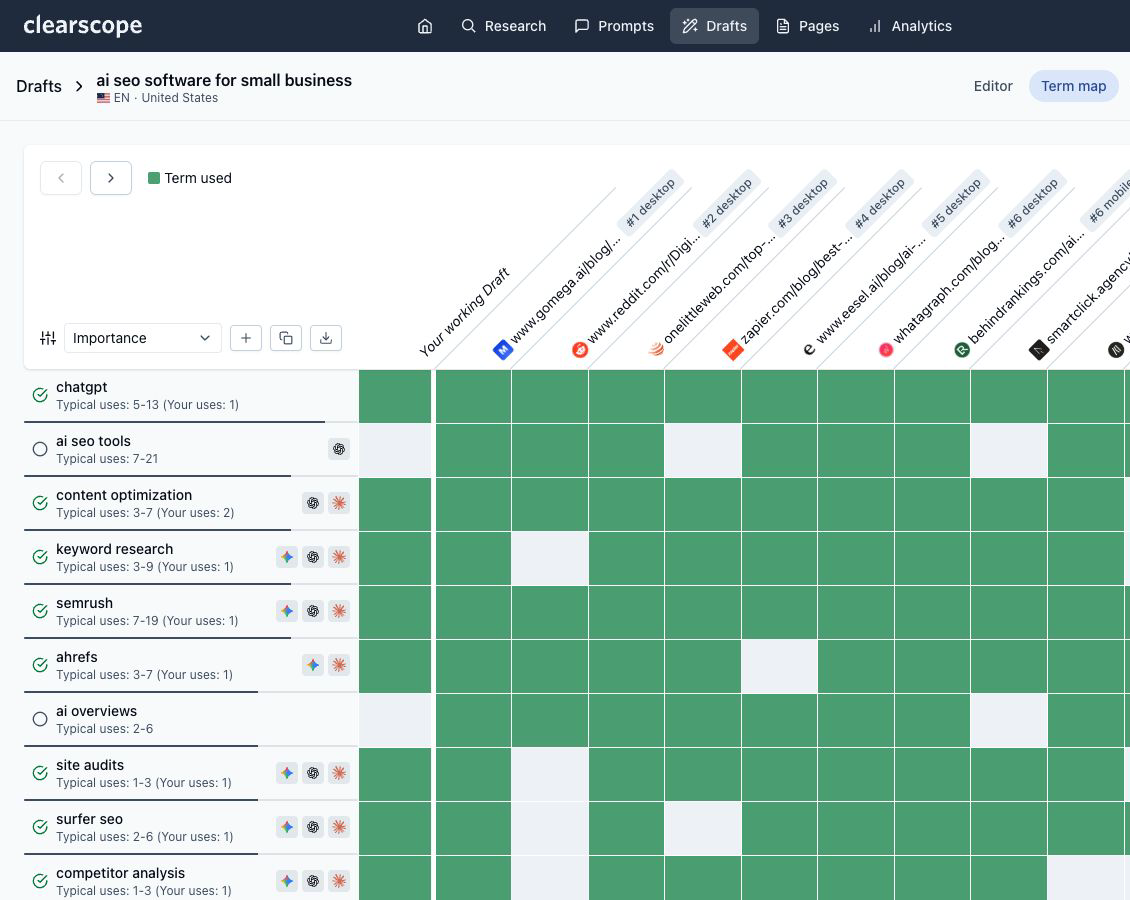
This is where the product earned trust. Not because the score became magically accurate, but because the inputs stopped feeling hidden.
That matters for experienced teams. Brand voice, differentiation, brevity, and positioning still require judgment. A writer may look at a recommended term and decide it belongs naturally. They may also decide it would make the article worse. The useful part is that Clearscope gives them something concrete to inspect before they agree or disagree.
That is a better editorial model than blind optimization. If your writers already resist SEO tooling because it feels arbitrary, the Term map is probably the view that reduces that resistance. It makes the recommendation engine visible enough to debate intelligently.
There is still healthy skepticism to keep. Explainable inputs are not the same as correct instructions. A term can be common among ranking pages and still be unnecessary in your article. But visible evidence is easier to use responsibly than a black-box score, and Clearscope’s evidence layers did more than enough to support that distinction.
Competitor evidence
The competitor view is where Clearscope became more useful and more dangerous at the same time.
For the tested query, Draft recommended 5,100 to 6,400 words. That target felt alarmingly easy to obey without much thought. Many teams, especially those under production pressure, would see a range like that and start filling space.
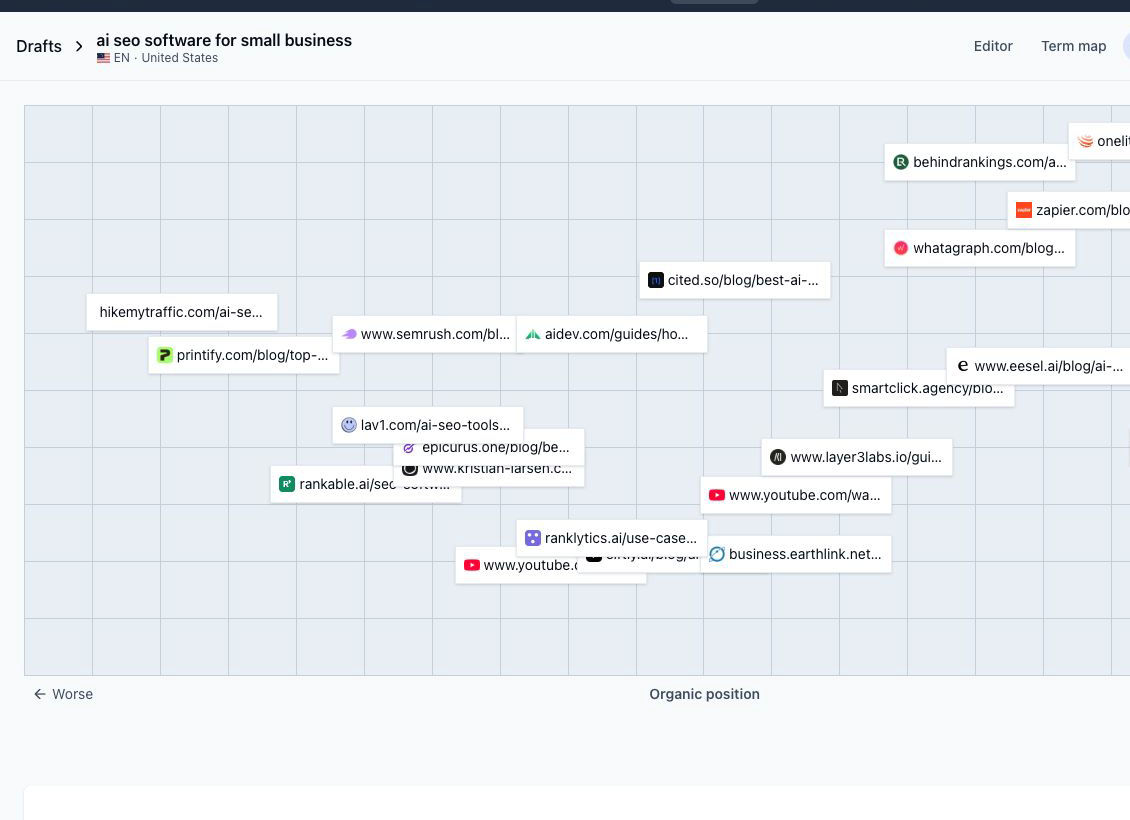
Opening the Competitors view made the recommendation more understandable. The ranking pages shaping the draft guidance ranged from roughly 3,100 words to nearly 15,000 words. So the target did not come from nowhere.
But the same view also showed why that target should not become a quota.
The broader pattern in the competitor evidence was that shorter, lower-graded pages could still rank near the top. That is exactly the kind of detail buyers need to know before rolling a tool out across a team. Clearscope can help explain the competitive landscape behind its recommendations, but it cannot decide whether your best article should be long, concise, transactional, explanatory, or deliberately different.
That is the most important skepticism in this review.
Clearscope is very good at making topical coverage and competitor evidence inspectable. It is much less useful if a team wants software permission to overproduce long content. The product does not force that mistake, but it can make the mistake feel justified if editors stop asking what the reader actually needs.
For disciplined teams, this section is a plus. It exposes the pages informing the recommendations and gives strategists a stronger basis for saying, “We understand the range, but we are choosing a different format.” For less disciplined teams, the risk is obvious: the number becomes the plan.
Used well, the competitor view sharpens judgment. Used badly, it can rationalize bloat. That is not a flaw unique to Clearscope, but it is a real buying consideration here because the tool makes the recommendation feel authoritative enough to follow.
Clearscope AI tracking
Prompt Tracking is a separate workflow from draft optimization, and it deserves to be evaluated that way.
For the observed prompt-tracking workflow, the setup was:
- Prompt: “What are the best AI SEO software tools for growing brands?”
- Watched brands: Clearscope, Semrush, Surfer SEO, Ahrefs, Frase, and the tested brand
In the first snapshot, Clearscope surfaced three Gemini responses and showed a 0% mention rate for the tested brand.
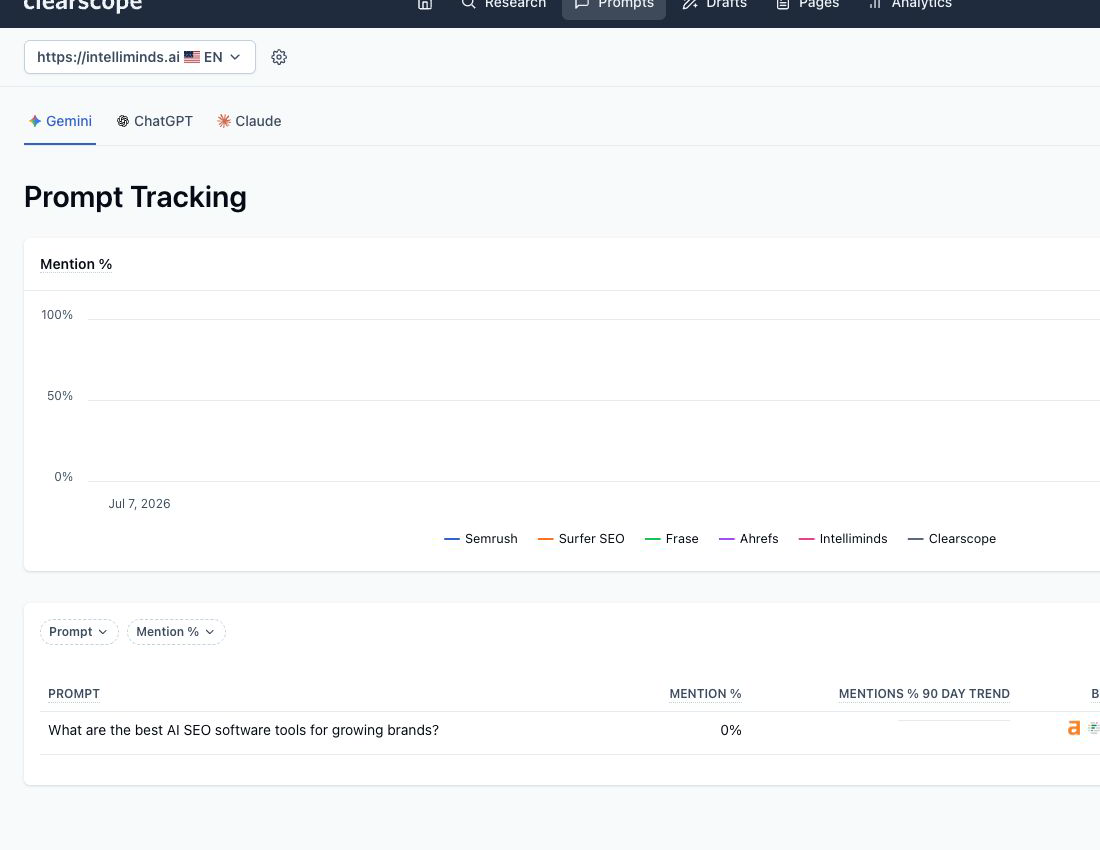
That is a timely feature. Software companies and agencies increasingly care about whether they appear in model-generated buying conversations, not just in conventional search results. If leadership is already asking, “Are we showing up in AI answers?” a monitoring view like this is immediately relevant.
There is quantitative reason to take AI-answer visibility seriously, even though it is not proof that any tracking tool improves performance. In a Seer Interactive analysis of 3,119 informational and educational queries across 42 client organizations, organic click-through rate averaged 0.70% when a brand was cited in a Google AI Overview, versus 0.52% when an AI Overview appeared without that brand cited. That is a 35% relative difference in the observed dataset. The study is observational, so citation may be associated with stronger brands rather than causing the additional clicks. It also measures Google AI Overviews, not Gemini.
There is also measured evidence that repeated AI-answer checks can vary substantially. A Vismore audit of 750 AI responses, conducted March 1–15, 2026, found that 38% of prompt-level comparisons across three identical runs had different sets of brands. That does not test Clearscope or establish an error rate for its tracking. It does show why a single 0% mention result—or a single positive mention—should be treated as a point-in-time observation, not a stable share-of-voice verdict.
The caution matters just as much. Model answers and competitive mentions are monitoring evidence, not verified product facts about the brands named inside them. Clearscope is showing what Gemini said in that moment. It is not certifying the accuracy of those statements.
There is also still a meaningful uncertainty gap. One observed snapshot can show that the workflow exists and that the results are readable. It cannot yet prove how stable mention rates or cited-source patterns will be:
- across later refreshes
- across prompt rewrites
- across Gemini, ChatGPT, and Claude
So the right way to think about this feature, based on the evidence available, is as an emerging visibility monitor rather than a mature reporting system.
That still may be enough. If your team is early in figuring out how AI-generated recommendations affect awareness and consideration, Clearscope gives you a concrete place to start watching. If you need repeatable executive reporting, this review does not yet support that claim.
Pages, analytics, integrations
This is the section where Clearscope’s boundaries showed up fastest.
In the tested workspace, Pages and Analytics did not offer standalone sample data. Both requested a Google Search Console connection before revealing more. That is the direct hands-on boundary, and it matters because some buyers will want to inspect reporting depth before connecting a production property.
The useful qualifier is that Clearscope’s core research and drafting workflows remained available without that step. Topic Exploration, Draft, and Prompt Tracking were still usable. So if your main buying case is better research and on-page optimization, a lot of the product is still understandable without handing over Search Console data.
Official materials and direct UI exposure were more reassuring on the writing-side integrations. The account exposed:
- Google Docs
- WordPress
- Microsoft Word
Official support also documents Google Docs and WordPress workflows.
That combination makes the workflow fit question fairly practical:
- Teams already comfortable connecting Google Search Console may treat the Pages and Analytics requirement as normal.
- Privacy-conscious teams, or buyers who want to evaluate performance features before connecting real properties, may find that boundary more significant.
- Writer-heavy teams may care more about Docs and WordPress fit than about native analytics depth in the first place.
So the value calculation depends on why you are shopping. Clearscope already looks useful as a content research and optimization layer without Search Console. Its deeper performance views may also matter, but this review cannot judge their real usefulness after connection, only the pre-connection boundary.
Clearscope pricing
Official pricing is easy to read and a little trickier to model against real workload.
| Plan | Price | Tracked prompts | Pages | Topic Explorations | Drafts |
|---|---|---|---|---|---|
| Essentials | $129/month | 50 | 50 | 20 monthly | 20 monthly |
| Business | $399/month | 300 | 300 | 50 | 20 |
| Enterprise | Custom | Custom | Custom | Custom | Custom |
A few official details materially affect the buying decision:
- Every plan lists unlimited users.
- Every plan lists unlimited projects.
- Sharing and exporting are included.
- Optional additional Pages and Drafts are listed, so the monthly subscription price is not the only scaling variable.
There are two opposing forces here.
On one side, unlimited users is a real advantage for agencies and growing in-house teams. If the point of the product is to create a shared research-and-optimization layer, seat restrictions would get in the way quickly. Clearscope avoids that problem.
On the other side, the usage allowances are not generous enough to ignore. Drafts, Pages, Topic Explorations, and tracked prompts still define how far the plan goes. The most striking detail in the listed structure is that both Essentials and Business include 20 Drafts. That does not automatically make the higher tier a bad deal, because the other allowances change a lot, but it does mean high-volume content teams should look carefully at which bucket they are most likely to hit first.
That makes pricing less about team size and more about publishing behavior.
Clearscope can make strong economic sense if your team applies it to high-value briefs and pages where cleaner research and faster revision loops save real labor. It becomes harder to justify if your operation needs the tool on every draft at high volume and the allowances start driving add-on spend.
In other words, the headline price is only the first question. The better question is whether your monthly content volume lines up with the included usage well enough to keep the workflow advantage from being eaten by limits.
| Plan | Price per month | Tracked prompts | Pages | Topic Explorations per month | Drafts per month |
|---|---|---|---|---|---|
| Essentials | $129 | 50 | 50 | 20 | 20 |
| Business | $399 | 300 | 300 | 50 | 20 |
Review patterns
Independent review patterns should stay clearly attributed, but they are still useful context because they largely reinforce the firsthand experience.
On G2, Clearscope showed 4.9/5 from 92 reviews when checked. The repeated praise centered on:
- clean interface
- straightforward optimization feedback
- strong Google Docs workflow
The recurring complaints centered on:
- price
- credit limits
- occasional weak or unexplained recommendations
On Capterra, Clearscope also showed 4.9/5 from 60 reviews when checked. That review pattern similarly reinforced ease of use and customer service, while a representative complaint said the price was higher than alternatives.
Those patterns line up with the hands-on findings in important ways.
The strongest alignment is on usability. The calm workflow from topic evidence to draft improvement felt like a real advantage, and outside reviewers appear to notice the same thing.
The price sensitivity also aligns cleanly with the official plan structure. Even with unlimited users and projects, key workflows are still allowance-based, so it makes sense that reviewers repeatedly call out cost and limits.
The “unexplained recommendations” complaint is more nuanced. In the tested flows, Term map and competitor evidence made a lot of the logic inspectable. That does not invalidate outside complaints, but it suggests the experience may depend on whether a team uses the evidence layers or treats the grade alone as the product.
So these review patterns do not dramatically change the verdict. They strengthen confidence that Clearscope is widely experienced as easy to use, while keeping a real warning label on price and usage boundaries.
What we still don’t know
Several questions remain important enough that they should stay separate from the verdict.
We still do not know:
- How stable mention-rate and cited-source results are across later refreshes and across Gemini, ChatGPT, and Claude. This matters if Prompt Tracking is supposed to become a reporting workflow rather than an interesting snapshot.
- How actionable decay, striking-distance, and internal-link recommendations become after connecting a representative Google Search Console property. This matters because Pages and Analytics asked for that connection before their depth could be judged.
- Whether an equally useful edit on a different topic would produce a comparable grade jump, or whether the observed C- to B- movement was unusually query-specific. This matters if multiple writers will be guided by the score.
- How well Draft with AI preserves a supplied brand sample on a full-length article. This matters if AI-assisted drafting is expected to touch publishable assets rather than rough internal drafts.
None of these unknowns automatically count against Clearscope. They simply mark the point where a serious buyer should ask for a deeper product walkthrough or a narrower proof of value before making the purchase decision.
Final verdict
Clearscope looks strongest when you judge it for what it is: a focused, low-friction way to research topics, inspect search intent, and improve drafts with visible evidence behind the recommendations.
The best evidence in its favor is still the simplest moment in the review. One useful 84-word addition moved the same draft from C- to B- without changing readability. That says something important about how quickly Clearscope can recognize better topical coverage. It does not say anything magical about rankings.
The biggest caution is just as important. Long word-count targets can be dangerously easy to obey, and competitor-informed scoring can drift into overproduction if your team lacks editorial discipline. Clearscope helps by making more of its logic visible, but it does not remove the need for judgment.
Treat the grade as a proxy, not a promise.
That leads to a fairly clear buyer recommendation:
- Move Clearscope forward now if you want a dedicated research-and-optimization layer for active writers and editors, and you already handle broader SEO work elsewhere.
- Keep it on a focused shortlist if the workflow looks right but you need to validate post-Search-Console analytics depth, AI-monitoring stability, or high-volume pricing fit.
- Look elsewhere first if your real requirement is a broader all-in-one SEO platform, or if you need performance features to feel useful before connecting Google Search Console.
If you need category-level comparisons, budget tradeoffs, or alternatives beyond this focused review, start with the Best AI SEO Software guide.
Clearscope review FAQ
This Clearscope review found a focused content research and optimization tool with a calm workflow, visible evidence, and meaningful usage limits. These answers summarize the main buying considerations from the review.
Who is Clearscope best for?
Clearscope fits growing brands, ecommerce teams, SaaS marketers, service businesses, startups, and agencies that already have content operations and want a dedicated research-and-optimization layer. It is less suitable as a replacement for a broader technical SEO, backlink, rank-tracking, or site-audit platform.
How much does Clearscope cost?
Official pricing starts at $129 per month for Essentials. Business is listed at $399 per month, while Enterprise pricing is custom. Plans include unlimited users and projects, but allowances for Drafts, Pages, Topic Explorations, and tracked prompts still affect the real cost.
What are the main Clearscope usage limits?
The main pricing caveat is that important workflows are allowance-based. Essentials includes 20 monthly Topic Explorations, 20 monthly Drafts, 50 Pages, and 50 tracked prompts. Business includes 50 Topic Explorations, 20 Drafts, 300 Pages, and 300 tracked prompts. Optional additional Pages and Drafts are also listed.
Does Clearscope require Google Search Console?
In the tested workspace, Pages and Analytics requested a Google Search Console connection before showing more. Topic Exploration, Draft, and Prompt Tracking remained usable without that connection, so the core research and drafting workflow could still be evaluated independently.
Can Clearscope’s content grade guarantee better rankings?
Clearscope’s grade should be treated as a proxy for topical coverage, not a promise of rankings, engagement, or reader satisfaction. The review found that one relevant 84-word addition moved a 438-word draft from C- to B- while readability stayed at College level, but that result came from one tested draft and query.
Article Record
ReferencesPrimary sources used for this article
Update HistoryMeaningful revisions to this article
- Added five frequently asked questions and answers to help readers understand Clearscope more easily.