
Frase lost trust at exactly the wrong moment: after Tool Review was selected for a 2,500-word brief, it generated a review of Intelliminds instead of Frase. Frase compresses research, optimization, audit, AI visibility, and prioritization into one ambitious AI SEO workspace, but that same breadth raises the cost of trust, so its best use is accelerating an expert operator, not replacing one.
That tension showed up across the workflows that matter to most content and SEO teams. Site analysis finished in roughly 75 seconds. The eight-stage research flow produced a dense, useful surface of evidence points, keywords, SERP questions, content gaps, and AI visibility signals. A live product review imported cleanly, preserved structure, and improved its score as soon as the primary keyword was set. The site audit exposed page-level content, SEO, and GEO scores that were easy to sort into action. But the first useful move was manually replacing every suggested competitor, and Frase Agent later spoke as if Search Console data existed when it did not.
Intelliminds overlaps commercially with Frase in AI SEO software, and this review evaluates Frase on observed workflow fit and evidence quality.
If you run content or SEO for a growing brand, ecommerce team, SaaS company, service business, startup, or agency, that is the real decision: does Frase remove enough workflow sprawl to make your team faster, or does it simply shift the work into verification?
At a Glance
The short version is simple. Frase is unusually good at pulling adjacent SEO content jobs into one place. It is much less convincing when you need its automation to keep competitors, entities, and data states straight without supervision.
What stood out most on the positive side:
- Site analysis finished in about 75 seconds, with 11 pages analyzed, 10 topics identified, and 7 proposed competitors
- The eight-stage research workflow returned 8 evidence points, 8 keywords, AI visibility across 4 platforms, 11 SERP questions, and 6 content gaps
- Live URL import worked cleanly and recognized a published review as 3,900 words, 14 headers, 16 links, 10 images, and 2 tables
- The completed audit scored intelliminds.ai at 91% based on 19 of 28 discovered pages and exposed page-level content, SEO, and GEO scores plus issue counts
The clearest cautions were just as specific:
- Automatic competitor matching was noisy enough that all 7 suggestions were replaced manually
- The Tool Review brief lost entity focus and reviewed the workspace brand instead of Frase
- Frase Agent claimed 20 indexed URLs had zero clicks and impressions even though Search Console was not connected
That combination defines the buying decision. If your team already has strong SEO judgment, Frase can compress research, optimization, auditing, and prioritization into a faster working rhythm. If you want AI output you can trust at a glance, the observed misses happened in places that matter too much to ignore.
How We Tested
The evaluation centered on common SEO content jobs rather than edge-case feature touring.
Frase was used to:
- analyze a live site and review the automatic competitor set
- replace competitors manually
- complete a full site audit
- run the eight-stage research workflow
- generate a Tool Review brief
- import a live product review for optimization
- set a primary keyword and observe score changes
- ask Frase Agent for the single highest-impact fix
- review billing meters alongside current public pricing facts
- check independent review patterns on Capterra and G2
Those tasks map closely to the day-to-day work many teams actually care about:
- building briefs faster without losing editorial control
- improving existing articles instead of rewriting everything from scratch
- turning a messy site into a page-level queue of fixes
- deciding whether AI SEO guidance is trustworthy enough to act on
If that sounds like your workload, the findings here should be decision-relevant. If your main priority is deep technical SEO diagnostics, enterprise governance, or fully autonomous content production, Frase may need a different kind of evaluation than this one.
Onboarding and Competitors
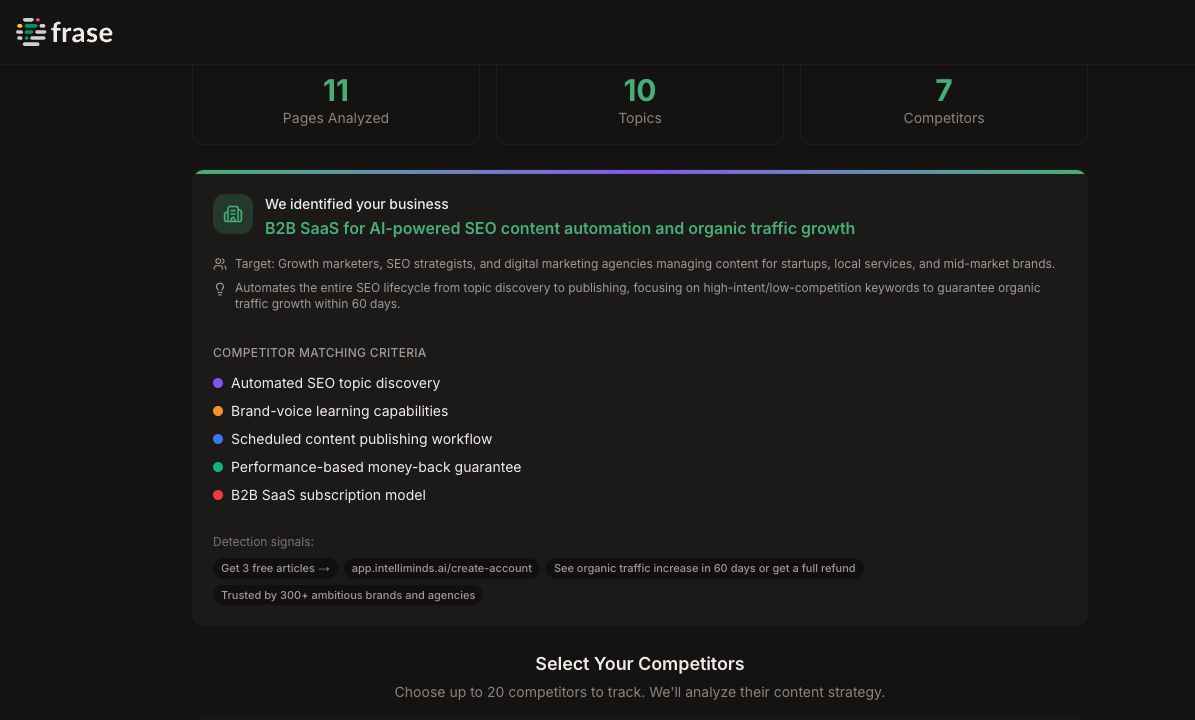
Frase makes a strong first impression. Site onboarding finished in roughly 75 seconds, analyzed 11 pages, identified 10 topics, and proposed 7 competitors. That is fast enough to feel operational, not just flashy. It creates the sense that Frase wants to move quickly from setup into actual work.
Then the automation stopped being enough.
The initial competitor set was mostly poor matches, and all 7 were replaced manually with Surfer SEO, Clearscope, Semrush, and Ahrefs before the rest of the workflow felt credible. The interface still felt polished. The time savings were still real. But the first genuinely valuable action was correction, not acceptance.
That matters because competitors in Frase are not an isolated setup choice. They shape the frame for downstream research, content gaps, comparison logic, and optimization targets. If that baseline is wrong, the rest of the workflow can still look smooth while quietly pulling you in the wrong direction.
For growing brands and agencies, this is a practical warning more than a philosophical one. Lean teams tend to adopt platforms like Frase to remove context switching and speed up execution. That is exactly where a bad competitor set is dangerous. It can distort the workflow before anyone has written a word.
The encouraging part is that Frase did not make correction painful. Swapping the list out was straightforward, and the product never felt sluggish or overbuilt during that step. The caution is simply that you should expect to do it. If your team already knows its real search peers, this is manageable. If you were hoping Frase would discover the right strategic comparison set for you, the hands-on evidence does not support that kind of trust.
So the judgment here is measured, not dismissive. Onboarding is fast, polished, and useful. It just does not earn the right to define your competitive landscape by itself.
Research and Briefs
Once the competitor list was corrected, the research workflow became one of Frase's most compelling screens.
The eight-stage process returned:
- 8 evidence points
- 8 surfaced keywords
- AI visibility across 4 platforms
- 11 SERP questions
- 6 content gaps
That output matters less for the raw count than for the way it is assembled. SEO content work is often slowed down by fragmentation, not lack of information. Keywords live in one tool, SERP notes in another, competitor observations in a document, and editorial framing in someone's head. Frase's best case is that it collapses those fragments into one surface a strategist can actually work from.
That best case showed up here. The research summary was rich enough to shape direction quickly. Instead of stitching together tabs, it gave a coherent starting point for topic framing, question coverage, and gap spotting. For a content lead trying to move from idea to brief without losing half the day, that kind of compression is easy to appreciate.
Then Frase hit the workflow where trust matters most and missed badly.
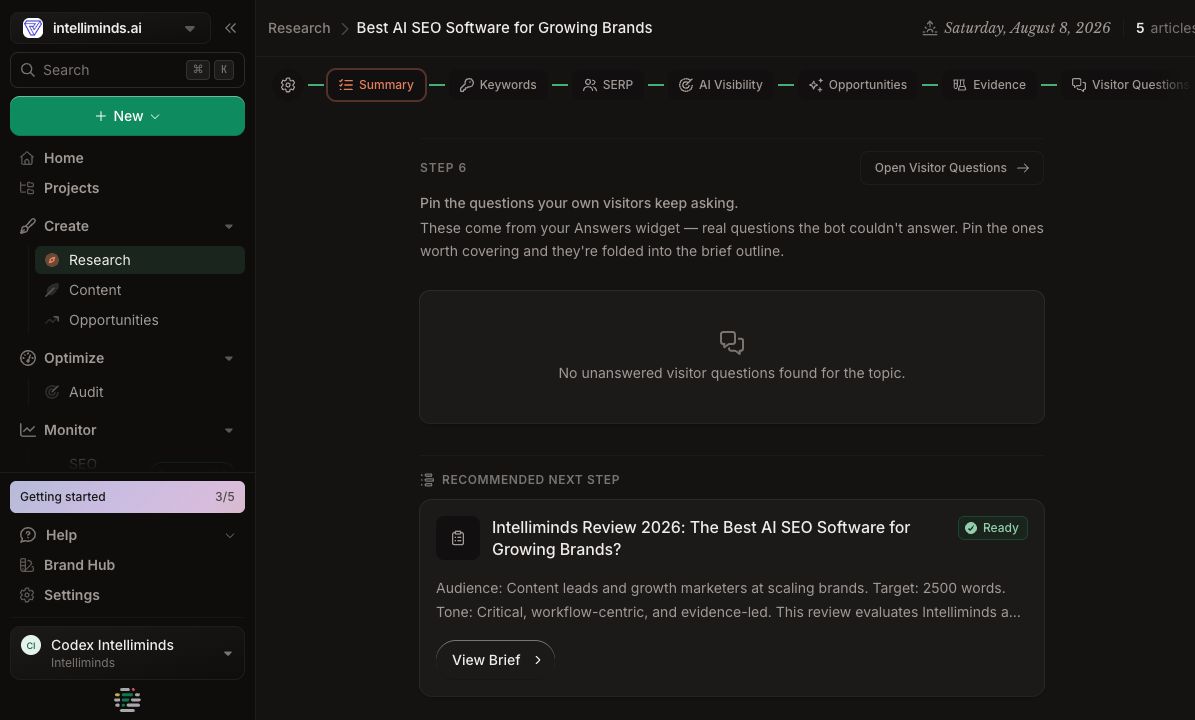
After Tool Review was selected with a 2,500-word target, Frase generated a review of Intelliminds rather than Frase. That was the trust-breaking moment because product reviews depend on clean entity control. A system can be imperfect on tone or structure and still be useful. It cannot safely confuse the workspace brand with the product being reviewed.
Why this lands so hard:
- review workflows need clear separation between the reviewed product, the workspace brand, competitors, audience, and article intent
- the final brief is supposed to reduce editorial cleanup, not create foundational doubt
- once entity control breaks, every downstream claim deserves extra scrutiny
For agencies, this is especially consequential. If you produce reviews, comparisons, or bottom-funnel content for clients, entity drift is not a cosmetic bug. It is the kind of error that can burn through the time you thought AI was saving.
There was a second trust issue in the same neighborhood. Several generated evidence cards were useful as leads, but some used questionable sources or broken numeric phrasing. That does not erase the value of the research workflow. It defines its safe use. Frase is better understood here as an evidence discovery assistant than a publish-ready fact layer.
That distinction matters a lot for SaaS marketers, ecommerce teams, and service businesses publishing high-intent content. If you are creating pages that compare tools, justify spend, or shape category perception, bad entity handling and soft evidence standards create cleanup work precisely where precision matters most.
The upside is still real. Frase can absolutely accelerate expert briefing. It gathers enough structure to save time and reduce tab sprawl. The downside is just as real. It did not show that it can maintain entity discipline with minimal oversight, and that is a meaningful limit if your team wants to hand briefs off confidently.
Content Optimization
Importing an existing article was the cleanest workflow in the product.
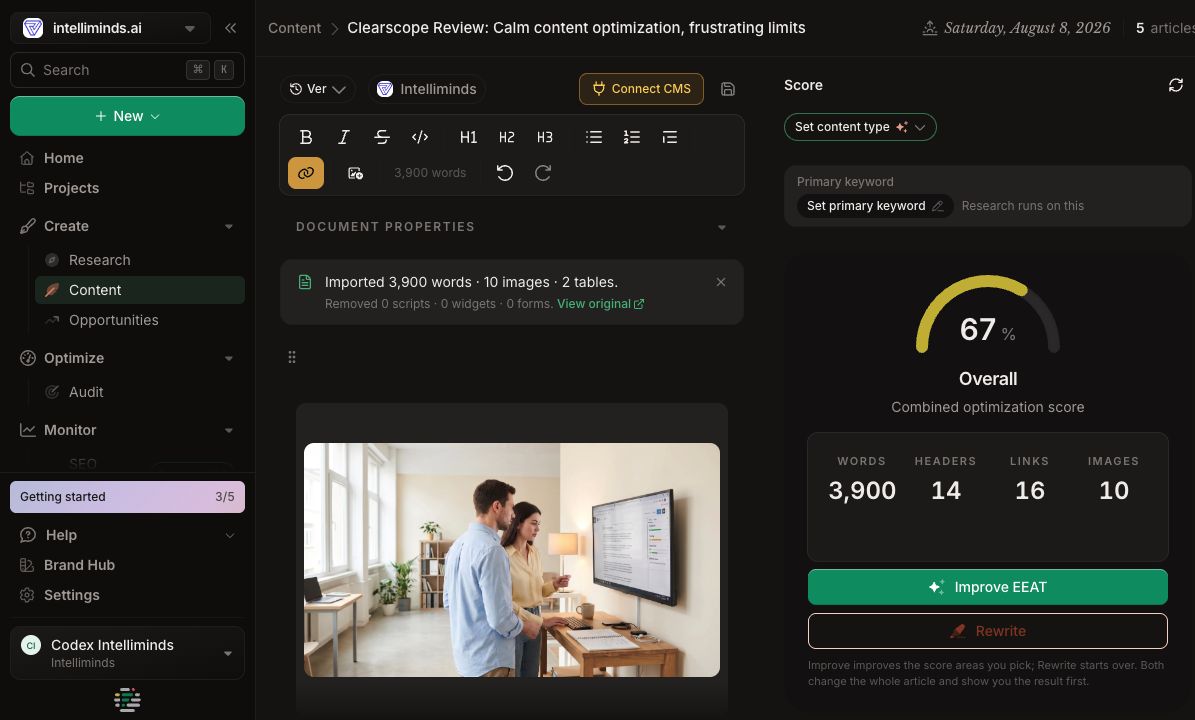
A live Clearscope review imported with structure intact, and Frase recognized:
- 3,900 words
- 14 headers
- 16 links
- 10 images
- 2 tables
That may sound mundane until you have used tools that flatten formatting, lose hierarchy, or turn a published page into cleanup work before optimization even starts. Frase handled the import like an editor would want it handled. The structure remained legible. The page did not need to be rebuilt to become workable.
The score movement after setting the primary keyword was also concrete:
| Metric | Before | After | Change |
|---|---|---|---|
| Overall score | 67 | 76 | +9 |
| SEO score | 75 | 90 | +15 |
| E-E-A-T score | 37 | 48 | +11 |
That is useful for editorial triage. It gives a strategist an immediate sense of how Frase evaluates the page once the target is defined, and it helps surface which assets might be quickest to improve inside the platform.
The important restraint is interpretation. Those numbers are not proof of ranking impact. They are proof that Frase can quickly re-evaluate an existing article within its own scoring model and make that guidance visible. For teams managing a refresh backlog, that is still meaningful. It shortens the distance between import, diagnosis, and action.
This is where Frase looks strongest for ecommerce and SaaS teams with aging comparison pages, product reviews, or category content that still has value but needs direction. If you already have a live asset, Frase can pull it in, preserve the structure, and give you a more organized editing surface fast.
There was one unresolved boundary. The deeper research process tied to this optimization flow was still running after more than a minute. That is not enough evidence to call Frase slow. It is enough to keep latency as an open question rather than a settled strength.
Even with that caveat, this section was one of Frase's better arguments for itself. When the job is improving something real that already exists, rather than trusting AI to set the entire editorial frame from scratch, Frase feels more grounded and more immediately useful.
Audit and GEO
The site audit makes a better impression than many SEO dashboards because it does more than hand you a single health score and leave the rest vague.
The completed audit scored intelliminds.ai at 91% based on 19 of 28 discovered pages. More importantly, it exposed page-level:
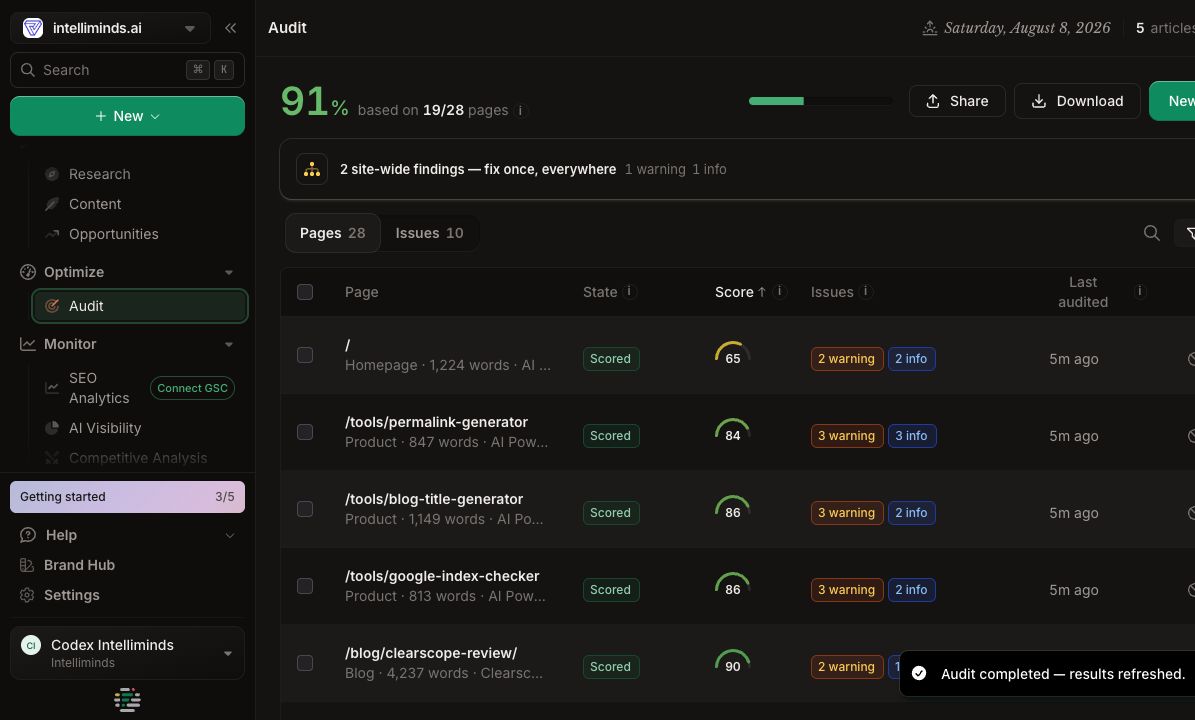
- content scores
- SEO scores
- GEO scores
- concrete issue counts
That turns the audit into a sortable queue instead of a vanity metric.
For content leads and SEO operators, that is the practical value. A site-wide percentage is only mildly interesting. A list that shows which pages are weaker, in which dimension, and by how much is far more useful. Frase looked genuinely good here because it translated the broad audit into page-level work you could assign or tackle in order.
The surprise was in page discovery. Hash-fragment homepage URLs appeared as separate unaudited pages. That kind of noise does not invalidate the audit, but it does mean someone should sanity-check the discovered URL set before treating the totals as clean. If you manage a growing site with mixed page types, URL quirks like that can clutter the queue and distort the overall picture.
The GEO piece deserves the same grounded reading. Frase surfaced page-level GEO scores, which makes them usable as one more prioritization signal inside the audit. That is what the evidence supports. What it does not prove is ranking impact, deeper GEO methodology, or how much weight a buyer should give those scores relative to standard SEO or content measures.
Still, for teams trying to consolidate workflow, this section is one of Frase's better selling points. You get content, SEO, and GEO in one audit view, and the page-level presentation makes it easier to decide what deserves attention first.
If your current process involves too much jumping between audit tools, spreadsheets, and content notes, Frase is closer to helpful than gimmicky here. Just keep one hand on the wheel when it comes to discovered URLs and scoring context.
Frase Agent
Frase Agent understands the appeal of a direct answer.
Asked for the single highest-impact action, it returned a crisp recommendation instead of a bloated essay. That answer style is genuinely attractive. Busy marketers and agency leads often do not want pages of hedging when they are trying to decide what to fix next.
The problem is what happened inside that clarity.
Frase Agent said 20 indexed URLs had zero clicks and impressions even though Search Console was not connected. In other words, it treated missing data as if it were observed data, then delivered the recommendation with enough confidence to sound sourced.
That is more serious than a wording slip.
For a time-constrained team, a statement like that can easily redirect priorities. It sounds like the system looked at performance, found a clear gap, and recommended a fix. If the underlying source is absent, the reasoning chain is shakier than the language suggests. The concise format makes the feature feel executive-ready, which is exactly why the data-state mistake matters so much.
This is where Frase's larger pattern comes into focus. The product often presents information in a way that is easy to act on. That is a strength when the inputs are sound. It becomes a risk when the platform does not clearly signal uncertainty, absence, or weak sourcing.
The balanced takeaway is not that Frase Agent should be ignored. It has value as a prioritization assistant for experienced operators who already verify the underlying signals. But if your team wants authoritative-seeming AI guidance without checking the premises, this behavior is a real caution. Missing-data states need much stronger skepticism markers before the feature can be treated as a dependable decision layer.
Pricing and Meters
Frase pricing makes sense only when you look at two different layers: official plan facts and the observed resource model.
Frase's public platform page says plans begin at $39 per month when billed annually. It also says annual billing saves 20%, and that Frase Agent, SEO and GEO scoring, site audits, and API access are included on every plan.
That is the simple headline, and on its own it is fairly attractive for a product this broad.
The more decision-relevant detail showed up in the billing and usage screen, which exposed separate meters for:
| Meter | Observed allowance | Buyer impact |
|---|---|---|
| Starting price | $39/month, billed annually | The headline entry point requires an annual commitment |
| Annual billing | 20% savings | Compare the savings with monthly flexibility |
| Articles | 5 | The clearest constraint for content production volume |
| Research units | 30 | Limits repeated brief and research use |
| Audit pages | 50 | A meaningful ceiling for larger content libraries |
| AI visibility prompts | 5 | A small initial tracking set |
| API requests | 250 | Relevant for automation-heavy teams |
| Domains and seats | 1 domain; 3 seats | Important for agencies and multi-brand teams |
This is why the entry price is only the start of the pricing conversation.
A content-heavy SaaS team may care most about article volume and research units. An ecommerce brand cleaning up a large library may pay more attention to audit pages and optimization workload. An agency will immediately care about the domain and seat boundaries. A developer-led team evaluating automation possibilities may zero in on API requests instead.
Multiple meters are not automatically a problem. In some cases they are a fair way to align cost with usage. The real issue is predictability. Frase is not just a monthly subscription number. It is a workspace with several consumption buckets, and the practical cost depends on which buckets your workflow burns through fastest.
That matters because Frase's value proposition is breadth. The more of the platform you actually use, the more important those meters become. Buyers should think in operating patterns, not just in headline pricing:
- how many articles or briefs will your team work through in a normal month?
- how often will research be run?
- how large is the site or content library you want to audit?
- will AI visibility be occasional or routine?
- do you need more than one domain or a bigger seat footprint?
- does API access matter for your stack, or is it irrelevant?
If you can answer those questions clearly, Frase pricing may be entirely reasonable. If your workflow is variable, multi-client, or still evolving, you should pressure-test usage assumptions early. That is especially true for agencies and fast-growing brands, where a low starting price can look cleaner than the actual operating model.
Review Consensus
Independent review patterns are strong, and they mostly reinforce the product's appeal.
Capterra listed Frase at 4.8 from 335 reviews and value for money at 4.9 from 297 reviews. G2 listed Frase at 4.8 from 304 reviews.
The recurring themes were specific, not generic. Review patterns repeatedly pointed to:
- ease of use
- pricing
- support
- research time savings
- SEO content value
- content creation value
That lines up with the hands-on strengths. Frase really does make sense as a productivity purchase because it pulls several related jobs into one environment and often does so quickly.
The more nuanced signal came from a recent G2 reviewer, who praised research gaps, audit, optimization, summaries, keywords, evidence, AI chat, and Content Guard. That same reviewer wanted plagiarism checking, more predictable pricing, and more integrations.
That split is useful because it sounds a lot like the hands-on picture. The breadth is attractive. The workflow value is real. But serious buyers still need to verify commercial predictability and ecosystem fit.
So the outside consensus does not erase the cautions in this review. It contextualizes them. Frase appears to satisfy many users because it saves time, is easy to use, and covers a lot of ground for the money. The more demanding questions are the ones this review also surfaced: how predictable is usage in practice, how much verification does the workflow need, and how well does Frase fit the rest of your stack?
Who Frase Fits
Frase makes the most sense when your main problem is fragmented workflow, not missing expertise.
Best fit:
- content leads at growing brands that want research, briefs, scoring, audit, and AI visibility in one workspace
- SEO strategists who can validate evidence before acting on it
- ecommerce and SaaS teams with existing content libraries that need structured refresh and page-level prioritization
- agency operators who want to compress repeated SEO content tasks without giving up editorial control
Weaker fit:
- teams that want the most defensible specialist optimizer above all else
- buyers expecting a fully autonomous AI SEO system
- operators who will not have time to correct competitors, validate evidence cards, or sanity-check agent conclusions
That distinction has direct business consequences.
If your team already knows how to judge a SERP, spot a weak source, and question a too-confident recommendation, Frase can save real time. It reduces tool sprawl, speeds up briefing, and gives you one place to improve existing content and prioritize site work.
If the real bottleneck is lack of SEO judgment, Frase is less likely to solve it. The platform helps most when review discipline already exists. It helps less when the buyer wants publish-safe autonomy or analytics interpretation without supervision.
If you need broader category comparisons or want to see how Frase stacks up against other options, this Best AI SEO Software guide is the better next read.
Open Questions
Some important questions remain open, and they should stay open until you verify them in your own evaluation.
The biggest unresolved ones are:
- Does keyword research normally take more than a minute, or was that temporary queue behavior?
- Can a user explicitly lock the reviewed entity so workspace brand context cannot redirect a Tool Review brief?
- How does Frase Agent distinguish a true zero-performance metric from a source that has never been connected?
- How stable are SEO, GEO, and E-E-A-T scores across recalculations and small controlled edits?
Those are not abstract concerns. They are the questions that determine whether Frase can own a larger share of your process or remain a supervised assistant.
A practical buyer checklist would be:
- ask for entity locking, or an equivalent control, in a live demo
- verify how missing data is labeled inside Frase Agent
- recalculate scores after small edits to test repeatability
- map expected monthly usage across articles, research, audits, AI visibility, domains, seats, and API requests
If Frase answers those cleanly, the case for consolidation gets stronger. If it cannot, the verification burden stays part of the product.
Final Verdict
Frase is the most ambitious all-in-one workflow in this evidence set, but breadth is not the same as trust.
The case for it is easy to see. Site analysis was fast. Research output was dense and well organized. Live URL import handled a real article cleanly and produced meaningful score movement once the primary keyword was set. The audit view combined content, SEO, and GEO signals at the page level in a way that felt genuinely usable for prioritization.
The case for caution is just as concrete. Automatic competitor matching needed full manual correction before the research felt credible. The Tool Review brief generated content about the wrong entity. Frase Agent delivered authoritative-sounding advice while relying on absent data.
That leaves a buyer-specific recommendation, not a universal one.
If you are an expert operator at a growing brand or agency, Frase can remove real workflow sprawl. It is strongest when you want one workspace to speed up research assembly, optimize existing assets, and sort site work without pretending that judgment has become optional.
If you are shopping for AI SEO software to replace editorial review, source validation, competitor selection, or analytics interpretation, this evidence does not support that leap. Frase can make skilled teams faster. It did not prove that it can make unverified decisions safe.
Choose Frase if consolidation and speed matter more than hands-off trust, and keep looking if your non-negotiable is reliable autonomy without constant verification.