
Most teams don’t need more keyword data. They need keyword research automation that stops the spreadsheet pileup and turns real search demand into pages you can actually publish.
For growing brands, SaaS teams, ecommerce shops, and agencies, the leak usually happens after discovery: sorting intent, assigning URLs, rebuilding briefs, chasing approvals. That’s where momentum dies (usually by Tuesday).
Look for the workflow gaps that cost you output:
- Clusters that map to one page, not five competing drafts
- Briefs that retain the research context writers need
- Publishing and refresh steps that don’t require another tool
Choose for throughput, not dashboards.
Why Teams Start Looking for a WriterZen Alternative
WriterZen can work well if your team wants hands-on keyword research and doesn't mind doing the rest manually. But that "rest" is usually where the real cost lives. We see teams hit that wall fast.
The pattern is familiar. You get a long list of keywords, maybe some grouping, maybe some scoring. Then somebody still has to decide what matters, turn it into page plans, build briefs, write drafts, get approvals, publish, and come back later when rankings stall. Keyword research wasn't the bottleneck. The workflow was.
Here’s what usually triggers the search for a writerzen alternative:
- too many keywords, not enough prioritization
- manual clustering and brief creation
- separate tools for research, writing, optimization, publishing, and refreshes
- weak connection between keyword lists and pages that actually drive pipeline or sales
That last one matters more than people admit. A keyword list feels productive. Revenue pages are productive. Those are not the same thing.
Different teams feel the pain in different ways:
- SaaS teams need research that lines up with product pages, comparisons, integrations, and use-case content
- Ecommerce brands need category coverage, collection support, and long-tail topics without publishing chaos
- Agencies need a repeatable system across multiple clients, not a strategy exercise that resets every month
- Lean marketing teams need more output without hiring two coordinators and three freelance writers
WriterZen still fits a certain buyer. If you want direct control over research and you're comfortable running the rest of the machine yourself, it can be useful. If you want automation across topic research, writing, and publishing, it starts to feel like one piece of a bigger system you still have to build.
What Keyword Research Automation Actually Means
A lot of tools use the phrase. Fewer earn it.
Keyword research automation, in plain terms, means software that finds search opportunities, organizes them, helps you pick what to act on, and moves that work toward publishable content with minimal manual handling. Not just data collection. Operational movement.
Partial automation vs full workflow automation
This is the split most buyers miss.
Partial automation usually covers discovery and maybe clustering. You still do page mapping, briefing, writing, scheduling, and refreshing by hand.
Full workflow automation carries the process further:
- expand keywords from seeds, competitor URLs, or first-party context
- cluster by intent so terms become page-level opportunities
- score opportunities by volume, difficulty, CPC, trend, or another signal
- map clusters to new or existing pages
- turn that into a brief or draft
- schedule, publish, and revisit aging content
If a platform stops after step two or three, you're still running a manual content operation. Just with better spreadsheets.
Why clustering matters more than raw keyword count
This is where seo topic clustering software earns its keep. Modern content planning is less about finding one keyword and more about building the right page around a cluster of related demand.
A single cluster can tell you whether you need:
- one commercial page
- one informational article
- a pillar page plus supporting posts
- or no new page at all because you already have a target URL
More keywords won't fix cannibalization. Better clustering might.
The goal isn't a bigger spreadsheet. It's a connected content system.
That changes how you evaluate the category. Some tools are research first and stop at discovery. Some AI SEO tools go into clustering, briefing, and drafting. End-to-end platforms keep the line intact all the way through publishing and refreshes. That's a very different operating model.
How to Evaluate a WriterZen Alternative for Topic Research
If you're comparing options, don't start with database size. Start with workflow fit. Big keyword indexes look nice in a demo. They don't publish content.
We'd evaluate a writerzen alternative for topic research in this order:
Topic discovery quality
Are the suggestions actually useful for your market, or just broad variations?Intent grouping
Can the tool group terms by likely page type, not just semantic similarity?URL mapping
Does it help map clusters to existing pages or identify where a new page is needed?Conversion into work
Can research become a brief, draft, or task without re-entering context?Market targeting
If you care about country-level demand, this can't be an afterthought.Workflow integrations
Search Console, CMS, content process. If insights get stranded, the tool loses value.Refresh capability
Old content is often the cheapest growth lever. A lot of tools ignore it.Human approval control
Automation without review is where teams get nervous, and fairly so.
A practical test helps. Count the exports. Count how many times your team has to restate the same context. Count how often strategy gets disconnected from writing. By the second afternoon of using a tool, you usually know whether it's helping or just moving the mess around.
A lot of platforms market automation while leaving the hardest parts manual: prioritization, brief assembly, and publishing. That's not a small omission. That's the work.
Quick Comparison of the Best WriterZen Alternatives
Before getting into detail, here’s the shortlist by actual use case, not hype.
- Intelliminds for teams that want topic discovery, article writing, scheduling, publishing, and content refreshing in one content-focused system
- Optimatio for teams that want seed-to-cluster planning, scoring, and page mapping with a clear structure
- FlowHunt for teams that want Search Console-led opportunity mining and briefs tied to tasks
- Allable for teams that want keyword research, briefing, writing, and rank tracking in one workspace
- Clustea for agencies and founders who want a more automated pipeline with gap analysis, article generation, and WordPress publishing
- SEO Rocket for fast multi-seed research and quick ranking feasibility checks
- SEORCE for teams that care about AI query discovery alongside classic keyword research
- AWDS for users who want configurable, multi-source keyword discovery with clustering and segmented opportunities
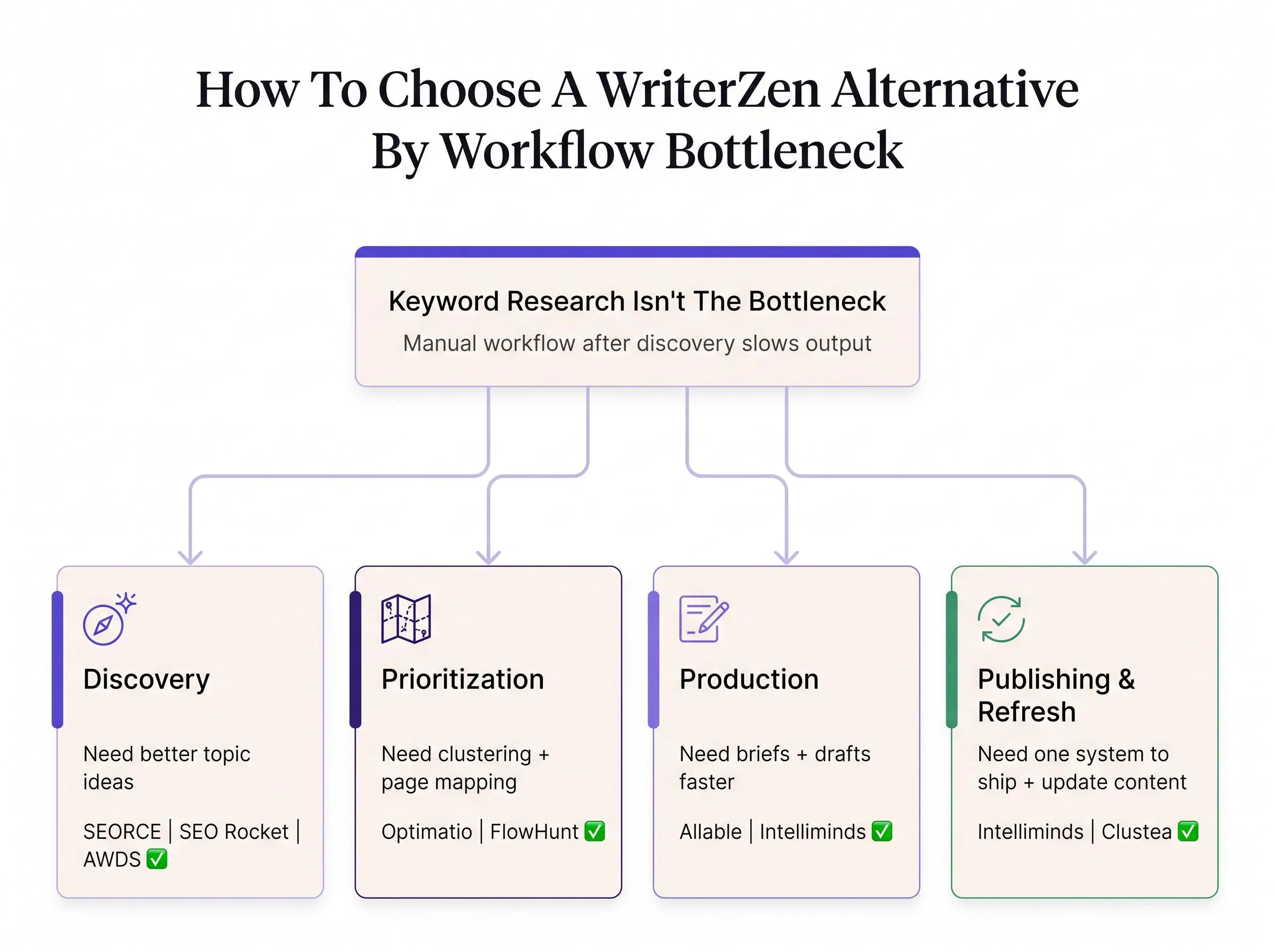
The right choice depends on where your bottleneck is:
- discovery if you don't trust the topic pool
- prioritization if everything looks equally important
- production if briefs and drafts are slowing you down
- publishing if good ideas sit in docs for weeks
Most teams think they have a research problem. Quite a few actually have an execution problem.
| Tool | Best for |
|---|---|
| Intelliminds | Teams that want topic discovery, article writing, scheduling, publishing, and content refreshing in one content-focused system |
| Optimatio | Teams that want seed-to-cluster planning, scoring, and page mapping with a clear structure |
| FlowHunt | Teams that want Search Console-led opportunity mining and briefs tied to tasks |
| Allable | Teams that want keyword research, briefing, writing, and rank tracking in one workspace |
| Clustea | Agencies and founders who want a more automated pipeline with gap analysis, article generation, and WordPress publishing |
| SEO Rocket | Fast multi-seed research and quick ranking feasibility checks |
| SEORCE | Teams that care about AI query discovery alongside classic keyword research |
| AWDS | Users who want configurable, multi-source keyword discovery with clustering and segmented opportunities |
Intelliminds for End-to-End Keyword Research Automation
If you're no longer looking for research alone, Intelliminds is the more relevant kind of writerzen alternative. We built it for teams that want a content system, not another dashboard full of terms.
The fit is straightforward. It's for brands and agencies that want to scale organic traffic without adding more manual content work, and for teams that care about turning topic research into a consistent publishing motion.
Where it changes the workflow
Intelliminds automates topic discovery around your website, audience, products or services, and existing content. From there, it can generate articles, support scheduling and publishing, and keep content refreshing inside the same workflow. It also keeps a human in the loop for review and approval.
That matters in a writerzen vs ai seo tool decision because context doesn't get dropped between steps. Research stays connected to execution. Fewer handoffs. Less "who owns this now?" energy.
For teams that want controlled end-to-end blog automation, Intelliminds SEO Autoblogger is also relevant. It finds keywords, generates editorial-style articles, adds structure, and publishes on a controlled schedule rather than turning into a bulk posting machine. That's an important distinction. Automation should increase output, not lower trust.
A practical detail helps here: the free trial includes 3 free articles. That makes workflow testing easier because you can judge the output in motion, not in theory.
Where it doesn't fit
This isn't meant to be a broad technical SEO suite. If your main goal is a standalone keyword database and you prefer to keep research, writing, and publishing manual, it may be more system than you need.
The best tool for keyword research automation is usually the one that removes handoffs, not the one with the loudest charts.
Optimatio for Structured Topic Clustering and URL Mapping
Optimatio is a good fit for teams that want research to end in a usable plan. That's more valuable than it sounds. Plenty of tools stop at "here are the keywords." Then your strategist does the real work elsewhere.
Its workflow is tighter than that. It expands a seed term into a large pool of ideas using live search data, groups those ideas into intent clusters, scores them, and maps each cluster to a target page. Existing or new.
Specifics matter here:
- one run can produce 500+ ideas from a seed
- clusters often land in 5 to 15 intent groups in one research flow
- it can work from seed keywords or competitor URLs tied to related product pages
- keyword data can include volume, ad cost, difficulty, and trend
That structure helps prevent overlapping articles. It also helps content teams separate quick wins from authority plays, which is a decision many tools quietly leave to gut feel.
Optimatio makes the most sense for content strategists, agencies building keyword maps, and teams that need a cleaner handoff into briefs and production. The tradeoff is fairly clear. It's more strategy-forward than full publishing automation. Stronger for planning and mapping than for running the whole engine in one place.
FlowHunt for Search Console-Led Opportunity Mining
FlowHunt takes a different angle. Instead of starting with external keyword suggestions, it can start with your actual site data. For established sites, that's often the smarter move.
Its most distinct workflow mines Search Console for position 4 to 20 opportunities, looks for rising-impression queries, clusters terms by intent, checks live SERPs for gaps, and turns priority clusters into briefs and project tasks. That's a very operational chain.
It can also work with data sources and tools like:
- Search Console
- SEMrush
- Ahrefs
- Google Suggest
- People Also Ask
- BigQuery
For sophisticated teams, this matters because prioritization begins with pages already close to winning. That's not glamorous, but it moves traffic faster. Weekly recurring runs can also support a steady editorial rhythm instead of random bursts of keyword work.
FlowHunt fits in-house SEO teams with real Search Console history, SaaS and service businesses with enough domain authority to mine, and teams that want briefs handed off instead of raw exports. If you're early stage and don't yet have much search performance data, it may feel less straightforward.
Allable for Keeping Research, Briefing, and Writing in One Workspace
Allable is a strong option when your main problem is fragmentation. Some teams don't need deeper data. They need fewer tabs.
It keeps keyword research, briefing, writing, and rank tracking in the same workspace. That sounds simple, but in practice it removes a lot of low-grade friction that slows content teams down.
Here’s where it helps:
- surfaces keywords with volume, difficulty, and intent in one interface
- highlights long-tail phrases, competitor gaps, and trending queries
- clusters keywords automatically
- maps clusters into pillar and spoke planning
- turns a selected keyword into a brief and draft without leaving the workspace
That continuity is the point. Research context stays attached to the content process instead of getting lost between export files, doc templates, and chat messages. For lean teams and agencies with internal handoffs, that's often worth more than another filter menu.
Compared with narrower research tools, Allable is stronger on workflow continuity and less centered on deep standalone exploration as the main value. If your biggest issue is process fragmentation rather than lack of data, it's worth shortlisting.
Other Strong WriterZen Alternatives Worth Shortlisting
Some teams have more specific needs. These are worth a closer look.
Clustea
Clustea fits buyers who want a more automated pipeline around gap analysis, content cluster strategy, AI article writing, SEO optimization, and WordPress publishing. It's especially relevant for agencies and founders who want one workflow and one bill instead of stacking tools. The tradeoff is simple: confirm that its research depth matches the complexity of your market.
SEO Rocket
SEO Rocket is better for fast, multi-seed research with live data and a shortlist of winnable terms. It supports up to 150 ideas per search with volume, difficulty, CPC, global volume, and SERP features, plus a country selector and weakest-competitor benchmark. Good for quick validation. Less like a full topic discovery platform.
SEORCE
SEORCE is more specialized. It combines traditional keyword data with an AI query layer, including conversational queries, intent mapping, and citation opportunity scoring. Useful if your brand cares about discovery in AI answer engines alongside classic search. If you're focused purely on blog production workflows, it may be more than you need right now.
AWDS
AWDS is for users who want a configurable, multi-source setup. It pulls from 5+ free sources and tools like SerpAPI and Google Ads, then applies AI clustering, competitor analysis, trend analysis, and opportunity segmentation. It also supports quick wins, authority builders, and ICP-based seed generation. The catch is obvious: more configurability can mean more operational complexity.
WriterZen vs an AI SEO Tool: What Actually Changes
When people search writerzen vs ai seo tool, they often think the difference is just AI writing. That's too shallow. The real difference is how far the workflow continues after keyword discovery.
Research-first tools help you find and analyze terms. AI SEO tools usually go further into clustering, briefing, drafting, scheduling, and publishing. End-to-end platforms add refresh workflows and ongoing maintenance.
That changes the operating model in a few concrete ways:
- fewer manual touchpoints
- faster path from opportunity to published page
- more consistent output cadence
- easier approval flow for lean teams
Research-first tools still make sense for some teams. If you have experienced strategists who want manual control, a solid editorial process, and a custom stack you're happy with, there's nothing wrong with staying modular.
But if your team is bottlenecked by operations, not ideas, the answer shifts. More dashboards won't fix a publishing problem. AI SEO tools make more sense when you're trying to scale content without scaling headcount, or when you want a repeatable acquisition system rather than another research layer.
How to Choose the Right Alternative for Your Team

The cleanest way to decide is by team type and operational need.
For SaaS companies, prioritize intent clustering, page mapping, Search Console insight, and refresh workflows. FlowHunt, Optimatio, or Intelliminds can all make sense depending on how far into execution you want to automate.
For ecommerce brands, prioritize long-tail discovery, category and collection mapping, and scalable publishing. You need a platform that can turn clusters into both editorial coverage and commercial support pages.
For service businesses and startups, simplicity matters more than feature count. Quick wins, lower overhead, and shorter time to first published article usually beat complex research setups.
For agencies, repeatability is everything. Look for cross-client workflows, page mapping, approval controls, and production speed. If the review process is clumsy, scale gets expensive fast.
Use this checklist before you choose:
- Do you need better discovery or better execution?
- Do you want manual control or guided automation?
- Do you need briefs only or full article generation?
- Do you need publishing and refreshes in the same system?
- Do you need traditional keyword data only, or broader AI query discovery too?
Short sentence, but it matters: buy for the bottleneck you have now.
Common Mistakes to Avoid When Switching Tools
Most switching mistakes come from solving the wrong problem.
A bigger database won't help if your team can't turn research into published pages. High keyword volume won't help if clustering and page mapping are weak. Automated discovery won't help if writers still rebuild every brief from scratch.
Another common miss is overvaluing article generation while ignoring publishing controls and quality review. Drafts are easy to produce. Reliable output is harder.
Before you switch, do the boring prep work:
- save your existing keyword lists and cluster logic
- document current page targets
- preserve baseline performance benchmarks
- define what success should look like after the move
Then run a small pilot. One real cluster is enough.
Track:
- time saved
- clarity of prioritization
- how easily research becomes publishable content
If the new tool still leaves your team stitching the process together by hand, you didn't really switch systems. You just changed interfaces.
Conclusion
The best writerzen alternative is not the one that shows the most keywords. It's the one that turns keyword research automation into a repeatable content growth system.
If you already have a strong production engine, a research-first tool may be enough. If your real pain is turning ideas into published, refreshed content, a workflow-centered AI SEO tool will usually get you further.
Shortlist the tools that match your actual bottleneck. Test one real topic cluster. Judge the result by speed, clarity, and how close it gets your team to consistent customer acquisition through organic search. That tends to cut through the noise pretty quickly.
Article Record
ReferencesPrimary sources used for this article
- Automated Keyword Research | AI Agent Does It For You
- AI Keyword Research Agent — Automated Keyword Discovery and Content Briefs | FlowHunt
- AI Keyword Research Tool — Find Top Keywords | SEO Rocket
- AI Keyword Research Tool — Find High-Value Keywords — AllAble
- #1 Keyword Tool by cognitiveSEO | Keyword Explorer & Content Optimization
- SEORCE - AI-Powered SEO Platform
- Keyword Clustering: Algorithms and Approaches of Popular SEO Tools