
Most teams treat an SEO topical map like a bigger keyword list. That is where content planning goes sideways: duplicate posts, missed subtopics, and internal links left for later.
What matters is page role, intent, and how topics connect to revenue. If you are scaling content for SaaS, ecommerce, services, or agency clients, you need a map that stops random publishing (even when the keyword sheet looks full).
What to watch for:
- Keywords that look different but should live on one page
- Clusters with traffic upside but no link to product, service, or sales questions
- Pillar pages published alone, so nothing compounds and you leave with a usable plan
What an SEO Topical Map Actually Is
An seo topical map is a content blueprint. It shows the core subject you want to own, the subtopics that support it, the role each page plays, the intent behind each page, and how those pages should connect.
That sounds simple. In practice, it's the difference between building authority and just publishing.
A lot of teams confuse a topical map with a keyword list or a content calendar. It isn't either. A keyword list tells you what people search. A calendar tells you when something ships. A map tells you why a page exists and how it strengthens the rest of the site.
At the center is usually one main entity or subject area. Around that sit supporting clusters and narrower detail pages.
For example, a content map for organic growth might include pages that do very different jobs:
- educate early-stage readers
- answer comparison or evaluation questions
- support conversion with product-adjacent context
- build authority through deeper coverage of important subtopics
Every article should have a job. If it doesn't, it becomes overhead.
Modern search doesn't reward isolated keyword matching the way many teams still plan for it. Search engines are getting better at evaluating semantic relationships, entity coverage, and site structure. So the goal isn't to publish on everything. It's to cover the right subject area deeply and coherently enough that both readers and search engines see you as credible.
Why Scalable Content Planning Breaks Without a Map
If your content process feels busy but strangely flat, this is usually the reason. You have articles, briefs, maybe even traffic, but no real structure underneath it.
We see the same pattern over and over. Teams publish from spreadsheets, Slack requests, sales ideas, and whatever looked promising that week. By the second month, things start colliding.
Common failure modes show up fast:
- multiple pages target overlapping meanings and cannibalize each other
- valuable subtopics never get covered because they had low volume or nobody noticed them
- internal linking stays weak because there is no clear topical structure to link within
- high-volume terms win prioritization, even when they have little commercial value
This is where topic authority planning changes the game. Depth compounds. Scattered publishing resets momentum every month because each new post has to stand on its own.
A real map reduces editorial guesswork. It becomes easier to brief writers, assign priorities, and track progress cluster by cluster. That matters more than most teams think. Strategy breaks down in operations long before it breaks down in theory.
Scale doesn't come from producing more disconnected posts. It comes from clarity you can repeat.
Why Topical Authority Matters More in Modern SEO
Search engines increasingly reward sites that cover a subject comprehensively and coherently. Not just one good page. A whole connected body of work.
Recent large-scale analyses of search results keep pointing in the same direction. Page-level topical authority is one of the strongest on-page drivers of visibility. That's consistent with what operators see in the field. Focused depth tends to move faster than broad, shallow publishing.
There's also a practical benchmark worth using. Clusters with roughly 25 to 30 interlinked articles have been associated with meaningful ranking lifts. It isn't a magic number, but it is a useful planning target because it forces completeness.
Why this matters goes beyond rankings:
- crawl paths get clearer
- related long-tail queries become easier to capture
- supporting pages start helping each other
- your site becomes more usable for AI-generated search experiences that favor extractable answers and clear entity relationships
A topical map is not a one-off SEO exercise. It's an acquisition system. The pages you publish this quarter should make the next quarter easier, not start from zero again.
How a Topical Map Differs From Topic Clusters, Content Hubs, and Keyword Research
These terms get mixed together all the time, and the confusion leads to messy planning.
A topic cluster is usually one pillar page plus supporting articles. Useful, but limited. A topical map is broader. It defines all clusters, the relationships between them, and the boundaries of what your site should and shouldn't cover.
A content hub is even narrower. It groups related content in one section. Helpful for navigation. Not enough for architecture.
Traditional keyword research does something different again. It surfaces demand. That's important, but it doesn't decide which topics deserve their own pages, how those pages relate, or how your site builds authority over time.
You can think of a topic graph for blogs as the network view of the map. Entities, subtopics, and internal links create meaning together. That's where the map becomes strategic instead of tactical.
A simple way to separate the roles:
- Keyword research shows what people ask.
- The topical map decides what the site should build.
- Cluster planning for seo turns that into an executable publishing structure.
Use keyword research as an input. Don't mistake it for the architecture.
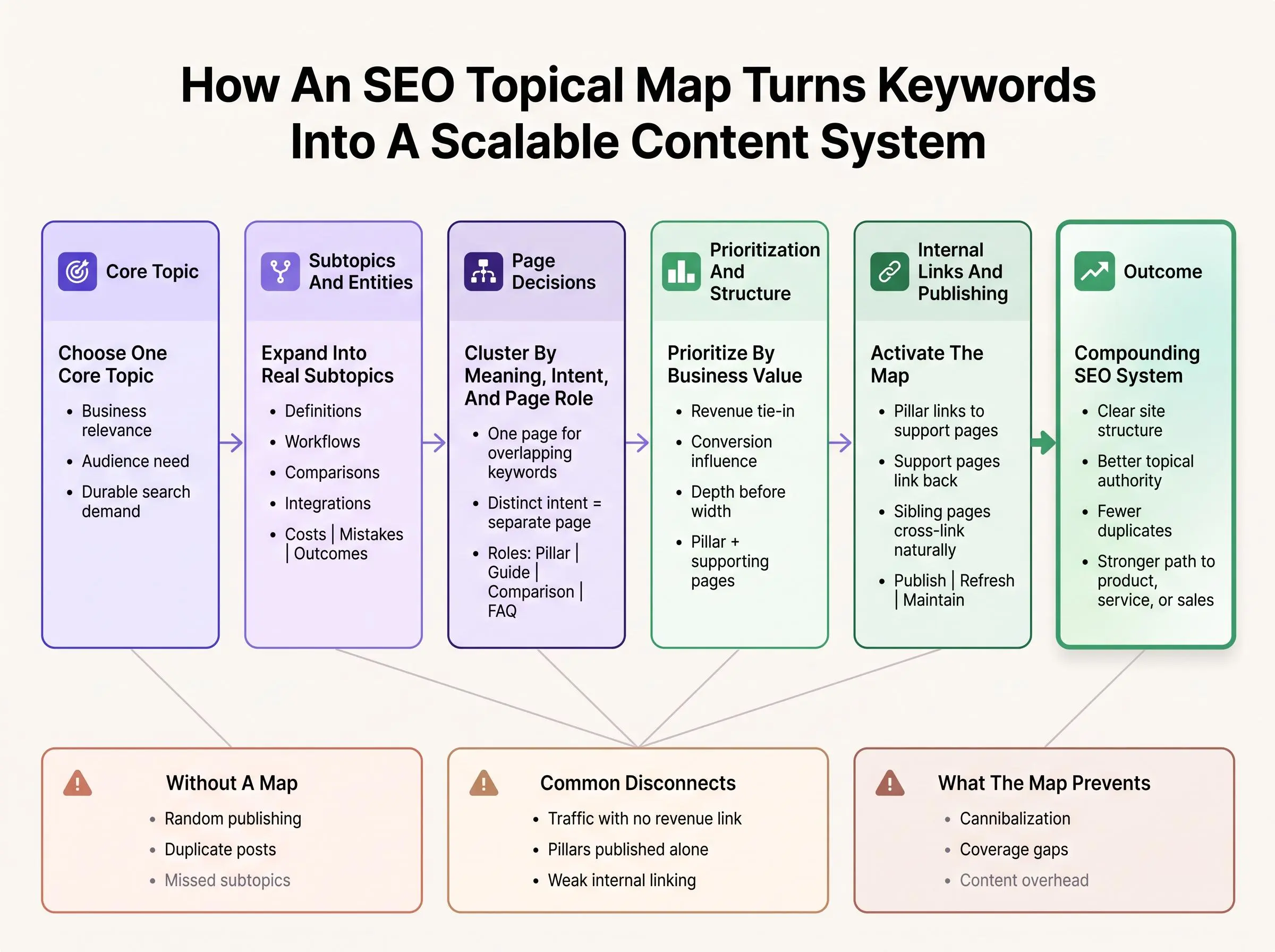
What Belongs in a High-Quality SEO Topical Map
A usable map is operational, not theoretical. If your team can't run publishing from it, it isn't finished.
At minimum, your map should include:
- central topic or entity
- supporting clusters
- page-level targets
- search intent labels
- business value score
- funnel relevance
- internal linking paths
- refresh opportunities
We also recommend keeping two layers of planning. One raw research sheet for discovery, and one cleaned planning sheet for decisions. Mixing exploration with prioritization sounds efficient. It usually turns into noise.
Page roles matter more than many teams expect. You need to label what each page is meant to be:
- pillar page
- comparison page
- how-to guide
- glossary
- use case page
- integration page
- FAQ support content
Intent should also be explicit. Informational, commercial investigation, transactional support, and post-purchase education are not interchangeable. If your map doesn't distinguish them, your briefs will drift.
For scaling teams, add operational fields too:
- content owner
- status
- publish date
- refresh date
- related product or service tie-in
That's the part people skip, then wonder why the plan never leaves the spreadsheet.
Step 1: Choose the Right Core Topic to Own
Start with one core topic that sits at the overlap of business relevance, audience need, and durable search demand. Not ten topics. One.
Define it as a subject area, not a single keyword phrase. "Payroll software" is a core entity. "Best payroll software 2026" is one query inside that entity.
This matters because one map should focus on one core entity. If you build a giant map that mixes unrelated themes, you don't get authority. You get sprawl.
Pressure-test the topic with questions like:
- what do we want to be known for
- what products or services does this topic naturally support
- what questions do prospects ask before they buy
- how broad is too broad for our current authority level
The answer depends on your business model. SaaS companies often anchor around a category, workflow, or core use case. Ecommerce brands usually do better with a product family, buying need, or problem space. Service businesses should anchor around the solution area tied to buyer pain and outcomes.
A hard truth here: if your core topic doesn't connect to revenue, your content engine will eventually lose internal support.
Step 2: Expand the Topic Into Real Subtopics and Entities

Once the core topic is set, expand it like an expert would. Not like a keyword tool would.
Good expansion comes from multiple inputs:
- live search results and top-ranking page headings
- People Also Ask, autocomplete, and related searches
- competitor navigation and sitemap structures
- support tickets, sales calls, and customer success questions
- your existing content and performance data
The goal is to capture the subject fully. That includes definitions, workflows, comparisons, mistakes, integrations, regulations, costs, and outcomes. You're mapping the real shape of the topic.
Take payroll software as an example. Strong branches might include compliance, tax deadlines, contractor versus employee classification, direct deposit setup, migrations, integrations, and pricing models.
Notice that not all of those are huge volume terms. Some are still strategically vital because they complete the subject and strengthen nearby rankings. Low-volume subtopics often carry more authority value than teams expect.
If you only collect keyword variants, you'll miss the actual knowledge model behind the topic.
Step 3: Cluster Topics by Meaning, Intent, and Page Role
This is where raw ideas become a publishing plan. And where most mess gets created if you're careless.
Group by meaning, not exact wording. Near-duplicate queries usually don't deserve separate pages just because the phrasing changed. That's how cannibalization starts.
A topic group might deserve:
- its own page if the intent is distinct and deep enough
- a section within a pillar page if it's important but not broad enough alone
- inclusion in an FAQ or supporting article if it's narrow and secondary
Then map each cluster to a dominant intent:
- educational
- problem-solving
- comparison
- buyer research
- product-adjacent support
There are two common structural patterns. Hub-and-spoke works well for newer sites or new topic areas. The pillar links down, and support pages link back up. Mature sites can move toward a mesh structure, where related pages cross-link more freely across shared entities.
Name pages and plan URLs with discipline. If the structure isn't clear at the planning stage, it won't magically become clear after publishing.
Step 4: Prioritize With Business Value Before Search Volume
A lot of teams build beautiful maps that never drive pipeline. The usual reason is simple. They prioritized traffic instead of business fit.
Score each cluster across factors like:
- relevance to the offer
- conversion influence
- existing authority
- search demand
- content effort
- freshness sensitivity
Then follow one rule that saves a lot of wasted motion: depth before width.
Finish meaningful coverage inside one cluster before chasing adjacent themes. Close the question loops inside a topic before expanding outward. Partial clusters often stall because they never send strong enough authority signals.
A practical tiering model helps:
- Tier 1 pages support demand capture and buyer education directly.
- Tier 2 pages deepen trust and address objections.
- Tier 3 pages extend coverage once the cluster is live and coherent.
Sequence matters as much as selection. That's the part keyword-first plans tend to ignore.
Step 5: Build Pillar Pages and Supporting Content That Work Together
The pillar page is the authority hub for a major branch of the map. Its job is to define scope, synthesize the subject, and route readers to deeper pages. It should not try to rank for every variation alone.
Supporting content does the heavier lifting on narrower intent. That's where you answer specific questions in real depth.
Common page types inside a cluster include:
- beginner guides
- process explainers
- comparisons
- checklists
- pricing education
- templates
- mistake roundups
- case-led use cases
A cluster starts to feel complete when it covers the full working surface of the topic:
- foundational definitions
- practical workflows
- edge cases
- objections and pitfalls
- commercial investigation content
- maintenance content that handles updates over time
One pillar page won't carry the cluster. That's wishful thinking. The win comes from the connected system, where each page strengthens the next.
Step 6: Design Internal Links That Activate the Map

Internal linking is how the map becomes visible to search engines and useful to readers. Without it, your topical structure mostly lives in your spreadsheet.
Link patterns should reflect hierarchy and meaning:
- pillar to supporting pages
- supporting pages back to the pillar
- lateral links between sibling pages when the context is natural
The goal isn't more links. It's clearer relationships.
Anchor text should describe the destination topic plainly and consistently. Forced anchors usually create awkward reading and weak signals. Good internal links feel obvious in hindsight.
A strong linking system helps you:
- reduce orphan pages
- improve crawl paths
- distribute authority within clusters
- move readers from discovery to evaluation
A topic graph for blogs gets much stronger when links mirror actual conceptual relationships instead of random related-post widgets. That's a small detail with outsized impact.
There is also measured evidence that a purposeful internal-linking overhaul can move search performance. A Graphite internal-linking A/B test summarized by Tatarek covered 199 URLs and reported results within 50 days. Its sitewide average and lowest-traffic pages should be read separately, but both point toward a useful auditing priority: do not leave smaller supporting pages disconnected from the cluster.
| Test outcome | Reported lift |
|---|---|
| Average daily impressions across 199 URLs | 42% |
| Clicks, lowest-traffic quartile | 172% |
| Impressions, lowest-traffic quartile | 767% |
These results do not mean that adding links mechanically produces the same lift everywhere. The test’s largest gains were concentrated in its lowest-traffic quartile, and the reported outcomes do not isolate which anchor text, destination choice, or site architecture produced the effect. Still, they make the operational priority clear: use the map to find underconnected supporting pages and add contextual links that express a real topical relationship—not generic related-post links.
Step 7: Turn the Map Into a Publishing and Refresh Engine
A map should create cadence. If it stays in planning mode, it has no value.
Assign each page a status, owner, publish window, and refresh trigger. Then sequence publishing so early pages create context for later ones. Each month should add density to a live cluster, not scatter new posts across unrelated areas.
Realistic expectations help here:
- new sites usually need sustained cluster completion over several months
- meaningful signals come from consistency, not a handful of isolated articles
Refresh work belongs in the system from day one. That includes:
- updating outdated stats and years
- improving FAQs
- tightening definitions and entity clarity
- adding missing internal links
- expanding sections where intent has shifted
Authority weakens when content is published once and ignored. Maintenance is part of scale, not a cleanup task.
How to Use Automation Without Losing Strategic Control
A full seo topical map can sound heavy, especially for lean teams. That's fair. The trick is knowing where automation helps and where judgment still matters.
Automation is useful for:
- topic discovery
- clustering support
- brief generation
- article drafting
- scheduling
- publishing
- refresh identification
That's exactly where platforms like Intelliminds fit naturally. We built it for teams that want to automate topic research, article writing, scheduling, and publishing around their site, audience, products, services, and existing content.
But speed cuts both ways. If the map is weak, automation just helps you scale confusion faster.
Use AI as an execution multiplier for a sound content map for organic growth. Don't ask it to replace planning.
Common Mistakes That Keep Topical Maps From Compounding
Most topical maps don't fail because the idea is wrong. They fail because the execution stays shallow.
Watch for these patterns:
- listing keywords instead of modeling a subject
- choosing a core topic that's too broad to own or too narrow to scale
- publishing breadth-first across many themes instead of finishing one cluster deeply
- creating multiple pages for semantically overlapping queries
- treating internal links as an afterthought
- ignoring business value and building traffic-only branches
- never revisiting the map as products, audience questions, and search behavior change
- assuming authority comes from volume alone
- using AI to generate content faster before deciding what each page should contribute
The memorable version is simpler.
More content is not the same as more coverage.
What a Scalable Topical Map Looks Like for Different Business Models
The structure stays consistent across business models. The page mix changes.
For SaaS, the core topic often centers on the category, workflow, or outcome. Clusters usually include setup, integrations, pricing education, comparisons, compliance, and role-based use cases. Strong SaaS maps connect educational intent to product-adjacent evaluation.
For ecommerce, the core topic often starts with a product family or buyer problem. Useful clusters include buying guides, comparisons, care instructions, troubleshooting, sizing, compatibility, and seasonal questions. The map should connect category pages to educational content that helps conversion.
For service providers, the core topic should focus on the problem solved and the method used. Clusters usually cover process pages, cost education, timelines, mistake prevention, comparisons, and local or industry-specific applications.
For agencies, the core topic often aligns to a service line or client outcome. Clusters can include strategy frameworks, implementation guides, reporting expectations, tool comparisons, and decision-maker content.
Different buyers. Same principle. Build around how authority and intent connect.
How to Measure Whether Your Topical Map Is Working
Don't measure this page by page only. Track performance at the cluster level.
Useful indicators include:
- growth in ranking keywords across the cluster
- internal link coverage
- reduction in orphan content
- time to first clicks
- assisted conversions from informational pages
- share of traffic landing on supporting pages versus only pillars
Why clicks need context in AI search
Clicks are still useful, but they are becoming a less stable standalone KPI for informational content. A Seer Interactive analysis of 3,119 informational queries across 42 organizations and 25.1 million organic impressions reported organic CTR of 0.61% for queries with Google AI Overviews, down from 1.76% in its comparison period—a 61% decline. The same report says CTR fell 41% year over year even for queries without AI Overviews.
That does not show that AI Overviews alone caused the change, and it does not measure rankings, impressions, or total clicks for any individual cluster. But it is a practical reason to read clicks alongside impressions, rankings, assisted conversions, and conversion outcomes. A cluster can earn more visibility while its click-through rate changes, so a click-only report can miss part of the picture.
One of the best signs is compounding. New pages should help nearby pages gain visibility. If every page behaves in isolation, the map isn't really functioning yet.
There's also a qualitative check that matters:
- are major buyer questions covered
- are there obvious missing branches
- are older pages still aligned with current intent
Tools can help operationalize the work. Intelliminds can support publishing consistency and refresh cycles. But the readout still has to tie back to cluster goals and business outcomes. Traffic without strategic lift is a vanity metric with better formatting.
Conclusion
An seo topical map turns content planning from reactive keyword chasing into a deliberate growth system. That's the real shift. You're no longer asking what to publish next in isolation. You're building coverage, intent alignment, and internal structure on purpose.
Scalable SEO comes from choosing the right core topics, building clusters with business relevance, linking them intelligently, and refreshing them consistently. Not from publishing more for the sake of motion.
If you want a practical next step, keep it tight. Pick one core topic. Map the first cluster fully. Publish it with sequence and discipline. Then bring in automation once the strategy is clear.
That's how content stops feeling chaotic and starts compounding.
Article Record
ReferencesPrimary sources used for this article
- Pillar Page: A Complete Guide For Content Marketers
- How to Build an SEO Topical Map (With Template)
- Topic clusters: The next evolution of SEO
- Semantic Keyword Clustering: How to Group Keywords by Meaning for Better SEO
- Topical Map Keyword Research Process Guide
- Is Your Internal Linking Helping Or Hurting Topical Authority? Ask An SEO
- Spam policies for Google web search
- What is a Topical Map in Semantic SEO? Definition, Structure, and Purpose
Update HistoryMeaningful revisions to this article
- Added a table to Step 6 comparing measured internal-linking test results, making performance benchmarks easier to understand.
- Clarified how internal linking can help strengthen low-traffic pages within a scalable content plan.
- Expanded the measurement section to include impressions, rankings, conversions, and assisted conversions alongside clicks and click-through rate.
- Explained how broader performance data helped readers evaluate topical map results more accurately as search experiences changed.