
Most teams treat a content refresh strategy like cleanup work. You swap a date, tweak a few lines, and wonder why traffic barely moves.
What matters is picking the right URLs, fixing intent drift, and changing what readers and search engines notice first. If you are scaling SEO without adding headcount, small edits don't cut it.
A few things to watch.
- Pages already ranking decently usually beat dead posts with no traction.
- Old screenshots, stale stats, and weak internal links quietly drag good pages down.
- Refresh the right pages well, and you get traffic gains without another publishing scramble.
What a Content Refresh Strategy Actually Means
A real content refresh strategy is not housekeeping. It's the ongoing process of auditing, prioritizing, updating, republishing, and remeasuring existing pages so they stay useful, relevant, and competitive.
That sounds simple until you look at how most teams actually handle old content. They change a date, swap a few lines, maybe add a paragraph, then wonder why nothing moves. That's not a refresh. That's cosmetic maintenance.
A real refresh improves the page in ways search engines and buyers can both feel:
- deeper coverage where the topic has evolved
- updated facts, screenshots, workflows, or product references
- tighter structure and better scannability
- stronger alignment with current search intent
- smarter internal linking
- clearer calls to action
- more convincing proof, examples, or decision criteria
It also helps to separate refreshes from other actions people lump together.
- Refresh means improving a still-valuable URL.
- Rewrite means the URL should stay, but the article needs major reconstruction.
- Consolidation means merging overlapping pages so you stop splitting authority.
- Pruning means removing or redirecting content that no longer serves a strategic purpose.
That distinction matters. We've seen teams spend weeks trying to update declining articles that should have been merged or retired on day one.
Organic growth is not just a publishing engine. It's a maintenance system for assets that already hold trust.
If a page has backlinks, ranking history, and some relevance left, you don't throw that away lightly. You improve it with intent.
Why Updating Existing Content Often Beats Publishing More
If you're trying to grow traffic with a lean team, refreshes usually beat net-new content on pure economics.
A new page starts from zero. An existing page already has indexation, history, internal links, backlinks, and some established topical relevance. You're not begging for trust from scratch. You're building on it.
That's why refreshed pages often produce stronger ROI than new posts. Across the industry, the right updates commonly drive roughly 3 to 5 times better return than net-new creation. That doesn't mean publishing is dead. It means the easiest growth is often hiding in what you already own.
Older posts also tend to carry more of the workload than teams expect. For many sites, a large share of monthly organic views comes from existing content, not from what was published last month. That's the quiet truth behind a lot of flatlining content programs.
The practical upside is hard to ignore:
- lower production cost than starting over
- faster time to impact because the URL is already known
- better use of content already tied to revenue or lead flow
- less editorial drag for teams already stretched thin
The best opportunities usually sit in pages already near better rankings. Think positions 5 to 20, or even 11 to 30 for valuable queries. Those URLs are already in the conversation. They often don't need a miracle. They need a stronger answer.
Publishing more expands topic coverage. Refreshing more unlocks traffic already within reach.
That's an important difference. One adds surface area. The other increases yield.
Why Freshness Matters More Than It Used To
Content doesn't just get old. It decays.
Facts go stale. Competitors improve their pages. Search intent shifts. Product categories change. Even a solid article can slowly become the wrong page for the query it used to own.
This is more visible now because the shelf life of content is getting shorter in many categories. Pages older than two years often decline, especially in competitive markets or topics that change with software, pricing, regulation, or platform behavior.
And freshness is no longer just a Google issue.
The new visibility problem
You now have two systems evaluating your content:
- traditional organic search, which still rewards trusted and useful pages
- AI-generated answers, which increasingly prefer clearly structured and recently updated sources
That second layer changes the cost of neglect. AI-cited pages tend to be fresher than many pages that still rank in standard results. In practice, that means a page can start disappearing from answer engines before it fully collapses in classic search.
We've seen this most clearly in content like:
- software tutorials after version changes
- statistics pages
- pricing and comparison content
- industry best-practice guides shaped by new rules or product shifts
Foundational evergreen content decays more slowly, but not never. Even the best evergreen how-to page can drift off-course if competitors answer the question better or if user expectations change. Evergreen is not permanent. It just buys you time.
Where the Best Refresh Opportunities Usually Hide
Don't start with a full-site panic audit. Start where the upside is concentrated.
The best refresh opportunities are usually easy to recognize once you stop looking at traffic alone. We're usually hunting for pages that have already shown signs of life and can still matter to the business.
Look first at URLs like these:
- pages that used to perform well but have lost clicks or rankings
- articles sitting on page one or early page two for commercially relevant terms
- posts with high impressions and weak click-through rate
- content that still attracts traffic but converts poorly
- pages with outdated screenshots, workflows, statistics, pricing, or product references
Positions just outside the top tier are often the sweet spot. The page is already considered relevant. Small improvements can produce bigger click gains than you'd expect. Moving from the middle of page one into the top few results changes the traffic curve fast.
That said, not every declining page deserves attention.
A low-value keyword, an obsolete topic, or a page with weak business fit should not crowd out better opportunities. Traffic without strategic value is how teams stay busy and stay stuck.
Prioritize business value, not vanity
Give extra weight to pages tied to:
- product categories
- solution or service demand
- high-intent comparisons
- lead generation paths
- important topic clusters and internal link hubs
Some posts will never be traffic stars, but they influence assisted conversions or support pages that do. Experienced operators don't miss that. The article that quietly feeds qualified pipeline may deserve more care than the flashy post with loose traffic.
When to Refresh, Rewrite, Consolidate, or Prune
Before you update anything at scale, you need a decision rule. Otherwise every old post turns into a debate.
Here's the simple version.
Refresh
Refresh when the URL still targets the right topic, has some authority or backlinks, and rankings have slipped even though intent remains broadly the same. Usually the article needs better depth, fresher information, sharper formatting, or stronger proof.
Rewrite
Rewrite when the topic still deserves the URL, but the current piece is too weak to save with light edits. Maybe the structure is broken. Maybe it misses current intent entirely. At that point, patching it is slower than rebuilding it properly.
Consolidate
Consolidate when multiple pages compete for the same topic and split authority. This is where blog cannibalization often starts. Someone creates a new article instead of updating the original, and now both pages underperform.
One strong resource usually beats three overlapping ones.
Prune or redirect
Prune when the page has no meaningful traffic, links, conversions, or strategic role. If the topic no longer fits the market or the brand, keeping it live just adds noise.
The common mistake is trying to refresh pages that should be merged or removed. Not all old content is an asset. Some of it is residue.
How to Audit and Score Your Existing Content

A good audit is less about completeness and more about making decisions faster.
Start with a content inventory. At minimum, track:
- URL
- page title and H1
- content type
- word count
- target keyword or topic
- last modified date
- funnel stage
Then layer in performance data from search and analytics:
- clicks
- impressions
- average position
- click-through rate
- conversions or assisted conversions
- backlink signals if you have them
Now add the part that most dashboards miss. Human judgment.
Ask a few blunt questions:
- Is the page still factually current?
- Does it still match search intent?
- Is it better than what's ranking now?
- Does it answer the core question quickly?
- Does it reflect our current positioning and offer?
Numbers tell you where to look. Qualitative review tells you what to do.
For scoring, keep it business-friendly. We like weighting pages by five factors:
- traffic opportunity
- conversion or revenue relevance
- current authority
- degree of content decay
- effort required to improve
That weighted approach matters more than people think. It prevents the backlog from being driven by the loudest opinion or the easiest edit.
At scale, manual auditing becomes a tax. This is where an AI-powered platform like Intelliminds helps. We use automation to surface decaying topics, flag update opportunities, and coordinate refreshes across larger libraries so the team can focus on judgment instead of spreadsheet drag.
A Practical Blog Refresh Workflow From Audit to Republishing
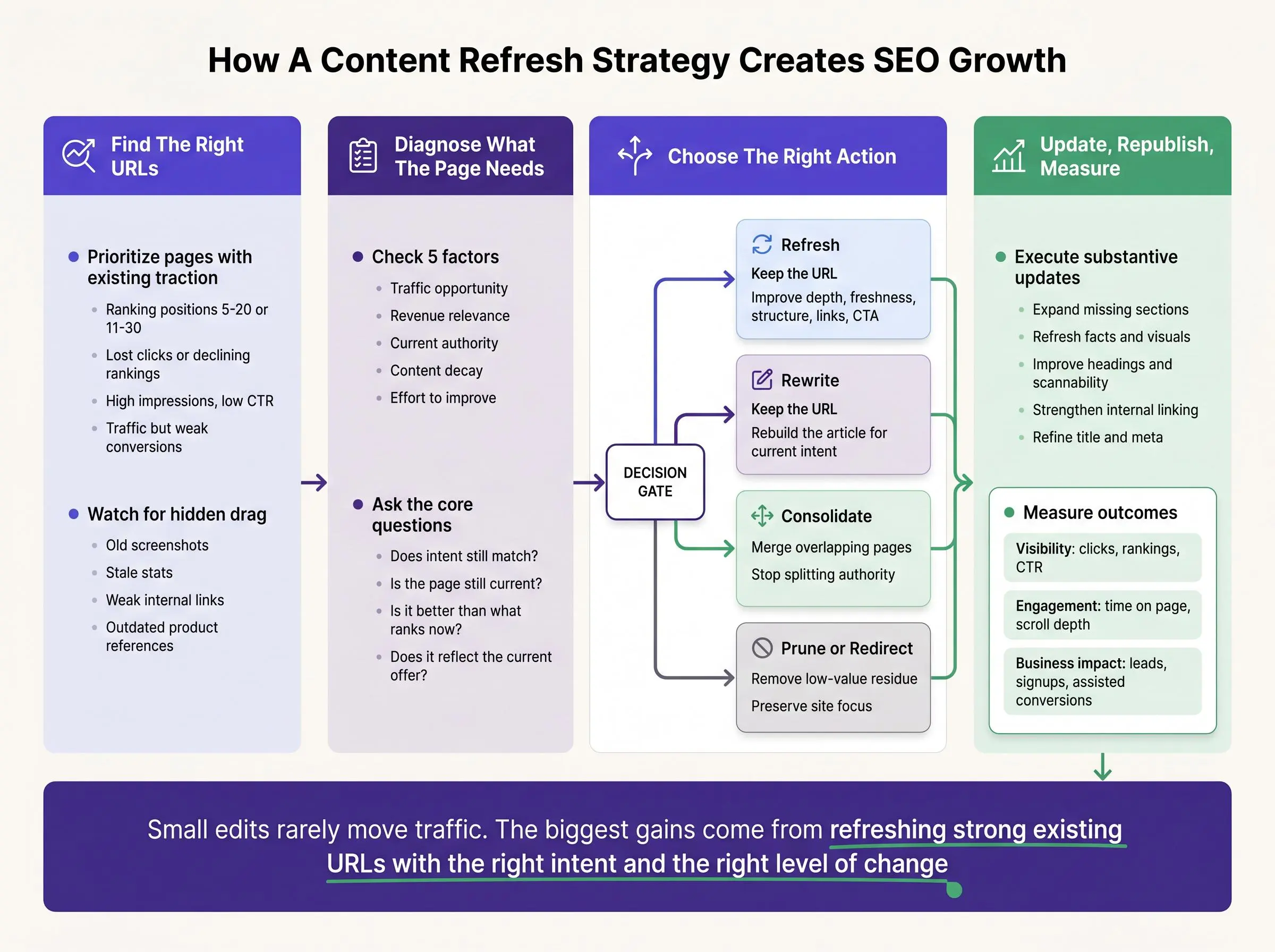
This is the blog refresh workflow we recommend when you want something repeatable, not heroic.
- Reconfirm the target query and intent. Check what ranks now. See whether the SERP favors guides, comparisons, category pages, templates, or quick answers. Sometimes the old article no longer deserves the keyword.
- Diagnose the decline. Was the information outdated? Is coverage thinner than competitors? Are proof points weak? Is the page hard to scan? Did intent shift?
- Identify gaps. Look for missing subtopics, unanswered objections, stale screenshots, weak examples, old statistics, or missing product context.
- Plan before editing. Keep what still works. Decide what to cut, expand, merge, or restructure. Don't edit sentence by sentence without a plan.
- Refresh the article substantively. Major expansions and structural upgrades usually move rankings more reliably than light touch-ups.
- Improve metadata and packaging. Rework the title tag, meta description, heading hierarchy, intro, and scannability. If a table of contents helps, add it.
- Strengthen internal distribution. Add links from authoritative pages. Update related posts to point to the refreshed asset. Think in clusters, not isolated URLs.
- Republish responsibly. Only update the modified date when you've added real value. If changes are substantial, request faster reprocessing.
- Monitor and iterate. Watch the next 30 to 60 days. If the page improves but stalls, make a second pass.
A lot of teams skip step four. That's where good refreshes quietly go bad. They start editing without deciding what the page needs to become.
What to Change on the Page to Improve Rankings With Content Updates
If your content refresh strategy stays abstract, it won't survive contact with a real backlog. You need clear update levers.
High-impact changes that tend to matter
- add missing definitions, steps, examples, and edge cases
- refresh facts, screenshots, tools, workflows, and product details
- remove stale claims and redundant sections
- rewrite the introduction so the page answers the core need faster
- align structure to how searchers now evaluate the topic
- include commercial context when buying intent is present
- add stronger proof points and clearer recommendations
- tighten headings around real user questions
- improve readability and surface direct answers early
- refine title and meta positioning
- strengthen internal links to related cluster pages
- update calls to action so they fit the buyer stage
One non-obvious point here: longer content is not automatically stronger content. We've seen plenty of pages gain nothing after adding 1,500 words of filler. If the update doesn't improve usefulness or intent match, it just creates more surface area for confusion.
The page should become easier to trust and easier to act on. That's usually the standard.
How to Refresh Old Blog Posts for SEO Without Hurting Conversions
This is the fear nobody says out loud. SEO updates can make a page rank a little better and sell a lot worse.
So start with the business question: what should this page help the reader do next?
That question keeps the refresh grounded. It stops you from bloating the article with sections that satisfy a keyword checklist but distract the buyer.
A few rules help:
- keep the search promise clear
- expand depth without burying the answer
- preserve strong hooks and proven examples
- keep high-converting CTAs unless the intent has changed
- update buyer language so the page sounds current
- add use-case framing where it helps ecommerce, SaaS, agencies, or services evaluate fit
The best way to refresh old blog posts for SEO is to make them more relevant to both the searcher and the buyer. Not one or the other.
After publishing, don't just watch rankings. Review time on page, scroll behavior, assisted conversions, and CTA engagement. If traffic rises but qualified action drops, the update solved the wrong problem.
How to Handle Historical Optimization at Scale
Historical optimization process sounds bigger than it is. In practice, it means you revisit older content on a schedule instead of waiting for visible decay.
That's essential once the library starts compounding. One-off cleanup doesn't hold for long. Manual review becomes unrealistic by the second or third content cycle.
Cadence should reflect volatility and business value:
- fast-changing pages every 90 to 120 days
- high-value evergreen pages quarterly or every six months
- annual review only for lower-risk assets
Annual review is often too slow for strategic content. By the time you notice the decline, the page has already leaked momentum.
A workable pipeline usually looks like this:
- audit
- prioritize
- brief
- update
- QA
- republish
- measure
Automation is what makes that pipeline sustainable. It can detect declining pages, flag stale information, suggest topical gaps, draft refresh briefs, and coordinate republishing. That's where Intelliminds fits naturally for scaling teams. We automate the heavy lift across topic research, updates, publishing, and ongoing refreshing, while keeping strategic choices in human hands. That's the right split.
How to Measure Whether the Refresh Worked
A refresh should be judged against the problem it was meant to solve.
If the page was losing visibility, measure recovery. If it drew traffic but weak leads, measure better business impact. One metric won't tell the full story.
Use three layers.
Visibility
- clicks
- impressions
- average position
- click-through rate
- number of ranking keywords
- visibility in AI-generated answers where relevant
Engagement and quality
- time on page
- bounce or engagement rate
- scroll behavior
- next-page visits from internal links
Business impact
- demo requests
- leads
- revenue influence
- product signups
- assisted conversions
Strong refreshes often show movement within 30 to 60 days, especially when the page already had some authority. Take before-and-after snapshots. They make it much easier to see whether you actually improved rankings with content updates, recovered lost traffic, expanded keyword coverage, or strengthened downstream conversion behavior.
For AI visibility, use a consistent prompt set across major answer engines and track whether the page is cited, cited more often, or surfaced more prominently. It's a practical layer now, not a future one.
Common Content Refresh Mistakes That Stall Results
Most failed refreshes don't fail because the idea was wrong. They fail because the execution was shallow or misdirected.
Watch for these:
- updating the date without improving the page
- prioritizing easy edits instead of high-value opportunities
- creating a new article on the same topic instead of updating the stronger URL
- expanding length without improving clarity or usefulness
- skipping a fresh SERP check before editing
- ignoring internal links, metadata, and conversion paths
- using the same review cadence for fast-decay and slow-decay topics
- measuring only rankings while ignoring lead quality or assisted conversions
- expecting light edits to rescue a page that needs a real upgrade
- treating refreshes as occasional cleanup instead of part of the operating model
Here's the line we come back to: stale content is rarely one bad article. It's usually a process problem.
Conclusion
A proven content refresh strategy is not a side task. It's one of the highest-leverage ways to grow organic traffic from assets you already own.
The path is straightforward even if the work isn't. Audit what exists. Prioritize the right pages. Choose the right action. Make substantive improvements. Measure results against rankings and acquisition, not traffic in isolation.
If you want a practical next step, start this week with your top declining URLs. Build a standing refresh queue from the pages with real business value. Don't wait for more decay to pile up.
Publishing creates inventory. Refreshing creates momentum.