
If you're comparing content operations software for a growing brand, SaaS team, ecommerce shop, or agency, the hard part isn't finding tools. It's filtering out platforms that look sharp in a demo but still leave you stuck between briefs, drafts, approvals, and publishing.
The good options cut manual work fast. They make planning, writing, and shipping easier for SEO teams, not heavier (this matters more than shiny AI labels).
We already cut this list down. These are the options worth your attention.
Show 4 more productsShow fewer products
1. Intelliminds

- Automates research-to-publish workflow
- Built for SEO content velocity
- Topic discovery tied to your site
- Supports scheduling and WordPress publishing
- Includes refresh workflows for older content
- Less suited to enterprise governance
- Limited fit for asset-heavy teams
- Narrower than broad content suites
If your real problem is getting from keyword opportunity to published article without dragging more people into the process, this is the category we know best. Intelliminds is built for teams that care about organic growth output, not enterprise content bureaucracy.
We designed it around the parts that usually break SEO execution:
- topic discovery tied to your website, products, services, audience, and existing content
- article generation for ongoing publishing
- content planning and weekly scheduling
- publishing support, including WordPress workflow through our plugin
- content refreshing so older pages don't just sit there and decay
That combination matters more than it sounds. A lot of tools help with one step. Fewer help you run the whole research-to-publish loop. That's the difference between a useful writing assistant and real content operations software.
2. Contentstack Content Cloud

- Strong structured content foundation
- Visual editing helps marketers move
- Built-in brand governance controls
- Native asset management reduces sprawl
- Unified multi-channel delivery workflow
- Less specialized for SEO automation
- Can be more platform than needed
- May require architectural buy-in
Contentstack is a broader platform. It isn't trying to be only an SEO workflow software. It's trying to unify how digital teams manage structured content, assets, governance, editing, and delivery across channels.
That changes the buying logic.
At its core is a headless CMS model, which makes it strong for teams managing reusable content across websites, campaigns, apps, and other digital surfaces. It also brings in visual editing for marketers who need to work against the live experience instead of abstract content fields. That sounds small until your team has to move quickly and non-technical users start getting blocked.
A few pieces make Contentstack more complete than many CMS-led setups:
- Brand Kit pushes governance into the workflow instead of leaving it as a separate review problem.
- Native asset management reduces the sprawl that happens when teams bolt together too many point solutions.
- Launch gives it an integrated front-end deployment story, which is useful if your stack is fragmented today.
Contentstack is especially relevant if your organization is trying to eliminate that fragmented stack problem. It positions itself around unified governance for both human teams and AI agents, and combines five products across the content lifecycle built for reuse across channels
- workflow support for modern content operations
- AI relevance through its broader content agent direction
- flexibility for teams building repeatable systems instead of isolated publishing flows
3. Sanity

- Structured content reused across channels
- Flexible model-first content architecture
- Supports modern team workflows
- Good fit for omnichannel content
- Requires clear content modeling upfront
- Less SEO automation focused
- Can feel heavy for blogs
In real use, Sanity tends to reward teams that already know how they want content modeled and governed. That's the non-obvious part. Its flexibility is powerful, but flexible systems ask more from the operator. If your taxonomy is messy or your workflow is vague, the platform won't magically fix that for you.
Compared with DAM-first tools, Sanity is less about asset control and more about composable content design. Compared with Intelliminds, it's less focused on seo content automation software and more focused on long-term content architecture. That makes it a smart choice for teams with cross-channel ambitions and enough operational maturity to support them.
If you just need to crank out SEO articles faster, Sanity may feel like using a larger machine than the job requires. If you're building a reusable content operating model, it's much more interesting.
4. Aprimo
- Strong enterprise workflow controls
- Built-in digital asset management
- Handles complex stakeholder approvals
- Good fit for governed campaigns
- Overkill for smaller SEO teams
- Less focused on SEO publishing
- Can add operational complexity
Aprimo sits firmly in enterprise marketing operations. When approval chains, stakeholder coordination, governance, and digital asset management all matter at once, it starts to make sense.
This is not the tool you buy because your writers need help getting first drafts done. It's the tool you buy when content moves through a lot of people, a lot of rules, and a lot of brand risk.
Aprimo is recognized for:
- enterprise marketing workflow support
- digital asset management
- governance and process control
- handling complexity across larger teams
That matters in organizations where content isn't owned by one compact team. By the second afternoon of most enterprise evaluations, this becomes painfully clear. The bottleneck isn't always writing. It's approvals, version control, asset coordination, and keeping everybody inside the same process.
Aprimo is broader for marketing operations than some governance-led alternatives, which gives it an edge for larger organizations managing campaigns, assets, and structured workflows together. But there is a cost to that breadth. Startups, lean agencies, and smaller SEO teams can end up paying complexity tax for capabilities they won't really use.
Relative to Sanity, Aprimo is less composable. Relative to Intelliminds, it's far less SEO-specific. That's not a flaw. It's just a different category decision. If output volume matters just as much as process control, you need to be honest about which one is actually the constraint.
5. Papirfly

- Strong brand governance across markets
- Templated creation supports local teams
- DAM and production in one
- Helps maintain brand-safe consistency
- Limited SEO publishing automation
- Less suited for keyword-driven workflows
- Better for governance than drafting
Papirfly is for distributed marketing environments where consistency is under pressure all the time. Different regions, local teams, partners, and markets all need to produce content, but the brand still has to hold together.
That's where Papirfly becomes relevant.
It combines digital asset management, brand governance, and templated content production in one environment. The templating piece is especially important because it changes the work from open-ended creation to controlled execution. In some organizations, that's the only realistic way to scale.
A few situations where Papirfly stands out:
- local teams need to produce brand-safe materials without reinventing them
- asset control is a daily problem, not an occasional annoyance
- consistency matters almost as much as speed
- distributed execution is more important than article generation depth
This is why Papirfly is often shortlisted in content operations conversations. It isn't solving only one layer. It's trying to connect governance, assets, and production in a way distributed teams can actually use.
For SEO-first teams, though, the fit is narrower. Papirfly is more brand operations-centric than an AI SEO content platform. It's stronger for controlled distributed creation than for keyword research, drafting, or automated blog publishing. If your team is asking how to publish SEO content at scale, and the answer depends on faster topic discovery and article production, this probably won't be the most direct route.
Still, if your content operation breaks because brand consistency collapses across markets, speed alone won't save you.
6. Bynder

- Strong asset findability and control
- Helps enforce brand consistency
- Supports approved creative workflows
- Useful for large asset libraries
- Limited SEO writing automation
- Less suited to blog publishing
- Can overprioritize asset governance
Bynder is another governance-heavy option, but with a clearer DAM-led center of gravity. If your content operations are anchored in approved creative, asset findability, and brand control, it makes sense.
Some teams don't have a writing problem first. They have an asset problem first. Wrong logo, outdated product image, inconsistent brand files, unclear usage rights, too many versions floating around. That kind of friction slows content just as effectively as a blank page.
Bynder is well aligned when you need:
- asset-centric workflows
- strong brand governance
- marketing workflow around approved materials
- structure for large creative libraries
Compared with Papirfly, it's in a similar neighborhood. Compared with Contentstack or Sanity, it's more asset-driven. Compared with Intelliminds, it's much less about article production automation.
That's the key distinction. Bynder can absolutely support content operations, especially when SEO content depends on approved visual assets and compliance. But if you're expecting deep topic discovery, draft generation, and automated publishing in the same platform, you're looking at the wrong kind of system.
An operator's rule of thumb: if your team spends more time hunting for the right assets than outlining articles, a DAM-led platform may solve the bigger problem. If not, don't let asset governance distract you from the actual bottleneck.
7. IBM Content Cortex

- Strong compliance and governance controls
- Centralized repository improves traceability
- Automates classification and records tasks
- Well suited for regulated enterprises
- Overkill for smaller marketing teams
- Less suited to SEO publishing
- Less marketing-native than alternatives
IBM Content Cortex is the most governance-heavy option on this list. It is aimed at enterprises that need centralization, compliance, automation, and content services discipline well beyond marketing.
This is a different conversation from SEO production.
IBM positions it as the evolution of its content services stack into a unified platform designed to make enterprise content AI-ready. That includes a governed repository, metadata enrichment and classification at scale, and automation around legal hold application, redaction, records management, retention, and audit trails.
The practical fit is clear:
- large enterprises with strict compliance requirements
- organizations needing traceability and security controls
- environments where governance is non-negotiable
- teams preparing content systems for broader enterprise AI use
This is stronger than anything else here for regulated environments. It's also far broader in administrative automation than what most marketing teams need. If you're a startup, agency, or mid-market brand trying to grow blog traffic, this is almost certainly excessive.
IBM Content Cortex is less marketing-native than Contentstack, Papirfly, or Aprimo, and much less suited to agile teams trying to scale organic publishing fast. But if your content operations software has to satisfy legal, records, compliance, and enterprise AI-readiness goals at the same time, that's exactly why it exists.
How to Choose the Right Content Operations Software
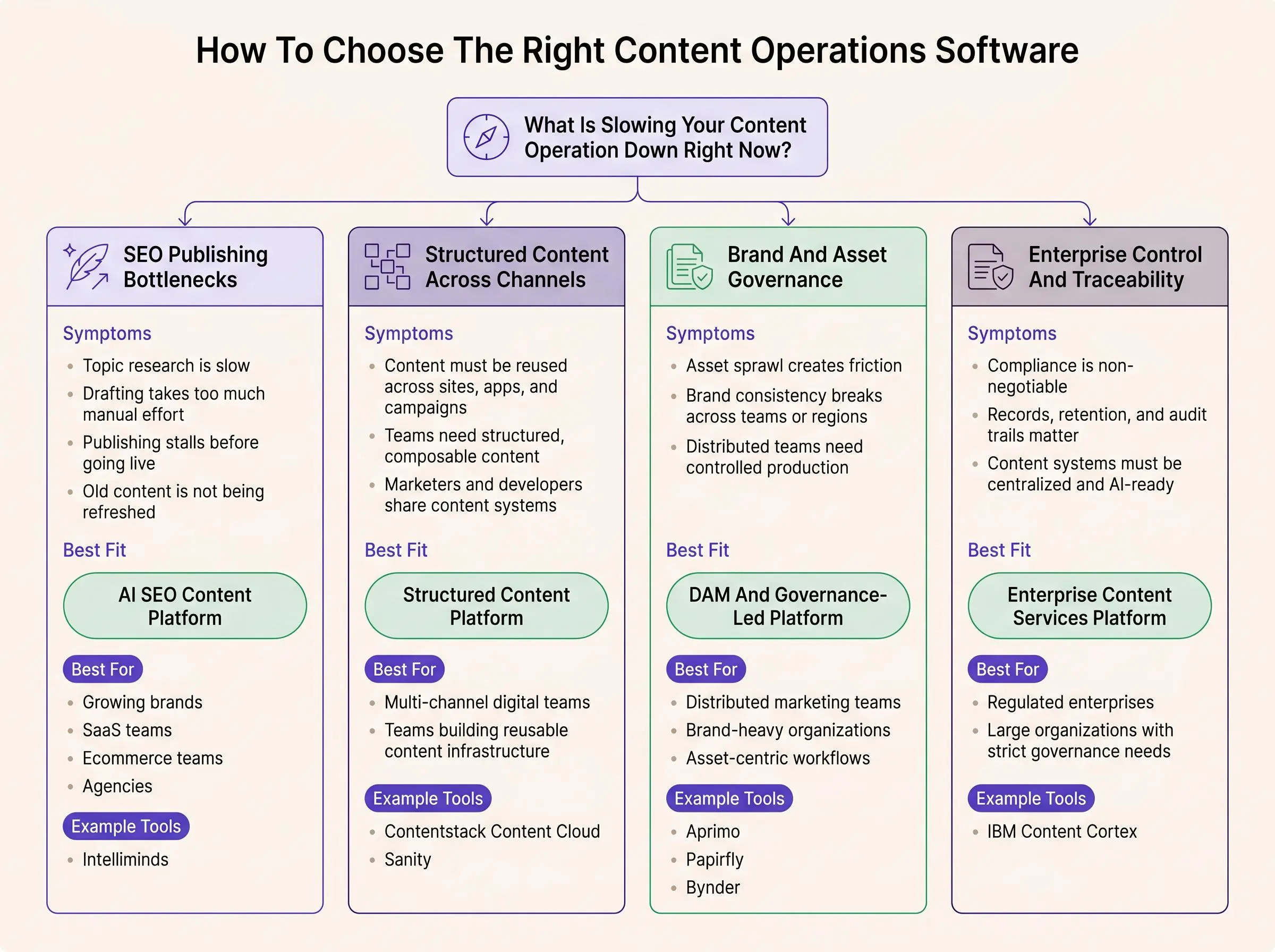
The real buying question isn't which platform has the longest feature list. It's which problem you're actually trying to fix.
Most evaluations fall into one of four paths:
SEO publishing bottlenecks
Choose an AI SEO content platform when your constraint is topic research, drafting, scheduling, publishing, and refresh work.Structured content across channels
Choose a structured content platform when reuse across websites, apps, campaigns, and teams is the bigger issue.Brand and asset governance
Choose a DAM and governance-led platform when brand consistency, asset sprawl, and distributed execution are creating drag.Enterprise control and traceability
Choose an enterprise content services platform when compliance, auditability, and governance can't be compromised.
A few evaluation criteria matter more than the demo usually suggests:
- how much of the workflow is truly automated
- whether planning, creation, publishing, governance, and refreshing live in one workable system
- fit for your team size and operating maturity
- how usable the platform is for non-technical people
- whether it helps publish SEO content at scale or mostly manages assets and approvals
Different teams should bias differently. Lean marketing teams need speed and low manual overhead. Agencies need repeatable workflow and scheduling. Ecommerce teams need consistent output around products and collections. SaaS teams usually need topic depth, refresh cycles, and a dependable publishing cadence.
Don't buy for the org chart you hope to have in two years. Buy for the bottleneck slowing you down right now.
What Matters Most if Your Goal Is to Publish SEO Content at Scale
If SEO growth is the goal, content operations software has to do more than store files and route approvals. That's table stakes for other categories. It doesn't solve publishing velocity.
The capabilities worth prioritizing are straightforward:
- topic discovery connected to your site, offers, and market
- article generation that removes blank-page work
- planning and scheduling that create a repeatable engine
- publishing support so content doesn't stall at the CMS handoff
- refresh workflows for older content that's already ranking or close to ranking
Here's the tradeoff many teams miss. General content operations platforms can support SEO work, but they often don't replace a dedicated automated SEO writing tool. Structured platforms create flexibility, but they may require more setup than a team wants when speed is urgent. Enterprise governance features are valuable, but they can slow adoption if your main KPI is output.
A simple way to frame it:
- if you publish a small number of strategic pieces and need omnichannel reuse, structured platforms may be enough
- if organic acquisition depends on a steady publishing pipeline, seo workflow software with automation matters a lot more
- if every article moves through multiple reviewers, visibility and approvals matter almost as much as generation quality
SEO teams don't need more theory. They need fewer manual steps between research and publication.
Common Buying Mistakes Content Teams Make
Most bad software decisions start with a correct instinct and a wrong interpretation. Teams know they need leverage. Then they buy the wrong kind.
The mistakes show up repeatedly:
- choosing a platform because it says AI, without checking whether the AI changes the workflow or just decorates it
- buying enterprise governance before fixing the daily gap between idea, draft, approval, and publication
- assuming a headless CMS or DAM automatically functions as seo content automation software
- ignoring refresh workflows, even though aging content often drives a large share of organic traffic
- underestimating operational fit between the platform and the actual team using it
That last one causes a lot of quiet failure. Startups and small agencies often need self-serve onboarding, speed, and immediate publishing support. Larger organizations may genuinely need permissions, localization, and cross-team governance first. Same market. Different constraints.
If you want a cleaner decision, use this checklist:
- define your primary bottleneck
- map who touches content today
- identify which steps are still manual
- rank needs by revenue impact, not feature novelty
The memorable rule here is simple: don't automate the wrong layer.
How We Evaluated These Tools
We evaluated these content operations software platforms by comparing the workflow problems each one is designed to solve and the capabilities described in their public product information. We considered:
- Workflow coverage: how well the platform supports planning, creation, publishing, refreshing, approvals, or asset management.
- SEO publishing fit: whether it directly supports topic discovery, article production, scheduling, publishing, and content refresh workflows.
- Structured content and delivery: how well it supports reusable content models and distribution across websites, apps, campaigns, or other channels.
- Governance and asset control: the strength of brand management, digital asset management, permissions, compliance, and process control.
- Operational fit: whether the platform appears better suited to lean teams, distributed marketing groups, or larger enterprises with complex requirements.
- Pricing visibility: whether public pricing is available and how clearly the available plans or pricing approach are described.
We then weighed each platform's strengths against the needs of growing brands, while recognizing that a tool built for enterprise governance or omnichannel content may not be the best fit for a team whose main constraint is SEO publishing speed. The rankings reflect this overall fit, not a claim that one platform is best for every content operation.
Content Operations Software FAQs
What is content operations software?
Content operations software helps teams manage parts of the content lifecycle, such as planning, creation, publishing, refreshing, approvals, digital asset management, governance, and delivery across channels. The right scope depends on whether your main need is SEO publishing, structured content, brand and asset control, or enterprise governance.
What is the best content operations software for growing brands?
There is no single best option for every growing brand. Intelliminds is positioned for teams prioritizing automated topic research, article generation, scheduling, publishing, and content refreshing. Contentstack Content Cloud and Sanity fit structured, reusable content across channels, while Aprimo, Papirfly, and Bynder are better aligned with governance, assets, and distributed marketing workflows.
What features matter most when publishing SEO content at scale?
Prioritize topic discovery connected to your site, offers, and market; article generation; planning and scheduling; publishing support; and refresh workflows for older content. These capabilities reduce the manual steps between research and publication.
How should a team choose content operations software?
Start by identifying the bottleneck slowing your team down. Compare platforms based on workflow automation, coverage from planning through publishing and refreshing, team size and operational maturity, usability for non-technical users, and whether the platform supports SEO publishing or mainly manages assets and approvals.
Conclusion
The best content operations software depends on what you're trying to solve. SEO execution speed, structured omnichannel content, brand governance, and enterprise control are related problems, but they are not the same problem.
Choose Intelliminds if your priority is automated research, writing, scheduling, publishing, and refreshing for organic growth. Choose Contentstack Content Cloud or Sanity if structured content operations and multi-channel delivery matter most. Choose Aprimo, Papirfly, or Bynder when assets, governance, and distributed marketing workflows are central. Choose IBM Content Cortex when enterprise governance and AI-ready content services outweigh marketing-only needs.
The next step doesn't need to be complicated:
- shortlist two or three platforms based on your main bottleneck
- compare them against your real workflow from topic idea to published content
- pick the one that removes the most manual work without adding unnecessary complexity
That's usually the right answer. Not the most impressive platform. The one your team will actually use, and that gets more quality content live.
Article Record
ReferencesPrimary sources used for this article
- Master Content Operations and Keep Your Team Moving Forward
- What Is the State of Content Operations in 2025? - Content Science Review
- The #1 Agentic Digital Asset Management & Content Operations Platform
- Everything your content operations need
- All‑in‑one hub for DAM and content creation | Papirfly Suite
- Headless CMS | Sanity
- Content services - IBM Cloud Pak for Business Automation
- Plans that scale with you
- Start free. Ship fast. Scale intelligently.
- Papirfly pricing
Update HistoryMeaningful revisions to this article
- Added a four-question FAQ section to help readers find answers more easily.
- Added a clear evaluation methodology section to explain how the featured content operations tools were assessed.
- Gave readers more context to help them compare the tools and choose the right option for their brand.
- Added an at-a-glance comparison to make it easier to evaluate content operations software options.
- Refreshed pricing information for seven tools to keep the comparison current and easier to use.
- Added clear pricing notes where available, including starting prices, free plan availability, and custom pricing.
- Updated product cards so readers can quickly see the latest pricing details while browsing the roundup.