Most teams treat the ideal blog post length for SEO like a fixed number, then pad articles until they drag. If you run content for a SaaS brand, store, or agency, that mistake gets expensive fast.
What matters is intent, depth, and how quickly the page earns trust. AI can help, but don't let it turn a clean answer into filler.
Start here:
- Check whether top results are quick answers, comparisons, or full guides.
- Match length to the job, not a team rule.
- Cut repeated paragraphs before publishing, so you end with a length you can defend.
The Short Answer: What Is the Ideal Blog Post Length for SEO?
If you want the direct answer, most informational posts tend to perform well somewhere in the 1,500 to 2,500 word range. But that range only works when the topic actually needs that much depth.
You'll see studies showing first-page results averaging around 1,447 words. You'll also see strong-performing pages closer to 1,152 words, while weaker content can sit around 668 words. That doesn't prove Google likes a specific number. It shows that useful pages usually say enough, and weak pages usually don't.
There are plenty of cases where far fewer words are enough:
- quick-answer posts
- announcements
- news updates
- simple glossary pages
Those can rank with 300, 500, or 800 words if the query is narrow and speed matters.
So the better question isn't really how many words for SEO. It's this: how much depth does this query demand before the reader feels done?
Length should be a byproduct of usefulness, not a target you force onto the page.
Why the Word Count Debate Confuses So Many Teams
This gets messy fast, especially for teams using AI. One side worries short content will look thin. The other side worries long content will turn into padded sludge. Both fears are reasonable.
The industry keeps repeating simple rules because they're easy to operationalize. "Write 2,000 words." "Always go long form." "Google prefers comprehensive content." That advice sounds practical until you compare different SERPs and realize it breaks apart almost immediately.
A competitive how-to query often produces long pages because the topic has a lot of moving parts. A definition query doesn't. A product comparison may need room for criteria, FAQs, and tradeoffs. A quick tactical fix usually doesn't. The ranking length is often a consequence of the topic, not the cause of the ranking.
That's the part many teams miss. Correlation isn't causation.
Google Search Central explicitly says Google does not have a preferred word count. Its guidance instead emphasizes people-first content that provides substantial value, originality, and enough information to help readers achieve their goal.
That gives teams a better standard than a blanket quota: make the page complete for its intended audience, then remove anything that exists only to inflate the count. If a page answers the query fully, supports your acquisition goal, and respects the reader's time, you're closer to the right answer than any fixed word-count rule will get you.
What the Data Actually Suggests About SEO Length
The most consistent pattern in SEO research is not that longer always wins. It's that strong-performing informational content often lands in a mid-to-long range because those topics usually need explanation.
There are a few useful signals worth keeping in mind:
- content over 3,000 words can attract significantly more backlinks than posts under 1,000 words
- that said, most posts earn no links at all, regardless of length
- traffic gains often flatten after roughly 2,000 words
- articles can start losing effectiveness when they become repetitive, bloated, or slow to answer the query
That's the real tension. Long content can work, but diminishing returns show up sooner than many teams expect. By the second half of an overextended draft, AI often starts rephrasing the same point with cleaner headings and less substance. It looks complete. It isn't.
We're also seeing average post length decline in recent years as teams get more disciplined about intent, structure, and efficiency. That's a healthy correction. Long content still has a place. Padding never did.
If you want a practical takeaway, use this one: long content works when it adds unique value. Not when it stretches basic points into extra paragraphs.
Search Intent Determines Length More Than Any SEO Rule
Search intent is the main driver of ideal length. Not format. Not tradition. Not what your competitor published last quarter.
Different queries need different levels of explanation. In practice, these ranges are usually reasonable:
- Quick-answer or definition queries: 300 to 600 words
- News or timely updates: 400 to 1,200 words
- How-to posts: 1,200 to 2,500 words
- Comparison and roundup queries: often 1,500 to 3,500 words or more
- Pillar pages and broad guides: 3,000 to 5,000 words or more when the scope truly warrants it
A simple tactical query like fixing one small analytics setting doesn't need a sweeping essay. A strategic topic like planning an enterprise SEO program usually does. One is a task. The other is a decision.
Where teams get it wrong
When readers want a fast answer, long intros and filler hurt performance. They don't create authority. They create friction.
When readers are evaluating options or trying to complete something nontrivial, shallow content feels incomplete even if it's written cleanly. That's why content depth for rankings is contextual. Depth isn't just more words. It's the right coverage for the job.
How Long Should AI SEO Articles Be in 2026 and Beyond?

AI-written articles should be as long as needed to satisfy the query. No more. No less. The problem is that AI makes overproduction much easier, so discipline matters more than ever.
Old long-form assumptions are getting less reliable because AI search and citation behavior have changed the environment. Pages cited in AI-generated search experiences average around 1,282 words, and more than half of cited pages are under 1,000 words. For some query types, grounding value appears to level off around 540 words. That's a useful reality check.
Concise clarity can beat bloated coverage.
AI does not remove the need for judgment. It increases the risk of:
- repetitive phrasing
- padded subheadings
- generic examples
- sections that sound complete but add no original utility
This is where a lot of teams quietly lose quality. The draft looks polished on first read, especially in a doc full of H2s and bullet points. But once you tighten it, whole sections disappear without changing the value. That's a red flag.
Our view on AI article length best practices is simple. Use AI to accelerate research and drafting. Then use human review to cut waste, add expertise, and sharpen relevance. AI helps you move faster. It doesn't decide what deserves to stay.
Ideal Length by Content Type and Business Goal
You don't need rigid rules, but you do need planning ranges. Here are practical bands we use when thinking about common formats:
- Announcement posts: 400 to 700 words
- Glossary or definition posts: 400 to 600 words
- News articles: 600 to 1,000 words
- Opinion or editorial pieces: 800 to 1,500 words
- Product reviews: 1,000 to 1,500 words for focused reviews
- How-to guides: 1,500 to 2,500 words
- Case studies and use cases: 1,500 to 2,500 words
- Comparison posts and listicles: 1,500 to 3,500 words
- Pillar or ultimate guides: 3,000 to 5,000 words or more
Those ranges only make sense when tied to intent. A product review may stay tight if the reader wants a focused verdict. A comparison post often needs more room because people need criteria, tradeoffs, and follow-up questions answered before they act. The goal should determine the format and depth, not a universal word-count rule. Writing educator Joe Bunting similarly frames blog length around the result a publisher wants, distinguishing shorter discussion-focused posts from longer content intended to attract search traffic.
Business goals matter too.
If you're trying to capture top-of-funnel traffic, broader semantic coverage may help. If the page is conversion-focused, tighter structure and faster access to proof often matter more than extra length. If you're building authority, deeper frameworks and sharper examples can justify a longer piece.
Long form SEO content guidelines should follow purpose, not habit. That's a much better planning rule.
A Practical Framework for Choosing the Right Length Before You Draft
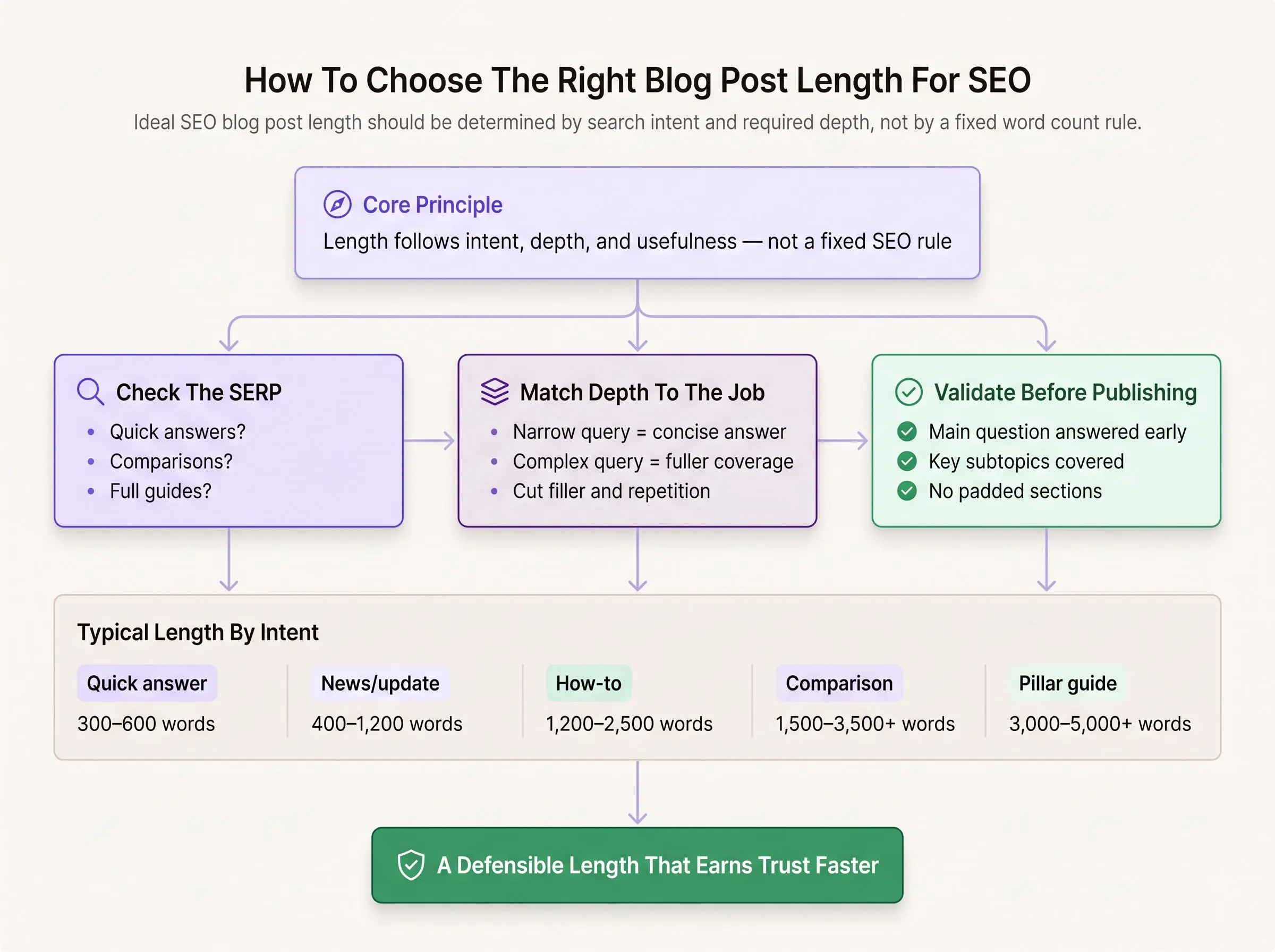
Most length problems start before writing. The fix is not "edit harder later." It's planning with a little more honesty up front.
Use this framework.
Audit the current SERP
Look at the top results. Are they short answers, guides, listicles, tools, product pages? Don't just eyeball word count. Notice how much detail the winning pages actually include.Map the true scope of the query
Identify the core question. Then list the subtopics, objections, examples, and decision points needed to answer it properly. Separate required coverage from optional tangents. This step saves a lot of wasted drafting.Match depth to the audience
Beginners often need definitions and plain examples. Sophisticated B2B buyers usually need frameworks, comparisons, and implementation detail. A local service prospect may just want clear answers and trust signals.Set a working range, not a fixed quota
Use the SERP and topic scope to establish a likely band. Aim to land somewhere reasonable relative to what's ranking, then outperform on usefulness.Draft, then trim or expand based on gaps
Cut repetition. Add missing clarifications. Improve scannability. If a section exists only because the outline wanted symmetry, cut it.
Content depth for rankings is the output of strong planning, not something you bolt on at the end with extra paragraphs.
What “Enough Depth” Looks Like on a Ranking Page
Enough depth means complete, efficient coverage of the reader's task or decision. Efficient matters here. A page can be long and still feel shallow if it wanders.
Depth shows up in structure more than raw word count. You can usually recognize it when a page does a few things well:
- answers the main question early
- covers important subtopics without forcing irrelevant ones
- uses examples or scenarios that make the advice usable
- handles edge cases and next-step questions
- includes supporting elements like FAQs, checklists, comparison tables, or methodology when the intent calls for them
Comparison queries often need the most room because they require evaluation criteria, product breakdowns, pricing context, and follow-up concerns. That isn't fluff. That's the job.
One good test is simple: after reading the page, does the user still need to go back to the SERP for obvious missing pieces? If yes, the page probably lacks depth. If no, you're close.
Signs Your AI-Written Article Is Too Short, Too Long, or Just Right
You don't need abstract writing theory to diagnose this. You need practical checks.
Too short
An article is probably too short when:
- it answers the headline question only at a surface level
- it skips obvious subtopics covered by competing pages
- it lacks examples, use cases, or supporting detail
- it feels like a summary rather than a resource
Too long
An article is probably too long when multiple sections repeat the same point in slightly different language, when the answer is buried under a long setup, or when tangents are included just to inflate semantic coverage. If readers have to scroll through filler before reaching the useful part, the draft is carrying dead weight.
Just right
A piece is the right length when the structure feels complete and proportional to the query, every section earns its place, and the reader can skim quickly or go deeper without friction. It should support both ranking goals and business outcomes.
We like a simple padding test: if a paragraph can be removed without weakening clarity, evidence, or usefulness, it's probably filler. If a subsection adds no new decision-making value, compress it or cut it.
AI Article Length Best Practices for Teams That Publish at Scale
At scale, word count discipline becomes an operating issue, not just an editorial one. Teams need a process that keeps content useful while moving fast.
Build briefs around the things that actually matter:
- search intent
- must-cover subtopics and entities
- audience sophistication
- desired outcome, whether that's education, sign-up, demo interest, or product discovery
AI should draft to a coverage standard, not a preset word count target. That's a real shift. It changes the whole system.
Editorial review should then do the work AI won't reliably do on its own:
- remove repeated patterns and boilerplate phrasing
- verify factual precision
- add original positioning and practical examples
- tighten intros and conclusions
Publishing workflow matters just as much. Consistency often beats occasional oversized content. And refreshes matter, because intent shifts, competitors expand, and pages that once felt complete can get stale.
This is exactly where a platform like Intelliminds fits naturally. We built it to help teams automate topic discovery, article writing, scheduling, publishing, and refresh workflows around their site and audience. The point isn't to produce longer content faster. It's to make useful content production repeatable without turning length into the strategy.
Common Mistakes Brands Make When Setting SEO Word Counts
Most bad length decisions are surprisingly predictable. We see the same ones over and over.
- setting a company-wide minimum word count for every article
- assuming AI content needs to be longer to overcome skepticism
- copying the longest competitor without asking why their page is long
- confusing topical coverage with keyword stuffing or section sprawl
- publishing first drafts without trimming repetitive AI output
- ignoring performance signals after publishing
- treating long form SEO content guidelines as universal rules
- failing to align length with acquisition goals
A page meant to educate should not be built the same way as a page meant to compare options or push a reader toward a product page. That sounds obvious. In practice, a lot of teams still miss it.
When Shorter Content Can Beat Longer Articles
Shorter content can absolutely win. It often should.
This usually happens when the query is narrow and the answer can be delivered cleanly, especially for:
- definitions and glossary terms
- straightforward pricing or feature questions
- timely updates
- quick tactical fixes
- pages where the user wants an immediate answer before taking another step
AI search results and answer engines often favor pages that are easy to parse, tightly structured, and direct. That's one reason bloated content has become riskier. It creates friction for both readers and retrieval systems.
Short useful content is complete for the query. Thin content is incomplete no matter how many words it has.
Brevity is not the opposite of quality, and length is not the same as authority.
How to Measure Whether Your Chosen Length Is Working

At some point, you have to stop debating theory and look at performance. That's where the real answer shows up.
Track the signals that matter:
- rankings by query type
- click-through rate
- on-page engagement
- conversions or assisted conversions
- links or citations earned over time
Then interpret them carefully. Good rankings with weak engagement can mean the content is front-loaded poorly or mismatched to intent. Low rankings despite strong writing can point to missing subtopics, weak authority, or the wrong format, not just the wrong word count. Steady traffic decay often means the page needs updating, expanding, or tightening because the SERP changed.
This is why refresh cycles matter. You do not need to get article length perfect on draft one. You need a system that lets you adjust once the page starts collecting real signals.
For teams publishing regularly, that's another place where Intelliminds can help. Not because it guesses the ideal word count for you, but because it supports a repeatable workflow for publishing and refreshing as search behavior evolves.
Conclusion
The ideal blog post length for SEO is the length required to satisfy intent, cover the topic completely, and help the reader take the next step. That's the rule. Everything else is just a planning aid.
Yes, many SEO posts land between 1,500 and 2,500 words. Yes, short content can rank when intent is narrow. And yes, very long content can work when the topic genuinely needs it. But none of those ranges mean much without context.
AI changes the speed of execution, not the standard. It helps you draft faster. It also makes it easier to overproduce, overexplain, and overpad.
So take one target keyword. Audit what's already ranking. Define the minimum useful scope. Then let length follow depth instead of guesswork. That's usually where better rankings and better content start.
Article Record
ReferencesPrimary sources used for this article
Update HistoryMeaningful revisions to this article
- Added expert-backed guidance to the section on choosing blog post length by content type and business goal.
- Made it easier for readers to choose an appropriate length for their articles.
- Added guidance from Google Search Central to clarify why helpful content matters more than a specific word count.
- Expanded the section on word count to help readers make more informed decisions about article length.