
Most teams don't have a content problem. They have a marketing approval process that drags good drafts through extra reviewers, vague comments, and avoidable delays.
If you run a growing brand, SaaS company, service business, agency, or store, speed comes from clear signoff rules, not more Slack nudges. Three places usually decide it.
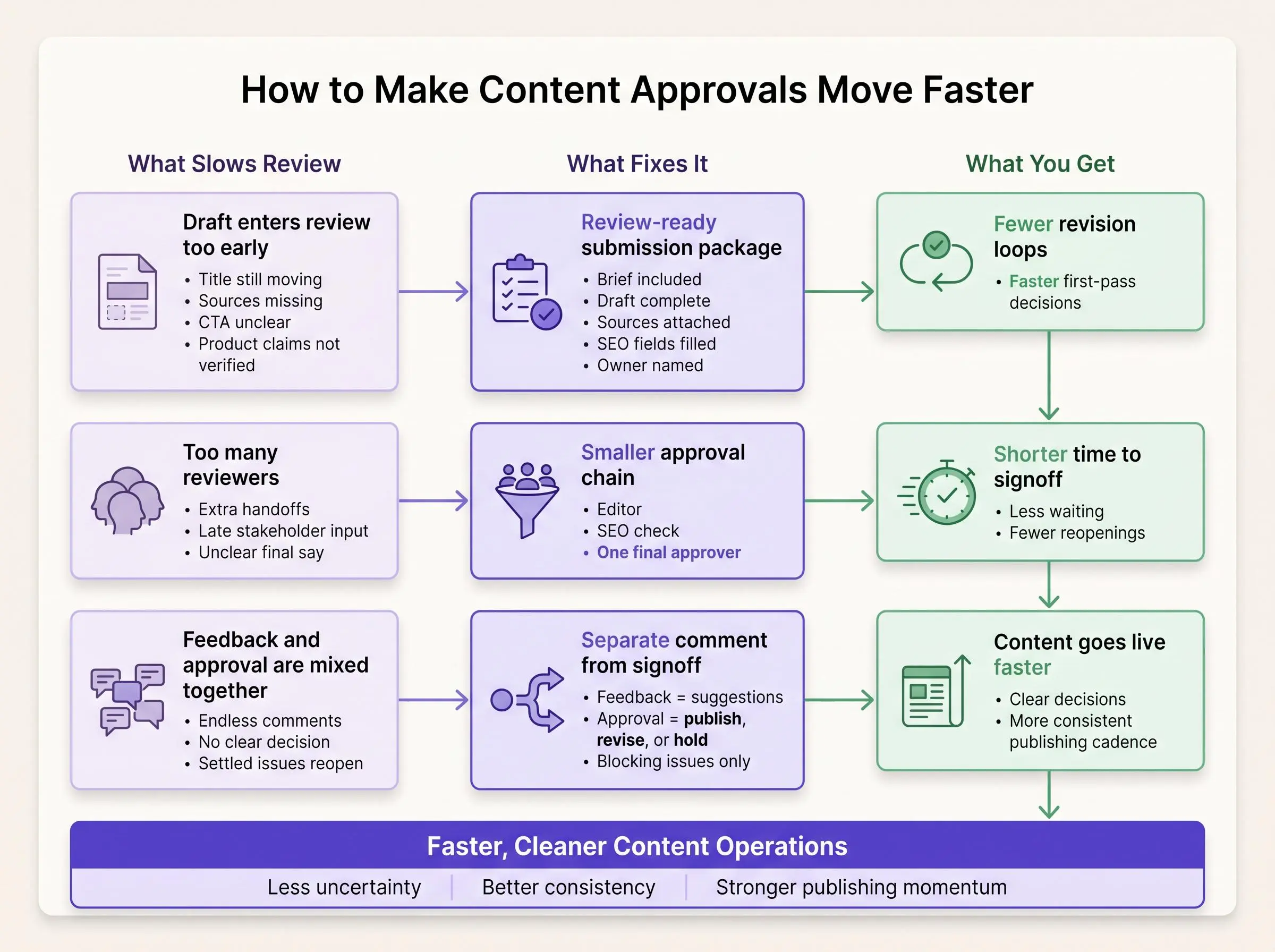
- A draft is not review ready if the title, sources, CTA, and product claims are still moving.
- Every extra reviewer adds delay; most assets need an editor, an SEO check, and one final approver.
- Feedback is not approval. Separate them, and content goes live faster.
What a Marketing Approval Process Means in Content Operations
A marketing approval process is the path a draft takes from "ready for review" to "ready to publish." It sits inside the broader content operation, but it is not the whole thing. Research, drafting, optimization, publishing, and refreshing are different stages. Approval is the narrower stage where the team decides whether the asset is aligned, accurate, on-brand, compliant if needed, and actually fit to go live.
That distinction matters because teams often confuse approval with feedback. They're not the same.
Feedback is open-ended. Approval is a decision.
When those get mixed together, comment threads turn into a holding area for uncertainty. People keep adding thoughts, nobody makes the call, and the draft just sits there. We've seen this happen even in capable teams with strong writers and smart stakeholders. The issue usually isn't effort. It's the lack of a designed decision system.
A strong marketing approval process should answer a small set of questions fast:
- Does this support the business goal?
- Is it factually sound?
- Does it match brand and positioning?
- Does it meet SEO and publishing requirements?
- Does anything here create legal, compliance, or client risk?
If the answer is clear, publishing moves. If not, the revision needed should also be clear. That's the point.
Done well, approval creates faster publishing, fewer review loops, better consistency, and a cleaner line from content production to customer acquisition. It should reduce uncertainty, not add ceremony.
Why Good Content Gets Stuck in Review
Most content doesn't get delayed because the draft is bad. It gets delayed because momentum collapses once review starts.
You know the pattern. A solid article is written. Then more people get pulled in. Someone from product wants to tweak phrasing. SEO wants changes to the title. A stakeholder drops in late with a strategic concern that should have been handled in the brief. By the second afternoon, nobody is really editing the piece anymore. They're negotiating process.
Reviewer sprawl is one of the biggest reasons teams fail to streamline content approvals. Every extra reviewer tends to add waiting time, not just feedback quality. In a lot of teams, one more person means one more business day. Stack enough of those together and a simple asset becomes a two-week loop before the final stakeholder or client even sees it.
Unclear ownership makes it worse. If nobody knows who has final say, everybody acts like they might. That creates duplicated comments, cautious language, and last-minute reversals. It's not a communication problem first. It's an ownership problem.
A few common causes show up again and again:
- Drafts enter review before they're actually complete
- Reviewers don't have source support or business context
- Metadata, links, CTAs, or screenshots are missing
- Comments are based on taste instead of criteria
- Final approvers appear late and reopen settled issues
There's also a quieter problem underneath all of this. Many teams assume that faster publishing must mean lower quality. We don't buy that. If speed creates quality risk, the process is weak. Good systems protect quality by making standards explicit before review starts.
That matters even more in SEO. When review cycles are unpredictable, publishing cadence breaks. Refreshes get pushed. Internal linking plans stall. Organic growth loses momentum not because the strategy failed, but because the content machine keeps stopping at the last ten percent.
What High-Stakes Approval Systems Teach Content Teams
Content teams can learn a lot from formal approval environments without copying all their bureaucracy.
The useful lesson is simple: speed improves when the submission package is complete before review begins. Not halfway through. Not after the first round of comments. Before.
In more structured environments, reviewers work from a shared decision record. They don't pass incomplete work through disconnected handoffs and hope each person fills in the missing context. That's where many content teams create their own delays. Editorial reviews one version. SEO sees another. Compliance gets pulled in after wording changes. The decision trail disappears.
Late-stage wording changes are especially expensive. That's true in formal approval settings, and it's true in content. Headlines, claims, disclaimers, CTAs, metadata, even a small label on a visual can trigger another round because they affect risk, intent, or positioning. Tiny edits at the end often cause oversized delays.
A better model is to treat approval as a benefit-risk decision:
Is this asset valuable, accurate, and ready enough to publish now?
That framing is more useful than "has everyone shared their thoughts?" It pushes the team toward decision-making instead of endless input collection.
When approval systems improve, the same things usually happen. Documentation gets consolidated. Responsibilities become clearer. The reason behind the final decision becomes easier to understand. That's not bureaucracy. That's operational clarity.
Build the Review-Ready Submission Package First
Faster approvals start before anyone opens the draft.
If your team wants faster article signoff, the first fix is usually the submission package. Reviewers should not have to hunt across docs, chats, and spreadsheets to figure out what they're looking at or what decision is needed.
For most assets, the package should include:
- content brief and target outcome
- audience and funnel stage
- primary keyword and search intent
- article draft
- supporting sources or internal inputs
- product or service references needing factual verification
- proposed title, meta description, internal links, and CTA
- visuals, screenshots, or supporting assets if needed
- publication priority and owner
At the top, add a short decision summary. Keep it tight. What changed, what needs attention, and what decision is required. Think decision memo, not loose handoff.
This is where experienced teams save time that inexperienced teams lose later.
Define what "review-ready" means and make it non-negotiable. For example, a draft is not review-ready if claims aren't sourced, SEO fields are blank, product mentions haven't been flagged for fact check, or the owner is unclear. Once you set that standard, don't let incomplete work into the queue. It sounds strict. It's actually kinder to everyone involved.
Map a Content Review Workflow That Actually Moves
A workable content review workflow needs clear stages, but it also needs restraint. Not every asset deserves the same path.
A practical workflow usually looks like this:
- Intake and prioritization
- Research and draft creation
- Editorial and SEO review
- Subject matter or product accuracy check
- Legal or compliance review when needed
- Final signoff
- Publishing and distribution
- Post-publish monitoring and refresh planning
The sequence matters less than the logic. Each stage should solve a distinct problem once, not reopen the same issue in a different room.
Editorial should handle clarity, structure, and audience fit. SEO should verify intent match, topical depth, and search readiness. Subject matter review should focus on factual correctness, not rewrite the article in someone's preferred style. Legal and compliance should only enter when the asset actually creates risk. That last part saves a surprising amount of time.
Not every article needs the heavy path. A low-risk educational blog post should move through a lighter system than a performance claim page, regulated email, or client-sensitive launch asset. If you treat every asset like a high-risk exception, you create your own publishing bottlenecks.
The teams that reduce publishing bottlenecks usually do one thing well: they group compatible reviews together. They don't force editorial, SEO, and factual review into separate waiting periods unless there's a real dependency. Decision velocity improves when the right people review in parallel and the workflow continues past signoff into publishing and refresh planning.
Because signoff isn't the finish line. Growth happens after publish.
Assign Clear Roles Across Writers, Editors, SEO, and Approvers
Most approval delays are ownership failures wearing a communication costume.
When roles are vague, people overstep, hesitate, or review the wrong thing. A writer gets comments on conversion strategy. A subject matter expert rewrites tone. A stakeholder assumes visibility means veto power. Then everyone wonders why the workflow feels heavy.
Keep the role model clear:
- Writer owns draft completeness and source support
- Editor owns clarity, structure, quality, and audience fit
- SEO owner verifies search intent, keyword use, and competitiveness
- Product or subject matter reviewer verifies factual accuracy
- Legal or compliance reviewer checks regulated claims and disclosures
- Final approver decides publish, revise, or hold
It also helps to separate three groups explicitly:
- people who must approve
- people who may comment
- people who only need visibility
Those are not the same. Treating them as the same is how teams get stuck.
Every asset needs one accountable final decision-maker. One. If you're an agency, define client signoff rights before production starts, not during round three. If you're in-house, don't negotiate authority asset by asset. That invites approval paralysis.
A strong editorial collaboration workflow depends on boundaries. People need to know when they're expected to contribute and when they're expected to step back.
Use Approval Criteria That Make Faster Article Signoff Possible
Faster article signoff doesn't come from faster typing in comments. It comes from shared criteria.
Without criteria, reviewers default to preference. They react to what they would have written, not what the asset needs to achieve. That's where churn starts.
Use a checklist that reviewers can apply consistently. The exact version will vary by asset type, but the core criteria are usually stable:
- strategic alignment with business goal and audience need
- factual accuracy and support for claims
- brand voice and positioning consistency
- SEO readiness, including intent match and topical completeness
- CTA relevance and conversion fit
- formatting and publication readiness
- compliance or disclosure requirements where relevant
One useful shift is to separate blocking issues from optional improvements. That single change can streamline content approvals more than another tool purchase. A missing disclaimer is blocking. A preferred word choice usually isn't.
For example, when reviewing an educational article, ask each reviewer to mark every issue as block, ** revise, or note**:
- Block: a claim lacks support, a required disclosure is missing, or the CTA points to the wrong destination
- Revise: the search intent is only partly addressed, the structure makes a key answer hard to find, or a product reference needs factual confirmation
- Note: a reviewer would use different wording, prefers another heading, or has an improvement that is not required for publication
The final approver then makes the decision from the blocking issues first. If none remain and the revision items are assigned with a clear owner, the asset can move to publish; notes can stay in the decision log for a later refresh or style update. This keeps a useful suggestion from becoming an accidental veto.
You should also create lighter, asset-specific checklists for things like landing pages, emails, social posts, videos, app listings, and sales collateral. The point is not more paperwork. The point is consistent decisions.
Criteria reduce opinion. Opinion is where timelines go to die.
Once teams agree on the standard, review becomes more predictable. The draft either meets the bar, needs specific revisions, or should be held. That's a real system.
Replace Serial Feedback Loops With an Editorial Collaboration Workflow

Serial review looks organized on paper. In practice, it's one of the fastest ways to slow content down.
The problem is not just waiting time. Each reviewer sees a different version, interprets the draft through a different lens, and often comments without seeing prior decisions. So the draft doesn't improve in a coordinated way. It gets re-litigated.
Use one shared workspace for comments, decisions, revisions, and status. If approvals are spread across email, chat, docs, and spreadsheets, the team spends too much energy reconstructing context. That's waste.
A better editorial collaboration workflow usually includes:
- parallel review where editorial, SEO, and factual checks can happen together
- comments tied to approval criteria, not broad preferences
- a decision log showing resolved and open issues
- revision summaries between rounds so reviewers focus on actual changes
That last one is underrated. A short revision note saves reviewers from rescanning the entire asset and reduces the "while I'm here" comments that create unnecessary churn.
This kind of workflow also improves trust. People can see why a decision was made, not just what changed. When the reasoning is visible, fewer issues get reopened out of caution or confusion.
How to Streamline Content Approvals With Automation
Automation should remove coordination friction. It should not replace judgment.
Used well, automation helps in a few specific places:
- routing content to the right reviewers based on content type or risk
- standardizing briefs and review-ready submission requirements
- keeping version history and status visible
- moving approved assets into publishing without another manual handoff
- triggering future refresh workflows after publication
This matters more as output grows. Manual approvals don't scale well. They depend on memory, follow-up, and someone's ability to chase the next person. That may work for five assets a month. It usually breaks at fifty.
For teams running SEO content seriously, the bigger gain comes from reducing scattered handoffs across the full operation. At Intelliminds, we've seen how a more unified flow across topic research, drafting, publishing, and refreshing reduces the approval friction created by disconnected tools and partial context. When the system carries the brief, draft, status, and publishing path together, fewer things get lost between stages.
Humans still own the hard calls. Messaging judgment. Compliance judgment. Final accountability. Automation should shorten the path to a decision, not blur who makes it.
When Compliance, Claims, and Clients Change the Process
Some teams need a stricter marketing approval process because the cost of getting it wrong is simply higher.
That usually applies to assets like:
- website pages
- social media posts
- email campaigns
- brochures and sales decks
- performance or results-based advertising
- videos, webinars, and scripts
- app store listings
- conference and event materials
In those cases, centralized workflows and clear recordkeeping matter. If content includes regulated claims, legal exposure, or external client signoff, you need an auditable trail. Not because it's elegant. Because rework and risk get expensive fast.
Still, don't overcorrect. Use risk tiers so every blog post isn't treated like a compliance-sensitive campaign. Keep the distinctions clean. Editorial review checks quality and audience fit. Compliance review checks legal or regulatory risk. Client approval checks whether the asset matches the agreed strategy and brand direction.
There's also a practical move many teams miss: define what can be approved once and reused. Standard disclaimers, approved positioning language, claims libraries, even common product descriptions. Pre-approved components shrink review scope and reduce avoidable delay.
Track the Right Metrics to Reduce Publishing Bottlenecks
If approval delays feel vague, it's usually because nobody is measuring them cleanly.
Start with operational metrics:
- time from draft-ready to approval
- time from approval to publication
- number of review rounds per asset
- percentage approved on first pass
- content volume waiting on specific reviewers or teams
- reasons assets get sent back
That gives you a map of where the workflow actually breaks. Not where people think it breaks.
Then add quality guardrails:
- post-publish correction rate
- compliance revision rate
- organic performance of fast-tracked versus standard-reviewed content
- percentage of older content refreshed on schedule
Those guardrails matter because speed alone can lie. If you publish faster but increase corrections, the system isn't improving. It's just moving risk downstream.
Use the data to redesign the workflow, not to blame people. One delayed reviewer might look like the problem when the real issue is that drafts keep reaching them incomplete. Small changes can compound quickly here. One fewer review round, one better checklist, one clearer owner. Over a quarter, those changes can create a much more consistent publishing cadence and a stronger organic acquisition engine.
Conclusion
A good marketing approval process creates confidence and momentum. A bad one creates confusion, delay, and disguised indecision.
If you want faster publishing, focus on the levers that actually move the system: complete submission packages, fewer unnecessary reviewers, clear approval criteria, integrated collaboration, and automation where it genuinely removes friction. That's how you streamline content approvals without lowering the bar.
Start with one content type. Define what review-ready means. Simplify signoff. Then expand the model across the rest of your content operation.
The fastest content teams aren't cutting corners. They're removing the friction that keeps quality work from moving.
Marketing Approval Process FAQ
What is a marketing approval process?
A marketing approval process is the path a draft takes from ready for review to ready to publish. It is the decision stage where the team checks whether the asset is aligned, accurate, on-brand, compliant if needed, and fit to go live.
How is approval different from feedback?
Feedback is open-ended; approval is a decision. When teams treat them as the same, comments can pile up without anyone making a clear publish, revise, or hold call.
What should a review-ready submission package include?
A review-ready package should give reviewers the context they need without making them search across docs or chats. The article recommends including:
- content brief and target outcome
- audience and funnel stage
- primary keyword and search intent
- article draft
- supporting sources or internal inputs
- product or service references needing factual verification
- proposed title, meta description, internal links, and CTA
- visuals, screenshots, or supporting assets if needed
- publication priority and owner
What criteria should reviewers use to approve content?
The article says approvals should rely on shared criteria, not preference. Core criteria include:
- strategic alignment with business goal and audience need
- factual accuracy and support for claims
- brand voice and positioning consistency
- SEO readiness, including intent match and topical completeness
- CTA relevance and conversion fit
- formatting and publication readiness
- compliance or disclosure requirements where relevant
When does a content piece need a stricter approval path?
Assets with higher risk or external exposure usually need a stricter process, especially when they involve regulated claims, legal exposure, or client signoff. The article notes this can apply to website pages, social media posts, email campaigns, brochures and sales decks, performance or results-based advertising, videos, webinars, scripts, app store listings, and conference or event materials.
Article Record
ReferencesPrimary sources used for this article
Update HistoryMeaningful revisions to this article
- Added a link to Intelliminds to help readers explore the offering more easily.
- Added a practical example to show how clear approval criteria can help teams sign off on articles faster.
- Added a 5-question FAQ section to answer common marketing approval questions more quickly.
- Expanded the article with practical guidance that helps readers move content through review with less back-and-forth.
- Made key approval topics easier to scan so readers can find the information they need faster.