
Most teams don't have a content problem. They have a planning problem, and pillar cluster strategy is usually where the fix starts. For SaaS, ecommerce, and agency sites, random posts create overlap, weak links, and pages that never earn traffic.
What matters is structure: one hub, clear supporting pages, and topics tied to revenue, not vanity volume.
A few things to lock down early:
- Pick a pillar topic with at least five distinct sub-intents
- Split pages by intent, not tiny keyword variations
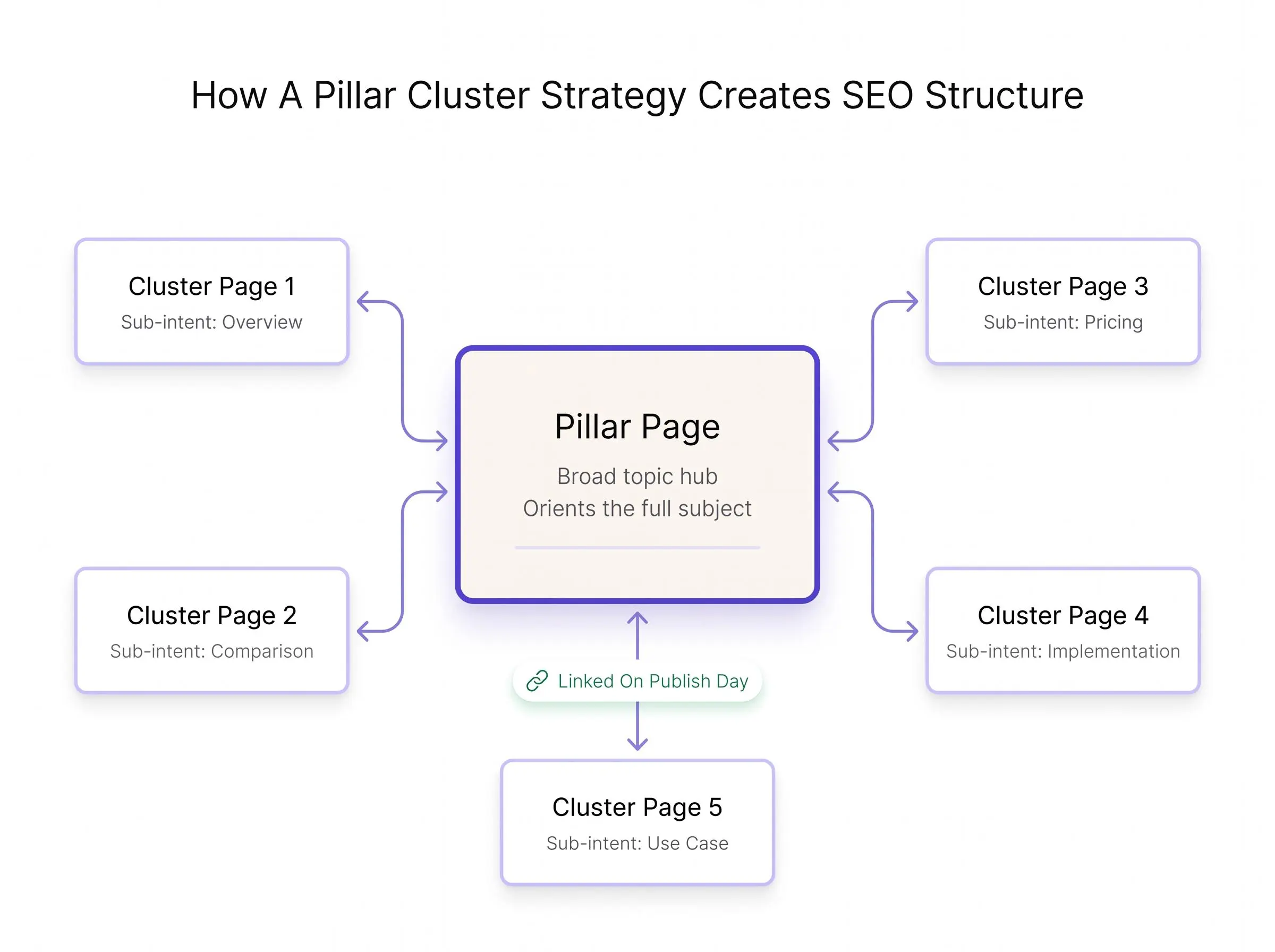
- Link the cluster on publish day so the whole thing can move
Why Most Content Plans Stall Before They Rank
Most teams don't have a writing problem. They have a planning problem.
By the second afternoon of keyword research, the spreadsheet is already drifting. One tab has head terms, another has question keywords, someone dropped in competitor topics, and now the team is arguing about which post to write first. A month later, you've published a few articles, but nothing compounds. Traffic is flat, rankings are scattered, and the blog starts to feel like storage, not strategy.
That's the trap. Isolated blog posts rarely become a growth engine on their own. They become a content graveyard when each page is planned in isolation, targets overlapping intent, or covers a topic too thinly to matter. Most pages on the web get no organic traffic. That makes weak topic selection an expensive habit, not a harmless one.
Publishing more without structure creates predictable damage:
- pages cannibalize each other
- subtopics get covered shallowly across multiple URLs
- internal links are added late, if at all
- search engines get mixed signals about which page should rank for the main idea
Search has moved well beyond one page, one keyword. Topical coverage, semantic relationships, and intent alignment carry more weight now. If your site looks like a pile of unrelated posts, it won't behave like an authority.
A pillar cluster strategy fixes the architecture underneath the content. That's the point. Not formatting. Not a nicer blog taxonomy. Structure.
What a Pillar Cluster Strategy Actually Means
A pillar cluster strategy is simple in concept and easy to get wrong in execution. At its core, it's one broad hub page supported by multiple focused cluster pages, all connected with deliberate internal links.
The pillar page is not supposed to exhaust every subtopic. That's where teams overbuild and create problems for themselves. Its job is orientation and synthesis. It helps both users and search engines understand the full topic area, then routes deeper intent to the right supporting pages.
Cluster pages do the depth work. They answer narrower questions, use cases, comparisons, or decision points with enough specificity to deserve their own URL.
A real cluster has three parts:
- A pillar page for the broad topic
- Cluster pages for distinct sub-intents
- Internal linking that shows hierarchy and relationship
That last part matters more than people admit. A loose category full of vaguely related posts is not a cluster. If the pages don't have clear roles and link patterns, you're just publishing adjacent content and hoping search engines sort it out for you.
A meaningful cluster usually needs several distinct subtopics, not two or three loosely related articles. In practice, we often see authority signals become more visible once a cluster has at least five published pages covering separate sub-intents. Mature clusters commonly grow into 15 to 25 interlinked pages. You don't need to start there. You do need to start intentionally.
This model works especially well for brands, ecommerce teams, SaaS companies, and agencies because it scales authority around commercially relevant topics. You're not just creating content. You're building a topic surface area that can rank, assist conversions, and hold shape as the library grows.
Good SEO content is rarely about one page winning. It's about the system making each page easier to trust.
Why AI Topic Planning Changes the Game
AI topic planning is the layer that turns keyword lists into topic systems.
Manual planning still has value, but spreadsheets are bad at pattern recognition once the keyword set gets large. AI topic clustering helps group terms by semantic similarity and shared search intent, not just matching words that look alike. That's the difference between "these keywords contain the same phrase" and "these searches probably want the same page."
Tool choice affects the quality of that first pass. In a standardized test of 17 keyword-clustering tools using the same set of 216 content-marketing keywords, overall quality scores ranged from 9 to 95 out of 100. That does not make one score a guarantee for your niche, but it does make a practical point: review cluster boundaries against live SERP overlap and commercial intent before turning an AI-generated grouping into a publishing plan.
That shift opens up a more useful planning view. AI can help surface:
- the parent topic that likely anchors the pillar
- supporting subtopics that deserve their own pages
- comparisons that sit mid-funnel
- question patterns that belong in sections or FAQs
- adjacent entities and use cases you might miss manually
This is where teams start to understand how to create topical clusters with AI in a way that actually improves decisions. The gain isn't just speed. It's cleaner boundaries.
When you use AI well, you can move faster on the hard parts:
- discovering keyword patterns across a topic area
- seeing where one page should end and another should begin
- deciding what belongs on the pillar versus what deserves its own cluster article
AI is not replacing strategy. It shouldn't.
The best use of AI is planning and pattern recognition first, content generation second. That's how you build an SEO topic map with AI that has structural integrity. It's also the real promise of content cluster automation and how serious teams build topic authority with AI without flooding their site with repetitive drafts.
Choose a Pillar Topic That Can Actually Become an Authority Hub
The wrong pillar topic breaks the model before a single draft is written.
A good pillar topic needs range, but it also needs edges. It should be broad enough to support many subtopics and specific enough that your brand can credibly own a piece of the market around it. It also needs to connect tightly to your products, services, or audience pain points. If it only attracts curiosity and never connects to acquisition, you're building traffic inventory, not leverage.
Use this filter before you commit:
- Can the topic support multiple distinct sub-intents?
- Is it close to revenue, product value, or customer need?
- Can your site realistically build authority here?
- Would ranking across this topic area create useful business outcomes?
The common mistakes are obvious once you've seen them a few times. Some teams go too broad and choose a category with almost no practical scope for one pillar. Others go too narrow and turn what should be a cluster article into the hub.
A useful test is simple: can this topic support several supporting pages without forcing overlap? If not, it's probably not a pillar. If the subtopics all collapse into one article, you've picked too narrow. If they explode into a market-wide encyclopedia, you've picked too broad.
Search volume can point you somewhere. It shouldn't make the decision for you. We plan around audience need and revenue relevance first, because a ranking that doesn't connect to pipeline is just a nicer vanity metric.
Build an SEO Topic Map With AI Before You Write Anything
Don't start drafting before the map exists. That's where the waste starts.
A practical SEO topic map with AI looks less like a keyword dump and more like a knowledge tree with page boundaries. The process is straightforward, but the sequence matters.
- Start with a seed topic grounded in business goals, customer problems, or product categories.
- Expand the keyword universe around that seed to capture broad, mid-tail, and long-tail demand.
- Use AI topic clustering to group keywords by semantic closeness and likely SERP overlap.
- Identify the head term that represents the broadest shared intent and could anchor the pillar.
- Separate sub-intent groups that deserve standalone pages from supporting terms that belong inside one page.
- Map questions, comparisons, and use cases so the cluster reflects a real topic structure.
- Flag overlap early before two pages start chasing the same intent.
The map should answer four planning questions clearly:
- What is the core topic?
- What are the major branches under it?
- Which branches deserve their own URLs?
- Which terms are just variants, not separate pages?
We recommend visualizing this like a tree. You want the writer, editor, and strategist to see the hierarchy at a glance. If the relationships aren't clear on the map, they won't be clear on the site either.
One non-obvious point here: not every keyword cluster deserves content. Some are noise, some are too weak commercially, and some belong inside product or service pages rather than the blog. Good planning includes exclusion, not just expansion.
Turn AI Topic Clustering Into a Real Content Architecture
Research is only useful when it becomes page structure.
Once you've grouped the topic correctly, the architecture becomes much easier to define. The pillar topic becomes the main hub page. Sub-intent groups become cluster articles. Supporting terms become H2s, subsections, FAQs, or semantic coverage inside those pages.
That translation is where many teams get sloppy. They gather good data, then flatten it into generic briefs.
Here's what the clusters should reveal:
- the primary topic of the pillar
- which themes deserve H2-level treatment on the pillar
- which subtopics should be introduced briefly, then expanded on separate URLs
The pillar should introduce all major angles without competing with every cluster page at full depth. If the pillar tries to fully answer every subtopic, you've erased the need for the rest of the cluster and invited cannibalization.
Internal linking rules need to be set upfront, not after publishing:
- the pillar links to every cluster page
- every cluster page links back to the pillar
- related cluster pages link laterally when the relationship helps the reader
Timing matters more than people think. New cluster pages should be linked from the pillar immediately, ideally on the day they publish. Waiting two or three weeks weakens the architecture and delays signal clarity. Search engines can't interpret relationships you haven't actually built yet.
And when similar topics overlap, decide which URL should carry the primary ranking signal. Sometimes that means consolidation. Sometimes it means canonicalization. Avoiding the decision doesn't make the overlap disappear.
A Practical Example of a Pillar Cluster Strategy in Action

Let's make this concrete.
Say the pillar topic is enterprise CRM software. The pillar page would cover the broad topic at overview depth: what enterprise CRM software is, who it's for, core capabilities, buying factors, implementation considerations, and major evaluation themes.
Then the cluster pages go narrow where intent clearly shifts:
- CRM vs. ERP for comparison intent
- CRM implementation checklist for setup and operational planning
- CRM pricing models for budgeting and vendor evaluation
Each of those pages captures a distinct reason for searching. None of them should be a longer rewrite of the pillar. That's the test.
This kind of cluster serves multiple stages of the buyer journey:
Early education
The pillar and broad explainer content help users frame the category and understand what matters.
Mid-funnel evaluation
Comparison pages and use-case articles help readers narrow options and define fit.
Decision support
Implementation, pricing, ROI, and integration content reduce buying friction.
AI topic clustering helps expand this structure without guesswork. It can surface adjacent subtopics around integrations, setup complexity, reporting, industry use cases, migration, ROI, and side-by-side comparisons. Some belong as pages. Some belong as sections. That's the planning judgment.
A strong cluster isn't built on word count. It's built on intent coverage and relationship clarity.
A Step-by-Step Workflow for Content Cluster Automation
Lean teams need a workflow they can repeat without turning content ops into a second full-time job.
The sequence below is how we think about content cluster automation when the goal is scale without chaos:
- Define the target topic area based on business priorities.
- Use AI to research keywords and group them into clusters with clear intent boundaries.
- Prioritize clusters by business value, ranking feasibility, and fit with current site authority.
- Turn the topic map into a publishing plan with pillar, cluster, and refresh priorities.
- Create briefs and drafts that reflect each page's exact role in the cluster.
- Add internal links, images, and on-page SEO before publication.
- Publish on a consistent schedule so the cluster grows as a system.
- Refresh older pages as intent shifts, rankings decay, or the pillar expands.
This is where a platform matters. Intelliminds SEO Automation Software is built around that workflow, with website-stated capabilities for automated keyword research, AI writing, auto-publishing to your CMS, and content refreshing, while keeping a human in the loop for approval. That's important. Automation should remove manual drag, not remove judgment.
For teams that want more end-to-end blog automation, Intelliminds SEO Autoblogger is another practical fit. It finds keywords, generates articles, and publishes to your site on a controlled schedule. Controlled is the keyword there. Bulk posting without approval discipline usually creates cleanup work later.
Where AI Helps Most and Where Human Judgment Still Wins
This is the reasonable objection: AI can speed things up, but it can also make a mess faster.
That's true. Used badly, AI creates volume without precision. Used well, it clears the repetitive work so humans can spend more time on the parts that actually change outcomes.
AI is strongest at:
- surfacing topic relationships
- grouping large keyword sets
- identifying content gaps
- drafting first versions
- spotting refresh opportunities across older content
Humans still win where strategy and differentiation matter:
- choosing the right topic areas
- defining brand point of view
- checking factual accuracy
- protecting commercial relevance
- deciding what should never be published as-is
We've seen teams confuse speed with leverage. They're not the same. A site full of fast, low-precision content doesn't become authoritative just because it grew quickly.
The best content cluster automation keeps editorial judgment in the loop. That's how you get more strategic control with less repetitive work, instead of giving up control and calling it efficiency.
Common Mistakes That Kill Cluster Performance
Most cluster failures aren't mysterious. They're operational.
Sometimes the team builds the pillar first from intuition, then tries to retrofit keywords into it after the fact. Sometimes they choose a topic that can't support a cluster, or one so broad the cluster never gains shape. Sometimes they publish related posts without defining page roles, then wonder why rankings bounce between URLs.
Watch for these failure points:
- pillar and cluster pages covering the same subtopics at the same depth
- orphaned cluster posts that never get added back to the hub
- identical anchor text repeated mechanically across every link
- multiple clusters blended together until intent gets muddy
- duplicate angles that should be consolidated or canonicalized
- refreshes treated as optional cleanup instead of part of the system
One mistake gets ignored too often: measuring each post in isolation. A cluster is supposed to work as a unit. If one supporting page doesn't rank immediately but strengthens the hub and adjacent pages over time, that's still useful. Operators understand this. Dashboards often don't.
How to Measure Whether Your Pillar Cluster Strategy Is Working
You need to measure the cluster, not just the pages inside it. Start with leading indicators: indexation of new pillar and cluster pages, internal-link completeness, growth in ranking keywords across the cluster, visibility for head and long-tail terms, and expansion of relevant subtopics covered on the site.
Organic traffic alone is now an incomplete reading for informational cluster content. In a March 2025 analysis of 68,879 Google searches by 900 U.S. adults, traditional results received a click on 8% of visits when an AI-generated summary appeared, versus 15% when no summary appeared. Links inside the summaries were clicked on roughly 1% of visits. This is observed click behavior, not an organic-CTR benchmark, but it makes a practical reporting point: separate AI Overview queries from other queries before judging whether a cluster is earning visits.
Across observed Google search visits in March 2025, traditional results were clicked less often when an AI-generated summary appeared.
Sources
Pew Research Center analysis, as reported by Data-Mania.
- The reported analysis covers U.S. adults and searches observed in March 2025, so it is not a universal benchmark for every audience, query type, or market.
- The figures measure search visits and click behavior, not a site’s organic CTR; they should not be compared directly with the Seer CTR percentages.
- The evidence is reported in a secondary analysis that attributes the underlying research to Pew Research Center.
| AI-generated summary status | Traditional-result click rate |
|---|---|
| Summary appeared | 8% |
| No summary appeared | 15% |
AI Overviews can substantially change click-through conditions, so report the share of tracked queries that trigger an AI Overview and whether your brand is cited in it. A study of 3,119 informational and educational queries across 42 organizations found that Q3 2025 organic CTR differed sharply across those conditions; its results are directional, not a universal benchmark.
The practical implication is to add two segments to cluster reporting: queries with an AI Overview that cites your site, and AI Overview queries that do not. In this Seer Interactive study, citation status was associated with a 35% higher organic CTR (0.70% versus 0.52%), but the researchers do not claim citation caused the lift. Track the distinction alongside impressions, rankings, and assisted conversions rather than treating it as proof of causation.
For indexation checks during rollout and refresh cycles, a lightweight tool like our Google Index Checker is useful. It lets you check up to 20 URLs at once, which is practical when you've just published or updated a batch of cluster pages.
Business outcomes come later, but they're the point: organic traffic growth, more pages ranking in top positions, better assisted conversions from informational content, and stronger customer acquisition efficiency over time. Refreshing content remains a recurring performance lever as intent, product realities, and cluster coverage change.
Conclusion
A pillar cluster strategy works because it turns content into a connected authority system instead of a pile of isolated articles.
The real shift is straightforward: use AI to map topic relationships, define page roles clearly, automate repetitive execution where it helps, and keep human judgment focused on strategy and quality. That's how you move from scattered keywords to a publishing system that compounds.
If you're deciding where to start, keep it tight. Pick one commercially important topic. Map it with AI. Define the pillar and the first five cluster pages. Build the structure first, then scale output.
More content isn't the answer.
Better architecture usually is.
Article Record
ReferencesPrimary sources used for this article
- How I Used SEMRush AI Search Health to Turn a Site Audit Into a 90-Day Plan
- What Is a Pillar Page & How to Create One (+ Examples)
- Topic clusters: The next evolution of SEO
- Internal Link Structure Best Practices to Boost Your SEO
- 17 Best Keyword Clustering Tools (Free & Paid Tested) – Complete 2026 Guide
- How Query Reformulation In LLMs Changes Keyword Research Methodology For GEO
- Using Cosine Similarity for AI SEO: The Quick Start Guide
- What is SEO A/B testing? A guide to setting up, designing and running SEO split tests
- Why (& How) Topic Clusters Are Your Most Powerful SEO Weapon
Update HistoryMeaningful revisions to this article
- Added a comparison of 17 keyword-clustering tools tested on the same 216-keyword dataset.
- Explained the wide range of tool quality scores to help readers make more informed topic-planning decisions.
- Added a chart to the measurement section showing how AI-generated summaries affected clicks on traditional search results and summary links.
- Made it easier for readers to evaluate how changes in search behavior may affect their pillar cluster strategy.
- Added a chart to show how AI Overview citations affect clicks from informational searches.
- Clarified the difference between searches where the brand is cited in an AI Overview and those where it is not.
- Made it easier to evaluate pillar cluster performance using more meaningful traffic insights.