
Most teams treat seo keyword grouping like spreadsheet cleanup. That is where your plan starts to drift, with too many pages, mixed intent, and three URLs chasing the same query.
What matters is simpler. You need groups that map to one page, one intent, and one job in the site. We've seen growing brands lose months writing around noise instead of building clean coverage. Start with these checks.
- If the top results shift page type, split the cluster.
- If one page can satisfy the terms cleanly, merge them.
- Give each group one owner URL, then plan content around that.
What SEO Keyword Grouping Really Means
SEO keyword grouping is the process of organizing related search queries into sets that can be targeted by one page, one cluster, or one connected content path. It sounds simple. In practice, it's the difference between a content system and a spreadsheet graveyard.
Google Search Central explains that Google's automated ranking systems prioritize helpful, reliable information created to benefit people, not content created primarily to manipulate search rankings. That makes grouping useful because it helps turn raw keyword lists into content that serves a clear user need instead of producing duplicate pages for every variation.
The core idea is this: not every keyword deserves its own page. A lot of variations can rank with one strong URL when they share the same intent. If someone searches for closely related versions of the same need, search engines often want to show one page that handles that need well, not five thin pages with slightly different wording.
That is why we group keywords into topics instead of treating every row as a separate assignment.
There is also a useful distinction between grouping and clustering:
- Keyword grouping is the broader planning activity
- Keyword clustering often refers to a more algorithmic process based on SERP overlap or semantic similarity
- In real workflows, people use the terms interchangeably, but the planning mindset matters more than the label
For most teams, the practical win is obvious. You stop staring at 8,000 keywords and start working with 200 to 400 real content opportunities. That collapse is where clarity shows up. Once duplicate intent is removed, the list gets smaller, but the plan gets better.
A good grouping process gives you three things fast:
- cleaner site structure
- less wasted writing effort
- a realistic content roadmap your team can actually publish
If your keyword research keeps expanding but your publishing plan keeps getting messier, the problem usually isn't volume. It's the lack of grouping.
Why Keyword Grouping Is the Foundation of Scalable SEO
Growing SEO programs don't break because they lack ideas. They break because every idea gets treated like a standalone article.
Scaling content is not mainly about producing more pages. It's about publishing the right pages with the right role in the site. That shift matters more than most teams expect.
When keywords are grouped well, a writer can build one asset around a primary query, supporting phrases, related questions, and the subtopics needed to compete. The page becomes deeper without becoming bloated. That's a very different outcome from chasing one exact-match term at a time.
Grouping also cuts down on cannibalization. One URL owns one intent. That sounds basic, but plenty of sites let three or four pages compete for the same search need because nobody decided which page was responsible for it.
More content doesn't fix a bad map. It usually makes it worse.
Internal linking gets easier too. Once you see the cluster, pillar pages, supporting articles, and relevant anchor text ideas become obvious. You no longer have to invent structure after publishing. The structure is already there.
For lean teams, this changes the operating model:
- briefs get simpler because the target is clearer
- editorial calendars become less reactive
- publishing stays more consistent
- content decisions tie back to business priorities instead of whoever shouted loudest in a meeting
And the business impact is real. Better grouping helps you build broader visibility across a category, strengthen topical authority, and acquire customers more efficiently. SEO stops feeling like endless keyword chasing. It starts acting like a structured growth engine.
The Signals That Tell You Which Keywords Belong Together
Good seo keyword grouping starts with one question: would the same page genuinely satisfy all of these searches? If the answer is no, they don't belong together, no matter how similar the wording looks.
Search intent comes first
Before clustering anything, tag the likely intent:
- informational
- commercial
- transactional
- navigational
This is where a lot of bad grouping starts. Teams see similar phrases and assume similarity equals one page. It doesn't. "best crm software" and "crm pricing" may sit near each other in a list, but they don't ask for the same page.
SERP similarity is your best validation layer
If two keywords return many of the same top-ranking URLs, search engines likely treat them as the same intent. A common rule of thumb is that if keywords share at least 3 results in the top 10, they often belong in the same cluster.
It's not a law. But it's a strong signal.
Semantic similarity matters too. Different wording can still point to the same topic and need. "project management app" and "pm tools" may be phrased differently, yet often resolve to the same comparison-style page.
Still, shared words alone aren't enough. Modifiers change the game:
- best often signals comparison intent
- free can imply a budget-focused or tool-focused page
- tutorial points toward educational content
- software may lean commercial
- for freelancers introduces a niche audience
- near me usually creates local intent
- comparison often deserves a dedicated page format
Geo matters as well. US and UK SERPs can merge or split intents differently. If you want to rank in a specific market, cluster based on that market's search results, not a generic assumption.
One more thing teams often miss: branded and non-branded terms usually deserve separate grouping logic. The searcher expectation is different, and the page strategy should reflect that.
SERP-Based, Semantic, Manual, and Hybrid Grouping Methods
There are four practical ways to build clusters. None is universally right. The right choice depends on scale, accuracy needs, and how much manual time your team can realistically spend.
SERP-based grouping
This is the highest-confidence method because it checks what search engines already rank for each query. If the same pages keep appearing, that's powerful evidence they belong together.
The tradeoff is speed. SERP-based work is more data-heavy and slower at scale. Once you're working through thousands of terms, it gets expensive in both time and process.
Semantic grouping
This method groups keywords by meaning, wording patterns, and contextual similarity. It's much faster for first-pass organization.
The risk is obvious after you've done this a few times. Semantic grouping can accidentally merge different intents, especially when terms sound related but imply different page types or buyer stages.
Manual intent grouping
For small lists or high-stakes pages, manual review is still the cleanest approach. Human judgment catches edge cases that models and formulas miss.
It doesn't scale forever. But for a list under a few hundred keywords, it's often realistic and worth it.
Hybrid workflows
This is usually the strongest keyword clustering guide in practice:
- use semantic grouping for speed
- validate important groups with SERP overlap
- manually review edge cases before page decisions
A simple way to choose:
- Small list under a few hundred keywords: manual review works
- Mid-sized list: hybrid gives the best balance
- Large-scale publishing programs: automation is essential, but final editorial judgment still matters
You don't need purity here. You need decisions you can trust.
A Step-by-Step Workflow to Cluster Keywords for Content Planning
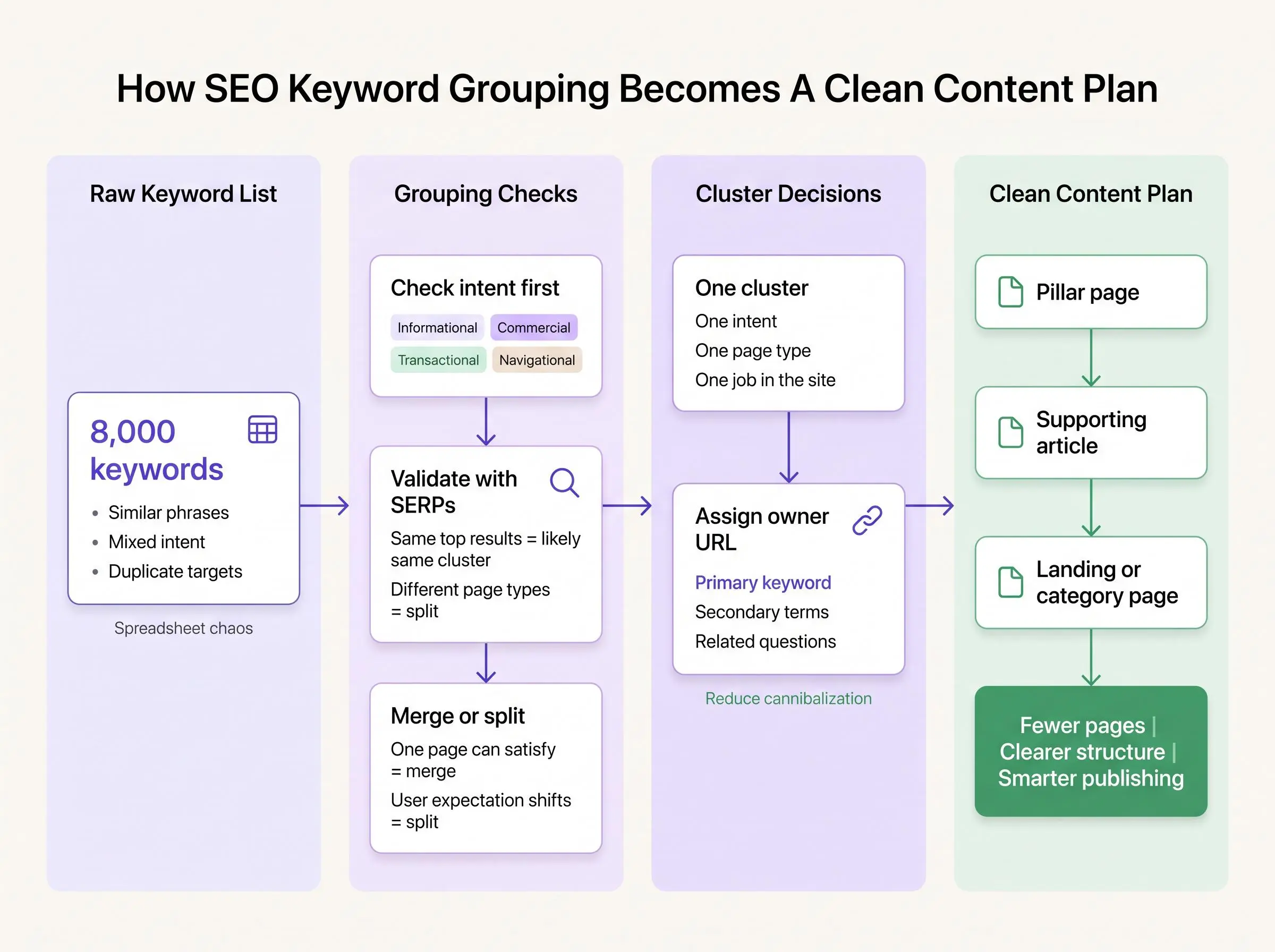
If you're looking for how to cluster keywords for content planning, keep it operational. The output should be a page plan, not a prettier spreadsheet.
- Collect broadly. Pull keywords from tools, Search Console, competitor patterns, customer language, reviews, sales calls, and support tickets. Search demand matters, but customer phrasing is where useful clusters often start.
- Clean the list. Lowercase it, deduplicate it, remove junk, separate branded terms, and tag geography if relevant.
- Tag intent first. Don't mix educational, commercial, and transactional queries before you even know what they are.
- Create first-pass groups. Use parent topics, recurring modifiers, or semantic similarity to shrink the raw list into workable buckets.
- Validate important groups in the SERPs. Look for repeated ranking pages across terms.
- Split where expectations change. A guide, a comparison, and a landing page are not the same thing.
- Merge where differences are only wording. If the same content can satisfy them all, keep one owner page.
- Assign a primary keyword. Then add secondary terms, related questions, and must-cover subtopics.
- Name the cluster like a page concept. "Best accounting software for freelancers" is useful. A raw string dump isn't.
- Choose the content action. Create new, update existing, merge overlap, split a bloated page, or support through internal links.
By the second pass, your list should stop looking like keyword research and start looking like a publishing backlog. That's the point.
How to Turn Keyword Groups Into a Content Architecture
Grouping only matters if it ships. This is where content cluster planning starts to pay off.
Every cluster should have one owner URL. One page owns the core intent. Everything else supports it, expands it, or converts it.
Common page roles usually look like this:
- Pillar pages for broad, high-value topics
- Supporting articles for subtopics, questions, use cases, and comparisons
- Category or landing pages for commercial and transactional intent
A hub-and-spoke structure works because it gives each page a job. The pillar handles the broad topic. Supporting pieces deepen coverage and create internal link paths that make sense to both users and search engines.
The hard part is deciding when one group belongs on one comprehensive page versus several connected pages. Our rule is practical: if the page can satisfy the shared intent without becoming unfocused, keep it together. If user expectation shifts, split it.
That is the heart of a cluster based content strategy. Each page should help the next page rank, not compete with it. Once you plan this way, refresh cycles get easier too. You can improve a cluster systematically instead of patching random pages.
How to Prioritize Clusters When Resources Are Limited
Most teams can't publish every cluster at once. That's normal. The mistake is pretending capacity doesn't exist.
Prioritize clusters using both traffic potential and business fit. We usually look at:
- search demand
- ranking difficulty
- intent value
- product or service relevance
- existing site authority
- refresh opportunity
Lower-volume clusters often beat bigger topics when the intent is closer to revenue. We've seen plenty of teams chase the loudest keyword and ignore the page that could actually influence pipeline.
A practical way to sort the roadmap:
- Near-term wins: easier rankings, existing visibility, clear fit
- Strategic pillars: bigger topics that need sustained investment
- Longer-term authority plays: broad coverage areas that compound over time
Search Console is especially useful here. If you're already visible for a set of related queries, grouping and strengthening that cluster can outperform starting from scratch.
Business model changes the order too:
- SaaS: pain-point, alternative, and comparison clusters often lead
- Ecommerce: category, use case, and buyer-modifier clusters matter early
- Service businesses: local, solution, and industry-specific intent groups usually come first
Scalable planning isn't about publishing faster. It's about sequencing intelligently.
Worked Examples of Grouping Keywords Into Topics

Examples make this click faster than theory.
Take best project management software, top PM tools, and project management app. In many cases, those can live on one comparison page if the SERPs align. Creating separate pages for each usually dilutes authority. You end up with three pages saying almost the same thing and none of them becoming the clear winner.
Now contrast that with accounting software for freelancers, free invoicing software, and small business payroll software. These sound related at a category level, but they often serve different needs and page types. One is audience-specific, one is cost-sensitive, one is function-specific. That should usually split.
A programmatic-style example shows why flat publishing can get dangerous. Broad terms around hydroponic systems may need a hierarchy:
- informational guides
- product-focused pages
- method-specific pages
If you flatten that into dozens of similar templates, the site gets noisy fast.
Modifier-driven splits matter too. Best dog food may not belong on the same page as best dog food for allergies or best grain-free dog food if the results show distinct expectations.
The planning outcome should be clear:
- one cluster becomes one owner page
- one cluster becomes a pillar with several support pages
- one cluster gets discarded because it doesn't fit the business or page strategy
Discarding bad-fit clusters is part of good planning. Not every searchable topic deserves your effort.
Common Keyword Grouping Mistakes That Slow Growth
Most grouping mistakes aren't technical. They're operational.
Here are the ones that quietly drag performance down:
- treating every keyword variation as a separate page target
- grouping by word similarity or search volume without checking intent
- trusting automated output without reviewing important commercial topics
- ignoring country-specific SERPs
- mixing informational and transactional intent on one page
- failing to assign one owner URL per cluster
- publishing too many low-value pages too early
- skipping refresh after publishing
- building cluster plans that content teams can't actually use
One mistake deserves extra attention: publishing lots of low-value pages in large-scale or programmatic projects. It feels productive for a week or two. Then indexing quality drops, crawl attention gets wasted, and cleanup becomes harder than the original plan.
Bad grouping creates content debt. That's the part people feel six months later.
When Automation Makes Keyword Grouping More Useful, Not More Chaotic
Most teams already know clustering matters. The bottleneck is operationalizing it consistently.
Automation helps most in the repetitive parts:
- large keyword collection and cleanup
- first-pass grouping
- turning approved clusters into briefs and publishing plans
- tracking what has been published and what's still uncovered
- refreshing content when clusters shift or pages underperform
Human judgment still matters in a few places that really count:
- intent edge cases
- page type decisions
- business-based prioritization
- merge, split, or deprecate calls
This is where platforms like Intelliminds become useful without turning the process into black-box SEO. We help automate topic discovery, article writing, scheduling, publishing, and content refreshing so grouped keyword plans are easier to execute consistently. For brands and agencies, that means less manual content workload and a clearer path from research to shipped pages.
Useful automation should reduce chaos, not multiply it. If the tool gives you more output but less confidence, it's not helping.
How to Measure Whether Your Grouping Strategy Is Working
Measure performance at the cluster level, not just by single keyword rankings. One page ranking for multiple related queries is a strong sign the grouping is aligned.
You should also watch for a few operational signals:
- reduced cannibalization
- clearer owner pages
- stronger internal linking patterns
- clusters moving from research into published assets on schedule
Another important measure is the balance between new content and updates. A lot of grouping wins come from merging, refreshing, or expanding existing pages. Teams that only count new articles usually miss where the real lift came from.
Over time, authority should spread across related topics, not show up as isolated wins. And the business lens matters. Better grouping should improve qualified organic traffic, content efficiency, and contribution to acquisition goals. If rankings improve but the system still feels chaotic, something is off.
Questions Teams Commonly Ask About SEO Keyword Grouping
A few questions come up in almost every planning session.
How many keywords should be in one group?
There is no ideal count. The right size depends on whether one page can fully satisfy the shared intent. Some clusters have three obvious terms. Others have thirty variations that all belong together.
Should you group keywords before or after creating content?
Before publishing, definitely. But grouping should also continue during refresh cycles as rankings and SERPs change. Content architecture is not one-and-done.
Is grouping the same for blogs, landing pages, and ecommerce categories?
The logic is the same. Intent decides the grouping. The page type and conversion goal change how you execute it.
Do you always need SERP data to cluster accurately?
For high-value topics, SERP validation is worth it. For early-stage planning, semantic grouping can move things along faster. Use precision where the decision cost is high.
What if one keyword has much higher volume than the others?
Volume helps with prioritization and with choosing the primary keyword. It should not override intent. High volume doesn't give a keyword the right to break a cluster.
When should you split an existing page into multiple pages?
Split when one page is trying to serve distinct intents and the results show separate ranking patterns. If the page feels like it has two jobs, it usually does.
Conclusion
SEO keyword grouping turns raw keyword research into a scalable content system built around intent, structure, and compounding authority. Once you start grouping well, page decisions get cleaner, internal linking gets easier, cannibalization drops, and prioritization becomes much more confident.
Start with one topic area. Group the keywords into clear clusters. Assign owner pages. Build a publishing plan from there.
If your team is ready to operationalize the process instead of managing it by hand, Intelliminds can help move grouped research into consistent article creation, scheduling, publishing, and refresh workflows. That's the real shift. Less keyword chaos. More momentum.
Article Record
ReferencesPrimary sources used for this article
Update HistoryMeaningful revisions to this article
- Added a Google Search Central citation to the introduction on helpful, people-first content.
- Reinforced the case for keyword grouping as a way to avoid duplicate, search-first page creation.
- Updated the first section with clearer reader-facing guidance on building content around user intent.