Most teams treat search intent optimization like a keyword label, then wonder why an AI article ranks and still does nothing. The draft sounds fine. The intent is off.
What matters is the live SERP, the page type, and whether the opening answers the real job fast. We've seen solid drafts miss for simple reasons. Watch for these before you hit publish:
- A "best" query usually wants comparison logic, not a generic explainer
- A definition query needs the answer early
- If the CTA fights the page intent, traffic won't convert
What Search Intent Optimization Really Means for AI Content
Search intent optimization is the practice of aligning a page with the reason behind a query, not just the words in it. That sounds simple until you look at how most AI content gets made.
A keyword tells you what someone typed. Search intent tells you what they were trying to get done. Those are not the same thing. Someone searching for "best CRM software" is not asking for a history lesson on CRM. They’re trying to compare options and narrow a decision. If your page misses that, the draft can still sound polished and fail anyway.
This matters even more with AI-written articles because AI is very good at producing fluent, broad, plausible copy. It often sounds complete before it’s useful. That’s the trap.
Google tends to reward pages that help the searcher finish the job.
That’s the lens we use for ai content search intent. Not as a theory. As a quality control issue. If the page doesn’t satisfy the task behind the query, it usually won’t earn strong rankings, strong engagement, or meaningful conversions. Speed alone won’t save it.
The shift is straightforward but important: stop treating AI as a volume shortcut. Use it as a scalable way to produce intent-matched content.
Why AI-Written Articles Often Miss User Intent
Most misses follow the same pattern. A team picks a keyword, asks AI for a 1,500-word article, gets something clean and readable, publishes it, and then wonders why it stalls on page two.
The problem is usually not the writing. It’s the mismatch.
A keyword label like informational or commercial is only a starting guess. The real answer sits in the live SERP. If the top results are comparisons and your AI draft is a general explainer, you’re out of step before the article even loads. We see this a lot with teams that skip SERP analysis because the keyword "looks obvious." It rarely is.
AI also has a tendency to average patterns across many sources. That smoothing effect removes the sharp edges that often make content useful. You end up with an article that covers the topic broadly and satisfies no one fully.
Typical symptoms show up fast:
- High bounce rates
- Low time on page
- Weak click-through despite rankings
- Rankings stuck on page two or three
- Content that looks polished but doesn’t convert
The mismatch is usually easy to spot once you look at the query honestly:
- Best CRM software usually needs comparison-led content, not a product page
- What is payroll software needs explanation and context, not a sales pitch
- Gusto login is navigational, which makes a generic blog post a bad target from the start
No amount of polishing can rescue a page built for the wrong intent. That’s the part many teams learn late.
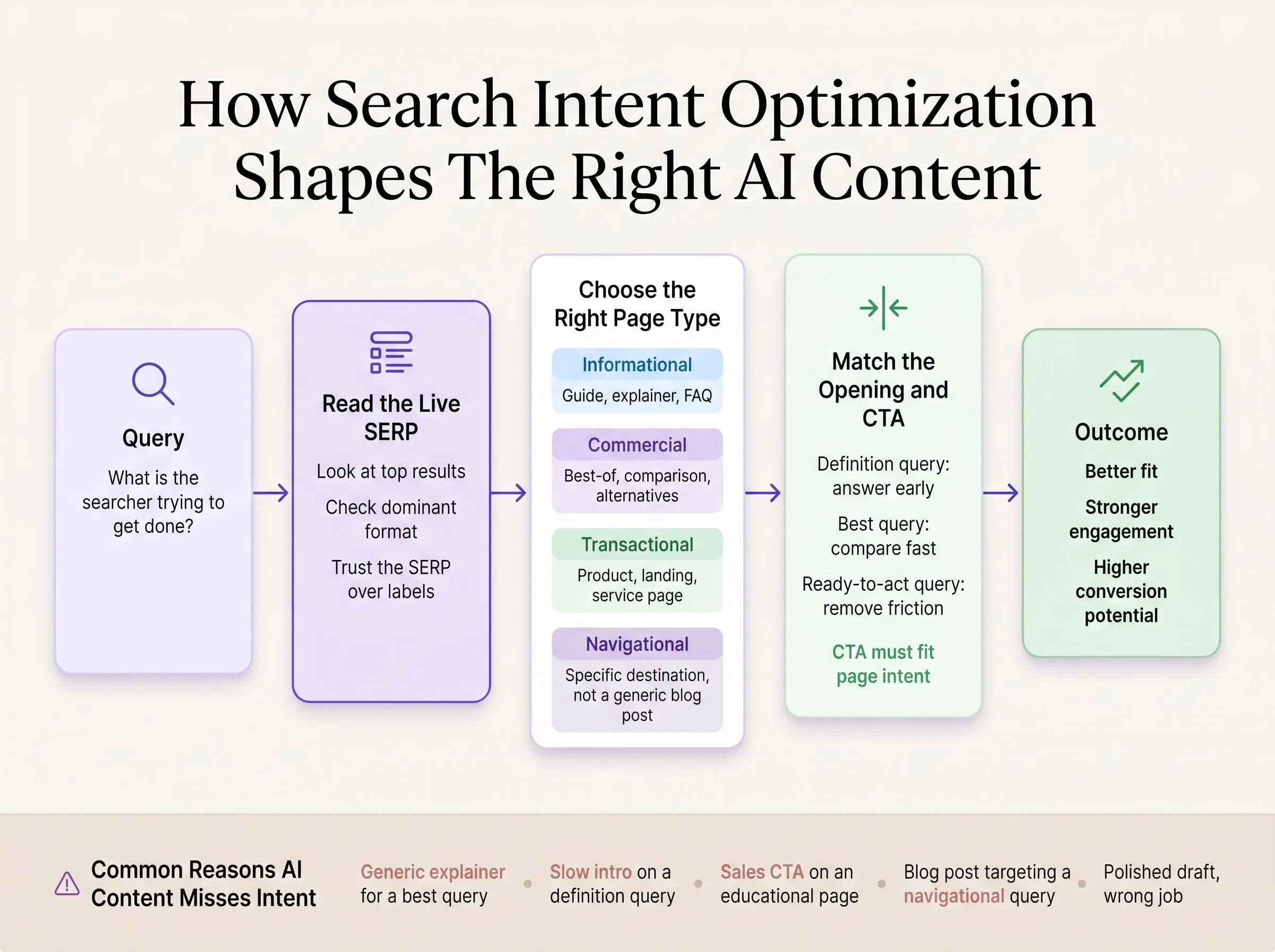
The Four Intent Types and How They Change the Article You Should Publish
You can’t match content to user intent if you haven’t chosen the right page type. This is where a lot of waste starts. Teams force every query into a blog post because blog posts are easy to generate.
Informational intent
The user wants to learn, define, solve, or understand something. These queries usually fit:
- Guides
- Explainers
- Tutorials
- FAQs
- Step-by-step blog posts
AI articles for this intent need clarity, structure, and direct answers early. If the page spends 400 words warming up, it’s already behind.
Commercial investigation
The user is evaluating options. They’re not ready to buy yet, but they’re moving. Good fits include:
- Best-of lists
- Comparisons
- Alternatives pages
- Ranked roundups
- Reviews
This is where intent based SEO writing needs actual decision logic. Not filler. Readers want tradeoffs, selection criteria, and distinctions that help them choose.
Transactional intent
The user is ready to act. Buy, book, request, sign up. They don’t need a broad educational essay. They need a clear path.
Best fits are:
- Product pages
- Landing pages
- Service pages
- Focused conversion content
If your AI draft wanders off into general education here, it creates friction. Ready-to-act traffic is easy to lose with unnecessary explanation.
Navigational intent
The user wants a specific destination. A brand, login page, category, or known resource. These queries are usually poor candidates for generic AI blog content. Trying to force them into content production is usually a traffic mirage.
Some queries carry mixed intent. Users may want education and comparison, or comparison and action. That’s normal. The key is deciding whether the SERP supports one page serving both or whether you need separate assets for separate stages.
Let the SERP Decide: How to Identify Intent Before You Write

The SERP is the most reliable signal because it shows how Google currently interprets the query. Not how a keyword tool labels it. Not how we wish it worked.
Before creating anything, review the top five to ten results and look for patterns:
- Identify the dominant content type
- Note whether winners are blog posts, product pages, comparisons, tools, videos, or category pages
- Study title patterns and repeated angles
- Check which subtopics show up repeatedly
- Compare content depth and structure
SERP features help you read intent quickly:
- Featured snippets and People Also Ask often point to informational intent
- Shopping results and product carousels usually suggest transactional intent
- Review snippets and comparison-style headlines often signal commercial investigation
- Video carousels can mean the searcher needs demonstration, not just text
Keyword modifiers can help, but they’re not enough. "Best," "how," "pricing," and "login" are clues, not answers. If modifiers and SERP disagree, trust the SERP.
For mixed-intent queries, we use a simple decision rule:
- If the SERP supports both needs on one page, serve both in a controlled structure
- If the results split by stage, choose one segment and build directly for that moment
Intent also shifts. A page that matched six months ago can drift out of alignment if Google starts favoring a different format. Teams that never revisit old pages leave easy gains on the table.
A Practical Workflow to Optimize AI Articles for Search Intent
If you want to know how to optimize AI articles for search intent consistently, you need a repeatable workflow. Not a one-off editorial rescue.
The seven-step process
Start with the business goal
Decide whether the page is meant to drive awareness, comparison, sales support, or ready-to-act demand. Traffic without stage alignment is cheap traffic.Analyze the live SERP
Confirm dominant intent. Note content format, angle, depth, and recurring sections.Define the page promise
Write one sentence describing what the reader should achieve on the page. This sharpens the brief fast.Build an intent-first brief
Include the primary query, related questions, audience, stage, format, must-cover sections, proof points, and next-step CTA.Generate the draft with the correct role
Don’t ask AI for a generic long-form article every time. Ask for the format the SERP rewards.Edit for intent alignment before SEO polish
Cut sections answering the wrong question. Add missing steps, examples, criteria, or objections. Tighten the intro so it satisfies the query quickly.Publish, monitor, and refresh
Watch engagement, rankings, and conversion behavior. Intent drift is real.
This is also where systems matter. Intelliminds is useful when you want this workflow connected end to end, from topic discovery and article generation to scheduling, publishing, and refreshes, instead of treating intent as a one-time briefing note.
How to Structure AI-Written Articles So They Match Intent Faster
Matching intent is not just about choosing the right topic. It’s also about order. Readers judge usefulness early, and search engines pick up on those signals.
An introduction should reflect the immediate goal of the query:
- Informational queries need a direct answer or definition near the top
- Commercial queries need comparison framing and buying criteria early
- Transactional queries need offer clarity, trust, and low-friction next steps
Section order matters more than many teams think. If someone wants a comparison and your article starts with a long industry overview, you’ve delayed the value. That delay costs attention.
A few structure patterns usually work well:
- Informational pages: answer first, then explanation, steps, examples, FAQs
- Commercial pages: quick recommendations, comparison criteria, side-by-side distinctions, selection guidance
- Transactional pages: offer clarity, proof, objections, action path
There’s also a depth issue. Too shallow for a learning query creates dissatisfaction. Too long for a simple transactional or navigational need creates drag.
One practical rule: use subheads that mirror real searcher questions. Generic headings like "Benefits" or "Overview" often signal lazy structure. They also hide the answer.
Intent-Based SEO Writing: What to Change Inside the Draft
Once you’ve identified intent, the draft itself has to reflect it. This is where intent based SEO writing becomes operational, not theoretical.
Informational content should define, explain, and guide. Commercial content should compare, rank, weigh, and recommend. Transactional content should clarify benefits, proof, pricing context, and next steps. Different verbs. Different job.
Review these on-page elements for intent fit:
- Title tag and headline
- Meta description
- Intro paragraph
- Subheads
- Calls to action
- Internal links
- Visuals, tables, and examples
The angle should match what the reader is trying to accomplish, not what the brand wants to say first. That’s a discipline problem more than a writing problem.
Useful formats often depend on the SERP:
- Direct answers and short summaries for informational queries
- Comparison tables and ranked criteria for commercial queries
- Checklists, proof points, and action steps for transactional queries
Trust signals matter even more in AI-written content. Add context, real reasoning, and grounded examples. Remove fluffy transitions and empty conclusions. The page should feel purposeful, not machine-expanded.
For different business models, the pressure points change:
- Ecommerce usually needs stronger comparison logic and product selection help
- SaaS often needs use cases, alternatives, and implementation context
- Service businesses usually need problem-specific, local, or outcome-oriented framing
How to Match Content to User Intent Across the Funnel
Intent is not just an SEO label. It’s part of the buyer journey. Once you see that, content planning gets cleaner.
Early-stage curiosity usually maps to educational posts and explainers. Mid-stage evaluation fits comparisons, alternatives, and best-of pages. Late-stage action belongs on product, service, demo, or signup pages.
Trying to force one article to do all three jobs usually weakens the page. We’ve seen this over and over. A page that tries to educate, compare, and convert at once often does none of them well.
Internal linking is how you connect the stages:
- Informational article to comparison page
- Comparison page to product or service page
- Product page to support or FAQ content
The best AI content systems build journeys, not isolated posts.
That matters if you want to optimize blog posts for intent in a way that supports customer acquisition, not just pageviews. The next logical action should shape the page.
Common Mistakes That Sabotage AI Content Search Intent
Most failures come from a small set of habits. They look harmless at briefing time and expensive three months later.
Common mistakes include:
- Targeting a keyword without checking the live SERP
- Treating intent labels as fixed truth instead of a working assumption
- Publishing a guide when the SERP rewards a comparison page
- Publishing a product or service page when the query is clearly educational
- Writing every article in the same tone, length, and structure
- Overloading pages with top-of-funnel education when the reader is ready to evaluate
- Ignoring mixed intent and never deciding which segment the page serves
- Optimizing around keywords while missing the job the user is trying to complete
- Failing to revisit older content when Google shifts the dominant intent
AI makes these mistakes easier to scale. That’s the danger. A weak process with fast output just gives you more underperforming pages, faster.
How to Measure Whether an AI Article Is Truly Aligned With Intent
Rankings matter, but rankings alone don’t prove intent fit. A page can rank modestly and still be useful. It can also rank briefly and fail to engage or convert.
A practical scorecard helps:
- Does the page type match the dominant SERP pattern?
- Does the intro answer the implied question quickly?
- Does the article include the format elements users expect, such as steps, comparisons, or product details?
- Does the page keep readers engaged instead of sending them back to search?
- Does it drive the next action that fits that stage?
Watch the supporting metrics too:
- Click-through rate
- Bounce behavior
- Time on page
- Scroll depth
- Conversion actions
- Ranking movement after revisions
Sudden ranking drops aren’t always about stronger competition. Sometimes the query intent shifted and your page didn’t. Quarterly review of priority pages against the live SERP is usually enough to catch those changes before they compound.
Building a Scalable Intent-First Content Engine With AI
If you’re a brand or agency trying to scale output, this is the real game. Not just drafting faster. Building a system where research, writing, publishing, and refreshing work together.
A scalable process usually looks like this:
- Cluster topics by audience need and funnel stage
- Validate intent before writing
- Create templates for each intent type
- Apply editorial review for alignment
- Refresh content when SERP patterns change
Scale without intent creates more low-performing pages. Scale with intent compounds relevance, topical authority, and customer acquisition. That’s a very different outcome.
This is a workflow challenge as much as a writing challenge. The teams that win here don’t just have better prompts. They have tighter operating systems. Intelliminds fits that kind of team well because it combines topic planning, article generation, publishing schedules, and ongoing refreshes around your audience, offerings, and existing content, which reduces manual workload without turning content into a blind volume exercise.
Conclusion
Search intent optimization is the logic that makes AI-written articles useful, rankable, and more conversion-minded. Without it, fast publishing just creates faster waste.
The process is not complicated, but it does require discipline: read the SERP, identify the real intent, choose the right page type, structure the content around the user’s job, and refresh when intent shifts.
If you have one underperforming AI article, review it today through an intent lens before rewriting anything. Often the issue isn’t the wording. It’s the mismatch underneath it.
Build an intent-first workflow, and AI becomes a growth partner. Not just a content production shortcut.