
If you are scaling organic, you do not need more content. You need a content ops framework that stops SEO work from turning into scattered briefs, late approvals, and posts nobody refreshes.
What matters is whether your ideas move cleanly from research to publish to update, with a owner at each step. That is where growing brands, SaaS teams, ecommerce shops, and agencies get stuck.
Before you scale, get these straight:
- An editorial calendar will not fix a handoff.
- If nobody owns refreshes, traffic decays in silence.
- More writers or more AI only help when the workflow is already tight.
What a Content Ops Framework Actually Is
A content ops framework is the system that runs the full content lifecycle. Not just planning. Not just writing. The whole thing from topic selection to drafting, publishing, measurement, refreshes, and eventually retiring pages that no longer earn their keep.
It helps to separate three ideas that teams often blur together:
- Content strategy decides what to create and why
- Content operations decides how that work gets done reliably
- Content management stores and organizes assets inside tools like your CMS
Those are not the same job. Strategy can be sharp and still fail in execution. A clean CMS won’t save a broken workflow either.
An editorial calendar is also not a content ops framework. A calendar shows dates. It doesn’t tell you how research gets translated into briefs, who owns review, what happens when a publish date slips, or how old articles get refreshed six months later when traffic softens.
That execution layer is the real system. It turns topic ideas into consistent output and measurable acquisition. Without it, SEO stays fragile. With it, SEO becomes a dependable operating function.
Scaling content is usually less about making more and more about making the system stop leaking.
Why Most SEO Content Programs Break as They Grow
Most teams don’t hit a content ceiling because they run out of ideas. They hit it because every article becomes a custom project.
You see the signs early:
- publishing dates slip for reasons nobody can explain cleanly
- article quality swings from strong to shaky
- briefs take too long and still miss key context
- research lives across docs, tabs, and random notes
- approvals keep reopening settled decisions
- nobody owns refreshes once a post is live
This shows up across SaaS, ecommerce, agencies, startups, and service businesses. Different teams, same failure pattern. Work depends on a few people remembering everything and pushing everything forward manually.
Adding more writers rarely fixes that. More AI prompts don’t fix it either. If the workflow is broken, all you’re doing is increasing the speed of inconsistency.
A lot of fragile traffic comes from a reactive model. One post gets requested. One brief gets made. One article gets published. Then everyone starts over from zero. That is not a content engine for organic growth. It’s repeated effort with very little compounding effect.
The pressure is higher now because search behavior no longer lives in one place. Traditional SERPs still matter, but AI answer engines are now part of discovery too. Fragmented processes create visibility gaps in both environments.
The real goal is simpler than most teams make it.
Move from heroics to rhythm.
The Core Components of a Scalable Content Ops Framework
A scalable content ops framework has a few core parts, and if one is weak, the rest usually wobble with it. You need strategy alignment, workflow design, role ownership, quality control, publishing infrastructure, measurement, and refresh loops.
Teams often over-invest in creation because that’s the most visible part. Articles feel productive. But mature operations connect planning, production, publishing, performance, and preparedness. If you only optimize drafting, you’ll still get stuck later in review, formatting, or refresh.
The components that make this work at scale are not glamorous:
- repeatable templates
- clear workflow stages
- automation where repetition is highest
- metrics that expose delays and quality issues
- shared visibility across SEO, editors, writers, SMEs, and leadership
Good systems support both velocity and consistency. You should not have to choose one. If you do, the framework is incomplete.
There’s also a maturity curve most teams move through:
- Ad hoc
Everything is manual and personality-driven. - Templated
Basic structure exists, but a lot still depends on human follow-up. - Automated
Repetitive steps are systematized. - AI-assisted
Research, drafting, routing, scheduling, and refresh support are built into the operating model.
Most teams sit somewhere between templated and automated. The jump to AI-assisted is where people get sloppy. They add tools without redesigning handoffs. That’s how you end up with faster chaos.
Start With Strategy Alignment, Not Production Volume
Before you optimize workflow, make sure the work deserves to exist. That sounds obvious, but this is where a lot of SEO programs quietly waste a quarter.
Content operations should start with business goals. Organic traffic matters, but traffic alone is not the target. For growing brands, the actual outcomes are things like product discovery, category education, qualified pipeline, and customer acquisition.
Every engine needs a defined set of inputs:
- target audience segments
- core products or services
- priority use cases
- search intent patterns
- topic clusters
- content gaps
Then build a backlog that’s ranked by four things: strategic fit, search opportunity, business value, and effort. If a topic can rank but doesn’t support your audience or offer, it belongs lower on the list. Sometimes much lower.
A strong content ops framework protects against vanity output. It keeps teams from publishing articles that look productive in a dashboard but don’t move the business.
Different content types should do different jobs:
- educational posts for discovery
- comparison or alternative pages for consideration
- use case content for conversion support
- refreshes for protecting existing gains
This is also how you build a compounding blog strategy. Cluster-based planning means each new article strengthens a broader topic position instead of sitting alone as a disconnected page. Over time, the domain gets clearer, not just larger.
Build the Engine Around the Full Content Lifecycle
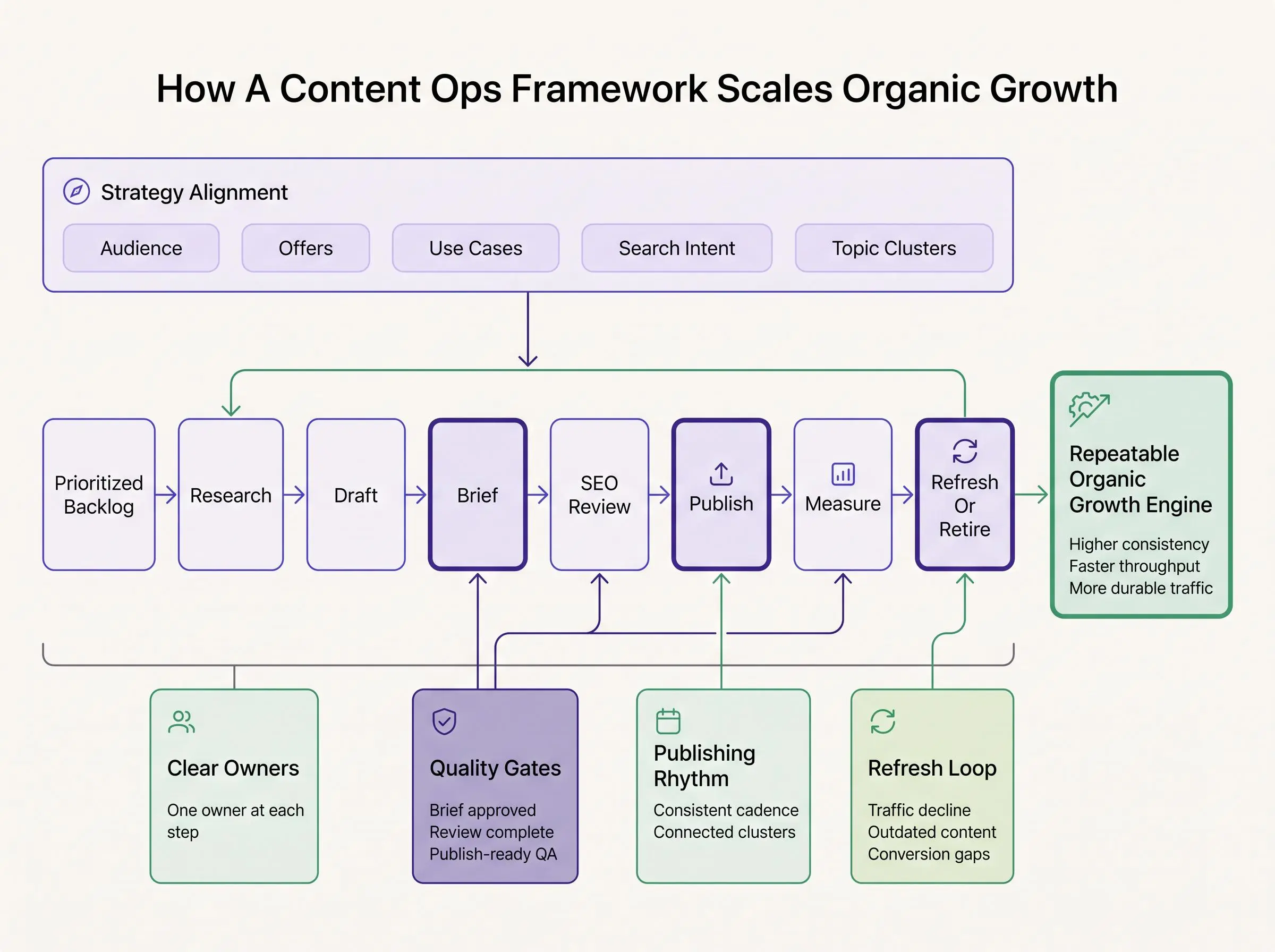
If you want a repeatable SEO content system, build around the full lifecycle, not just the draft.
The stages are straightforward:
- topic discovery
- prioritization
- research
- brief creation
- drafting
- editing
- SEO review
- CMS formatting
- scheduling
- publishing
- performance tracking
- refresh or retirement
What breaks teams is not the existence of these steps. It’s the assumption that some of them can stay informal. Research handoff gets fuzzy. Publishing QA is rushed. Post-publish maintenance gets deferred until nobody remembers what the original page was meant to do.
Each stage should create a clear output for the next one. A brief should answer enough that the writer isn’t rebuilding the strategy. Editorial review should produce specific revisions, not general discomfort. Publish readiness should mean the page is actually ready, not “close enough.”
Document entry and exit criteria. Not in a giant operations playbook nobody reads. Just make the standards visible and usable.
A true content engine for organic growth is circular, not linear. Performance data should feed back into planning. Refreshes are not cleanup work. They’re part of the system.
Define Roles, Ownership, and Handoffs Before You Scale
Unclear ownership will bottleneck a promising content program faster than low traffic. Work doesn’t fail because nobody cares. It fails because everyone assumes someone else has the next step.
At minimum, assign explicit owners for:
- roadmap and prioritization
- research and briefs
- writing
- editing
- SEO optimization
- CMS publishing
- analytics and refresh decisions
The shape of those roles changes by team size. A solo marketer may wear five hats. A lean in-house team may share execution. A larger team or agency may split work across specialists. That’s fine. The job still needs an owner.
One operator rule we’ve learned: if SME input is required, define the review window upfront. Otherwise it becomes an invisible dependency that slows everything without showing up in the workflow.
Simple service-level expectations help a lot. Two business days for editorial review. One business day for final approval. If feedback misses the window, the piece moves forward or gets rescheduled intentionally. Limbo is not a workflow state.
Human effort should go toward judgment, brand voice, prioritization, and fact-checking. Repetitive operational work is where automation should carry the load.
How to Build an SEO Content Engine That Is Actually Repeatable
Repeatability comes from standardization in the right places. Not from heavy process. Not from endless documentation.
Start with a few operating rules:
- one intake path
- one brief format per content type
- one visible workflow
- one quality standard
- one publishing cadence
Brief templates matter more than most teams think. A useful brief should include:
- primary keyword
- secondary keywords
- search intent
- target reader
- article angle
- required questions to answer
- internal link targets
- relevant product or service context
Then add quality gates at the moments where work usually slips:
- no draft without an approved brief
- no publish without editorial and SEO review
- no refresh without updated links and current data
Batching helps too. Research three related cluster articles together. Review a set of refreshes in one pass. Context switching kills throughput by the second afternoon, even on good teams.
And don’t confuse aggressive volume with a repeatable SEO content system. A stable weekly cadence beats a heroic burst followed by silence. That’s how you build an SEO publishing machine that lasts.
Make Research the Fuel for the System, Not a Separate Task
Research is often the first major bottleneck because too many teams treat it like pre-work instead of core work. Then writers have to redo it mid-draft, and the whole system slows down.
Strong research goes beyond keyword lists. It should include:
- search intent mapping
- SERP pattern analysis
- related question discovery
- topic gap analysis
- internal content gap analysis
- entity and subtopic coverage
That matters even more now because modern discovery is split. Traditional Google results don’t fully represent what answer engines surface. If you only research one environment, you’re making assumptions the content may not survive.
The important operational move is turning research into reusable inputs. Writers should not start from a blank page with a keyword and a due date. They need audience context, product context, content gaps, and clear direction on how the topic fits the broader site.
That’s how you build a compounding blog strategy in practice. Every article reinforces a topic system. Research isn’t just helping one page rank. It’s strengthening the whole domain.
Use AI to Remove Operational Drag, Not Editorial Judgment
AI fits naturally inside a content ops framework when it handles the heavy operational lift. Topic discovery, research synthesis, first drafts, workflow routing, scheduling, publishing assistance, refresh identification. That’s where it earns its keep.
Human involvement still matters where trust and differentiation live:
- editorial judgment
- fact-checking
- nuance
- brand voice
- final approval
The most common misuse of AI is simple. Teams use it to accelerate a weak process and publish more low-trust content faster. That rarely ends well.
AI-assisted production should be treated as pipeline redesign, not a writing shortcut. The benefit is leverage. Fewer manual resets between tools. Less copy-pasting context. More time spent on decisions that improve performance.
That’s the reason platforms like Intelliminds are useful in this category. It can automate topic discovery, article writing, scheduling, and publishing around your website, audience, offers, and existing content. For lean teams, that can remove a surprising amount of coordination work without forcing humans out of the loop.
Design Quality Control Into the Workflow
Speed without quality control gets expensive fast. Not always immediately. But eventually.
Your standards should be explicit enough that reviewers can make pass-fail decisions without turning every piece into a debate. Define expectations for:
- factual accuracy
- intent match
- structure and readability
- topical completeness
- voice consistency
- internal linking
- publish-ready formatting
Review should happen in stages. Editorial review first. SEO review next. Brand or stakeholder review only when needed. Then pre-publish QA. Collapsing all feedback into one final pass sounds efficient until five people reopen the article from five different angles.
Often the fix isn’t adding reviewers. It’s reducing them. More reviewers usually means more subjectivity, not more quality.
Quality at scale comes from standards, not from last-minute rescue work.
Use checklists. They make judgment more consistent and keep preferences from masquerading as requirements.
Build a Publishing and Distribution Rhythm That Compounds
Publishing consistency is not just a nice habit. It’s an operating signal. It proves the system is real.
Set a recurring schedule that matches actual capacity. Weekly is enough for many teams if the articles are strategically connected and consistently shipped. Aspirational calendars are one of the fastest ways to damage trust in the workflow.
Your publishing rhythm should map to:
- topic clusters
- seasonal demand
- product launches
- refresh windows
At the publish stage, a few details matter more than people admit:
- final QA
- metadata completion
- internal links checked
- correct category placement
- scheduling accuracy
- a basic distribution plan
A blog only becomes a content engine for organic growth when the posts are connected through topic structure and internal linking. Regular publishing alone is not enough. A pile of disconnected posts is still a pile.
For teams that want one system for planning, article generation, and weekly publishing schedules with less manual coordination, Intelliminds is relevant here too. Especially if you want self-serve execution instead of stitching together a stack.
Create a Refresh Loop So Traffic Becomes More Durable
The best content engines don’t stop at publish. They protect what they’ve already built.
Refreshes are a growth function, not maintenance debt. They preserve rankings, keep pages current, and improve the return on assets you already paid to produce.
Common refresh triggers include:
- traffic or ranking decline
- outdated examples or stats
- new product or market context
- weak conversion performance
- incomplete topic coverage
- broken internal links
Refresh workflows should have their own queue, criteria, and owner. They are not the same as net-new production, and treating them as side work is why older assets quietly decay.
This is a big part of a compounding blog strategy. Older pages keep contributing instead of fading while all attention moves to net-new output.
AI can help here as well by surfacing aging pages, identifying update opportunities, and making refreshes operationally sustainable rather than sporadic.
Measure the System Like an Engine, Not Just a Set of Articles
If you only measure traffic, you’ll miss the mechanics causing the result.
A true seo publishing machine should be observable at two levels: workflow performance and business performance.
Operational metrics might include:
- time from idea to publish
- backlog depth
- on-time publishing rate
- review cycle time
- first-pass acceptance rate
Outcome metrics should include:
- rankings and impressions
- organic traffic by cluster
- conversions or assisted pipeline
- refresh lift versus net-new lift
- visibility across AI discovery surfaces where relevant
Measure by cluster and content type, not just by individual article. One post can underperform while the cluster is gaining traction. Another post can rank but fail commercially. Both are useful signals if you structure the measurement correctly.
If the system is measurable, it becomes diagnosable. Then improvable.
The Most Common Mistakes That Break a Content Engine
Most failures are not mysterious. They’re repeated, boring, and avoidable.
Here are the ones we see most often:
- publishing more before fixing bottlenecks
- treating strategy and operations as the same thing
- overbuilding process for edge cases instead of standardizing the repeatable work
- using too many disconnected tools
- relying on AI for final judgment
- letting reviews stay open-ended and subjective
- ignoring refreshes because net-new feels more urgent
- measuring traffic without measuring throughput, quality, and conversion mechanics
- creating content that ranks but doesn’t support the audience or business
The pattern underneath all of these is the same. Teams chase output while the system underneath stays unstable.
A Practical 90-Day Rollout Plan for a Lean Team

You do not need to automate everything at once. In fact, you shouldn’t.
A lean team can make real progress in 90 days with a narrow, dependable rollout.
Days 1 to 30
- audit the current workflow
- map the bottlenecks
- define goals and core KPIs
- identify priority clusters
- document roles and ownership
Days 31 to 60
- create brief templates and review checklists
- set up one visible workflow
- launch one repeatable content type
- establish a realistic publishing cadence
- build the first refresh queue
Days 61 to 90
- automate repetitive steps
- batch production by cluster
- tighten approval windows
- compare planned versus actual throughput
- refine quality gates based on missed handoffs or delays
The practical note here is simple: one dependable workflow beats a half-built operating maze every time.
If you want to reduce manual topic research, drafting, scheduling, and publishing work without building a complex stack from scratch, Intelliminds is a sensible starting point.
Conclusion
A content ops framework is what turns SEO from fragile, one-off output into a repeatable engine for organic acquisition.
The shift is straightforward, even if the work takes discipline: align strategy, define ownership, standardize the workflow, build quality gates, publish consistently, and refresh systematically. That’s how you build an engine instead of a backlog.
The point is not to remove humans from content. It’s to remove preventable operational drag so humans can focus on judgment, differentiation, and brand clarity.
Start by auditing your current system and standardizing one high-impact area first. Briefs. Reviews. Publishing cadence. Refreshes. Pick the place where work keeps breaking and fix that layer properly.
And if you want to operationalize the system faster, it may be worth exploring Intelliminds. The platform includes a free trial with 3 free articles, which is a practical way to test a more automated approach without committing your whole process on day one.