
SEO content mapping usually gets reduced to a keyword sheet, and that's where the mess starts. You publish more, rankings blur, and three pages chase the same term.
What matters is page role, search intent, and how each piece connects before you write a word. Treat this like an operating guide, not content about content.
A few things to watch:
- Map one primary intent to one page. No shared homes.
- Audit old posts first. Cannibalization usually starts there.
- Build the links before volume. You'll leave with a cleaner plan.
What SEO Content Mapping Actually Means
SEO content mapping is the process of assigning keyword clusters, search intent, and business goals to the right pages across your site. It sounds simple. In practice, it's the difference between building an SEO system and just publishing articles.
A lot of teams think they have a map because they have a keyword sheet or a blog calendar. They don't. A keyword sheet tells you what exists. A calendar tells you what ships next. Neither one tells you how the pieces work together.
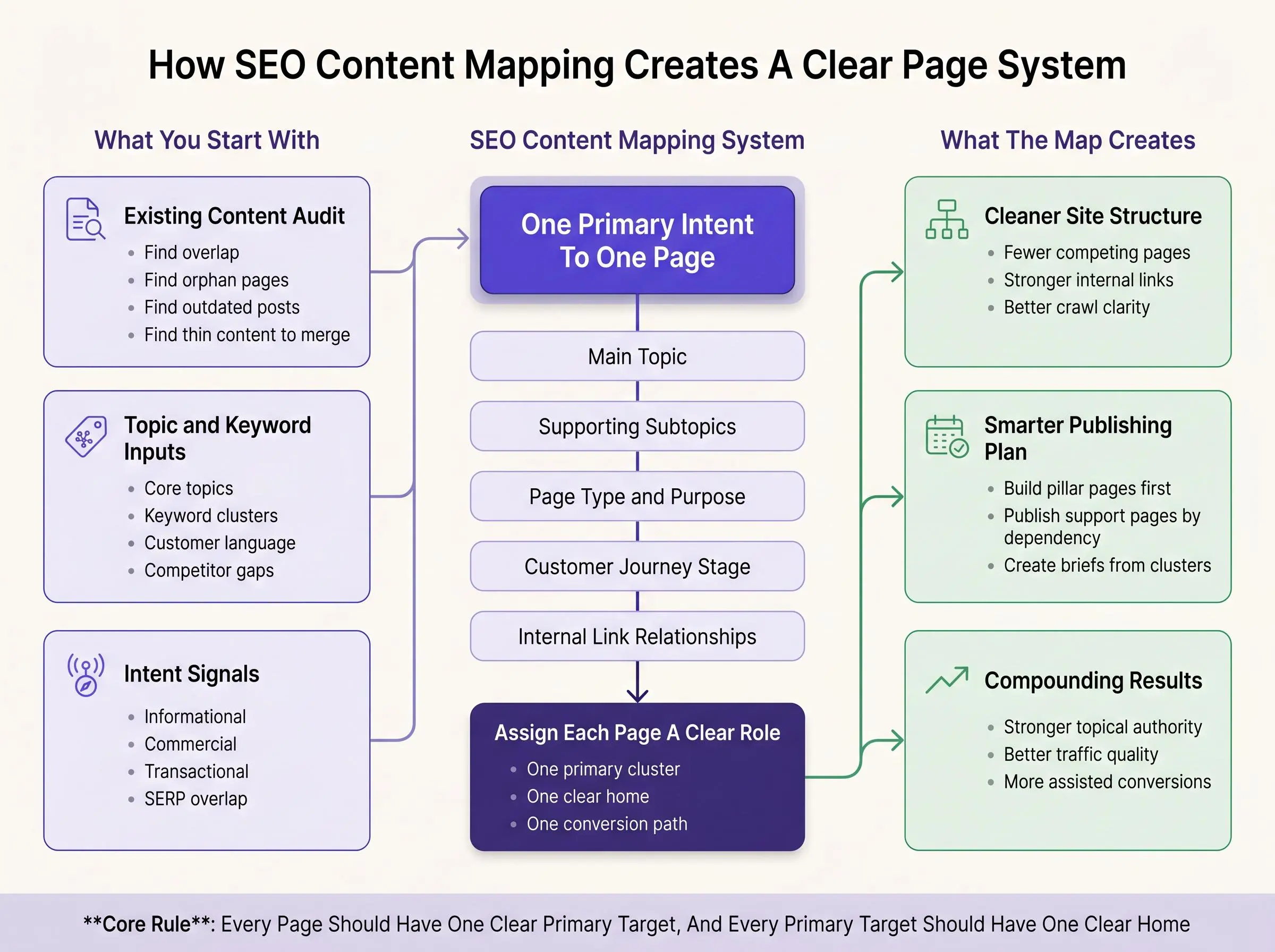
A real seo content mapping system connects five layers at once:
- topics you want to own
- keyword clusters tied to those topics
- page purpose and format
- internal link relationships
- customer journey stage
That structure is what reactive publishing misses. When teams create one article per keyword without a larger model, they usually end up with overlap, weak internal links, and content that ranks in pockets but doesn't compound.
The promise here is practical. Fewer random articles. Clearer priorities. Stronger topical depth. Less wasted production. As Google Search Central notes, helpful content should be made for people first, with substantial value rather than pages created mainly for rankings.
The map is the strategy. The articles are just the output.
Why Growing Brands Need Content Mapping Before They Need More Content
Most growing brands don't have a content shortage. They have a coordination problem.
By the second or third quarter of serious SEO work, the symptoms are obvious. More keywords. More briefs. More pages. Still no clear answer to whether the library is building authority or just getting bigger. That's the scaling trap.
Content mapping changes the job. Instead of treating SEO like a production treadmill, you start treating it like an acquisition channel with defined roles and dependencies. That shift matters more than most teams expect.
Here’s what improves when the map comes first:
- keyword cannibalization drops because page ownership is clearer
- internal linking gets stronger because pages are built to support each other
- crawl and index efficiency improve because the site structure makes more sense
- content gaps become easier to spot
- outdated pages stop hiding in plain sight
For SaaS, ecommerce, service brands, and agencies, this isn't abstract. Better maps support product discovery, lead generation, pipeline influence, and a better return on existing content budgets.
Lean teams feel this fastest. When every page already has a role before writing starts, decision fatigue drops hard. You stop debating from scratch every Monday.
SEO Content Mapping vs Keyword Mapping vs Topical Maps
These terms get collapsed together all the time, and that usually leads to sloppy planning.
A topical map defines the subject territory your brand wants to cover. It answers a strategic question: what do we want to be known for, and what subtopics do we need to cover credibly?
Keyword mapping is narrower. It assigns one primary keyword or keyword cluster to one page so pages don't compete with each other.
SEO content mapping sits above both. It combines topic architecture, keyword assignment, intent alignment, and content planning into one operating model.
A simple rule helps:
- Every page should have one clear primary target.
- Every primary target should have one clear home.
That rule sounds obvious until you review a real site. Then you find three articles chasing the same query from slightly different angles, plus a product page that should have owned the term all along.
Content clusters are the published result. The map is the planning layer that decides what gets built, what gets merged, and how everything connects.
The Five Elements of a Scalable SEO Content Map
If the map won't scale, it won't survive contact with a real content program. We keep it grounded in five elements.
Main topics
These are the core subjects tied directly to your product, service, or market position. If a topic can't reasonably support demand and connect back to what you sell, it probably doesn't belong.
Supporting subtopics
This is where depth comes from. Use cases, comparisons, workflows, implementation questions, and adjacent problems. These pages do more than pull traffic. They create relevance around the main topic.
Search intent
Intent decides page type. An educational query needs a guide. A comparison query needs evaluation content. A transactional query belongs on a category, service, or product page. Get this wrong and the rest of the work fights uphill.
Customer journey stage
Awareness, consideration, decision. If your map only serves awareness, you'll build traffic and still wonder why pipeline feels thin.
Internal link relationships
You need to see how pillar pages, supporting pages, and conversion pages reinforce each other. A page without link relationships is usually a page without a job.
Some teams manage this in a spreadsheet. Others use a content planning system or platform. The tool matters less than visibility. If these five layers aren't visible in one place, the map won't guide execution.
Start With What You Already Have, Not Just What You Want to Publish
Before adding new topics, audit the site you already have. Otherwise you're mapping on top of old confusion.
Inventory current pages and posts. Look at what exists, what ranks, what overlaps, and what's missing. This is the reality check most brands skip because it's less exciting than ideation. It's also where a lot of easy wins live.
A useful audit should surface:
- orphan pages with weak or missing internal links
- multiple pages targeting similar terms
- outdated pages that need refreshes
- thin articles that should be consolidated
- high-potential pages that need better support
Use site data, search performance data, and page-level keyword visibility to understand what each page is already associated with. Teams are often surprised here. A page they thought was about one term may already be getting impressions for a more valuable cluster. That's not a small detail. It changes what you build next.
Old content doesn't disappear just because nobody owns it. It keeps competing.
Define the Topics Your Brand Should Actually Own
This is where boundaries matter. Without them, keyword research turns into hoarding.
Start with a few direct questions:
- What is the site's core focus?
- What do you want the brand to be known for?
- Which themes connect products, services, and customer problems?
- Where should the topic boundary stop?
Topic selection should pass three filters:
- relevance to the brand
- usefulness to the audience
- business potential
Miss one of those and the map gets weak fast. High-volume topics that don't connect to what you sell are usually expensive distractions.
In practice, the shape varies by business:
- SaaS brands often map feature, workflow, use case, and integration topics
- ecommerce brands map categories, buying questions, and product use cases
- service businesses map problems, solutions, and local or industry pages
- agencies map service lines, proof content, and demand capture pages
We've seen brands lose months chasing traffic that looked attractive in a tool but had no path to qualified demand. Search volume is not a strategy.
Gather Keyword Ideas Without Losing Strategic Focus
Keyword research is raw material. It is not the map.
Pull ideas from multiple sources so you don't inherit the blind spots of any one tool:
- keyword tools
- Search Console
- autocomplete and related searches
- People Also Ask
- competitor topic coverage
- sales and support language
Customer-facing language is often the most underrated source. It shows how buyers describe the problem before they know the category term. That's useful if you want content that actually meets demand instead of just mirroring SEO software.
AI can help expand related subtopics and question sets quickly. It's good at breadth. But someone still has to filter for relevance, intent, and business value. If you skip that judgment, you just get a larger pile.
Capture informational, commercial, and navigational variations around each core topic. Then stop. The goal isn't the biggest list. It's the cleanest set of useful inputs.
Group Keywords by Search Intent, Not Just Similar Words
This is the step that usually separates scalable SEO from content chaos.
A lot of teams group keywords by wording alone. If terms look similar, they treat them as one page. If terms look different, they split them into different pages. Search doesn't work that way.
To group keywords by search intent, cluster queries that call for the same page type, satisfy the same user need, and tend to rank similar results. That's the basis of keyword clustering for seo content that reflects how search engines actually interpret queries.
The practical test is SERP overlap. If several of the same URLs rank across multiple queries, search engines likely treat those queries as the same underlying intent. If the results diverge, the intent probably does too.
For each cluster, look for:
- the dominant page format
- the main question or task
- required subtopics
- the likely conversion path
Some patterns are straightforward:
- broad educational terms belong on guides
- product-led problem queries belong on solution pages
- comparison terms belong on evaluation content
- transactional terms belong on category, service, or product pages
This is also where many teams over-split. One strong page often beats three thin ones built around minor wording differences. If the intent is the same, separate pages usually create internal competition, not extra reach.
Build Topic Clusters That Support Real Site Architecture
Once you've clustered by intent, you can turn research into site structure.
The model is simple:
- Merge same-intent keywords into one page target.
- Group related page targets into broader topic clusters.
That creates a working structure of pillar pages, supporting articles, and commercial pages that reinforce each other. The important part is not the diagram. It's the connection to the actual site.
Topic clusters for blog automation only work when the blog is tied to the rest of the site. If supporting articles never connect meaningfully to product, category, or service pages, you get a content island. Traffic may show up. Business impact usually doesn't.
Sequence matters too. Publish by dependency, not just search volume. Foundational pages and pillar assets usually come first because later pages rely on them for internal linking and topical context.
A topic may deserve:
- one comprehensive page if the intent is broad but unified
- multiple supporting pages if sub-intents are meaningfully distinct
- a cluster tied directly to a money page if discovery and conversion are closely linked
- consolidation if you already have weak pages competing for the same ground
Assign One Clear Role to Every Page
This is the operating rule that keeps the system clean: one primary keyword cluster, one main intent, one core page purpose.
Define that before writing starts. Not after draft two.
We recommend tracking a few fields for every page in the map:
- target cluster
- primary intent
- page type
- buyer journey stage
- supporting subtopics
- internal links in and out
- business goal
That turns an idea list into an executable system. It also makes collaboration easier because strategists, writers, editors, SEO leads, and stakeholders can all see why the page exists.
If a page can't be described in one sentence, it probably isn't scoped tightly enough. That sounds strict. It saves a lot of rewriting.
Turn Keyword Clusters Into Stronger Content Briefs
Good briefs don't start from scratch each time. They come from the map.
Content briefs from keyword clusters should include the cluster itself, the dominant intent, required headings, likely reader questions, internal link targets, the desired conversion action, and notes on angle and depth. Without that structure, writers tend to drift toward generic content that sounds fine and performs inconsistently.
A useful brief usually covers:
- primary cluster and secondary terms
- dominant intent
- required headings and subtopics
- likely reader questions
- internal linking targets
- desired conversion action
- notes on angle, depth, and differentiation
Brief quality is a leverage point. When the cluster is defined well, brief creation gets faster and more consistent across teams. That's where platforms like Intelliminds help. We can generate structured briefs from mapped topics and keyword clusters so the manual prep shrinks without losing the strategic frame.
Fast is good. Fast and vague is expensive.
Where Automation Helps, and Where It Can Hurt

Everyone wants leverage. Fair enough. The mistake is using automation to produce more disconnected content faster.
Automation helps most with repetitive, high-volume tasks:
- expanding topic research
- organizing large keyword sets
- cluster related keywords automatically
- generating first-draft briefs
- drafting articles
- publishing at scale
- identifying refresh opportunities
But there are choices automation shouldn't make alone:
- what fits the brand
- whether intent is truly shared
- where page boundaries should sit
- what deserves priority based on business value
- how the messaging should convert
The better model is orchestration. Automate the repetitive steps. Keep humans focused on strategy, editorial quality, and business alignment.
That's the workflow we believe in at Intelliminds. One system spanning topic research, writing, publishing, and refreshes is far more useful than a stack of disconnected tools that all require handoffs and cleanup.
Content Mapping Across the Full Customer Journey
Strong maps don't stop at top-of-funnel traffic. They support awareness, consideration, and decision.
Here's how those stages usually break down:
- awareness: educational guides, definitions, problem-framing content
- consideration: comparisons, alternatives, workflows, solution pages
- decision: pricing, service, category, product, and proof-driven pages
Growth often stalls because brands overproduce informational content and underbuild evaluation and purchase paths. The traffic report looks healthy. The revenue story doesn't.
Each cluster should include logical next steps. Awareness pages should point to consideration content. Consideration pages should connect to the decision layer. Internal linking is part of conversion design, not just SEO hygiene.
If readers keep learning but never move closer to action, the map isn't finished.
B2B buyers are reaching sellers earlier
In 6sense’s 2025 global study of more than 4,000 B2B buyers, the average buying cycle shortened and the first seller conversation happened earlier in the journey. That gives content maps less time to leave buyers stranded in awareness-only content.
| Study year | Average buying cycle (months) | First seller contact (% through journey) |
|---|---|---|
| 2024 | 11.3 | 69% |
| 2025 | 10.1 | 61% |
The practical implication is not to abandon awareness content. It is to map the evaluation path early: comparison, alternatives, implementation, pricing, proof, and security or integration pages should be easy to reach from educational entry points. In the same study, 95% of winning vendors were already on the Day One shortlist, and the pre-contact favorite won roughly 80% of deals. For B2B teams, a map that only earns early research traffic may arrive after preferences have already formed.
These figures describe surveyed B2B buying behavior, not a controlled test of a particular content-mapping program. Still, they make a useful planning constraint: connect discovery content to consideration and decision assets before prospects need a sales conversation.
The Most Common SEO Content Mapping Mistakes
Most mistakes here are common, and fixable. That's good news.
We see the same patterns over and over:
- building maps around search volume without checking business fit
- creating multiple pages for the same intent because keyword variations look different
- treating every subtopic like a separate article when one stronger page would work better
- publishing support articles before pillar or commercial pages exist
- leaving old content unmapped, which creates overlap and orphaned assets
- ignoring refresh planning, so clusters decay over time
- confusing automation with strategy and scaling output before page roles are defined
The non-obvious one is timing. Teams often think the problem is content quality when the real problem is sequence. They built support content before the pages that were supposed to anchor it.
How to Know if Your Content Map Is Working
Don't judge the system only by individual articles. Measure at the cluster level.
Track signals like:
- rankings across mapped clusters
- reduction in internal competition
- growth in impressions and clicks by topic
- indexing and crawl coverage improvements
- traffic to pillar and supporting pages
- assisted conversions from organic content
- refresh impact on older pages
You want to see compounding behavior. Supporting pages should strengthen pillar pages. Topic visibility should rise together, not in isolated spikes.
A content map is not a static artifact. Products change. SERPs shift. Customer questions evolve. If the map isn't reviewed and updated, it slowly turns into fiction.
What a Practical SEO Content Mapping Workflow Looks Like for Lean Teams
This only works if the workflow is usable. More process for its own sake helps nobody.
For lean teams, agencies, startups, and established brands with growing libraries, the operating model can stay simple:
- audit current content
- define core topics and boundaries
- collect keyword and question inputs
- group keywords by search intent
- build page-level clusters
- map internal links and journey stage
- create briefs
- publish in dependency order
- refresh based on performance and change
Small teams need leverage. Agencies need consistency across clients. Startups need focus. Larger brands need governance as content libraries expand.
The point of seo content mapping isn't to make SEO feel heavier. It's to make scaling quality easier.
SEO Content Mapping FAQs
What is SEO content mapping?
SEO content mapping assigns keyword clusters, search intent, business goals, page purpose, internal link relationships, and customer journey stage to the right pages across a site. It connects individual pages into a coordinated system instead of treating each article as a separate publishing task.
How is SEO content mapping different from keyword mapping?
Keyword mapping assigns one primary keyword or keyword cluster to one page so pages do not compete. SEO content mapping sits above keyword mapping by combining topic architecture, intent alignment, page planning, internal links, and customer journey stages.
What are the main steps in an SEO content mapping workflow?
A practical workflow is to:
- Audit current content.
- Define core topics and boundaries.
- Collect keyword and question inputs.
- Group keywords by search intent.
- Build page-level clusters.
- Map internal links and journey stages.
- Create briefs.
- Publish in dependency order.
- Refresh based on performance and change.
How can you tell whether an SEO content map is working?
Measure performance at the cluster level rather than judging only individual articles. Track rankings across mapped clusters, internal competition, impressions and clicks by topic, indexing and crawl coverage, traffic to pillar and supporting pages, assisted conversions, and the impact of refreshing older pages.
Conclusion
SEO content mapping is the shift from scattered publishing to intentional, compounding growth.
Define topic boundaries. Cluster by intent. Assign one clear role per page. Connect content to the customer journey. Build refreshes into the system from the start. That's how SEO stops feeling like guesswork or brute-force output.
If you're stuck, start small. Map one core topic. Audit the pages already touching it. Build the cluster before creating anything new.
Whether you manage that system manually or use a platform like Intelliminds, the right setup should make SEO feel coordinated, measurable, and ready to scale.
Article Record
ReferencesPrimary sources used for this article
Update HistoryMeaningful revisions to this article
- Added a four-question FAQ section to help readers find clear answers about SEO content mapping more easily.
- Added a table to the customer journey section to show when buyers evaluate and validate options before contacting sellers.
- Clarified how earlier content can help growing B2B brands influence buyer decisions before direct sales conversations begin.
- Added official guidance to the opening section to support the article’s explanation of SEO content mapping.
- Reinforced the first section with a trusted source to make the guidance easier to trust and apply.