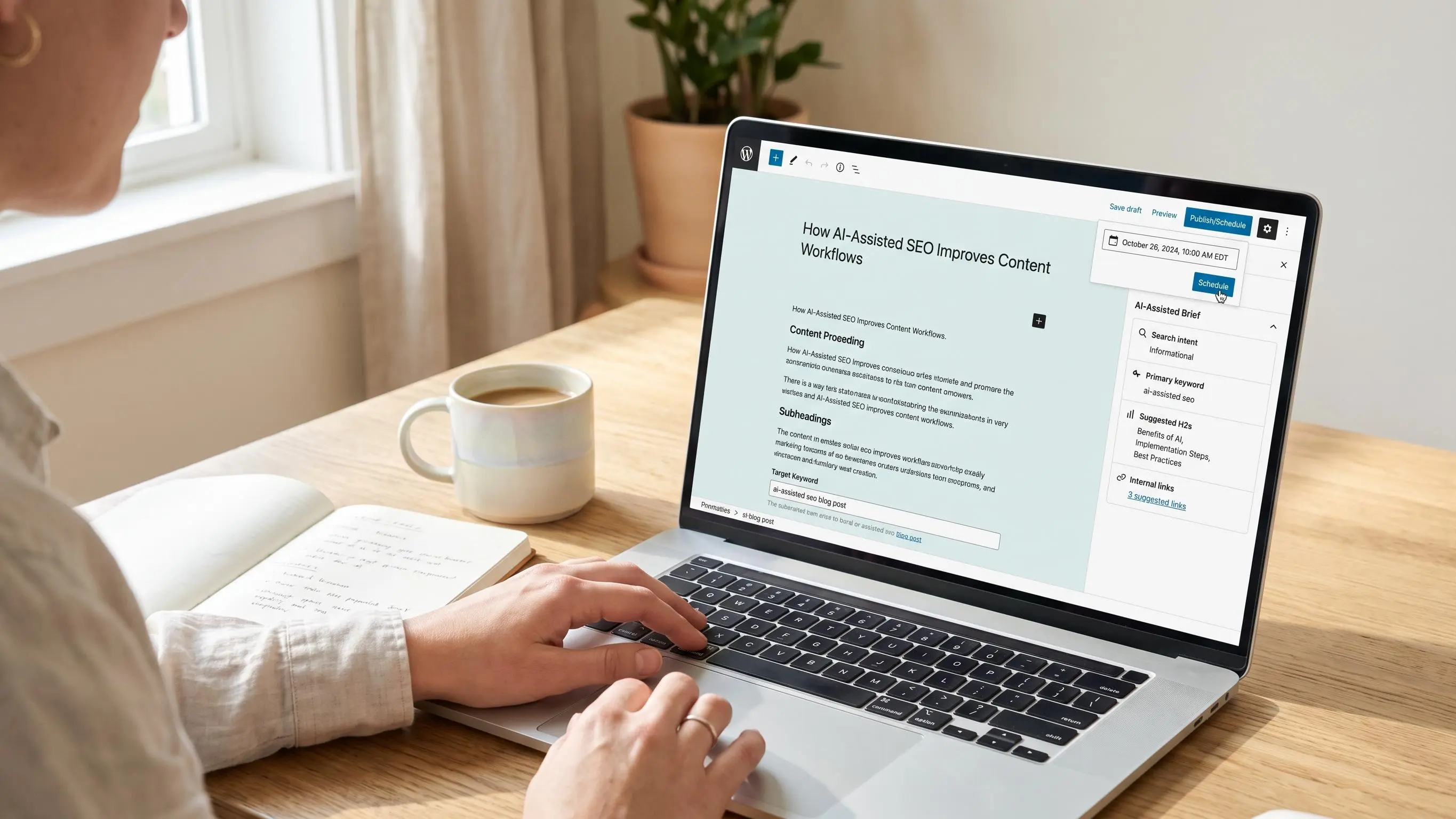
If you're trying to optimize headings for SEO, the usual advice will waste your time. Most teams stuff keywords into H2s, skip hierarchy, and then wonder why the page still feels hard to scan.
What matters is clean structure, intent match, and headings that help buyers move. For SaaS, ecommerce, and service pages, that small shift changes how fast people find what they need (and whether they keep going).
Watch these first:
- H1s that say too little or try to say everything
- H2s that repeat the keyword instead of answering the next question
- Broken heading order that confuses readers and weakens the page
Why Headings Matter More Than Most Teams Realize
Most teams treat headings like formatting. That’s the first mistake.
Headings are structural signals. They tell search engines what the page is about, how ideas relate to each other, and where one subtopic ends and the next begins. They also help real people move fast, which is how most pages are actually used. Busy buyers don’t read top to bottom. They scan, jump, compare, hesitate, and come back.
A strong heading structure does a few practical things at once:
- clarifies the main topic and supporting themes
- improves scanability for shoppers, evaluators, and stakeholders
- gives screen reader users a usable page map
- reduces messy overlap between sections
- creates cleaner paths toward action
The usability case for scanability is measurable. In a controlled Nielsen Norman Group comparison, a scannable layout using the same text as a promotional-text control improved usability by 47%. A version combining concise, scannable, and objective writing improved usability by 124%. Headings are only one part of that package, not a standalone cause of those gains—but clear, meaningful section labels are part of the design that lets readers find what matters quickly.
The ranking question is worth answering directly. Heading structure alone usually has only a very small standalone impact on impressions. So no, this isn’t a magic lever.
But that’s the wrong frame anyway.
Good headings improve topical segmentation, reduce implementation mistakes, and make content easier to understand and extract. That leads to better engagement, stronger organic fit, and fewer dead-end pages. If you want more qualified organic traffic, headings need to do more than look organized.
What It Actually Means to Optimize Headings for SEO
When we optimize headings for SEO, we’re not trying to impress an algorithm with repeated keywords. We’re aligning hierarchy, intent, relevance, and reader flow so the page works.
That means each heading should do four jobs:
- signal the page topic
- break content into logical sections
- make the page easy to scan
- create clean passage boundaries for search features and AI retrieval
Bad optimization is easy to spot. It sounds stiff. Every H2 repeats the target phrase. The wording feels written for a machine that stopped evolving in 2012.
Good optimization reads naturally. It gives both humans and machines the same clear answer about what the page covers and why each section exists. That’s the real point. Headings aren’t a standalone trick. They’re part of the larger article structure for SEO, which is why weak outlines usually produce weak headings later.
Start With Search Intent, Not With Keywords Alone
Keywords tell you the topic. Intent tells you what the reader is trying to get done.
That difference changes the whole outline. If you start drafting headings from a target phrase alone, you usually end up with shallow coverage and awkward repetition. If you build an outline from search intent, the page starts to mirror the way a prospect actually thinks.
A practical intent breakdown helps:
- Informational queries need definitions, explanations, steps, and examples.
- Commercial investigation queries need comparisons, criteria, tradeoffs, and alternatives.
- Transactional or service-led queries need proof, trust signals, process clarity, and a next step.
Heading style should follow that intent. Educational content often benefits from question-based H2s. Decision-stage pages need criteria-led or comparison-led sections. Service and product pages usually work better with outcome-focused headings.
A good writer knows this instinctively: headings should match the thought process happening in the reader’s head.
That’s how you build a content outline for rankings. Not by forcing a phrase into every section, but by covering the topic the way searchers expect it to unfold.
Build a Clean Heading Hierarchy That Search Engines and Readers Can Follow
Hierarchy is not decorative. It’s the page’s logic.
In plain English, the structure is simple:
- H1 is the main topic of the page
- H2s are the major sections
- H3s support those sections with narrower points
- H4 to H6 are only for deeper nesting when you truly need it
We recommend one clear H1 per page. Multiple H1s usually won’t break rankings, but they do make structure less clear. And clarity is the job.
Skipped levels are another quiet problem. Jumping from H2 to H4 because the design looks better creates confusion, especially for accessibility. Screen reader users often rely on headings as primary navigation. If the structure is sloppy, the page is harder to use. Full stop.
That risk sits inside a broader accessibility gap. In WebAIM’s February 2026 automated review of one million home pages, 95.9% had at least one detectable WCAG 2 failure, with an average of 56.1 detected accessibility errors per page. Those figures do not measure heading errors alone, and an automated scan cannot confirm full accessibility. They do show why heading hierarchy belongs in routine publishing QA rather than a cosmetic cleanup pass.
Read your headings as a table of contents. If they sound coherent in sequence, you’re close. If they feel random, duplicated, or uneven, the draft probably is too.
Most pages don’t need to go deeper than H3. When they do, it’s often a sign the page is trying to cover too much at once.
Write H1s That Clarify the Topic and Earn the Click
Your H1 is the clearest on-page statement of what the page is about. It should remove doubt fast.
That usually means the primary keyword belongs in the H1, naturally. But clarity matters more than exact-match rigidity. “Services” is not an H1. “Features” is not an H1. Those are labels, not topics.
Keep the H1:
- concise enough to understand at a glance
- specific enough to match intent
- strong enough to set expectations
The H1 and title tag should align closely, but they don’t need to match word for word. Slight variation often improves readability and search appearance.
A few solid angles:
- SaaS education page: “How to Build SEO Optimized Article Outlines”
- Ecommerce guide: “How to Choose the Right Running Shoes for Trail Use”
- Service page: “Technical SEO Services for Ecommerce Brands”
- Thought leadership article: “Why Content Operations Break Before Traffic Does”
A good H1 makes the visitor feel they’re in the right place before they read the second line.
Use H2s and H3s to Build Topical Depth Without Creating Chaos
H2s should cover the major subtopics a reader expects. H3s should make those sections easier to navigate, not noisier.
A simple test helps: read the H2s in order without the body copy. Do they form a convincing outline on their own? If not, the page probably lacks focus or has gaps.
H3s are where you handle the useful detail:
- examples
- process steps
- objections
- comparisons
- use cases
- implementation notes
This is where secondary phrases belong naturally. Not because you need to “sprinkle keywords,” but because real subtopics use related language. That’s how seo optimized article outlines get built properly. During planning, not after the draft is already swollen and confused.
One operator rule we use often: if an H3 feels important enough to stand alone but sits under the wrong H2, the section structure is off. The problem usually isn’t wording. It’s the outline.
How to Place Keywords in Headings Without Sounding Forced
Keyword relevance matters. Forced phrasing doesn’t.
Use the primary topic signal in the H1. Use H2s for major subtopics and close variations. Use H3s for supporting terms and detail-level relevance. That’s enough structure for most pages.
The balance looks like this:
- one clear primary topic signal
- several intent-aligned supporting headings
- natural semantic variety across the page
What you want to avoid is the same formula repeated every few lines. It makes the page sound synthetic, and it usually creates weaker section labels. Google Search Central recommends creating content for people rather than primarily trying to manipulate search rankings; descriptive, helpful headings follow that principle. Readers notice when wording feels forced, and search systems are designed to prioritize helpful content.
Match heading language to real search behavior. If people search “common SEO heading mistakes,” write that cleanly if it fits. Don’t turn it into “Mistakes in Optimizing Headings for SEO for Better SEO Performance.” That kind of wording is a red flag.
Helpful signposts win. Keyword lists don’t.
Structure Headings to Win More From Featured Snippets and AI Retrieval
Clear section boundaries make content easier to extract. That matters more now than it used to.
For informational queries, question-shaped H2s often work well because they map directly to how search systems identify answer passages. Good patterns include:
- What is
- How does
- When should you
- Benefits of
- Common mistakes
- Best practices
Then do the part many pages miss: open the section with a direct answer before expanding. Don’t bury the definition in paragraph three.
Not every heading should be a question. Comparison pages, opinion pieces, and higher-authority analysis often read better with statement-style headings. You still need editorial flow. A page made entirely of FAQ-style headers can feel thin, even when it isn’t.
Better extractability can create visibility beyond standard blue links. That’s not guaranteed traffic, but it improves your surface area. In practice, clearer passages often outperform more “creative” sectioning.
Match Heading Style to the Page Type and Buyer Journey
Different pages need different heading strategies. Treating them all the same is lazy planning.
For blog and educational content, explanatory H2s tend to work best. Cover definitions, methods, examples, and mistakes. For SaaS and service pages, outcome-led headings are stronger because buyers are looking for fit, proof, and next steps. Ecommerce pages need headings that support discovery and buying confidence. Comparison pages need parallel structure so readers can evaluate quickly.
Funnel stage matters too:
- Early stage: education, framing, problem awareness
- Mid-stage: criteria, comparisons, objections, fit
- Late stage: proof, implementation, risk reduction, action
Good article structure for SEO is always tied to business context. A heading that works in a top-of-funnel guide will often underperform on a service page. Same topic, different job.
Turn Topic Research Into Stronger Heading Plans
Topic research should shape headings directly. If it doesn’t, the research wasn’t operationalized.
Before drafting, identify:
- the main query
- related subtopics
- recurring audience questions
- objections and friction points
- adjacent terms that show depth
Then group those into parent sections. That’s how a real content outline for rankings gets built. Not as a document full of notes, but as a usable structure.
A solid brief to outline workflow is usually:
- define the target keyword and intent
- list must-cover subtopics
- cluster them into major sections
- draft H2s and H3s
- review for overlap, hierarchy, and flow
- only then start writing
This is one of those places where content teams lose time quietly. They do the research, then improvise the outline anyway. Platforms like Intelliminds help close that gap by turning topic research into structured briefs and outlines faster, without flattening the editorial logic.
Common Heading Mistakes That Quietly Limit Organic Performance
Most heading problems don’t look dramatic. They just keep the page from doing its job.
A few common ones:
- Vague or competing H1s dilute the main topic.
- Skipped heading levels create structural confusion.
- Styling-only headings look fine but weaken semantic clarity.
- Clever but unclear headings hide the actual subject.
- Repeated keyword formulas make sections feel redundant.
- Overlapping sections blur topical coverage.
- Mismatch between heading and content breaks trust fast.
- Too much nesting makes the page feel bloated.
- Late-stage heading cleanup usually means the draft was never properly outlined.
Each mistake creates friction somewhere: readability, accessibility, topical clarity, or conversion flow. The page may still rank. It just won’t perform as cleanly as it should.
A Practical Workflow to Optimize Headings Across New and Existing Content
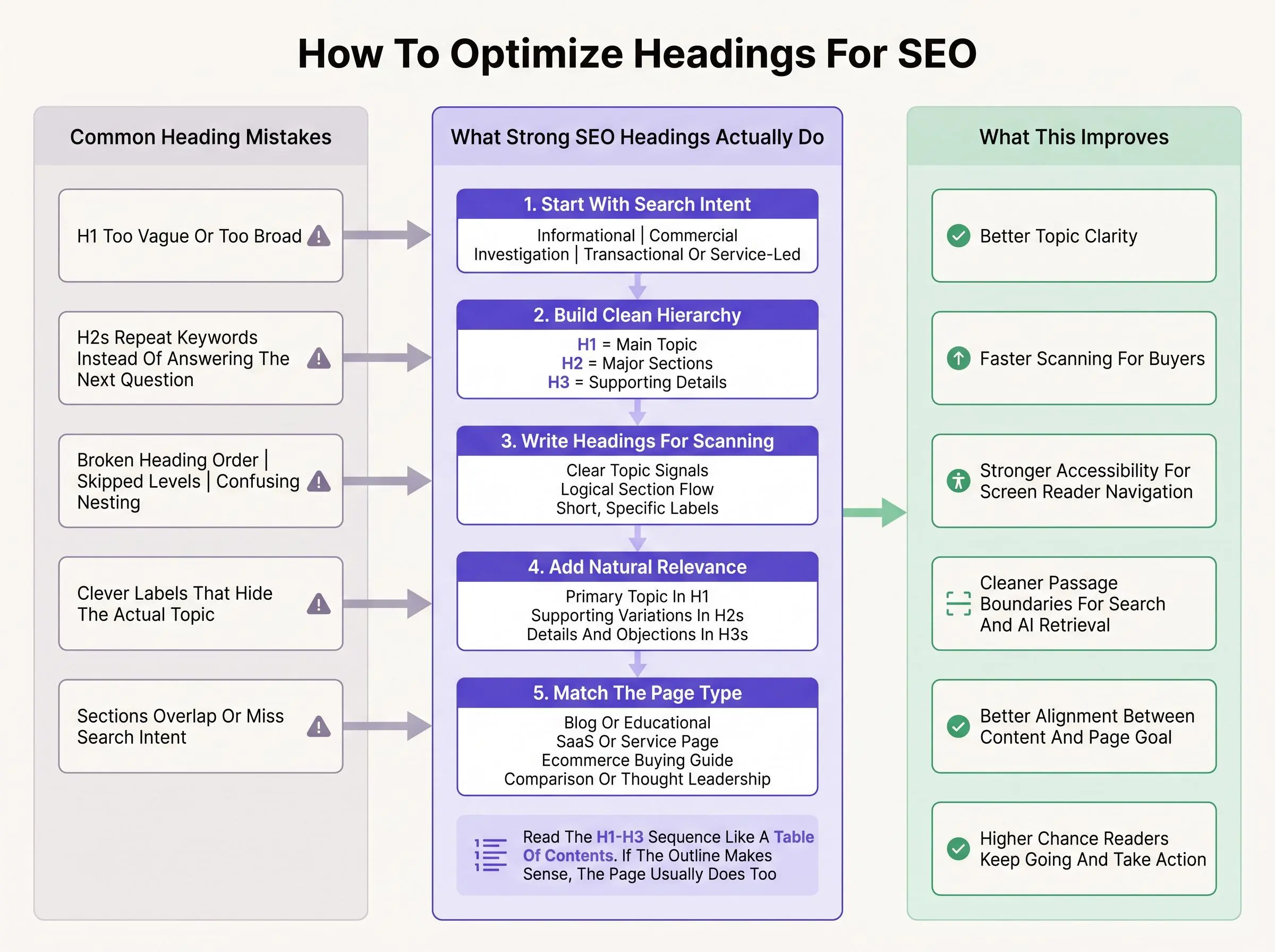
This works best as a repeatable QA process, not a rescue mission.
Start here:
- confirm the primary intent and page goal
- review the H1 through H3 structure as a standalone outline
- identify gaps, overlap, weak labels, and skipped levels
- rewrite for clarity, specificity, and keyword alignment
- check whether sections lead naturally toward the page goal
- tighten the opening paragraph under key headings
- re-audit after publishing
That last step matters. Headings are part of performance, so treat them like something measurable. Look at engagement, rankings, and search appearance over time.
For lean teams and agencies, this should become standard operating procedure. If heading optimization only happens during occasional cleanups, inconsistency creeps back in by the second or third publishing cycle.
Examples of Stronger Heading Decisions in Real-World Content

The difference is usually obvious once you see it.
A weak H1 might be “Our Platform.” A stronger H1 is “AI SEO Content Platform for Scalable Organic Growth.” One is a label. One tells the reader where they are.
Weak H2s often sound like this:
- Overview
- Benefits
- Tips
Stronger H2s are intent-aligned:
- How AI Content Workflows Reduce Manual SEO Work
- What to Look for in a Content Automation Platform
- Common Mistakes That Slow Organic Growth
A few practical shifts by page type:
- SaaS educational article: move from generic teaching labels to process-led headings that mirror adoption questions.
- Service landing page: replace broad claims with headings on outcomes, proof, implementation, and fit.
- Ecommerce buying guide: use headings around selection criteria, use cases, and common buying mistakes.
- Agency thought leadership: use sharp, opinion-led headings that still stay clear about topic and stakes.
Better headings improve topic clarity, scanability, and conversion readiness at the same time. That’s the point.
How to Scale Heading Quality Across a Growing Content Program
Heading inconsistency gets worse as output grows. More writers, more briefs, more CMS edits, more drift.
The fix is not more subjective review. It’s stronger systems.
Build internal rules for:
- H1 style
- H2 scope
- H3 depth
- keyword placement
- when to use question-based sections
- how conversion-oriented sections should appear
This is where seo optimized article outlines become a real operating advantage. Standardized outlining reduces revisions and keeps quality from depending on who wrote the draft that week.
We’ve seen the same pattern repeatedly: brands don’t struggle because they lack ideas. They struggle because research, writing, publishing, and refreshes are disconnected. Intelliminds is built to support that full workflow, from topic research to article structuring to publishing and refreshes, so heading quality scales with output instead of collapsing under it.
More output with less manual overhead only matters if the structure stays sharp.
How to Audit and Refresh Headings on Existing Pages
Older content often underperforms for a simple reason: the structure no longer matches current search behavior or depth expectations.
Check legacy pages for:
- outdated H1 phrasing
- thin or generic H2s
- missing subtopics now expected in the SERP
- headings that no longer match intent
- broken hierarchy introduced through CMS edits
Prioritize pages with existing impressions but weak click-through or unstable rankings. Those are often the easiest wins because the topic already has some visibility.
Heading refreshes work best when paired with broader updates:
- stronger body copy under weak sections
- better internal linking
- clearer calls to action
- tighter alignment between promise and delivery
Optimization isn’t just for net-new content. In a mature program, refreshes are often calmer and more efficient than constant publishing. You don’t always need more pages. Sometimes you need your existing pages to make more sense.
FAQ: Optimize Headings for SEO
Here are a few quick answers to common questions about heading structure, keyword use, and page hierarchy.
Do headings alone improve SEO rankings?
Heading structure by itself usually has only a very small standalone impact on impressions. Its bigger value is in improving clarity, topical segmentation, accessibility, and how easily a page can be understood and extracted.
Should the primary keyword appear in the H1?
Usually, yes — but naturally. The H1 should clearly state the page topic and match intent. Clarity matters more than exact-match rigidity.
How many H1s should a page have?
The article recommends one clear H1 per page. Multiple H1s usually won’t break rankings, but they can make the structure less clear.
When should I use question-based headings?
Question-based H2s often work well for informational queries because they map to how search systems identify answer passages. Other page types, like comparison pages or opinion pieces, may read better with statement-style headings.
Conclusion
To optimize headings for SEO, you need to stop treating headings as cosmetic formatting and start treating them as strategic structure.
The real value isn’t a tiny standalone ranking bump. It’s better relevance, better readability, better accessibility, cleaner topical coverage, and a clearer path from search to action. Strong headings come from a systematic process that starts with intent, turns research into a clean outline, and carries that logic through drafting, publishing, and refreshes.
If you want a practical next step, audit one high-value page this week. Read its H1 through H3 structure as a standalone outline. Tighten the hierarchy. Sharpen the intent match. Fix vague labels.
A heading should do more than organize a page. It should move the page forward.
Article Record
ReferencesPrimary sources used for this article
Update HistoryMeaningful revisions to this article
- Added a narrative data point about accessibility issues across home pages.
- Made the connection between clear heading structures and more accessible reading easier to understand.
- Enhanced the “Why Headings Matter More Than Most Teams Realize” section with a clearer data-based explanation of how scannable content can improve usability.
- Added context to show that the supporting research examined a combination of layout and writing choices, helping readers interpret the findings accurately.
- Added guidance from Google Search Central to explain how helpful content principles apply when placing keywords in headings.
- Made the heading advice more practical, helping readers write clear headings that fit naturally into their content.
- Added a FAQ section with four questions and answers to help readers find key information more easily.