
SEO content ROI goes sideways when teams treat rankings as the win and ignore labor, refresh work, and the long sales path. That mistake gets expensive fast.
What matters is knowing which content brings revenue, which pages only assist, and where the payback actually shows up. Good programs need better bets, not more posts.
Start here:
- Count writing, publishing, and updates before calling a post profitable
- Split direct conversions from pages buyers read earlier
- Refresh winners before spending on another net new article
What SEO Content ROI Actually Means
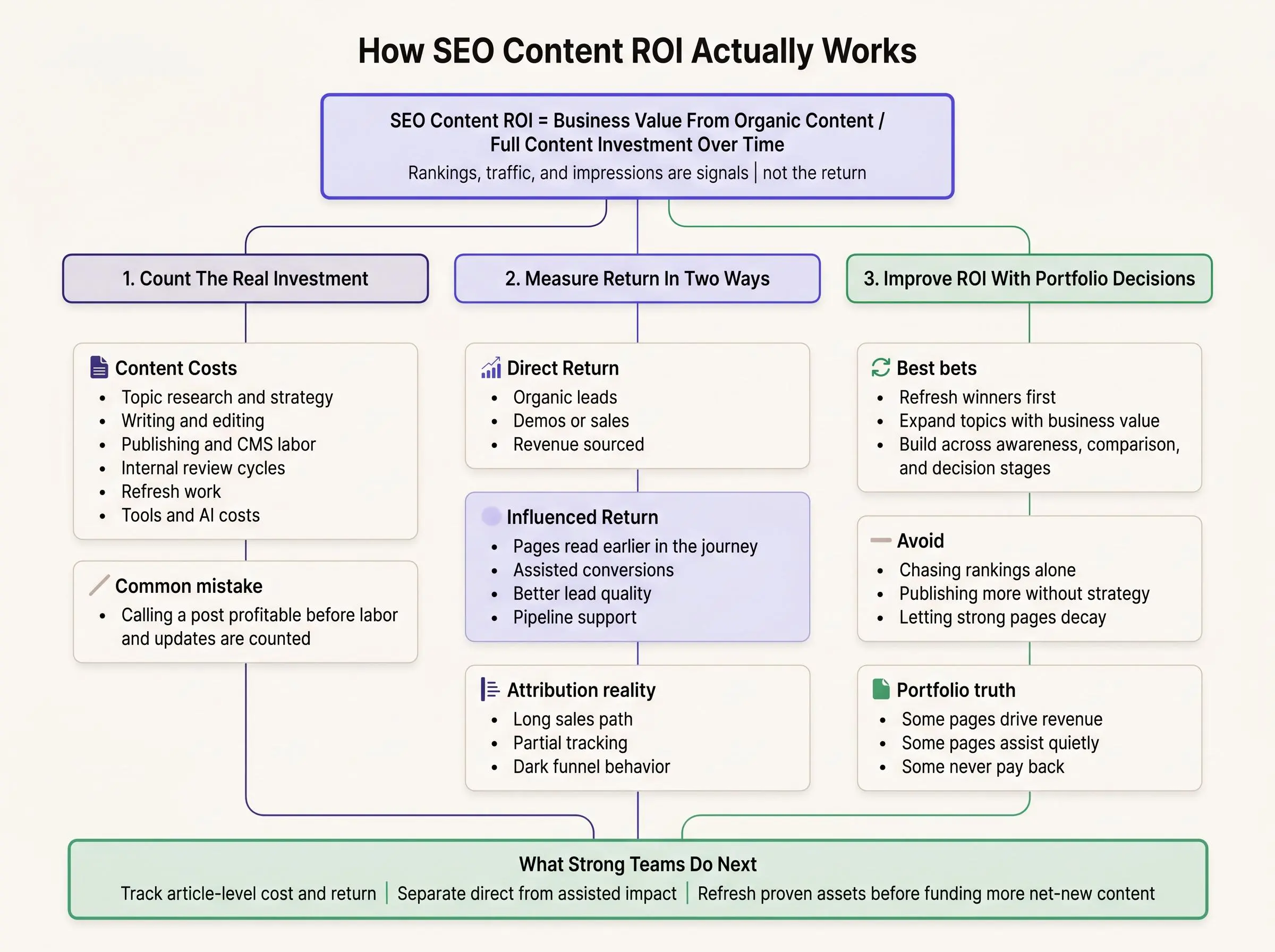
If you're serious about organic growth, seo content roi needs a stricter definition than "we got more traffic." Traffic is useful. Rankings matter. Impressions can tell you something early. None of them are the return.
In practical terms, seo content roi is the business value created by organic content relative to the full cost of researching, producing, publishing, maintaining, and improving that content over time.
That definition sounds simple. Most teams still measure it loosely.
There are really two kinds of return:
- Direct return from organic sessions that convert into leads, demos, sales, or revenue
- Influenced return from content that educates buyers, improves lead quality, supports later conversions, and reduces friction in the pipeline
That second bucket is where a lot of value hides. Especially for SaaS, services, and considered ecommerce purchases.
Lean teams feel this tension more than anyone. Content gets treated like a cost center because the work happens now, while the payoff shows up across months and multiple touchpoints. It rarely lands neatly in one dashboard. So people default to the wrong question: did this post convert on its own?
That isn't how healthy programs work.
Good content ROI is a system result, not a single-post vanity result.
We think about content marketing roi for seo the same way we'd think about an asset portfolio. Some pages become reliable performers. Some assist deals quietly. Some never pay back. The point is not that every article wins. The point is that the system compounds when research, production, publishing, and refreshing are run with discipline.
Why SEO Content Often Feels Hard to Trust
Most skepticism around content isn't irrational. It's usually earned.
Topic research takes longer than expected. Drafting drags. Publishing slips. Updates get pushed to "later," which often means never. Then someone asks what revenue came from the blog, and the answer is vague enough to make everyone uncomfortable.
Attribution got harder, not easier. The average B2B deal now involves about 266 touchpoints over roughly 211 days, which is a good shorthand for why single-touch reporting breaks down in real buying journeys.
A newer 2026 B2B benchmark illustrates the measurement challenge from another angle. Drawing on more than 66 million sessions and 3.5 million customer journeys, it reports an average journey of 272 days, 88 touchpoints, four channels, and 10 stakeholders. Its touchpoint definition is not directly comparable with the 266-touchpoint estimate above, but both figures make the same operational point: no single session, form fill, or last-click source can represent the whole buying process.
That complexity creates three predictable trust problems:
- The timeline problem: many teams expect proof in a quarter, even though article-level ROI usually needs at least 90 days before judgment and often 6 to 12 months for a fair read.
- The measurement problem: first-touch and last-touch models each miss part of the story, especially when buyers read content early but convert much later through another channel.
- The cost-accounting problem: teams often make content look more profitable than it is by excluding internal labor, reviews, publishing overhead, and refresh work.
Those three issues compound. If you measure too early, with incomplete attribution, and with undercounted costs, content can look unreliable even when the program is improving.
That's why better SEO ROI reporting is less about finding a perfect dashboard and more about using honest triangulation. In practice, that means combining direct conversions with assisted conversions, CRM source data, self-reported attribution, and a full accounting of content costs.
In other words, distrust usually comes from a broken measurement model, not automatically from a broken channel.
How to Measure Blog Revenue Impact Without Oversimplifying It
If you want to measure blog revenue impact well, use two levels at the same time.
First, track article-level P&L so you can see which assets are earning their keep. Second, track program-level ROI so you can evaluate the full engine without overreacting to any single page.
The core formula is straightforward:
- Calculate business value from organic content
- Subtract total investment
- Divide by total investment
Business value can mean different things depending on your model. Ecommerce brands may use revenue and margin. SaaS and service businesses may use qualified leads, pipeline, or closed revenue. The mistake is pretending every company should use the same endpoint.
Costs are where teams usually get sloppy. Commonly missed categories include:
- Topic research and strategy time
- Writing and editing
- SEO tools and subscriptions
- Design or media support
- CMS formatting and publishing labor
- Internal review cycles
- Refresh work
- Allocated AI platform cost per article
We've seen teams undercount content cost by 30% to 50% simply by excluding internal labor hours. That makes reported ROI look better, right up until someone asks for budget confidence.
Don't judge an article too early either. Unless a post is clearly off-strategy, avoid making hard calls before 90 days. For a more complete read, think in 6 to 12 months.
A layered view keeps you honest:
Early signals
- Impressions
- Indexing
- Ranking movement
- Engagement
Mid-stage signals
- Organic visits
- Assisted conversions
- Lead quality
Late signals
- Opportunities
- Revenue
- Cost per lead
- Payback period
Article-level visibility matters because it improves future planning. You learn what to refresh, what to replicate, and what to stop producing. That's where ROI becomes operational, not theoretical.
The Right Way to Attribute Leads From Organic Content
The real question isn't whether attribution will be perfect. It won't. The question is whether you can attribute leads from organic content honestly enough to make better decisions.
Each common model has a use, and each one fails somewhere.
- First-touch shows discovery well, but misses downstream influence
- Last-touch captures the conversion entry point, but undervalues earlier education
- Multi-touch is directionally better, though still limited by tracking gaps
For growing brands, a practical stack works better than chasing a magical dashboard:
- GA4 assisted conversions for directional path analysis
- CRM source tracking for lead-to-opportunity visibility
- Self-reported attribution fields like "How did you hear about us?"
- Sales call notes that capture dark funnel mentions of content, search, and brand discovery
Self-reported attribution is underrated. Buyers often remember the article, comparison page, or resource that shaped their thinking even when analytics doesn't.
More mature teams can add aggregate methods. About 67% of marketing leaders are investing in media mix modeling because it helps measure channels in a privacy-safe way when user paths are incomplete.
Incrementality testing adds credibility too. Compare performance before and after a content refresh, a new cluster launch, or a decision-stage content rollout. Use holdout periods or topic groups when you can. It's not perfect science, but it gets you closer to what content changed beyond baseline demand.
If direct tracking is weak, use a fallback: estimate traffic value based on equivalent paid search cost. It's not revenue, but it's still useful directional evidence.
Honest attribution is triangulation, not theater.
The Metrics That Actually Predict SEO Content ROI Early
Skeptical teams usually look for revenue too soon, then conclude nothing is working. That's just bad timing.
Leading indicators predict future return. Lagging indicators confirm realized return. You need both, but they don't show up on the same schedule.
The leading signals worth watching are more specific than most reports suggest:
- Search Console impressions growth often appears 2 to 3 months before traffic growth
- Ranking movement from page four to page three can signal a topic is gaining traction
- Backlink quality matters more than raw backlink count for durable rankings
- Engagement signals help show whether the page actually satisfies intent
That page-four-to-page-three movement gets ignored all the time. It shouldn't. We've seen plenty of pages look dead at first, then move steadily once Google gains confidence in relevance.
Lagging indicators are the business proof:
- Qualified organic leads
- Opportunity creation
- Revenue influenced
- Revenue sourced
- Cost per lead
- Payback period
Business model changes which lagging metrics matter most. Ecommerce brands should care about organic revenue, assisted revenue, and margin by landing page group. SaaS and service businesses should care more about pipeline, meeting quality, close rate, and customer value.
One nuance matters in executive conversations: strong content often improves sales efficiency before it creates a dramatic spike in lead volume. Better education can pre-qualify buyers, strengthen win rate, and reduce wasted sales time. That shows up quietly at first.
Organic CTR Varies With AI Overview Conditions
Early visibility is no longer a one-to-one proxy for traffic. In a Seer Interactive study of 3,119 informational and educational queries across 42 client organizations, Q3 2025 average organic CTR differed depending on whether an AI Overview appeared and whether the brand was cited. That makes result-page context worth adding to any early ROI readout.
Average organic click-through rate by AI Overview condition in Q3 2025, based on monthly averages across Seer Interactive's informational and educational query set.
Source: Seer Interactive, Q3 2025 averages across 3,119 informational and educational queries.
- This is an observational study, so it cannot establish that an AI Overview or citation caused the CTR difference; stronger brands may be more likely to be cited.
- The sample covers informational and educational queries from 42 client organizations, not all query types, industries, or Google searches.
- Values are Q3 2025 monthly averages across the study query set and should not be used as a universal traffic forecast.
View chart data
| Search-result condition | Average organic CTR |
|---|---|
| No AI Overview | 1.45% |
| AI Overview, brand cited | 0.70% |
| AI Overview, brand not cited | 0.52% |
The cited condition was associated with a 0.18-percentage-point higher CTR than the uncited AI Overview condition, but it still remained below the no-AI-Overview condition. Treat this as a reporting segmentation, not proof that citations caused more clicks: the study notes that stronger brands may be more likely to be cited in the first place. For ROI forecasting, separate informational queries by result context and compare clicks, assisted conversions, and revenue over time rather than applying one sitewide CTR assumption.
The System Behind High-ROI SEO Content
High seo content roi usually comes from four connected motions, not one clever tactic.
- Topic research
- High-quality article production
- Consistent publishing
- Ongoing content refreshing
Weak topic research poisons everything downstream. If you chase search volume without business value, you can grow traffic and still fail commercially. That happens more than people admit.
A better prioritization lens is simple: keyword opportunity versus business benefit. Not whatever feels interesting this week. Not whatever a generic keyword export spits out.
Content layering matters too. Build clusters across awareness, comparison, and decision stages. That gives buyers multiple entry points and helps search engines understand depth. It also keeps your program from being trapped at the top of funnel where traffic looks good and pipeline stays flat.
Consistency is not glamorous, but it's usually the separator. Strong programs keep shipping, learning, and updating. They don't wait for perfect conditions.
Refreshing deserves more respect than it gets. Updating aging winners is often cheaper and faster than starting from zero. Improve the title, tighten the structure, add missing intent coverage, fix internal links, sharpen the CTA. Sometimes the best ROI move is not net-new content. It's rescuing an asset that already has traction.
The goal isn't more content. It's a better content system that compounds.
Why Content Quality Still Decides the Outcome
There is no workaround here. Quality still decides the outcome.
In large-scale benchmark data, 96.55% of pages receive no Google traffic. That number should end the idea that publishing alone creates return. It doesn't.
Low-quality, repetitive, or generic AI content doesn't just fail to rank. It increases cost. You pay for drafts, reviews, formatting, and opportunity cost, then get little back.
In ROI terms, quality means:
- Clear match to search intent
- Useful depth
- Original perspective
- Strong structure
- Credibility and accuracy
- Conversion-aware calls to action
This isn't about writing pretty articles. It's about economics. High-quality content is more likely to rank, earn links, hold attention, and support conversion paths. Poor-quality content creates hidden waste through rewrites, low visibility, and weak conversion performance.
Automation doesn't remove the need for editorial judgment. It should remove manual drag while protecting standards and fit. That's the line. Cross it, and volume becomes expensive noise.
The ROI of Content Automation for Lean Marketing Teams
Lean teams eventually face the same choice: keep running SEO as a labor-heavy workflow, or move to a more automated model.
Manual execution erodes ROI in predictable places. Topic selection gets slow. Drafting bottlenecks. Publishing becomes irregular. Updates get forgotten. Coordination across tools and people starts eating whole afternoons.
The roi of content automation should be evaluated in business terms, not novelty terms:
- Lower cost per published and refreshed asset
- Faster time from idea to indexation
- More consistent publishing cadence
- Better coverage across topic clusters
- Less internal labor spent on repetitive work
There is a catch. Automation helps when it strengthens process and output quality. It hurts when it just increases volume without strategy or review.
The most valuable use cases are usually practical:
- Topic research and prioritization
- First-draft generation
- Publishing workflow coordination
- Refresh identification and execution
- Performance monitoring that surfaces what to optimize next
A platform like Intelliminds fits here naturally because it connects research, writing, publishing, and refreshing in one workflow. That matters less for convenience than for operating rhythm. When the system is connected, teams spend less time managing tasks and more time improving outcomes.
Human input still matters most in a few places: positioning, editorial standards, subject-matter nuance, conversion messaging, and final approval where brand risk or accuracy matters.
What SEO Reporting for Executives Should Look Like
Executives do not want a list of rankings. They want to know whether content is helping the business grow more efficiently.
So seo reporting for executives should be built around business questions:
- Are we acquiring customers more efficiently?
- Is organic contribution growing?
- Which content investments are paying back?
- Where should we double down or cut back?
A simple reporting stack works well:
- Executive summary with business outcomes
- Trend view of organic traffic, leads, pipeline, and revenue influence
- Cost-efficiency view with spend, cost per lead, and payback timing
- Asset view with top pages, refresh wins, and underperformers
- Forward-looking section showing what is being tested next
Keep the executive deck separate from the operator dashboard. Leaders care about revenue, efficiency, risk, and momentum. Operators need impressions, indexation, rankings, and page-level diagnostics.
Include both leading and lagging signals. That reduces anxiety during slower ramp periods. Also explain attribution limits plainly. Organic content often assists deals that analytics cannot fully credit, so reports should combine direct conversions, assisted conversions, self-reported attribution, and aggregate impact.
One more thing. Show portfolio logic. Not every article needs to win if the program as a whole is compounding profitably.
Common Mistakes That Destroy SEO Content ROI
Most failed content programs don't fail because SEO stopped working. They fail because the operating model was weak.
A few mistakes show up again and again:
- Quitting too early, often around month three when real ROI usually needs 6 to 12 months
- Measuring revenue before impressions, rankings, and authority have had time to build
- Using blended averages that hide which assets are profitable and which drain budget
- Underestimating total cost by ignoring labor, reviews, publishing overhead, and refresh work
- Overvaluing last-touch conversion data in long buying journeys
- Publishing too broadly and chasing traffic with low business value
- Skipping refreshes while good assets decay
- Producing volume without standards or brand control
- Failing to connect content to funnel stage
That last one is costly. Educational content matters, but so do comparisons, use cases, and decision-stage pages. If your library only answers broad early questions, don't be surprised when pipeline stays thin.
A Practical 12-Month Plan to Improve SEO Content ROI
You don't need a perfect content machine next quarter. You need a better operating rhythm than the one you have now.
Here's a practical 12-month path.
Month 1 to 2
Establish the baseline. Audit existing content, organic traffic, conversions, and cost structure. Identify current winners, decaying assets, and funnel-stage gaps. Decide what ROI means for your business: revenue, pipeline, leads, or a blended value model.
Month 2 to 3
Build the measurement model. Set up article-level cost tracking. Align GA4, CRM, and self-reported attribution fields. Create separate views for executives and operators.
Month 3 to 6
Launch focused topic clusters. Prioritize realistic opportunity with clear business benefit. Publish consistently, not in bursts. Build around actual buyer problems, comparisons, and use cases.
Month 4 to 8
Refresh and optimize. Update pages that already have impressions. Improve weak titles, structure, internal links, CTAs, and conversion paths. Compare refreshed performance against pre-refresh baselines.
Month 6 to 12
Scale what works. Double down on topics, formats, and clusters that produce qualified demand. Cut low-value patterns that consume budget without traction. Add automation where manual work is slowing output or consistency.
For teams that want to move faster, a platform like Intelliminds can automate topic research, article production, publishing, and content refreshing while keeping ROI measurement tied to one operating rhythm.
The win is not instant perfection. The win is moving from content chaos to a measurable, repeatable engine.
Conclusion
seo content roi gets easier to trust when content is run like a system. Clear costs. Realistic timelines. Disciplined attribution. Ongoing optimization.
The strongest programs use portfolio thinking. They do not expect every article to be a winner. They expect the system to compound.
If you want one practical next step, start here: audit what you already have, define the ROI model that fits your business, and build a workflow that connects research, production, publishing, and refreshing.
That changes the conversation. You stop trying to prove content works in theory. You start building a simpler process that makes organic growth easier to measure and easier to repeat.
Article Record
ReferencesPrimary sources used for this article
- AIO Impact on Google CTR: September 2025 Update
- How to Measure ROI on Content: Proven Per-Article P&L (2026) — The Seo Engine
- How to calculate the SEO ROI for your strategy (2026) - Incremys
- Content Performance Analysis: The Definitive Guide
- The Real ROI of SEO: How to Prove the Value of Organic Search in 2026 - The HOTH
- What Is Evergreen Content? & How to Create It
- 12 SEO Techniques to Boost Your Visibility and Traffic
Update HistoryMeaningful revisions to this article
- Added a large-scale B2B benchmark to clarify how journey length, touchpoints, channels, stakeholders, and dataset size affect content attribution.
- Made the challenges of measuring SEO content ROI easier to understand with a more practical data story.
- Added a chart to clarify how organic click-through rates varied across different AI Overview conditions.
- Made the early content ROI metrics easier to compare, helping readers evaluate performance signals more clearly.
- Reframed the section on why SEO content often feels hard to trust to show that the challenge is often measurement and timing, not just channel performance.
- Strengthened the article’s narrative flow so readers can better understand how to evaluate SEO content results with more confidence.
- Made the article’s core argument easier to follow for brands looking to judge content performance more clearly.