
Most brands treat LLM search optimization like a new channel and get sloppy fast. You need pages AI systems can lift, trust, and reuse when buyers ask product questions.
What matters in practice is plain answers, proof, structure, and content that stays current. We've seen strong pages vanish from AI answers because the useful line sat halfway down the page.
Start here:
- Fix pages that already rank or convert before publishing more.
- Add stats, definitions, and comparisons a model can grab fast.
- Track answer mentions for prompts, then close the gaps. You waste less and show up more.
What LLM Search Optimization Actually Means
llm search optimization is the practice of making your content easier for AI-powered search systems to retrieve, understand, synthesize, and cite. That includes tools like ChatGPT, Perplexity, Gemini, Copilot, and Google's AI Overviews. Different labels get used for the same shift, and that confuses people more than it helps.
You’ll hear LLM SEO, GEO, LLMO, and answer engine optimization for blogs. The vocabulary overlaps. The practical goal does not: increase qualified visibility anywhere an AI system assembles an answer from the open web and decides which sources deserve to show up in that answer.
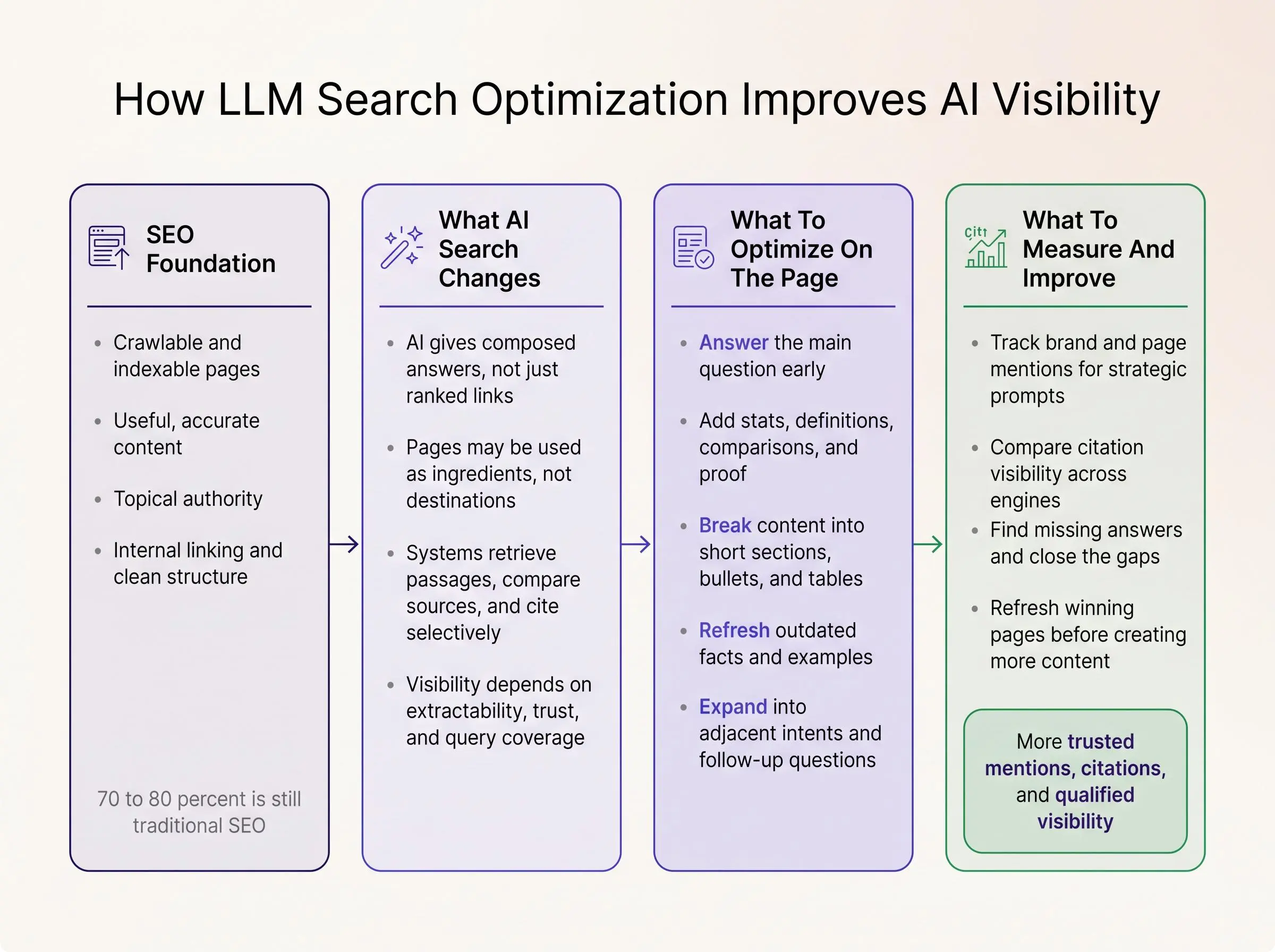
Here’s the part most teams need to hear: your SEO instincts are still mostly right. Roughly 70 to 80 percent of the foundation is still traditional SEO work.
- Pages still need to be crawlable and indexable
- Content still needs to be useful, accurate, and better than thin alternatives
- Topical authority still matters
- Internal linking and clean site structure still help machines understand what you cover
What changes is the last layer. AI systems don’t just rank pages. They pull passages, compare sources, compress ideas, and cite selectively. So now your content also needs:
- passage-level extractability
- broader query variation coverage
- clearer entity and topic signals
- higher odds of being trusted during answer synthesis
That’s the shift. Not a new game. A stricter version of the old one.
AI search hasn’t made SEO obsolete. It has made vague content easier to ignore.
How AI Search Changes the Rules of Visibility
Traditional search gives a ranked list. Generative search gives a composed answer. That sounds like a small interface change until you look at how visibility actually happens.
In classic search, winning often meant getting one strong page to rank high enough to earn the click. In AI search, your page may never be the destination. It may be the ingredient.
Three differences matter in practice.
First, engines don’t all pull information the same way. Some lean harder on external web retrieval. Others rely more on model knowledge unless the query triggers fresh sourcing. If you test one engine and assume the rest behave the same, you’ll make bad decisions by the second afternoon.
A 2026 benchmark of 11,500 user queries puts scale behind that warning. Google displayed an AI Overview for 51.5% of the study’s representative real-user queries. More importantly, the sources retrieved by Google’s organic results, AI Overviews, and Gemini Flash 2.5 had less than 0.2 average Jaccard similarity. In plain English: even when systems address similar questions, they often draw from markedly different source sets.
Second, source diversity varies. One engine may cite a wider mix of pages. Another may repeatedly favor a tighter set of sources. That means a page that earns citations in one environment may barely appear in another even when the prompt looks similar.
Third, answers aren’t stable. Same query, different run, different output. Sometimes different citations too. Marketers hate that. We get it. But instability doesn’t mean randomness. It means you need repeated usefulness, not one lucky screenshot.
Generative systems often cover the same topics as traditional search, but from a very different retrieval footprint. So the strategy changes. You’re not just trying to rank one page. You’re trying to become a trusted source that gets selected, extracted, and reused across many answer moments.
That creates real tradeoffs.
Fewer clicks may come from some informational queries. At the same time, brand exposure can happen earlier, before the buyer is ready to visit a site. For growing brands, that’s not nothing. If your name shows up consistently when buyers ask category, workflow, or comparison questions, you’re shaping demand before the click exists.
The benchmark covers Google organic results, AI Overviews, and Gemini—not every answer engine or every query market. Still, it is a practical reason to test your priority prompts across multiple surfaces instead of using conventional rankings as a proxy for AI visibility.
Why Growing Brands Should Care Now
Most teams already feel the pressure. Attention is fragmented. Content volume keeps rising. Every quarter seems to bring a new AI rumor that makes solid operators wonder if the rules changed again.
The reason to care now is simple: AI search has created another visibility layer. If your content is trusted, well-structured, and current, you can earn mention and citation before a user ever lands on your site.
That matters differently by business model.
- SaaS buyers use AI answers to compare tools, workflows, integrations, and vendor fit
- Ecommerce shoppers ask for recommendations, alternatives, and use-case guidance
- Service buyers use AI search for niche expertise, local context, and decision support
For smaller brands, this can be unusually fair. You may not outspend larger players on paid acquisition. You can still beat them on specificity. AI systems often reward the source that explains the issue clearly, not the company with the biggest logo.
The mindset shift is the hard part. Stop treating visibility as ranking alone. Start building an answer-ready content engine that compounds. Good pages should help discovery, support consideration, and strengthen conversion over time. One page can do more than one job if it’s built with intent.
The Signals That Influence AI Citation and Selection
Quick summary: AI citation decisions favor verifiable, concise, and easily extractable signals over polished vagueness.
Evidence & Citations — one-line definition: Explicit data and source attributions that let the engine verify claims.
- Exact statistic: Specific statistics showed the biggest visibility gains in one benchmark at 115.1 percent
- Exact statistic: Citing sources increased visibility by 77.0 percent
- Action: Add clear citations and headline statistics that the model can surface directly.
Quotability & Direct Quotes — one-line definition: Short quoted snippets that can be lifted verbatim into answers.
- Exact statistic: Quotations improved visibility by 72.2 percent
- Action: Include concise, attributable quotes or pull-quotes for easy reuse.
Extractability & Structure — one-line definition: Information formatted so facts and steps are easy to parse and reuse.
- Exact statistic: Easy-to-understand language also helped at 2.4 percent
- Action: Use lists, headings, and short sentences so the engine can extract items cleanly.
Tone & Fluency — one-line definition: A confident, readable voice that signals authority and clarity.
- Exact statistic: An authoritative tone added 21.5 percent
- Exact statistic: Fluency improvements added 15.2 percent
- Action: Edit for a clear authoritative voice and fix grammatical/flow issues.
Technical Specificity — one-line definition: Precise terminology for technical topics that improves match quality.
- Exact statistic: Technical terms helped modestly at 5.8 percent
- Action: Use correct technical terms where relevant, but keep explanations concise.
Negative Signals — one-line definition: Patterns that reduce the chance content is cited.
- Exact statistic: Unusual wording slightly reduced visibility in one benchmark. Keyword stuffing performed worse, with a 10.2 percent decline
- Action: Avoid keyword stuffing and eccentric phrasing; prefer plain, verifiable wording.
That list tells you a lot. AI systems seem to prefer content that is verifiable, evidence-backed, and easy to extract. Not clever. Not padded. Not “thought leadership” that says little in polished language.
This is a welcome correction for serious brands. If you know your subject, you’re already closer than you think. Add proof. State things cleanly. Give the engine something it can safely reuse.
How to Optimize Content for AI Search Without Rewriting Everything
You do not need to start from zero. Most teams don’t have that luxury anyway. The better move is to upgrade the pages that already matter.
Here’s the framework we use.
- Start with high-value pages. Look at high-intent guides, comparison pages, use-case articles, and category explainers that already rank, convert, or attract links.
- Improve answer coverage. Rewrite weak sections so they directly answer common questions in plain language.
- Add evidence. Include statistics, definitions, examples, product details, and concise expert commentary that can be lifted into answers.
- Make it extractable. Break long narrative blocks into short paragraphs, bullet lists, tables, and labeled subsections.
- Refresh old details. Update outdated facts, screenshots, workflows, and examples.
- Expand around adjacent intents. Cover the follow-up questions and nearby use cases AI systems often branch into.
For ai search optimization for brand blogs, a lot of effort gets wasted on net-new content when the archive is the better opportunity. Update old posts that already rank or convert. Prioritize evergreen buyer questions. Turn thin opinion pieces into evidence-backed resources.
A simple refresh workflow makes this actionable. Suppose a SaaS team has an existing guide about choosing project-management software. Instead of rewriting the entire page, the team can:
- record the page’s current title, URL, traffic, conversions, and last-updated date
- list the main question plus follow-ups such as team size, integrations, implementation effort, security, and alternatives
- inspect each section and mark it keep, clarify, add evidence, reformat, or remove
- rewrite one weak section as a self-contained answer with a clear heading, brief explanation, relevant caveat, and supporting source
- add a comparison table only where readers need to evaluate defined attributes
- update screenshots, product details, and dated references before republishing
- review the revised page for unsupported claims, repeated points, and unanswered follow-up questions
The same checklist works for a category explainer, use-case article, or comparison page. It keeps the work focused: improve the sections most likely to answer real buyer questions before spending time on a full rewrite.
A good test is this: if an AI system pulled only one section from the page, would that section still stand on its own and help someone? If the answer is no, the page probably needs surgery, not polish.
Structure Matters More Than Most Brands Realize
Even strong content gets overlooked when the structure is messy. AI systems need to locate useful segments quickly. Humans do too, which is why this work usually improves both.
There are three levels to care about.
Macro, meso, and micro structure
Macro-structure is the page architecture and section order. Does the page answer the main question early? Does it move in a logical sequence?
Meso-structure is how information gets chunked. Are ideas broken into digestible units or buried inside long blocks?
Micro-structure is the local clarity. Labels, headings, definitions, caveats, and visual hierarchy all live here.
In one multi-engine experiment, structural optimization alone improved citation performance by 17.3 percent across six engines. The same changes improved perceived content quality by 18.5 percent. That tracks with what we see in practice. Better structure doesn’t just help machines read. It helps readers trust what they’re reading.
A few structural habits pay off fast:
- put the clearest answer early in the section
- use descriptive headings that mirror search intent
- add comparison tables when useful
- isolate important facts and caveats instead of burying them
- keep formatting consistent across related posts
One especially practical detail: tables can outperform prose when a system needs to compare options or attributes quickly. One dataset reported a 4.2x citation lift from tables versus prose. That won’t save weak content, but it often improves extractability.
Schema deserves a reality check too. It can support machine readability. It is not a guaranteed citation lever. One study even found a 4.6 percent drop in AI Overview citations after adding schema. So yes, use structured data where it makes sense. Just don’t expect markup to rescue a vague page.
Build an AI Search Content Strategy Around Query Coverage, Not Just Keywords
Keyword targeting still matters. It just isn’t enough. An effective ai search content strategy starts with intent, then expands into sub-intents, objections, comparisons, and follow-up questions.
AI systems often decompose a prompt before answering it. They may look for adjacent angles, missing context, or next-step questions. If your content only covers one phrasing of one keyword, you’re visible for less of that reasoning path.
A better planning model looks like this:
- map the main question
- list the supporting questions
- note common objections and comparison angles
- include action-oriented follow-ups
- explain the reasoning behind the recommendation, not just the recommendation itself
That last point is underrated. Buyers don’t just want the answer. They want the logic. Pages that explain why something matters, when it applies, and what changes the decision tend to be more reusable in AI-generated answers.
Research supports the shift. Intent-aware optimization has shown up to 2.44x improvement on objective metrics and 1.23x on subjective metrics in one method.
Content clusters that usually perform well for growing brands include:
- beginner-to-advanced guides
- versus and alternative pages
- use-case and role-based pages
- implementation walkthroughs
- glossary and concept explainers tied back to commercial pages
If you want to optimize content for ai search, don’t stop at definition-level coverage. Build the page so it can answer the next two questions too.
Brand Authority in AI Search Comes From More Than Your Own Blog
Your blog matters. It just isn’t the whole authority picture anymore.
AI systems often pull from a mix of owned content, editorial coverage, and reference-style sources. One dataset found 48 percent of LLM citations came from third-party editorial sources. That’s a strong reminder that brand visibility in ai search is shaped beyond your domain.
We think about this as an authority stack:
- publish useful first-party content on the topics you want to own
- earn mentions in reputable industry publications and communities
- keep brand entity signals consistent across profiles, review platforms, and knowledge sources
- contribute original data, frameworks, or commentary that others can cite
Mentions matter more than many SEO teams are used to admitting. In AI search, your brand name can appear in summaries and citations without sending the same click volume you’d expect from classic rankings. That doesn’t make it worthless. It changes how value shows up.
For smaller teams, a few moves go further than broad PR campaigns:
- publish internal benchmark data where appropriate
- create customer case studies with concrete outcomes
- offer quotable commentary on timely issues in your niche
Durable trust beats vanity visibility. Every time.
How to Measure Brand Visibility in AI Search
Measurement is still messy. Outputs vary by engine, time, and run. Waiting for one perfect dashboard is a good way to learn nothing for six months.
Use a layered model instead.
Track whether your brand, products, or pages are mentioned for strategic prompts. Monitor citation frequency and which URLs get surfaced. Compare visibility across major engines. Then connect exposure to downstream signals like branded search growth, referral traffic, assisted conversions, and pipeline influence where you can.
A practical prompt set usually includes:
- top-of-funnel category questions
- comparison and alternative queries
- use-case prompts by role or industry
- problem-aware questions tied to product value
- bottom-funnel prompts around selection criteria
Stability matters. A single screenshot is weak evidence. Repeated monitoring is much more useful, especially when prompts are documented by funnel stage, product line, and audience segment.
This is also where operational drag shows up. Researching topics, producing pages, publishing consistently, and refreshing aging content takes real work. Platforms like Intelliminds help reduce that burden by turning topic research, article creation, publishing, and content refreshing into a more systematic loop.
The point isn’t to obsess over every answer. It’s to spot patterns early enough to make better content decisions.
Common Mistakes Brands Make With LLM Search Optimization
Most mistakes come from overreaction. Teams either treat AI search like magic or ignore it until traffic softens.
The usual failures are familiar:
- treating AI search as separate from SEO and neglecting the fundamentals
- publishing thin AI-generated content at scale with no evidence or editorial judgment
- chasing rumors and hacks instead of fixing clarity, extractability, and recency
- stuffing keywords or trying to sound clever when simple language performs better
- assuming schema or formatting tweaks will fix weak substance
- ignoring third-party credibility and entity consistency
- measuring success only through clicks
- misreading manipulation research as permission for spammy tactics
- letting content decay after publication
That last one is more expensive than it looks. A page can still rank in classic search while quietly losing usefulness in answer systems because the facts, screenshots, or workflows are stale.
A Scalable Workflow for Teams That Cannot Add More Manual Content Work

This is the operational problem underneath all of it. Most growing brands don’t lack ideas. They lack a repeatable way to produce and maintain enough quality content without turning the team into a publishing factory.
The operating model should be simple.
Research demand and identify topic clusters tied to revenue. Prioritize pages by business impact and refresh need. Write with answer-ready structure and evidence. Publish on a dependable cadence. Then revisit winners as products, markets, and search behavior change.
The refresh loop matters more in AI search than many teams expect. Outdated pages can lose visibility quietly because answer systems care about reliability at the moment of synthesis, not just historical ranking strength.
Automation helps when it reduces friction across research, writing, publishing, and refreshing. It hurts when it scales noise. That distinction is the whole game.
At Intelliminds, we’ve built around the first version of that idea: automate topic research, article writing, publishing, and content refreshing so teams can scale quality without losing strategic focus. Not more content for its own sake. More useful content, produced consistently enough to compound.
A practical decision lens:
- if your team has expertise but weak output consistency, fix workflow first
- if your team publishes often but earns little citation or visibility, fix quality and structure first
- if both are inconsistent, build a system before adding more channels
Conclusion
llm search optimization is not a replacement for SEO. It’s an evolution toward content that is easier to retrieve, verify, synthesize, and trust.
The playbook is straightforward. Keep your SEO foundation strong. Improve answer coverage. Add evidence. Structure content for extraction. Expand intent coverage. Build authority beyond your own site. Refresh content consistently.
If you want a calm next step, don’t start with your whole site. Audit a handful of high-value pages. Improve them for AI search first. Watch what changes. Then turn those wins into a repeatable content engine that compounds over time.
That’s how growing brands stay visible without turning content into a constant manual scramble.
Article Record
ReferencesPrimary sources used for this article
- GEO: Generative Engine Optimization
- How Generative AI Disrupts Search: An Empirical Study of
- Characterizing Web Search in the Age of Generative AI
- Mind Reader: Latent User Demand-Guided Content Optimization for Generative Search Engine
- Structural Feature Engineering for Generative Engine Optimization: How Content Structure Shapes Citation Behavior
- Quantifying Uncertainty in AI Visibility A Statistical Framework for Generative Search Measurement
- Role-Augmented Intent-Driven Generative Search Engine Optimization
- Controlling Output Rankings in Generative Engines for LLM-based Search
- AIO Impact on Google CTR: September 2025 Update
Update HistoryMeaningful revisions to this article
- Added a practical example to show growing brands how to improve AI search visibility without rewriting all their content.
- Added a comparative benchmark to show how often AI Overviews appear and how their sources differ from traditional Google results.
- Expanded the section on AI search visibility to help growing brands better understand where their content can be discovered.
- Reorganized the signals section into clearer, labeled categories to make it easier to scan.
- Kept all original claims, citations, links, and tone intact while improving readability.